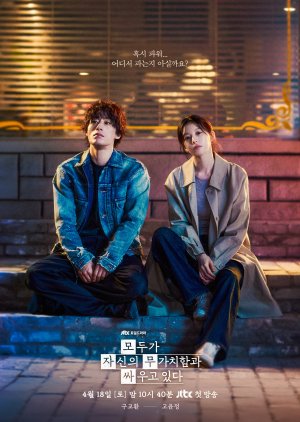
A drama where flawed adults confront the realities that shape them
This screenwriter clearly has a gift for crafting emotional stories centered on older, weathered characters played by veteran actors who carry decades of life in their faces. Her last three works feel like they come from the same mold, but honestly, if the mold keeps producing this level of depth, why change it. I loved My Mister, found Liberation Notes slower but still quietly brilliant.This drama starts rough. The main characters are imperfect, obnoxious, even embarrassing at times. They push you away before they pull you in. But as the story unfolds, their flaws become the very thing that makes them human. You start to understand them, then root for them, then feel protective of them. Their growth isn’t dramatic or flashy; it’s slow, painful, and shaped by the people around them. Watching them confront their inner demons and gradually become wiser feels earned. Hardship teaches lessons that comfort never will, and this drama understands that better than most.
Was this review helpful to you?

- Hwang Jin-man
I love this side of Korean movies or drama's where they deconstructs and explores the complexity of human psychology. This drama is a one kind .Not everyone gonna watch it or they will love it. But if you just give it a watch it will make you realize so many things. Not in same situation but you could understand each character (Eun-ah, Dong-man and even Park Gyeong Se)
All the casts did a great job as they are all great artists. Hope to see them again in this type of genre.
Was this review helpful to you?
This review may contain spoilers
Tender Moments Without Much Payoff
I started We Are All Trying Here partly because it was written by the same writer as My Mister, and I hoped it might give me some of that same quiet ache. Unfortunately, despite some genuinely lovely moments, it never really did.The drama is very gentle and understated, which isn’t something I usually mind. But here the restraint often left the dramatic and emotional moments having surprisingly little impact on me. I even took a long break between starting and finishing it, which probably says something about how little urgency I felt to return.
My bigger problem was the lack of payoff. Dong-man’s story reaches something tangible with him finally making his movie, but I was left wanting considerably more from Eun-ah, Gyeong-se, Jin-man and Jeong-hee. There are suggestions of healing and closure, but much of it is left implied rather than something we’re actually allowed to experience with them.
There are some wonderfully tender scenes along the way, and the performances are good. But after spending so many hours with these characters, I wanted the ending to make that investment feel worthwhile. Instead, I reached the end feeling strangely unrewarded.
Was this review helpful to you?

Emotional Realism
It is a slow-paced drama, but it still keeps me curious about how the characters’ stories will eventually unfold. Instead of focusing on success or dramatic achievements, it highlights everyday life pressure, disappointment, and the emotional weight of simply trying to keep going.The story mainly explores life struggles and different coping mechanisms. Each character expresses their emotions in their own ways that are hard to understand at first.
Watching this can bring out familiar feelings like envy and anxiety, especially when seeing others succeed while you feel like you are falling behind. The drama captures this emotional experience very well. It doesn’t just tell a story, it reflects something many people may have felt or are currently going through.
Some dialogues feel a bit unusual or influenced by language differences, but the acting is strong enough to carry the emotions. The negative feelings in the story are also presented in a subtle, sometimes satirical way, which adds depth to the narrative.
Overall, it is a quiet but emotionally heavy drama.
Was this review helpful to you?

 1
1Some stories leave you with thoughts. This one left me still searching for language.
I usually write reviews when I feel compelled to. Not because I have watched something good, but because I have encountered something that leaves a lasting imprint through a performance, a story, a visual language, or an emotional experience that continues to linger after the credits roll.This series captivated me, yet it has proven remarkably difficult to write about. Not because there is nothing to say, every time I try to define what exactly touched me, the words seem to flatten something that felt infinitely more complex.
First, thank you to the creators for giving us something original, willing to challenge its audience. In an industry increasingly reliant on recycling familiar concepts, proven formulas, and recognizable tropes, this series feels refreshing. And perhaps that is where my difficulty begins.
Is it a love story? Certainly. Yet calling it a love story feels insufficient, as though it reduces something much larger. Is it a journey of self-discovery, healing, and reflection? Also yes. Yet even that description feels strangely shallow. The emotional landscape of this series is vast and layered, so any attempt to summarize it risks diminishing it.
Perhaps the series itself provides the answer. At one point, the protagonists reflect on whether love can be displayed as a singular emotion, suggesting instead that it is a construct composed of emotions, experiences, perceptions, and contradictions. In many ways, the series functions similarly. It feels less like a story that communicates a message and more like a construct designed to evoke something profoundly personal.
The story is generally described as one of struggle, and the two protagonists appear to embody that struggle. Yet that never sat quite right with me. As the narrative unfolds, it becomes clear that everyone around them is struggling. What distinguishes Hwang Dong Man and Byeon Eun A is not the severity of their suffering, but their relationship to it. Paradoxically, this same vulnerability grants them a kind of freedom that many other characters never achieve.
Both seem less constrained by social expectations and less dependent on being accepted, validated, or understood by others. Their struggles run so deep that they manifest physically and therefore become impossible to hide, creating an emotional detachment that is often painful to witness. For that reason, I did not see them as tragic heroes. The series contains so much subtext that reducing its characters to conventional archetypes feels almost profane. Beneath every conversation lies another conversation. Beneath every conflict lies another wound. Perhaps that is why the moments that remain with me most strongly are not the dramatic plot points, but the quieter emotional expressions.
I have to commend the writers for the intoxicating language they gave Hwang Dong Man. His quiet monologues of love for Byeon Eun A are some of the most beautiful moments in the series. They are unconventional, almost nonsensical at times, yet deeply sincere. Through ordinary objects, fleeting observations, and seemingly insignificant details, he transforms everyday life into symbols of connection and affection.
Equally moving is Byeon Eun A's recognition of Dong Man's empathy and sincerity. She sees something precious in him that others overlook or dismiss. Her appreciation of his compassion feels less like romantic admiration and more like an acknowledgment of something fundamentally necessary in the world. Their relationship transcends conventional romance and becomes an exploration of transformative love itself, love as understanding, acceptance, and recognition.
And finally, a humble declaration of love for Koo Kyo Hwan's art. He achieves far more than simply portraying a character. He creates an entire emotional ecosystem, capturing the multifaceted universe of a deeply complex personality. As someone who tends to engage with performances through empathy, I found myself absorbed by every nuance of the character's emotional landscape. Every subtle shift, every contradiction, every unspoken emotion felt tangible. It is precisely here that words fail me most.
The closest comparison I can offer is that of a child staring into a snow globe that has just been shaken. At first, everything appears chaotic, beautiful fragments swirling in every direction. Yet the longer you watch, the more you realize that every piece belongs exactly where it is. The chaos possesses its own logic, its own significance, its own reason for existing.
That is how his performance felt to me.
In the end, these elements became so impactful that the storyline itself occasionally felt secondary. Not because the narrative lacks value, but because it succeeds in what I believe it ultimately sets out to do: provide a thread strong enough to carry an emotional experience. And what remains is a story filled with compassion, hope, longing, vulnerability, and the quiet reassurance that every person is fighting a battle against their own sense of inadequacy.
Was this review helpful to you?
Peak Everywhere, trust the overwhelming positive reviews
The acting is an absolute class, Koo Kyo-han delivered one of his best performance yet perhaps even THE best performance from his resume. Go Youn Joung, is an A-lister that continues to prove that she can play any role. And Park Have Jon, despite the focus being equally spread amongst the different characters HE was brilliant, overall it's just surrounded with acting that's highly commendable.The cinemography is a masterclass, no awkward closeups that I DESPISE, the lighting, the angle, the OST it's immaculate.
The plot is great, revolving around giving light to how they really are trying lol. Yet this is a melodrama that's comparable to the other mega hits (My Mister, Our Movie, Move to Heaven) it depicts the idealogy of being "lost", being left behind, perfectly.
Was this review helpful to you?

This review may contain spoilers
When I almost gave up on k-drama
When I almost gave up on watching k-drama this show brought me back. It was hard to get into, but I kept trying because of the reviews and Koo Kyo Hwan (who’s acting I enjoyed in DP) and by the end of the first episode I was hooked. I loved almost every scene and every character - even unlikable ones (one exception is FL ex - he is simply deplorable)… Everything worked beautifully together. Every scene was worth watching and meaningful. I also liked that romance was subtle yet heartwarming. Personal highlights: strong female characters Hye Jin and Eun A, Mi Ran and Eun A friendship, Dong Man a cat person! 😻🐈⬛🤜🤛😅I only wished we got more insight at Dong Man’s depressive episode during the shooting and it’s development and more realistic ending (all friends and smiles was almost too cheesy) but compared to the whole - these didn’t take away from my enjoyment of the show. Happy to see photos in the end - it seems to be rare nowadays. Superb storytelling, acting and direction 10/10 ❤️🌹🏆👏👏
p.s. What happened to Knock knock knock?!
Was this review helpful to you?

Trying and succeeding
This was an absolutely wonderful season of television. I feel like it took a few episodes to fully get into the swing of things, but when it did, it just completely drew me in. I was always looking forward to the new episodes every weekend, and I'm a bit bummed that it's over.I absolutely adored the performances and chemistry between Koo Kyo-hwan as Hwang Dong-man and Go Youn-jung as Byeon Eun-ah. It was a very unconventional relationship, and I loved the direction they went with it. The entire rest of the cast knocked it out of the park too.
Pretty much every episode made me laugh and cry multiple times. It made me really invested in all of the characters, and I liked where pretty much all of them ended up by the end. I'm really glad I decided to check it out. It will definitely be one of my favorite seasons of TV this year.
Favorite Episodes:
Episodes 6, 8, 9, 11 & 12
Was this review helpful to you?

Man, what a good piece of art
I rarely give anything anything above 8, but this one deserves it.Complex, well-written characters. Heavy topics tastefully mixed with lighthearted comedy.
Beautiful cinematography, well-matched music, great acting from everyone. Editing enhances overall atmosphere of the show.
So why only 8.5 and not more?
Pacing and conclusion some threads.
The overall pacing of the drama can appear slow. For me it is fine. I like to dive deep into characters and overthink what the author had in mind, so slow pacing works for me. (it is psychological drama in the end). But for some viewers it might be too slow. Last episode is at the same time faster than the rest, but also holds slow tempo of the rest of episodes. But overall everything is concluded gracefully.
There are some plot threads that I have problem with, because they are concluded with bare minimum.
Mainly ML's brother's thread could have been slightly more complex (not much) and better spread out throughout episodes instead of concluding hurriedly in the last episode.
Generally I recommend this show. It is well-written and good from technical side. The story is coherent, complex and enjoyable to watch.
Was this review helpful to you?

Give it a chance
The story was amazing from beginning to end. All the relationships felt real and the drama did a good job of showing “you never know what a person is thinking.” I heard a lot of people say they dislike the ML personality, which is understandable, but like my headline “give it a chance” you will grow to love him. The only problem I truly had was that it had a couple of drawn-out, short moments. Ex: A scene of just silence, with a character seated, would be 20 seconds long. Which I know was for emphasis just didn’t really like it.I thought I wouldn’t like it because I didn’t really like My Liberation Notes, but I really enjoyed it
Was this review helpful to you?

Four Episodes Away of Perfection
I have been watching Park Hae-young’s work for two years now, and honestly, I still do not know how to correctly review it. My Mister humbled me. My Liberation Notes finished the job. And then We Are All Trying Here arrived and did something neither of those managed to do, it made me question whether I had the language for this at all, not just in any of the five languages, but in the one I built specifically for this space. How do you put into words something that was always going to be better experienced than explained? I am genuinely not sure you can. But Park Hae-young did not write this drama for critics. She wrote it for the person sitting alone at midnight, heart still racing twenty minutes after the credits rolled, wondering why they cannot stop thinking about people they have never met. So consider this less a review, and more a letter from someone who got found.Park Hae-young sits in an SSS tier (mirroring Kiseki’s Bracer’s Guild ranking) of her own making in my book, a designation I do not hand out lightly and have never had reason to revisit. My Mister and My Liberation Notes remain two of the finest dramas I have ever watched, and both earned their place through the same terrifying gift: her ability to create a spectacle out of the mundane, to weaponise silence and negative space until the absence of sound becomes louder than anything a score offers, and to write human beings with a precision making you feel personally targeted. When We Are All Trying Here was announced, my expectations were already set at an altitude most writers never reach. What followed was something I did not anticipate even then: a writer I thought I understood, showing me she had been holding something back all along. Park Hae-young did not repeat her previous language here; she pushed it into new territory. The result is a drama that feels like a step forward in ambition, even if it is slightly constrained by its shorter twelve-episode structure compared to her usual sixteen.
It is not a comfortable watch. It is not an easy watch. It is, however, unmistakably a Park Hae-young work operating at near-peak intent, even when the format occasionally tightens around it.
I need to confess something: the character who almost made me quit this drama is also the reason I ended up loving it. Koo Kyo-hwan plays Hwang Dong-man, our male lead and, in a first for any Park Hae-young drama I have watched, a character who actively repulsed me in the opening episodes. Dong-man is an aspiring film director who has spent nearly two decades failing to debut while his entire social circle, a prestigious industry film club called “The Eight,” has long since surpassed him. He talks too much, he picks fights at dinner tables, and he radiates that desperate, sweaty energy of a man who is trying too hard to prove he still matters. His brother works odd jobs to keep them both afloat, the people around him walk on eggshells to manage his emotions, and he repays all of it with contempt aimed outward. It is much harder to feel compassion for someone cushioned by other people’s love who still chooses to be cruel, and for three episodes I was ready to file a formal complaint with Park Hae-young herself.
But here is the trick Park Hae‑young pulls. She wrote him as repulsive on purpose. Because once you sit with that discomfort, once you stop flinching and start looking, you see the layers underneath. What she did with him afterward belongs in the section below, but here I want to give Koo Kyo-hwan his full due: he plays Dong-man with a raw, almost frightening vulnerability that never feels like acting. There is no visible effort, no actorly plea for sympathy, no performance asking you to notice it. A man in a body that has been at war with itself for twenty years, and Koo Kyo-hwan makes every scene feel like something happening rather than something being performed. He fakes an injury just to have a moment of rest. He climbs a hill and screams his own name into the void so he can feel like he still exists.
Opposite him is Go Youn-jung as Byeon Eun-ah, in a role that finally made me sit up and seriously notice her. Eun-ah is a producer known in the industry as “The Axe” for the precision of her screenplay critiques, and she is the perfect emotional foil and counterbalance to Dong-man. Where he externalises everything, she keeps it all locked inside, speaking in short quiet bursts while carrying her own deep trauma of abandonment. The role demands enormous subtlety, minimal facial expression, and the ability to deliver devastating emotional weight through the smallest possible physical gesture. Go Youn-jung devoured every scene. There is a two-minute sequence in episode two, almost entirely silent, where she does more with a hesitation and a forced smile than most actors manage across an entire series. After this drama, she climbed straight into the same category in my mind as Shin Hae-sun, and I will be watching everything she does next with considerable attention. Byeon Eun-ah was definitely the quintessential Park Hae-young’s experience that I’m familiar with and she dragged me back in, kicking and screaming.
Of course, a Park Hae‑young drama is never just about the two leads. There is a whole ecosystem of side characters, and while I will not list all of them, a few supporting performances absolutely stole the show for me. Oh Jung‑se is, as always, reliably excellent as Park Gyeong‑se, a successful director who is secretly just as insecure as Dong‑man but hides it by lashing out at him. Then there is Kang Mal‑geum as Ko Hye‑jin, who became one of my favorite supporting characters in the entire drama. Hye‑jin owns a small production company with a bar underneath, and that bar serves as the main hub where all the characters gather and where most of the plots evolve. Kang Mal‑geum delivers a standout moment when her character finally snaps and tells Dong‑man the brutal truth about how his behavior affects others. It is the kind of scene that makes you hold your breath.
Another supporting character who charmed me completely was Jung Min‑ah as Park Jeong‑min. She is effortlessly funny and warm, and her character functions as one of the primary pressure release valves of the narrative as Park Gyeong‑se’s co‑writer. Her ability to flip back and forth between comedy and the more melodramatic moments as the plot evolves made me put her firmly on my radar for future works. And finally, I have to include Han Sun‑hwa as Jang Mi‑ran. I first noticed her in Welcome to Samdal‑ri, then accidentally stumbled upon her in Work Later, Drink Now. From romcom to straight comedy to now a dark comedic melodrama, I have started to see her range, and I genuinely look forward to whatever she does next.
We Are All Trying Here marks something of a departure for Park Hae-young in one specific way: it is her first drama to lean meaningfully into comedy, and the tonal balance she maintains between the genuinely funny and the quietly devastating is one of its quieter achievements. The first three episodes tested my trust in her more than anything she has written before. Hwang Dong-man was hard to love. He was, to put it plainly, bleeding other people to fund his own dysfunction, and the empathy contract Park Hae-young has always maintained with her audience felt deliberately fractured. Where her previous leads carried their wounds inward, Dong-man wore his outward and aimed them at the people who loved him most. However, as the narrative progresses, that perception breaks down. Dong-man is revealed as someone constantly drowning in unspoken anxiety. His noise is survival. His cruelty is deflection. His chaos is regulation. I felt guilty for briefly feeling relieved when his friends finally set their boundaries. This guilt, I later understood, was the drama working exactly as intended.
Because what Park Hae-young was building underneath the irritation was this: Dong-man and Eun-ah are distorted mirrors of the same wound. He externalises, she internalises. He creates noise, she creates silence. He fills every room he enters, she empties herself to make space for others. But underneath all of it, both are trying to say the same impossible sentence, help me, and the tragedy is that neither of them has ever learned how. Dong-man talks endlessly because silence feels like drowning. Eun-ah stayed quiet through things that would break most people, including a mother who crossed her off at nine years old and an ex-partner who erased her name from work she co-wrote, because asking for help was never something the people around her made available. Their relationship is not a Kdrama rescue mission. It offers something far more radical: the idea that comfort does not come from someone telling you everything will be fine, but from someone saying “I know why you are like that,” and meaning it without condition. This is a story about people finally willing to ask for help, and discovering it does not diminish their worth.
The OST deserves a mention, because this is a Park Hae-young drama and the music always pulls its weight. Starlight by Lucy anchors the lighter comedic register with exactly the right amount of warmth, and Pieces by TAEYEON is a standout in holding the emotional weight of the heavier sequences. I will admit I was surprised Sondia did not appear on this OST given her near-permanent presence in Park Hae-young’s previous works, but every selection here earns its place with the same quiet precision the writing demands.
Visually, the drama understands negative spaces in a way few others do. Those long silences, the shots of Dong‑man walking alone at night, Eun‑ah sitting in a room full of people and saying nothing. Park Hae‑young has always been a writer who weaponizes what is not said, and here the camera follows her lead.
Here is where my heart genuinely hurts. The real flaw of We Are All Trying Here is the narrative estate. Twelve episodes are simply not enough for Park Hae‑young to tell her story, and that constraint becomes painfully obvious in the final episode. She tried, she really did, and almost every plot point does get closed. But an 80‑minute finale is brutally tight pacing for a writer who usually luxuriates in 16 episodes. Something had to give. And what gives is Eun‑ah’s story with the script. Her conclusion is nowhere near as clean or as satisfying as the rest of the drama, especially when I compare it to Park Hae‑young’s other works. I do not say this lightly, but it left me feeling slightly dirty, like she became the sacrificial lamb because Dong‑man’s story needed more room to land. There is a strange and uncomfortable irony in a drama about a woman who spent her life being made invisible choosing to leave her resolution the least visible of all. I would have understood more if they had sidelined Hwang Ji‑man’s plot line instead, but they did not. And so here I am, sitting with the knowledge that this drama was four episodes away from my third Perfect 10 of the year. I am genuinely grieving those four episodes we should have had. This imbalance does not break the drama, but it does reveal its boundaries. The final stretch feels less like failure and more like a visible ceiling placed on an otherwise expanding emotional architecture.
As is typical of Park Hae-young’s writing, this is a drama you have to experience yourself. Behind the mundane and deceptively ordinary surface of people simply being people, layers fold into layers, and no summary does them adequate justice. She remains the only writer who has ever made me cry purely from dialogues. No swelling score, no camera tricks, no close-up held a beat too long to cue the emotion. Two people in a room, talking, and somehow I was undone.
For a drama that began with me wanting to remove Hwang Dong-man from the premises entirely, Park Hae-young got me to the point where the two leads’ unconscious cry for help shattered me completely. It is terrifying how thoroughly she dismantled every resistance I brought to this drama: an obnoxious lead, a gimmicky device I dismissed in episode two, a tonal register I did not recognise as hers at first. Because it is one thing to write within a viewer’s established preferences. It is another thing entirely to identify exactly what makes a viewer resistant and then dismantle that resistance so carefully and so precisely that by episode eight I was sitting there thinking she probably could have made me love a love triangle. That is not just good writing. That is a writer operating with complete command of her audience’s emotional interior.
It is, ultimately, a reminder of what Park Hae-young does best, and what she might achieve with even more narrative space. It really is unfortunate that the drama is four episodes short of what it needed. She needs the narrative estate. She deserves it. Give Park Hae-young all the narrative estate she needs, damnit. Hell, give her 20 episodes like Mr. Sunshine. She’d knock that out of the park too.
Was this review helpful to you?

This review may contain spoilers
The best of reality
Actually when this first came out I wasnt really gonna watch it , I didnt knew why but when I watched it it deeply resonated with me. I am from the music industry. A producer and eventhough unlike Dongman its just five years I still havent released my own songs. And I gave up in that dream and currently surviving life.Beside that what deeply resonated ith me was in Ep 6. When hs was struggling to save his brother in the bathroom. It reminded me of my childhood, the helplessness, the want to scream loud and ask for help. My mother once tried to take the lives of my sister and me and her all together because of problems, since that day, what I always checked in the morning was both of them were breathing. This is something really personal but I realized watching this drama, so there are actually people suffering just the way I am, and..? Yeah I was a bit relieved. Call me selfish, I acually felt relieved that I wasnt the only one feeling this way, struggling this way. Always trying not to break down cause I dont know till when I could hold on, thats what I thought. But I am still holding on. Dongman actually reminded me of myself. A self that I didnt want to acknowledge. Eventhough I am not as straightforward as him, his character had this unexplainable warmth. A drama that will make you cry but laugh at the same moment.
From acting to production to the OST(ofc melomance is the best in this) I enjoyed every second of this. Every minute. Eventhough I won't step in to the music industry again, I think this is a great drama for those who are still walking without loosing hope, and also giving us the reality of doing it. They showed the reality of friends around us, because none of us are perfect, each have their own toxic trait, and yet they would still show up. Growing Up means having less friends, so yeah we need to cherih them alot. i dont know how else to praise this drama, I will rewatch this and rewatch again.
Was this review helpful to you?