Makes you think
I liked this a lot at the start but I think it sort of fizzled out a bit.Some things that happen feel a little convenient, and there some other plot points that are set up but don't have the pay-off I expected. While I understand that this is more of a quiet and contemplative slow burn, the final episode left me feeling a bit unsatisfied.
With that being said, however, there were a lot of interesting themes introduced here — it addresses depression and envy in extremely creative ways, and I appreciate the drama even more for being brave enough to make its main character unlikable.
I think My Mister is still my top Park Hae Young drama by far, but anyone who enjoyed that and My Liberation Notes will like this one too.
Was this review helpful to you?

small review
this kdrama was so well written, I feel like I could understand every character and their decisions.Personally hwang-dong-man was THE ONE character who struck with me the most, to see him finally achieve his dream even after being criticized that much by his friends who only saw him as a guy denigrating other people’s film when he didn’t even debut, instead of asking him why he was acting this way.Or him having the constant pression of wondering if his brother was alright because of his multiple attempts, anyway I’m really bad at reviewing but I felt like I needed to write something about this kdrama that was litteraly my comfort show from the moment it started to the moment it ended🤍.Was this review helpful to you?

The real star of this drama is screenwriter Park Hae Young
What a wonderful, heartfelt drama. Park Hae Young has to be one of the best screenwriters currently working. She has a very distinctive style that gives the actors room to create/inhabit their characters through her thought-provoking dialogue. She weaves incredibly clever subplots through the story that make it so much richer. In her previous script for My Liberation Notes, you can see it starting to come together. With We Are All Trying Here she is in full control.That Dong-man's oafish, morose brother is also a celebrated poet feels incongruous, but his appearance throughout serves to shock us, elicit anguish for him, scare us, and rejoice with him. When a loan shark appears, the trope is turned completely on its head with a very clever twist. In anyone else's hands, a plot device like the "emotion watch" would be a cheap gimmick, but Writer Park uses it to help us connect with the depth of the two leads’ suffering and at one point uses it to wrench a cry of desperation out of them that is absolutely heart-breaking ("Help me...").
The cast is terrific. Koo Kyo Hwan is exasperatingly delightful as Hwang Dong-Man, and Go Youn Jung is heart wrenchingly soulful as Byeon Eun A. In one of the most touching (and controversial) scenes, Eun A loops her cardigan over Dong-Man as if to bring him into her womb to protect and nurture him. If that was in the script, it is pure genius. If it was something the actors ad-libbed, then kudos to Writer Park for creating the space for it.
Once again, Oh Jung Se is absolutely perfect as the antagonist Park Gyeong Se. (Is there a better character actor?) And Park Hae Joon's role as Dong-man's brother Hwang Jin-man is a delightful contrast to his recent role as IU's father in “When Life Gives You Tangerines”.
The cast was so good that I couldn't help but feel that the actors loved this work as much as the viewers did. This drama will be on everyone's “Best Of” list for 2026, and rightfully so. But let no one forget, the real star of this drama is screenwriter Park Hae Young.
Was this review helpful to you?
This review may contain spoilers
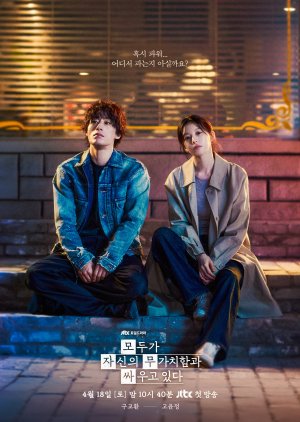
We Are All Trying Here has become my all-time favorite drama
I don’t know what movies are to others. For me, movies are survival itself. My days are a loop: I wake up in the afternoon, I eat, I watch a film, and then I work. In the past, I would spend the rest of the day translating films. Now, I study cinema history and watch related films to write scripts for my channel, or I edit videos. When I need to rest, I play music or watch other films; then, I go back to work.Evening comes. I go to the market and cook. I talk to my girlfriend. When she falls asleep, I watch a drama while eating. Then, I go back to work again. Time slips away—I eat, I watch, I work. In the morning, I talk to my girlfriend again, watch something else, and finally, I sleep. For 10 years, I have been living in this cycle—a routine that occupies about 29 days of every month.
Whenever my spirit sinks, it is usually films that provide the strength I need to keep living. K-dramas rarely give me that kind of profound, quiet strength, but We Are All Trying Here did. While Reply 1988 was my all-time favorite, We Are All Trying Here has now become my personal, all-time favorite.
I liked it from the very first episode, but I never expected the ending to be handled this perfectly. In episode 11, I was deeply impressed, but I didn't think they could wrap up every single character so beautifully in just one final episode. I was wrong. Every character stayed true to their purpose until the very end. The businessman remained a businessman; those between the artist and the entertainment world stayed right in that space; and the only true "artist" in the show stayed true to his convictions until the final moment.
Seeing this final part, I realized that Park Hae-young is not just a screenwriter—she is an artist who truly understands what it means to live. Even if Hwang Dong-man is the protagonist, the soul of this story lies with his brother, the poet Hwang Jin-man. She shaped this throughout every episode, and in the finale, it reached its true climax. The real climax of the story was found in the character who had the fewest scenes among the leads. One could say we felt the most poetic experience through a character who had stopped writing poems.
In the act of creating art, the hardest part is not telling people what you want to say, but knowing what not to say. Hwang Dong-man is a character who talks too much, but Hwang Jin-man is a character who never says anything unnecessary. In We Are All Trying Here, watching Hwang Dong-man feels like seeing myself, but watching Hwang Jin-man feels like seeing the person I want to become. It might be an impossible dream, but my life’s ambition is to become someone like him—someone who wants for nothing and who can live courageously in a corner of the world, defined entirely by his own meaning.
Was this review helpful to you?

Brilliant lines, beautiful shots
Instead of choosing happiness, we laugh at the misery, more or less my personal motto (and has been for a while), and apparently could also be Park Hae Youngs motto too...Most of the time I am a character and fluff mood watcher. But to be honest I often seem to need to be dragged in to the depth of despair to truly love a drama. This drama excelled at the art of making a drama so powerful you don't really care if you love the characters or not , one where you get fed scene after scene, line after line with so much depth, emotion and thought it made me pause and rewatch several scenes some multiple times with such lines as:
" I don't get books like "please look after mom," iv got a different idea of "mom" from everyone else"
"My hair is pretty thick, if you start a fight and start pulling it, you might loose a finger"
While I did get annoyed with most of the characters in one way or another (because of their behaviour, and after a while its in a good way) The female lead was outstanding in every single way, actually most of the female characters in this had amazing lines, great acting and felt oddly relatable in very different slightly disturbing ways. The way hardship, mental illness, trauma fear and everything in between is displayed made me fall in love with this.
The power of words, the power of the sound of high heals, the power of silence and emotions are displayed in so many ways. The attention to detail it is indeed a true Park Hae Young (as you can read in the article me and Anquat wrote about her)
All this said I am going to admit that something was off in the last few episodes that kept me from rating this with a full 10 star rating but I will say this was brilliant.
Was this review helpful to you?

A Reflection of Life Itself
The cinematography is simply beautiful, but what truly makes this drama special is how human it feels. Every character carries their own insecurities, regrets, and dreams, making their journeys feel incredibly real and relatable. This isn't a story about perfect people finding perfect answers. it's about imperfect people trying their best to move forward despite life's uncertainties. Few dramas have made me reflect on myself as much as this one.By the end, it felt less like I was watching a drama and more like I was looking at a reflection of life itself.
Was this review helpful to you?

This review may contain spoilers
One scene left an impact
I honesty didn't like the synopsis (bc I hate productions that delve in the jealousy and greed topic), but I was tempted to watch so I didn't start from episode 1, what's funny is that the first scene I landed on was ML getting a beating from his brother, no context what so ever, which really left an impact on me, and when I understood the context it got funnier and funnier (and darker). Looking back, I don't know if I like it if I watched it the way the it was filmed, but I think the series is very interesting. The balance between the comedy and the sorrow was well done.PS: removing stars, bc I don't like the ai propaganda. no party should have that much access and control over people's data.
Was this review helpful to you?

Between wounds and softness, we keep trying
We Are All Trying Here is the kind of drama that never tries to impress with huge plot twists or overly dramatic scenes. Instead, the series shines through its sincerity, softness, and deeply human way of portraying emotional wounds, loneliness, and the need to be loved and understood. As the episodes go on, you naturally grow attached to the characters, to the point where it feels like you’re becoming part of their daily lives.One of the drama’s greatest strengths is obviously the duo formed by Koo Kyo-hwan and Goo Yoon-jung. Their chemistry is simply incredible. Nothing between them ever feels forced: their looks, silences, and small everyday interactions are enough to convey so many emotions. Their relationship develops with a lot of naturalness and tenderness, which makes every scene even more touching. It becomes impossible not to grow attached to Dong Man and Eun A because their story feels so sincere and realistic.
And honestly, Koo Kyo-hwan delivers an exceptional performance here. His acting is subtle, nuanced, and deeply emotional. He manages to portray his character’s pain, emotional exhaustion, and vulnerability with disarming simplicity. On the other hand, Goo Yoon-jung brings so much softness and sensitivity to the drama. Together, they completely carry the series and make every moment memorable.
The supporting cast also deserves a lot of praise. No character feels useless or poorly written. Every relationship adds something meaningful to the story, whether it’s lightheartedness, comfort, or more melancholic moments. The drama truly takes its time developing the supporting characters, which makes the world feel even more alive and immersive.
The OST is also beautiful. The music perfectly supports the emotions of each scene without ever feeling overwhelming. Some songs make the romantic moments even more intense, while others strengthen the melancholic and comforting atmosphere of the series. It’s definitely the kind of soundtrack you keep listening to long after finishing the drama because it leaves such a strong impression.
As for the ending, I have mixed feelings about it. Even though it stays consistent with the realistic and melancholic tone of the drama, I found it slightly frustrating. After becoming so emotionally attached to the characters, I expected a conclusion that felt a little stronger emotionally and more satisfying for certain storylines. The ending intentionally leaves a feeling of emptiness, which may deeply affect some viewers, while for others it may feel somewhat incomplete.
Despite that, We Are All Trying Here remains a deeply human and comforting drama, carried by an exceptional cast, incredible chemistry between the leads, and an emotional atmosphere that stays with you long after the final episode. It’s the kind of soft and melancholic series that manages to touch your heart without ever falling into exaggeration.
Was this review helpful to you?

This review may contain spoilers
its pretty depressing and the mc is crazy
not my cup of teathe show is very very realistic in the sense that there's a lot of misery and just full of sad, unfortunate moments that reflect a lot of people's lives. honestly imo i don't think this show is for me cuz there's so little upsides and moments of relief. like its just sad/unlucky/depressing moments one after another and it feels like there's no light at the end of the tunnel yk-- which ofc is realistic ik but if you're looking for a drama that gives you that "escape", this is def not for you.
the mc is pretty insane. like he's a crazy man loll and i can see that its supposed to bring that "relief" aspect in the form of humor but imo its pretty awkward and like idk cringe?? idk but his character is not my cup of tea.
the relationship between him and eun-a is also idk like ig its nice to watch but its kinda confusing?? idk and there's a lot of plot holes aka side plots that don't feel finished and idk it just feels rushed towards the end.
the friend group is weird too like he badmouths every single one of them for like idk 10 years straight and everyone feels bad for him despite all of that like okay i get it if it hasn't been that long but like how did they take it for so long?? and when the mc finally got his breakthrough everyone was happy for him after everything he's done to them? like ok if it was just said to the friendgroup idc (ig? idk) but like he went around saying that at like public settings and with like the whole production team? idk...
anyways this type of mc just isn't for me... as for this type of drama loll but i'm giving it an 8 cuz i can see why its good
the acting from the whole cast was really good, the ost was sooo good, but the story? um not for me lol
Was this review helpful to you?

Healing and emotional drama
For anyone who has struggled or is struggling to make their dreams come true, I suggest watching this drama. This demonstrates realistic portrayal of trying to find footing in the film industry filled with people with jealousy and resentment. There will be many tears but also hope and relief. Finding solace in someone else who is also struggling and being there for each other is the ultimate cure for depression. The touch on mental health theme can be heavy but it can also be healing.The acting of the staff was wonderful. They will be sweeping every award next year. Overall loved this drama and can’t recommend it enough.
Was this review helpful to you?

This review may contain spoilers
What exactly is the bridge between storytelling and life?
We Are All Trying Here (2026) 🎥I did enjoy Eun-a's story, but honestly, her mother's subplot was easily the least interesting for me. Otherwise, I am reminded of what I really enjoy about Park Hae-young's works, her ability to craft complex characters and show how life is never as straightforward as we want it to be. There is no one way to solve something, and we have push and pulls that make these stories, our cries to say that we exist humourously, happily, pitifully, and everything else. The emotion watches were a rather provocative tool, and they were used in a way that allowed the characters to still exist and learn to deal with their greatest mental setbacks. Eun-a and Dong-man bonded over the unknown emotional pattern flashing red, and learned to address the feeling rather than repress it. Specifically, the main thing here is how they know when they feel it and the reason why they cannot feel as in touch with their emotions.
I really got to know and understand these characters as human beings, and maybe learned a lot about why stories are ingrained into our lives, where I sympathized with these creatives, who, above all, are people, criticized their actions often, and sat back without saying a word, watching this. I need to probably rewatch some episodes and reflect a bit more, but this was still a fascinating drama. Sometimes the pacing was not to my standard, but I still think I will take their words with me every time I choose to create anything; those simple reminders will help me. Dong-man is very flawed, but he has heart and chooses stories to achieve a lighthearted approach that is not consumed by anxiety and envy at its best. I did not feel bad about how people chose to respond towards him because he is just not the hero you can root for; he can maybe write those heroes, but with grit and honesty, as with the stories he tells his friends. Eun-a mostly relied on facial expressions to craft her story, but she was also the perfect balance for all the relationships encompassed. She got to understand the root of her trauma and grab it while she still can.
Ko Hye-jin was someone who also stole the spotlight, and she was equally intriguing and complex, someone you would want to root for in the film business, too. I enjoyed seeing Jang Mi-ran, too, and Hwang Jin-man for his insights but felt his ending was rather rushed, besides the other directors in this drama. Choi Dong-heon of Choi Film was also a businessman who invests in films, but that doesn't make him completely unlikable, besides his treatment of Eun-a. Eun-a, changing her name from Si-on, reminded me of My Mister, quoted by Lee Ji-an, where she says she wants to live as a new person, change her name, and move to a place where no one knows her.
Highly recommended, and I would say that the character writing of Dong-man exceeds the work in My Mister and My Liberation Notes. But just take your time with it and don't take long breaks in between episodes either.
Was this review helpful to you?

A story that heal you
I am watching this story in going and start because GYJ. But through out the storyline, I do hate the main character and all of the other characters at the beginning then we start to understand everyone has a flaws. Everyone is trying their best despite whatever background, whatever trauma, whatever environment they're in, all of them is trying their best. This story is a heartwrecking one if you delve too much and if you don't delve at all then it's going to be boring. For me, this is one of a story art that is slowburn and piece of life which not everyone are going fancy it. Will I recommend this to everyone? Absolutely not. Will I rewatch? Absolutely not. But was it a really good drama? Yes, so much yes. I didn't even skip any part of this drama.Was this review helpful to you?