News


This review may contain spoilers
Unexpected discovery
First of all, please bear with me, as it is my first time writing a review.I decided to do this because I was amazed by the main actors. I was initially interested in it because of Song Kang (who I really liked in My Demon). However, the unexpected discovery for me was Lee Jun Young. I was really amazed by his acting and the way he portrayed Choi Joung-yo. I love how he switched his character from a bubbly high school student to a mature adult. There’s no way out for me. I just love him. (I’ve watched his previous works before, such as When Life Gives You Tangerines, Imitation, and Badland Hunters, and I didn’t know it was him.) Thus, this one really stuck with me and made me want to learn more about him.
Song Kang also played the role well. There are a lot of scenes without dialogue, but just through his eyes, you can feel the emotions he is trying to convey. My favorite scene was in Episode 12 when he found the church where Choi Joung-yo might be.
Anyway, enough of that. Moving on to the review of this beautiful work, aside from the main characters, all the actors played their characters really well. Notably, Kang Ji-hye (Pi O’s mother). She was so great that it really pissed me off. Hahaha. Like, how can you do that to your son?! Another notable character is Jo Hyun-cheol (Choi Joung-yo’s older friend). From time to time, I think he was a better friend than Pi O. He was always there for Joung-yo, even helping him take care of his father. The best! No one seemed to be on Choi Joung-yo’s side except him.
On the other hand, some characters were not fully developed. For example, Yoon Sun-ju (Grandpa’s 2nd wife). I was expecting more from her character. It seemed to me that she was always using Joung-yo for her own pride and to accomplish something. I feel bad that they completely forgot about Joung-yo after he disappeared, but when he returned, they used him again.
The love stories between Pi O and Jae-in, as well as between the mother and the teacher, were unnecessary for me. The drama could survive without those. There were also a few parts that didn’t make sense to me, like how Choi Joung-yo, when searching for answers about what happened to him, was led to believe that Pi O was the one who tried to kill him. But when Pi O was the one searching for him, he found out that it was actually his mother.
The cinematography and music were great as well. There wasn’t much OST, but with the main character playing the piano, that was all it needed. Overall, it was a great drama, and I will definitely recommend it.
Was this review helpful to you?

This review may contain spoilers
A masterpiece of music, emotion, and incredible acting
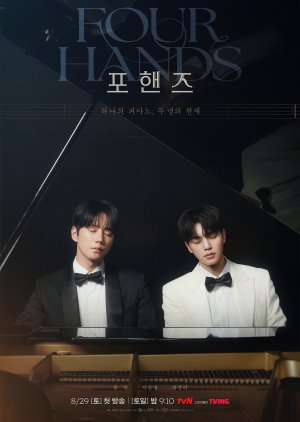
This is actually my very first time ever writing a review, but Four Hands, Two Sonatas completely blew me away and I just had to share my thoughts. I ended up giving it a 9.5 overall because the entire 12 episodes journey was an emotional rollercoaster that stayed with me long after the final credits rolled.What makes this drama so extraordinary is how deeply it explores the bond between Kang Pi-o and Choi Jeong-yo. From the very first episode, when Pi-o is established as the unrivaled musical prodigy at their arts high school, the tension is palpable the moment Jeong-yo arrives as a transfer student. Watching two completely different worldviews collide on the piano keys made the early episodes so captivating. Their transition from bitter rivals to forced duet partners is where the magic really begins. When they are tasked with playing together, Jeong-yo slowly teaches Pi-o how to actually feel the music and find joy in playing, rather than treating it like a cold competition.
As the story progresses toward the middle episodes, things take a much darker and more intense turn. Pi-o's obsession with perfection during the Prague Harmonie International Competition takes a massive toll on his mental state. Then we hit the time jump, where Pi-o has achieved global success but is completely miserable and suffering from a severe slump. At the same time, searching for what happened to Jeong-yo leads into some of the most heartbreaking storytelling in the entire series. Finding out about Jeong-yo’s tragic past, the kidnapping incident, the devastating injury to his hands that stripped away his ability to play piano, and how he had to abandon his dream, was absolute agony to watch.
The dynamic between them in the second half of the show is so complex and raw. It isn't a simple or cheerful reunion. There is anger, guilt, resentment, and deep grief over lost time and lost talent. Jeong-yo pushes Pi-o away with harsh words, but at the same time, he is the only person who truly understands Pi-o's soul and can help him overcome his severe mental block at the piano. The intensity of their interactions in episodes 9 through 11 had me completely holding my breath the whole time.
And then we get to the finale. Episode 12 had me ugly crying from start to finish. The way they bring everything full circle with their joint performance of "Four Hands, Two Sonatas" is pure artistry. They didn't even need words to express what they meant to each other, everything was communicated through the music, their facial expressions, and the subtle gestures between them. Even though their paths don't end up locked together in a simple cliché way, the resolution feels completely freeing. They finally let go of the pain, guilt, and resentment that kept them trapped for years.
Beyond the incredible plot and character development, the acting and casting were a solid 10/10. Song Kang and Lee Jun-young gave performance of a lifetime level work here. Their chemistry was electric, and you could feel the heavy weight of their characters history in every single gaze. And the music! The soundtrack is easily a 10/10 on its own. Every piece of piano music and every background score track was placed so meticulously to heighten the emotional impact of the scenes.
If you are looking for a deeply emotional, bittersweet drama about talent, rivalry, trauma, and healing with an unbelievable soundtrack, you absolutely cannot miss this one. Have your tissues ready for the ending, because that breathtaking reunion scene and the reality of the show coming to an end will completely break your heart in the best way possible.
Was this review helpful to you?

If you enjoy atmospheric, psychological music dramas
Four Hands, Two Sonatas (2026) is Netflix’s brooding, high-stakes entry into the classical music K-drama space. Marking Song Kang’s highly anticipated return following his military service, the 12-episode series trades lighthearted high school romance for an intense, noir-tinged exploration of artistic obsession, perfectionism, and class divide.Key Strengths
* The Mozart vs. Salieri Dynamic: The central push-and-pull between Kang Bi-o (Song Kang) and Choi Jeong-yo (Lee Jun-young) forms the show’s emotional core. Bi-o is the pristine, technique-obsessed prodigy suffocating under family pressure, while Jeong-yo is the raw, intuitive talent playing purely from survival and passion. Their intense screen presence—and subtle, ambiguous dynamic—drives the narrative forward.
* High-Stakes Atmosphere: The series immediately hook-lands viewers with a dark, high-tension flash-forward opening, setting a tone far heavier than typical teen dramas.
* Standout Performances & Soundscape: Beyond the main duo, Jang Gyu-ri shines as Hong Jae-in, providing a necessary, grounded contrast as a pragmatic violist. The soundtrack and classical piano performances are executed with visceral, narrative weight.
Weaknesses
* Overstuffed Drama Tropes: At times, the script leans heavily on traditional K-drama clichés—authoritarian grandparents, hidden parentage, loan sharks, and childhood connections—which occasionally dilute the focus on the music itself.
* Timeline Mechanics: The early non-linear storytelling and sudden shifts between dark flash-forwards and present-day academy life can temporarily disrupt the pacing.
Verdict
| Aspect | Rating / Assessment |
|---|---|
| Acting & Cast | 8.5/10 — Strong performances, particularly from Song Kang and Lee Jun-young. |
| Cinematography & Audio | 9.0/10 — Striking visual direction with superb classical scoring. |
| Story & Pacing | 7.5/10 — Gripping premise, though relies on familiar melodrama. |
| Overall Score | 8.3/10 |
Final Take: If you enjoy atmospheric, psychological music dramas like Your Lie in April, Whiplash, or Do You Like Brahms?, Four Hands, Two Sonatas delivers a compelling, performative duet worth watching.
Was this review helpful to you?

Perfecf synergy of phenomenal writer, director, and actors
So I was busy and only had time to watch it now, from ep 1-5 the pacing has been amazing.
It’s a given that the start of series is slow, but from the opening of both ep 1 and 2, they give something that raise the tension right away.
In the ending of ep 3 and 4, the transition was so jarring that it struck my mind.
Now with today ep 5, they’re halfway through, and it was truly amazing change of field. The tension of everything from previous episodes clues coming together. I can only say the writer is amazing at playing with the plot.
The director is no less amazing, the camera composition and sound direction is amazing. Especially in ep 4 where kang bio found choi jeongyo in his house. The music started in forte as he found choi jeongyo shoes, the music goes pianissimo with the footstep enriching the scene, then come the revelation as the music pick up the pace once again.
And lastly appreciation to the actors, I really applaud lee junyoung performance in this. I noticed he did so many full body playing. I didn’t know he could play the piano. He really did well on all the emotional and funny scenes. Truly exceptional.
While song kang acting has always been under scrutiny, he did really well in this. There are still some scene that could be improved like the confrontation scene after bio avoided jeongyo after their performance. But he definitely isn’t as bad as people make it to be.
Jang gyuri doesn’t have many scenes, but she’s quite natural in her acting. I have high hopes for her career.
Was this review helpful to you?

A deeply moving musical tragedy driven by a masterful duo.
Four Hands, Two Sonatas is a massive emotional rollercoaster. The series quickly leaves behind the usual high school clichés to plunge us into a human drama of profound sadness, yet rare beauty. Here, the piano is not just a prop; it is the only way for two broken young men to express what they keep buried deep inside. What makes this drama so powerful is how it shows that music is no longer just art, but a matter of psychological survival for the characters.
The entire intensity of the story rests on the incredible performances of the actors. Song Kang plays the role of Kang Bi-o with impressive restraint. He embodies this wealthy boy, completely suffocated by his mother, who takes refuge in robotic technical perfection to keep from collapsing. Opposite him, Lee Jun-young delivers a raw and visceral performance as Choi Jeong-yo. He is a poor prodigy, deeply wounded by life, who had completely abandoned music. The chemistry between the two is insane; they start by hating each other before realizing they are the only ones in the world who truly understand one another.
The dialogues between them perfectly express the heavy weight of their situation. Far from easy or cliché lines, their exchanges carry rare psychological violence, and every word cuts right where it hurts. This is clear when Jeong-yo, pushed to the brink by his past, screams painful truths at a spiraling Bi-o: "I don't care if your fingers bleed on the keys, your technical perfection sounds like nothing but a coward's cry." Their final confrontation is equally heartbreaking. It is the moment when the secrets of their trip and the truth about their trauma explode, proving that their bond goes far beyond a simple rivalry.
The series is steeped in constant melancholy. The characters' distress can be felt in every frame, especially when Bi-o experiences an immense slump after his burn-out, or when the misery and violence of the past catch up with Jeong-yo. It becomes clear that their friendship is not built on smiles, but on pain, unspoken words, and tears. Certain scenes leave a lasting mark, like the very first time they play a four-hands piece together in a dark room. Without a single word, purely through the power of their eyes, their connection becomes undeniable. The piano becomes their own language to sync the beat of their hearts to the exact same rhythm.
In conclusion, this series stands out as a captivating psychological masterpiece where human distress finds its salvation in the acceptance of the other. By rejecting easy tragic endings in favor of a slow and hopeful healing process, the drama proves that even the most broken lives can eventually find their harmony. It is a powerful work that lingers long after the credits roll, reminding us that the most beautiful music is often born from our shared imperfections.
Was this review helpful to you?
Thank you for the masterpiece
The work portrays the most pathetic human impulses and helplessness. There was not a single truly strong character in the story; all of them were surrounded by their own flaws and weaknesses. The essence of the tragedy is conveyed not simply through the pain each character experienced, but through their helplessness in the face of one another.It becomes a genuine tragedy about the lives of weak and powerless people. Everyone is both a culprit and a victim. One crime only gave rise to another, until eventually even the victim was forced to stand with blood on their hands.
Was this review helpful to you?
Strong bond of friendship
This drama depicts strong friendships, both between people of the same sex and between men and women, and has nothing to do with romantic love. Conflicts, rivalries, family relationships, and social dynamics all come into play, set against a beautiful classical music backdrop. The two male leads are perfect in their roles, but I could do without the female lead, as her character felt rather superfluous.Was this review helpful to you?

Bromance x Piano
The cast of "Four Hands, Two Sonatas" is nothing short of exemplary, bringing a captivating energy to each performance. The chemistry between the characters is palpable, drawing you deep into their world and engaging you with their personal stories. The way the master of ceremonies (MC) guides the narrative is particularly impressive; they manage to weave the musical elements into the storyline seamlessly, keeping the audience invested and eager for the next episode.Even though I must admit that I don’t have a trained ear for music, which means some of the technical discussions may float over my head, I still find myself completely absorbed by the overall vibe. The emotions conveyed through the performances resonate strongly, and I appreciate how the music complements the unfolding drama.
I highly recommend this series, especially if you enjoyed Song Kang's "Navillera." The two have a similar charm and depth, and I think fans of poignant storytelling intertwined with music will find "Four Hands, Two Sonatas" equally rewarding. Each episode leaves you craving more, and I can't wait to see where the next chapter takes us.
Was this review helpful to you?

A Revenge Story Rooted in Misunderstanding and Poor Communication
I expected a story about friendship and rivalry coexisting, but it leans much more toward an enemies/revenge conflict rooted in misunderstanding and poor communication.The acting is believable, the directing is well done, and the music is good, though somewhat repetitive. However, I found the characters' behavior often toxic and unreasonable, with little character development and no exploration of teamwork.
If you enjoy emotionally charged rivalries and revenge-driven conflicts, you may still enjoy it.
Was this review helpful to you?

This review may contain spoilers
A beautifully complicated bond
It is one of those series where, it is difficult not to notice the emotional intensity between its two main characters. While the adaptation introduces a female lead and does not openly frame itself as a BL, the heart of the story remains centered on the deep connection between Pi-O and Jeong Yo.The series follows two young pianists who are almost complete opposites. Pi-O is technically brilliant, disciplined, and capable of achieving perfection, but somewhere along the way he loses the emotional connection that makes music truly meaningful. Jeong Yo, meanwhile, has the passion and sensitivity of a true artist, but struggles with confidence and the technical skills needed to fully express himself.
What makes their relationship so compelling is that they become the missing piece in each other’s lives. They do not simply help each other improve as musicians, they bring out qualities that the other person has lost or never had. Pi-O gives Jeong Yo structure and confidence, while Jeong Yo reminds Pi-O that music is also about emotion. Together, they represent the balance needed to create something beautiful, much like a sonata performed by four hands.
The strongest part of the series is the bond between the two leads. Their relationship develops through shared struggles, admiration, competition, and moments where they constantly challenge and support each other. There is a constant push and pull between them, and the chemistry between the actors makes their connection feel especially powerful. Whether interpreted as friendship, artistic partnership, or something deeper, their attachment to one another is clearly the emotional center of the story.
The series also does an interesting job exploring the idea that some people become essential parts of our lives. Pi-O and Jeong Yo are stronger together than they are apart, and the story repeatedly shows how deeply they affect each other’s identities, dreams, and healing.
Although this adaptation seems hesitant to fully embrace its BL origins and adds elements that make it harder to define, the emotional intimacy between the two protagonists remains impossible to ignore. Their bond carries a sense of longing and somewhat devotion that goes beyond a typical friendship dynamic, while still leaving room for viewers to interpret it in their own way.
With strong performances, beautiful themes, and a story that balances warmth with heartbreak, this is an emotional watch. It can be enjoyed as a story about music and friendship, but also as a story about two people who, in many ways, complete each other.
Was this review helpful to you?
Most poetic show ever.
First I would like to say that this is my first Song Kang drama, and I’m quite impressed. He delivered such a beautiful and touching performance, and I really felt the emotional weight behind his character.The storyline of this drama was truly beautiful and, honestly, quite unique. There is something about the way the story is told that really stayed with me.
Is it romantic love between two men? Or is it an incredibly deep connection between two people who became completely immersed in the art they created together?
Could it also be a form of trauma bonding? They met when they were just little boys and connected through the piano. They created music together, grew up without a father figure and without much maternal love/presence, and in many ways, the piano became the only constant source of warmth, connection, and comfort in their lives.
I actually think leaving their relationship somewhat undefined makes their bond even more fascinating. Not every profound connection needs to be given a label.
The only reason this isn’t a 10/10 for me is that there are still some questions I feel were left unanswered.
Who exactly is Pio and Jeong-Yo’s father? And why did the grandfather’s wife leave the house during the ten years when Jeong-Yo was missing? These are things I really wanted more clarity on.
Overall, this drama was emotional, beautifully written, and unlike anything I’ve watched before. The storytelling, the music, the complicated relationships, and the ambiguity all worked really well for me.
For me, this is so far the best K-drama of 2026. 🎹❤️
Was this review helpful to you?

A Beautifully Composed Story of Friendship and Rivalry
I was seated the entire time, eagerly anticipating each next episode. The acting was amazing—especially Lee Jun-young as Choi Jeong-yo, who absolutely slayed the role. I also have to praise Song Kang as Kang Pi-o, who brought the perfectionist pianist to life with real depth.I loved the chemistry between the main leads—Song Kang as Kang Pi-o, an elite pianist whose life has been a rigid path to perfection, and Lee Jun-young as Choi Jeong-yo, a free-spirited, natural talent who abandoned the piano after a difficult childhood. The way they always care for each other, moving from rivals to friends and piano partners, was beautifully portrayed.
The storyline is amazing but sad, and it makes you think: would they have had to go through all that if only the adults had behaved like adults and supported them? I loved the suspense in each episode, waiting for the story to unfold. Great writing plus amazing acting makes it a full package.
I loved the ending, but I wish we could get at least ten extra minutes with them. I really hated Kang Pi-o's mother, Kang Ji-hye (Yoon Se-ah), as her manipulation started all the unfortunate events. I think it's an amazing story about friendship—both male leads did an amazing job, and I was so rooting for them to finally find their happiness. The music added so much to the story; it wasn't just background—it was the heart of the narrative.
Final Verdict: A beautifully composed coming-of-age drama with stellar performances from Song Kang and Lee Jun-young, a moving friendship at its core, and music that elevates every scene. The ending is satisfying, though you'll wish for just a little more time with these characters. Highly recommended.
Was this review helpful to you?