

 3
3 2
2



Hello, Me!
I like that Hello, Me! is simple, funny, and fun all in one. One can never go wrong with Choi Kang Hee in a fantasy rom-com drama. I enjoy her narrating in her head what she wouldn't dare say out loud. It works so well. But what works more is that she's opposite Kim Young Kwang in the drama; I had forgotten how tall he is. He plays the spoiled, bratty 30-year-old who's never worked a day in his life rather well. The drama is off to a fun start. Despite reading the synopsis, I hadn't realized Ji Seung Hyun would have a part in this drama; what a pleasant surprise. However, I did know Eum Moon Suk would, and boy, am I loving him and his knack for the grandiose; it suits him perfectly. He had me smiling from ear to ear. And how about Jang Ki Yong and Lee Soo Hyuk's cameo, and in the first episode, nonetheless. That was a treat.Was this review helpful to you?
More Than Just a Comedy
This drama was such a pleasant out-of-right-field surprise. The posters make it look like a loud, silly comedy, but it is actually a sweet and funny story about regular people who get stuck with messy superpowers. The best part is that these characters do not want to be heroes. They are embarrassed by their powers and desperately try to hide them because their abilities are so awkward to use.The story happens in a small beach town in 1999, right when everyone is panicking about the Y2K end-of-the-world bug. A sick young woman named Chae-ni tries to fake her own kidnapping to get money to travel, but she ends up having a heart attack. Her clumsy friends panic and leave her in a junkyard, not knowing the dirt is full of toxic chemicals from a secret lab. Instead of dying, the chemicals save her life and give the friends powers. But these are broken, or maybe the better word is flawed, superpowers. They only act up based on their bad habits or flaws, which forces them into a wild battle against a creepy cult that is kidnapping locals. This premise is not necessarily new, but what’s new is how it’s executed.
The cast is what makes the show so lovable. Park Eun-bin plays Chae-ni, a wild and reckless girl who can teleport, but only when her heart rate shoots up from drinking too much caffeine or getting scared. She's so much fun to watch because she acts like a real, panicked person rather than a shiny comic book hero.
Cha Eun-woo as Un-jeong, a quiet, awkward city worker who can move things with his mind because he was experimented on as a kid, is a pleasure to watch. He acts as the serious guide for the group, and I must say does a great job showing his hidden sadness with just small looks.
The side characters are just as great, like a florist who accidentally gets stuck to walls and a giant pushover with super strength. But I think what makes them that much more special is the friendship that binds them rather than the superpower abilities. It’s the human side of relationships. Choi Dae Hoon continues to wow me with his brilliant acting. Whether he is panicking because his hand is glued to a window frame or ruthlessly clearing a room full of enemies with his bare hands, he brings a unique magnetism to the screen. He seamlessly blends high-stakes intensity with down-to-earth humor, making every single character he plays feel like someone you actually know and care about.
The director, Yoo In-sik, who also directed Extraordinary Attorney Woo, makes the show look like a cozy memory from the late 90s. Instead of using lots of bright, fake computer effects, the show uses warm colors and keeps the powers looking grounded. When someone teleports, it looks disorienting and messy, and when things get thrown, it looks heavy and dangerous. Small 90s items like soda cans and old cell phones keep everything feeling like it is happening in the real world.
In the end, the show reminds us that having special powers does not fix your life. The characters do not fight to save the world; they fight because they want to protect their neighbors and families. It has a really heartwarming message that true strength does not come from being perfect, but from loving the people around you.
Was this review helpful to you?

The Life of a Mobster
I went into this movie completely blind, it came up on my feed on Netflix, and I thought I would give it a try, and boy, was I hooked. It's a movie with the least amount of dialogue between the male and female leads, Park Tae Goo and Jae Yun, but their body language was more than enough to captivate me. I think the one line in the movie that best described it to me was when Jae Yun told Park Tae Goo he was a dead man walking because, in a way, everybody in the movie was a dead man walking. To me, it encapsulated the sheer hopelessness and cutthroat underworld life of a gangster— a hard and high-stakes world fueled by fear, the survival of the fittest, strongest, and the fastest to betray or be betrayed, and, of course, mass murder. But when one has lost everything that ever meant anything to them, and there's nothing left for them to lose; what could they possibly be afraid of; absolutely nothing. I will admit I am not familiar with Uhm Tae Goo at all, this is my first anything for him, and I was blown away with him. And the same goes with Jeon Yeo Bin (she was brilliant), Cha Seung Won, Lee Gi Young, and Park Ho San. I loved the movie's slow pace, the unlikely connection of two lost souls with nothing left to lose, and most importantly, the banging end -- well done!Was this review helpful to you?

This review may contain spoilers
We Can’t Always Measure The Other Person’s Love For Us By Our Love For Them
I am not going to say I appreciated Nevertheless's mixed ending, but at the same time, it's quite realistic in that there are many out there who fall for people they know will not make them happy in the long run but can't help but be with them. In that sense, it was as realistic as can be. I know, I've been there, and it was real for me, but it also didn't last that was real too. If I can commend Nevertheless for anything, it would be the compelling way it shows viewers that relationships aren't easy. It also clearly described each couple's fear of loss, the conflicts regarding freedom and possessiveness, honesty and deception, trust and jealousy, togetherness and separateness, satisfaction and sacrifice, and even judgments of unconfirmed love.It was relatable in the way it portrayed the all-consuming experience from that magical match that includes: sexual attraction, mutual enjoyment, emotional knowing, social compatibility, sensitive consideration, physical affection, friendship feeling, and romantic excitement, all combining to create a sense of caring, commitment, and completeness that make that other person the only one for you even if not the most ideal. Still, it failed to deliver the overarching message because it is a fairytale ending at best, following one's heart when undoubtedly knowing it won't lead to happiness. I say this because I know how it ends from a personal experience, but maybe that was the point, and if it was, then I guess it delivered.
In a way, it made sense that Nabi ends up with Park Jae Eon despite everything or maybe because of it and that she chose to be with that magical love even if it wasn't one she believed would give the eternal happiness she wants. Because in the end, and this is the message I chose to take from the drama since I wasn't really sure if it had one -- is that love is risky because the person we love the most can hurt us the worst. Love that feels forever does not necessarily last forever, but it's worth the risk. And we can’t always measure the other person’s love for us by our love for them.
As for the cast, I think they all did a great job in their individual roles, some more than others. Yoon Sol's character completely and utterly overtook me, which is a testament to Lee Ho Jung's acting. Nam Kyu Hyun was another character that had me invested in his story, and again it speaks volumes to how Kim Min Gwi portrayed the role. Kudos to him for that. Chae Jong Hyeop was a blessing, a much-needed breath of fresh air from the heaviness of Nabi and Park Jae Eon -- again a great testimonial to Han So Hee and Song Kang. A job well done to the whole team.
Was this review helpful to you?

A Drama About Love Disguised as a Spy Thriller
Agent Kim Reactivated is a revenge-action thriller about Kim Do-Hyeon (Manager Kim), a retired covert operative who is forced to reactivate his old identity when his daughter disappears. But beneath the espionage, conspiracies, gangsters, betrayals, and political games is a story about human bonds and what people are willing to sacrifice for one another.On paper, the plot sounds familiar. Kim Do-Hyeon lives a quiet life as a bank manager and single father after abandoning a dangerous life as an elite operative. When his daughter is abducted, he resurrects the skills and identity he buried years ago to save her. What makes the drama work, however, is that the rescue itself becomes a vehicle for exploring several different kinds of relationships: parent and child, friendship and brotherhood, loyalty between comrades, loyalty to country, loyalty to principles, and the betrayal of those loyalties by institutions.
The show repeatedly asks a simple but powerful question; what is loyalty worth if the people you are loyal to treat you as expendable? Governments, intelligence services, criminal organizations, and powerful businessmen all speak about loyalty and sacrifice. Yet many of them casually discard the very people who gave everything to them. Meanwhile, the strongest forms of loyalty come not from institutions but from ordinary human relationships. That contrast is, in my opinion, the real emotional engine of the drama.
As for the acting, it is no surprise that So Ji-sub is the soul of the series. True to form, his greatest strength here is not the action scenes, though those are excellent, but his ability to communicate pain, exhaustion, regret, and determination with very little dialogue. He conveys everything, especially in the moments that matter most, through his expressions and presence alone. Kim Do-Hyeon is not portrayed as an invincible action hero. He is a grieving husband, a frightened father, and, most of all, a man constantly questioning whether his past destroyed any chance of a normal life.
For me, the most memorable scenes are not always the fights. They are the moments where you can see a father realizing that the quiet life he built for his daughter may never have been enough to protect her. There is an almost tragic quality to Kim. He is not fighting because he enjoys violence or because he misses being Agent 66. He is fighting because he has run out of alternatives. That distinction gives the drama tremendous emotional depth.
One of the strongest aspects of the series is the friendship between Kim Do-Hyeon, Seong Han-su, and Park Jin-Cheol. What I especially appreciated is that Kim does not have to carry the entire drama on his shoulders. Many spy dramas focus on romantic chemistry. Agent Kim Reactivated's strongest chemistry is actually between these three middle-aged men. Their relationship feels earned. These are not friends because the script tells us they are friends. They are men who have shared trauma, shared missions, shared losses, and years of silence. When Kim needs help, they do not stop to ask whether helping him is wise. They simply show up. That is one of the drama's recurring messages: love is an action; loyalty is an action. Not a feeling. Not a speech. An action. Their friendship becomes a direct challenge to the selfishness and corruption surrounding them. In a world where institutions repeatedly fail people, these men prove that genuine loyalty still exists.
As far as I am concerned, the reason the stakes feel real is that Min-ji could easily have become a simple "kidnapped daughter" plot device. Instead, she represents everything Kim spent fifteen years protecting. She is his future, his redemption, his promise to his late wife, and the reason he abandoned his former life and chose family over service to country. That is why the story ultimately becomes a battle between two identities: the agent and the father. What makes the drama so compelling is that Kim rediscovers Agent 66 because he is a father, not in spite of it. His love for his daughter becomes stronger than his desire to remain hidden.
Many reviews I read before the drama ended focused on its geopolitical elements and viewed it primarily as a thriller involving North and South Korean intelligence. To me, however, the political conflict is largely symbolic. Throughout the series, we see how agents are used by governments, how operatives are treated as disposable assets, how allegiances shift, and how secrets destroy lives. We see institutions demand sacrifice while rarely repaying those who make it. What I admire most is how the drama quietly asks whether loyalty to a nation should outweigh loyalty to the people we love. The answer it provides is surprisingly humanistic. The characters who survive emotionally are the ones who prioritize people over systems. The villains often do the opposite. Even when they seem to flourish, their victories are temporary because they have sacrificed their humanity in pursuit of power.
I would be remiss not to discuss the action because it deserves considerable praise. The action works because it reflects character rather than existing solely for spectacle. The drama never presents Kim as a young superhero. Every fight feels brutal, personal, and costly. When he fights, it is usually because his daughter is in danger, his friends are threatened, or someone vulnerable needs protection. The violence therefore carries emotional weight. It is not entertainment for its own sake. It is an expression of desperation, fear, and determination.
I think one of the biggest reasons for the drama's success is the chemistry among the cast. The father-daughter relationship between So Ji-sub and Seo Su-min grounds the series emotionally. Even when they spend much of the story apart, their emotional connection remains the driving force behind every decision Kim makes. Equally impressive is the chemistry between So Ji-sub, Choi Dae-hoon, and Yoon Kyung-ho. Together, they create a completely believable sense of lifelong camaraderie and trust. Their friendship feels authentic because it is built on shared history, mutual respect, and unwavering loyalty.
The antagonists are equally effective because they embody different forms of corruption: power without responsibility, loyalty without morality, and authority without compassion. They are not merely obstacles for the heroes to overcome. They represent the cold systems that place ordinary people in danger and then treat them as expendable.
If someone asked me what Agent Kim Reactivated is about, I would not say it is a story about a retired spy rescuing his daughter. I would say it is a story about a man discovering that the relationships he built are worth more than the identity he sacrificed. The series argues that family is not defined solely by blood. Friendship can become a form of family. Loyalty must be earned rather than demanded. Love is measured through sacrifice. Governments, agencies, and organizations often forget the human cost of their decisions, but individuals do not.
In the end, Agent Kim Reactivated is not really a spy story. It is a story about people who refuse to abandon those they love, even when doing so would be easier, safer, or more rational. The spies, conspiracies, and action are simply the framework. The real story is about the bonds that survive betrayal, time, distance, and even war. And that is why the drama resonates long after the final fight is over. I, for one, look forward to a second season.
Was this review helpful to you?
Deserved So Much More Attention Than It Got
Mary Kills People to me stands out significantly in the K-drama landscape for its courageous handling of a controversial and illegal theme: physician-assisted euthanasia. I think the show successfully anchored a complex ethical debate within a fast-paced medical thriller, making it a compelling, albeit heavy, viewing experience at times. The drama centers on Woo So-jung (Lee Bo-young), a competent emergency room physician who secretly operates a clandestine practice, providing lethal medication to terminally ill patients suffering from unbearable pain. Her mission, driven by a conviction to offer dignity in death, is supported by Choi Dae-hyun (Kang Ki-young), a former doctor. While financial considerations are a minor subplot, the narrative consistently emphasizes So-jung's primary motivation as the alleviation of suffering and the patient's right to autonomy.I think what makes this drama intriguing is that it's built upon a multi-layered conflict, successfully blending philosophical and genre elements. Firstly, there is the ethical drama that is Woo So-jung’s Mission. The show dedicates significant screen time to the personal stories of individual patients. These cases serve as the emotional anchors of the drama; they continually forced me to grapple with the core question: Is So-jung's action an act of murder or one of compassion and salvation? Secondly, there is the investigative part, where the plot escalates when Detective Ban Ji-hoon (Lee Min-ki) is assigned to a missing person’s case that leads him to suspect So-jung. The initial cat-and-mouse dynamic takes a profound, personal turn as Ji-hoon is revealed to be a terminal brain tumor patient. This development brilliantly blurs the lines between the hunter and the hunted, transforming the legal pursuit into a moral and existential crisis. Thirdly, there is the crime and conspiracy aspect, which extends beyond the ethical dilemma; the plot introduces darker elements that tie So-jung's practice to the criminal underworld. This includes a ruthless businessman and drug supplier, Goo Kwang-cheol (Baek Hyun-jin), and elements of corruption within the police force, complicating So-jung's life and her access to necessary drugs.
Character Analysis and Performance: The emotional weight and complexity of Mary Kills People rest entirely on the nuanced performances of its central cast. Woo So-jung (Lee Bo-young) is the drama's ethical core. Masterfully portrayed by Lee Bo-young, the character effectively conveys the complex inner conflict of a dedicated physician torn between her duty to save lives and her deep conviction in the right to die. Her performance is characterized by a restrained intensity that anchors the complex subject matter. Ban Ji-hoon (Lee Min-ki) provides the opposing force and the show's most potent dynamic. Lee Min-ki brings compelling depth to the role of the detective/terminal patient. His dual existence transforms the legal pursuit into a moral and existential crisis, allowing the actor to convey a powerful internal struggle as professional duty clashes with his own imminent fate. Choi Dae-hyun (Kang Ki-young) acts as So-jung's warm and vital ally. Kang Ki-young's performance provides a crucial balance of warmth and humanity, acting as the grounded, sympathetic voice of the movement. His character supports the philosophical argument that assisted death can be a final act of love and care. Goo Kwang-cheol (Baek Hyun-jin) functions as the primary antagonist. Baek Hyun-jin’s portrayal is key to establishing him as a menacing, unpredictable, and volatile presence. As the ruthless drug supplier and businessman, he introduces intense criminal danger to So-jung's operation, moving the narrative beyond ethical dilemma into a high-stakes thriller.
As with any work of fiction translated to the screen, there are strengths and weaknesses. The strengths of this show lie in its bold thematic exploration, making it significant for being the first of its kind in South Korea to address the controversial topic of euthanasia directly. It successfully initiates a necessary dialogue on human dignity, suffering, and autonomy in the context of death, focusing on the ethical quandaries faced by medical teams. Then there are the stellar performances of the leads and supporting cast. The central cast received high praise for their complex and nuanced characterizations, particularly Lee Bo-young and Lee Min-ki, whose performances elevate the heavy material. The drama also artfully merges a character-driven medical drama (centered on patient anguish) with a suspenseful crime thriller (featuring police pursuits and criminal conspiracy), creating a consistently tense narrative. Last but not least, the individual patient narratives are the emotional linchpin, effectively illustrating genuine suffering and resonating deeply with viewers.
The weakness for me was mainly in the show’s pacing, with subplots occasionally feeling underdeveloped or prolonged. At times, the narrative focus shifted too heavily toward conventional crime and conspiracy tropes, arguably diminishing the unique strength of the central ethical debate. Then there was the styling of Dr. Woo So-jung's appearance, specifically the hair, which was noted by some viewers as a minor detractor. While likely intended to convey a doctor too consumed by work to prioritize self-care, the execution did not always meet my standards. The intentionally vague ending, while serving to spark continued philosophical debate, frustrated me. I was looking for a clear narrative resolution regarding the fates of the main characters and the conclusion of So-jung's practice.
The drama's core issue, which is also its strength as far as I am concerned, is the ethical complexity surrounding voluntary choice. The narrative does not fully resolve the risk of coercion (whether from family or the medical system) that can influence a patient’s request, leaving the audience with a crucial, unanswered question: how absolute voluntariness can be ensured. All in all, Mary Kills People is a worthwhile and compelling watch for mature audiences who appreciate dramas that tackle complex, morally ambiguous subjects. Its strength lies in its profound questions, sophisticated genre blending, and the superb, challenging performances of its lead cast.
Was this review helpful to you?
This review may contain spoilers
Excellent -- Genius
Best time travel drama to date as far as I am concerned. I loved how the director transitioned between the two worlds, pristinely done. And even though all the characters had the same names and, in some cases, the same jobs with slightly different life choices, it didn't once get confusing. I enjoyed Yoon Shi Yoon in both worlds but more so as he crossed to the 2nd world, becoming calmer, centered, focused, and more thorough. On the other hand, I pitied drug addict Do Won for his choices; I am sure it wasn't easy living with the stigma of being labeled a son of a murderer. I found myself wondering how long he had been one and what drove him to it, as it didn't seem like he’s always led that kind of life. And liked how the drama seamlessly reveals the little aspects of how the two worlds formed. My guess is the killer may be a woman, but time will tell. I didn't want the episode to end, and I don’t want to wait a week for the next one, but as they say, beggars cannot be choosers.Train as a drama excited me to no end. I couldn't stop thinking; now, this is how one does a parallel world drama. As they say, genius is making complex ideas look simple, and that’s precisely what the writer, director, and cast of Train gave us. I loved how cleverly transparent the show was in its build-up and delivery. I've enjoyed Yoon Shi Yoon as an actor in all of his roles, but I am beyond impressed at the ease by which he portrayed the dual roles of Do Won -- two similar yet somewhat wholly different and complex characters. Indeed great casting, as I doubt any other actor would’ve fit as perfectly to the role as he did. I am in awe of him. I think what I love most about this drama is how the writer seamlessly created two worlds, which at the core had the same people yet who acted so radically different separated mainly by the choices they made. Highly recommend this short but delightful to watch drama!
Was this review helpful to you?
Was this review helpful to you?
Preliminary Review: Taxi Driver 3 and the Real-World Crises That Make Its Fantasy Hurt More
Wow, three seasons in and still strong, still as impactful, if not even more, than ever, and it's only the first episode. While watching the first few opening minutes of Taxi Driver 3, I couldn't shake the feeling that this season, or at least the opening episodes, were going to hit closer to reality than ever, especially when I think about what's happening right now in Sudan, Somalia, South Africa, Haiti, the DRC, the Central African Republic, and others. These aren't places I'm mentioning lightly; they're places where sexual violence and trafficking of women aren't just issues, they're ongoing emergencies. And honestly, as I watched the first episode of Taxi Driver 3 swoop in to save victims the world has forgotten, I found myself wishing something like that actually existed where it's needed most.The opening of Season 3 lays everything bare as we see women lured by false promises, transported across borders, and trapped in a system that feeds on their vulnerability. The police shrug, the authorities stall, and everyone who should help seems either compromised or overwhelmed. It's chilling because we know that, in some parts of the world, this isn't a plot; it's daily life. This is precisely why Taxi Driver, from the very beginning, felt so cathartic and so heartbreaking at the same time. The team doesn't wait for permission. They don't get bogged down in bureaucracy. They don't tell victims to come back when they have more evidence. They act. They care. And they treat each person like a human being whose suffering matters, not just another case file.
In places like Sudan, Somalia, or Haiti, where institutions have crumbled and conflict has swallowed entire communities, the idea of a group like Taxi Driver feels like a fantasy we shouldn't have to wish for, but I do, especially since I grew up in Sudan; the atrocities currently happening there are like daggers to my heart. When justice systems collapse, women pay the price first. When corruption rises, traffickers thrive. Watching the drama, I kept thinking how many real women would be saved if even a fraction of this kind of coordinated, victim-centered intervention existed.
But here's what the show also reminds me: its power isn't just revenge, it's protection, it's restoration, it's exposing systems that prefer silence over accountability. And while the drama always wraps it all in stylish action, the emotional truth at its core is painfully real. Of course, vigilante justice isn't the answer in the real world. It can easily spiral, and it doesn't rebuild the structures that survivors actually need. But what isn't fantasy is the heart of Taxi Driver, the parts rooted in care, extraction, and showing up when no one else will. In the real world, that looks like survivor-centered NGOs, rapid-response rescue networks, trauma-informed support, and international pressure that actually has teeth.
For me, the first episode of this third season landed so hard because it showed what justice could look like if it prioritized victims instead of protecting systems. It reminded me that humans are the worst types of monsters. When I look at the places suffering the most from sexual violence and trafficking right now, I find myself wishing that a brightly colored taxi could pull up for the women who desperately need it. The truth is, they deserve that kind of rescue, and the world should be doing far more than it is.
Was this review helpful to you?
Through The Darkness Comes Light
I loved that this drama focused on the profiling techniques to identify and help capture vicious criminals, and the heavy weight and darkness the profilers carry with them. Kim Nam Gil had me deep in my emotions. I can hardly imagine how it must be to live day in and day out with the viciousness of the crimes we've witnessed in this show in real life -- the secondary stress, compassion fatigue, burnout, post-traumatic stress, and everything else in between. As someone once said, the expectation that one can be immersed in suffering and loss daily and not be touched by it is as unrealistic as expecting to walk through water and not get wet. Ha Young reaching that burnout point and wanting to escape the darkness is only natural, but wanting and actually being able are two completely different things. Kim Nam Gil and this drama make all the other current dramas pale by comparison.Just like how I enjoyed the depth Kim Nam Gil brings to his role as Song Ha Young. I loved the passion Kim So Jin brings to Tae Goo. A top-notch police officer disregarded her for her gender. The more I watched Through the Darkness, the more respect I gained for Kwon Il Yong as the first ever South Korean criminal profiler, and for pouring his all into looking inside the hearts of monstrous criminals at the time when the term criminal profiling and the idea of serial killers was nonexistent. And what I like more is that the drama focuses more on those who chase serial killers, rather than the serial killers themselves. I liked that the drama was unapologetic in its realistic depiction of the events at that time, the overt contempt and ingrained prejudices of male police officers at all levels towards their female counterparts even more than I did the serial killings, and I abhorred those. I understand the behavior is reflective of the times, and despite it having gotten somewhat better, the sad truth is that the battle between feminism and deep-seated misogyny continues to this day and is perpetuated by historical practices. I love that this drama doesn't shy away, nor skims through the dark issues.
What affected me most as I watched the events of this drama unfold is how Kook Young Soo, Yoon Tae Goo, Jung Woo Joo, Reporter Choi Yoon Ji, and particularly Song Ha Young struggled to come to terms with the senseless abuses and murders each case and interview brought to the forefront. I would be remiss not to mention Kim Nam Gil's brilliance in the role of a man and police officer who feels too much, so much so that he distances himself from everyone as a way to cope. There were many scenes that touched me deeply, and in particular the scenes where the team desperately searched for a murdered child's missing fingers. When Ha Young wishes in his sleep, he could've puffed her killer away before he committed the most atrocious act against. What I like most about Ha Young is that he doesn't fit nor does he try to fit. And the more I watched the drama, the more I realize that serial deviant behavior flows from a hard heart. One choice leads to many, many choices until the conscience is so hardened that the predators forget they even have one. and no longer in operation.
When one is fully immersed in a show 12 episodes seem so short. The end came a lot faster than I expected or wanted, and just when I started to get used to Ha Young's smiling face. I loved the rapport and camaraderie Song Ha Young, Kook Young Soo, and Jung Woo Joo persistently built together, helping each other through what may have seemed like endless darkness. They went from being marginalized for their grandiose ideas to becoming the most sought after criminal profilers. My biggest takeaway from this drama is that through the darkness comes light, through fear comes love, and through pain comes triumph, as someone once said. No doubt Kim Nam Gil, Jin Seon Kyu, Kim So Jin, Ryeoun and the many other brilliant and talented actors made it seem a lot simpler and sexier than in real life -- the true heroes are the likes of Kwon Il-yong, who encountered evil time and time again and persevered through it all. Kim Nam Gil in The Fiery Priest was awe-inspiring, so much so that I thought he wouldn't be able to top that role, but I was wrong. He did again, and I am sure he will do it again and again. A thousand and one kudos to those who penned, directed, and brought this profound drama to life -- a job beyond well done. Kim Nam Gil definitely leaves a void, and I pray this is not the end, but the beginning of many seasons to come.
Was this review helpful to you?

This review may contain spoilers
Unexpectedly Delightfully
I am a huge Kim Ok Bin fan. The first time I saw her was in The Villainess, and she was brilliant -- a true villainess. And I have since enjoyed her in everything she's done, especially Children of the Lesser God. I have seen her master all kinds of roles, from an assassin to a future foreseeing police officer, to playing Tan Ya in the Arthdal Chronicles series, to a zombie-fighting detective. She is perfect in all of them, and what I love most is that she always plays a strong, badass female lead. Having read the premise of this drama, I wasn't sure if the role of Yeo Mi Ran would suit her, but I needn't have worried. She plays her so naturally that it is almost hard to separate the actor from the character.Yeo Mi Ran is similar to many other female roles Kim Ok Bin has played in many ways. She is tenacious, headstrong, and righteous and does not let any man walk all over her or get too close. She is a lawyer, and by all accounts a very good one, but in her personal life is a true philanderess, never faithful to one man, and it goes back to her home life more than anything until she meets Nam Kang Ho (Yoo Teo), a famous actor in South Korea due to his handsome appearance, intelligence, and kindness. He is sought after to work in romantic movies but doesn't trust women, and he cringes at the mere thought of their touch to the extent that it leads to severe panic attacks controlled only by subscription medication.
Love to Hate You is a romance drama about a woman who detests male chauvinists and meets a borderline misogynist with a prejudice against women who at first hate each other, but as they slowly get to know each other, they are drawn to each other. Before they know it, they fall in love. And in many ways, their difference brings them together to make them the perfect couple. In a way, it's the typical hate-to-love drama, with a twist of a contractual relationship that leads to a full-blown romance. But what's different about Love to Hate You is that it intelligently handles sexism and prejudices against women, whether in the workplace, at home, or in relationships, and how society disguises it as culture or tradition, making it socially acceptable to keep women at a lower social status than men.
But what's intriguing about Love to Hate You is that it not only addresses misogyny but also brings awareness to manizing (women who pursue multiple casual relationships with different men) and the sexual double standard of a patriarchal society that glorifies, rewards, and even praises men for their womanizing way. In contrast, women are derogated and stigmatized for similar behaviors. Love to Hate You doesn't just stop there; it also sheds light on the complex landscape of the cancel culture and how fans are crucial stakeholders in the entertainment industry. Their passion, excitement, and involvement are pivotal in making or breaking the celebrity they have a significant hand in creating. In a way, holding them accountable for their actions, but in some cases, it can be extreme.
Many celebrities deserve to be canceled, mainly if the wrongs they engage in or have engaged in the past reflect their character (sexual assaults, bullying, prostitution, sex trafficking, emotional, mental, or physical harassment, abuse in the workplace or at home, etc.). Other than that, in my opinion, who a celebrity chooses to sleep with, love, marry, spend their time with, or how they live their personal lives is their business. As such, I loved how Love to Hate You addressed Yeo Mi Ran's manizing past and how Nam Kang Ho stands up for his love and doesn't give in to the pressures of his agency or fans. I hope some celebrities similarly and unfairly impacted by the cancel culture could learn a few things from Nam Kang Ho.
It would be a real mistake to assume that Love to Hate You is just another rom-com; it's far from it. Yes, it has some silly and funny moments, but it also has some profound moments that refreshingly push the boundaries in K-drama to question ridiculous, if somewhat offensive acceptable social norms; this elevates the show from your typical, expected rom-com to delightfully unexpected. Aside from the powerful message it sends, Love to Hate You brings some beautiful visuals in actor Kim Ji Hoon as Do Won Joon Nam Kang Ho's agent, protector, and friend; Go Won Hee as Shin Na Eun as Yeo Mi Ran best friend and fierce protector; Lee Joo Bin as Oh Se Na Nam Kang Ho's first love and many others who did a fabulous job portraying their different characters. Highly recommend it.
Was this review helpful to you?

The Beautiful and the Sexy
I loved the transitionally yet commendable growth in Su Yeol through his alter ego K. The best part of them was that even in their splitness, they remained an extension, rather than two separate entities fighting to dominate one another. Everyone needs a heroic figure who, in spite of weaknesses, and not always knowing the right answers, helps them overcome life's adversities, and maybe even even help them recover a piece of their humanity that they may have lost along the journey of life. And K is exactly that for Su Yeol. I enjoyed every aspect of the Bad and Crazy, it solidified my admiration for Lee Dong Wook as an actor and not just a beautiful face, while at the same time introducing me to a different side of an amazingly brilliant talent that is Wi Ha Joon. Additionally, I enjoyed the many talents we met while on this journey, but the two that stood out the most are Kim Hi Eo Ra as Boss Yong and Won Hyun Joon as Andrei Kang, her henchman. I am forever a fan. I will miss this fun drama, but look forward to seeing Lee Dong Wook and Wi Ha Joon in their upcoming projects later this year.Was this review helpful to you?

The King's Affection: a Sageuk Done Right
I decided to watch this drama firstly because it's a sageuk, and secondly because of Rowoon and Park Eun Bin, and the story at its opening did not fail me. I don't think I felt this much admiration for a character in a historical drama, as I did for Yeon Seon/Lee Hwi/Dam Yi, and all the credit goes to Park Eun Bin. She was brilliant in this role and worthy of an award. The King's Affection wasn't only a good script, but also riddled with many brilliant talents.From the Crown Princess/Queen Jang Sun, played by Han Chae Ah, who is beyond impressive in her limited but impactful cameo appearance, to Bae Soo Bin as Jung Seok Jo and Jung Ji Woon's (Rowoon) father in how brutally and precisely he fulfills his duties to the royal palace, and the same goes to Yoon Je Moon, who is phenomenal as the demon grandfather. So is Choi Myung Bin in the dual role of young prince Lee Hwi and princess Dam Yi, but the actor who stole the show for me was Nam Yoon Su in his unshaken stance to protect those that mean the most to him, regardless of who he had to go against to do it.
As I continued to watch the drama, I wasn't sure if I should be enraged at the royal place for believing twins were abominations, or for the measures they took, or laugh at the ridiculousness of it all. But then I reminded myself of the era and the deeply knitted beliefs of the times, and felt utter sadness for the many lives that must have been lost because of those beliefs. Some elements of the story reminded me of Mirror of the Witch, but unlike it, this one was cruel with its carnage. But it stayed true to the idea that choices make people who we are -- people are the culmination of their past actions, which have a way of creeping back up to them unannounced and when least expected in their present. No evil deed goes unpunished.
At the core of it, this drama is a story of courage in face of adversity, but also about immense cruelty, betrayal, treason, and unconditional love. The most impressive parts of this drama have been in its loyalties. From misplaced loyalty, to firmly edged subject to royal loyalty, to loyal love and brotherhood. Even the unrequited loves in this story are engulfed in loyalty. At the same time, the story is also about greed, fear, and the injustices committed in the name of loyalty. But most of all, it's about courage and how an unsung hero born out of circumstances rose to the occasion when she could no longer coexist with the hypocrisy that was the royal palace, and gained the respect and loyalty of many, even her enemies, but also the love of her life, hence the title: The King's Affection.
The King's Affection is a drama that stayed solid to the end, which was fitting to the story it told, from suppression to betrayal, love, and the fight to be acknowledged, as a human being worthy of the life she was born into, a twin and a princess, who through her trails and tribulations came to understand her worth, which made her powerful. Her world gravely needed a hero, so she became that, a strong woman disguised as a man who took no nonsense from anyone. A thousand and one kudos to the writer, director, and all the cast, production team for a job beyond well done. A drama worthy of your watch!
Was this review helpful to you?
Liberating and Worship Worthy
My Liberation Notes is a drama that resonated with me in many ways. Just watching it made me feel like I, too, am being liberated, and I wasn't even half as deep as the characters were, if at all. But then, who can't relate to the struggles of fading youth, wanting to love and be loved, managing mounting responsibilities to the extent of losing the will for idle talk, and the unavoidable frustrations and challenges of daily life when even living itself is burdensome? Not many.I loved how the story handled itself, and the message that liberation is realizing the voices in our heads aren't who we are, and only when we see that can we indeed be free. I felt liberated by how this drama depicted human relations, giving me the sense to appreciate the people in my life and opening me up to accept those to come in the future, something my old self before My Liberation Notes wouldn't have done. Every relationship in this drama mattered no matter how small, which made it so special.
I loved how real this drama was in expressing real people's thoughts and actions; how it addressed the fact that some people put others down, not because they are evil or rotten human beings, but because sometimes it's the only way they know how to feel better about themselves. And that sometimes all a person needs is the acknowledgment that someone cares to make a difference.
More than any other drama, My Liberation Notes made me realize how blessed I was in my life rather than the life I think I should've had. I would not have had that without going on this fantastic, silent yet deeply touching and meaningful journey with Gu, Mi Jung, Ki Jung, Chang Hee, Tae Hun, and everyone else who was part of this story, whether in a prominent or supporting role. There were many touching and emotional moments, but the Yeom children gathering for their father's birthday, and him finally opening up to them, is one of the best. The genuine moments between Gu and Mi Jung, Ki Jung and her boss, and Tae Hun and Chang Hee at work and with his friends—all the little nuances in the storytelling — made this drama one of the best, if not the best, of 2022.
A thousand and one kudos to the writer who excelled at making me feel and live each step of this drama's journey. The director for bringing it all to life, and the actors for quietly yet forcefully imparting to me the message that life is what we make it, always has been, and always will be; we just need to believe that. I felt worshiped just watching this drama.
I will miss My Liberation Notes. As much as I already enjoyed Lee Min-Ki and Son Seok Koo's acting skills in other projects, their natural way of depicting their roles in this one made me realize how talented they are, and the same goes for Kim Ji Won, Lee El, Lee Ki Woo, Chun Ho Jin, and the rest of the cast. Next to My Mister and Lost, My Liberation Notes will remain with me for a long time to come for silently making me hear the things I unconsciously and sometimes consciously ignored.
Ignore what you may have heard or read about this drama; watch it, and I mean really watch it. Don't fast-forward through it; you will not be disappointed. On the contrary, you may learn something about yourself you didn't know before.
Was this review helpful to you?
Real and raw -- not a fluffy rom-com
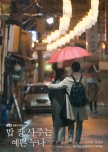
Something in the Rain. Where do I even begin with this one? It's a drama that sticks with you, but not always in the ways you might expect. First, the premise is simple: it's a noona romance, older woman/younger man, and what complicates their relationship besides the age factor is that the younger man is the older woman’s best friend’s brother. What I loved at the beginning was how natural their relationship felt. It's a slow burn, watching them go from being friendly acquaintances to realizing there's more there. The chemistry between Son Ye-jin and Jung Hae-in is undeniable. They capture those little moments of connection – the glances, the handholding, the way they talk – so well. It's all very sweet and, honestly, kind of swoon-worthy.The drama does a great job of portraying the everyday aspects of falling in love. It's not all grand gestures; it's also about the intimate moments that make a relationship feel real. The title, Something in the Rain, is quite fitting because rain often features in these pivotal, romantic scenes. However, this is where it gets a bit tricky; the drama isn't all sunshine and roses (or should I say, sunshine and rain). It also delves into some heavy stuff. We see their challenges due to their age difference, especially the disapproval from Jin-ah's family. Korean society can be quite traditional, and this drama doesn't shy away from showing how societal pressures can affect a relationship and burden it and the people involved in unimaginable ways. At times, it was hard to watch how intrusive and borderline abusive Jin-ah’s parents were, particularly the mother. We also see the difficulties Jin-ah faces at work, including issues of sexual harassment. It's a stark reminder that even in seemingly modern settings, these problems still exist. I appreciated that the drama addressed these issues, even though they sometimes made it a bit tough to watch.
The pacing of the drama is something to note. It's quite slow, especially in the beginning. Some reviews found this boring, but I think it helps build the emotional connection between the characters. It gives you time to really invest in their relationship. Later in the series, the pacing shifts, and it can feel a bit uneven.
Overall, Something in the Rain is a drama that shook me because a grown woman is stripped of her adulthood and choices regarding who she can love or live her life. The drama is almost perfect for its realistic portrayal of falling in love, heavy plotlines, and pacing. It’s not for everyone, but I recommend watching it, especially if you're a fan of romance dramas. Just be prepared for a bit of a rollercoaster ride. The acting is superb, the chemistry between the leads is amazing, and it offers a glimpse into some of the social issues in South Korea. And maybe I like this drama because it is not a light and fluffy rom-com. It’s a real, gritty experience.
Was this review helpful to you?


