

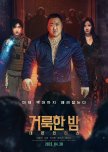
Feels awkward
A tasteless rendition of Ma Dong Seok's prowess that most probably exists just because of the success of the Roundup franchise, where they thought they could exploit the same formula and use it in every other movie genre. The acting in this one is awkward and the presentation seems lacking of resources, as he continues to kick and punch not only the criminals, but doing serious exorcism with his bare fist. It's just difficult to treat it seriously because it really looks like a comedy skit or something, and brand power alone isn't going to suffice in this movie.Was this review helpful to you?
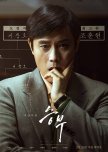
"Go is a fight against yourself"
The Match starring Lee Byung Hun and Yoo Ah In was based on South Korea’s great Go player Cho Hun Hyeon and the student he trained who eventually surpassed his master, Lee Chang Ho. The pacing of this film was similar to a slice of life. The conflicts weren’t insurmountable and there were no villains. Everyone loved the game, hated losing and saw their opponents across the table as the enemy. But those enemies weren’t afraid to be a friend away from the stones.In 1982 Cho Hun Hyeon became a national hero when he won the 1st Ing Cup, an international Go competition where Cho was the only invited Korean participant. Two years later through an acquaintance, he is introduced to the young Lee Chang Ho, an arrogant and self-trained Go player who takes on all comers, even Cho. When Cho observes his raw talent, he takes him on as a student and invites him to live in Seoul with Cho and his family. Lee gradually develops his own Go strategy which is at odds with Cho’s. The two gifted players travel along a competitive trajectory which will test their relationship.
Despite being devoted to the game of Go and hating to lose, Cho believed in a detached attitude which fit Lee Chang Ho's personality as well. Both were also capable of arrogance. Their approaches to the game were complete opposites. Cho quickly attacked, Lee methodically defended. Cho may initially have had a mental set-back as his student surpassed him, but both men refused to allow bitterness to enter their relationship. Thankfully, the film didn’t try to overexaggerate the growing pains the two faced.
Lee Byung Hun as Cho gave a restrained performance as would be expected of this composed Go player. If Byung Hun had to reel in his emotions, Yoo Ah In, had to swallow them in order to convey the slow growth of “The Stone Buddha.” The legendary Go competitors were in safe hands with these two actors. Jo Woo Jin gave a lovely performance as the defeated competitor of both, and also someone who offered the student and teacher the encouraging words needed at just the right times.
The Match’s soundtrack wonderfully matched the events taking place with the final epic battle perfectly told through the music. Go was played with black and white stones, yet the game displayed a wide range of battle plans, just as the relationships weren’t black and white, showing a range of nuance.
“Go is about trying to find answers when there are no answers.”
8 May 2025
Was this review helpful to you?
This review may contain spoilers
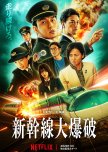
Prioritize, organize, synchronize & mobilize.
***Minor hints of spoilers***"Bullet Train Explosion," Its theme reminds me of the movie "Speed." Only it's a train. To be fair, BTE's organization and management of the situation seemed better. I enjoyed the entire effort made by the production to show how well-crafted and dedicated the Japanese officials of all levels of government were. They showed the true meaning of conflict management.
As far as the acting, it was convincing. The discipline and dedication to duty were cool and slightly frustrating. As not all avenues of minimizing conflict were respected. I can imagine the chaos that would ensue. A train with the speed of a Formula One race car with an explosive on board—crazy.
"Bullet Train Explosion" overall was an admirable effort. Production and acting, on point... to a degree. This leads me to why I gave it a 7.5 (which is still above average). As the theme and aggressive execution were good and entertaining, it was mainly just that. Storywise, it could have used more tension. The praise of the conflict resolution was also a weakness. Having some of those fail miserably, or the process of making the audience really feel that it would, was not always there.
The villain was more menacing off-screen, as the actor's portrayal wasn't quite convincing. The character appeared as more of a broken person that needed love, respect, and attention than a person capable of mass destruction and murder.
Not quite a deal breaker; it's still entertaining and worth a watch.
Was this review helpful to you?
This review may contain spoilers
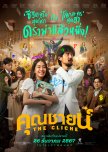
This movie has so much cliches...but it works!
DisclaimerWhat I am writing here are my views and thoughts about this movie. Some of you may not like it. That does not give you the right to try to come at me with your opinions on why this series should get a better score and why it is better than I think it is. You have your own opinions, and I have mine. Kindly respect that.
When I watch any series or movies with clichés, I sometimes roll my eyes because I am so over it, and I feel that it doesn't add anything to the story. That was not the case for this movie, which is entitled, you guessed it, 'The Cliché'. This movie was riddled with clichés that were done in such a comedic way that you really can't hate how it was presented.
There were clichés that even I know I have a guilty pleasure for from mean girls, girls dressing up as boys and even, ahem...a hint of BL. But besides having these clichés, we also get a heartwarming story in here as well. I do recommend this movie to anyone who just wants a simple movie that not only is full of cliches but has a heartwarming story to tell as well.
Was this review helpful to you?
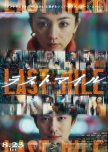
Last Mile Review
After finishing this movie, I have so many thoughts about it. First off, the cast did an amazing job! Mitsushima and Okada were an interesting duo that is perfect for this shared universe. While short, seeing the cast from MIU404 and Unnatural was a delight!For the movie's plot, I really enjoyed how everything was laid out and while the connections were not there yet; I was excited to see how everything would click in place. As for the movie's theme, I do agree it could have been a little tighter and a bit more critical, but I hope this movie will allow people to talk more about these issues. I think Nogi did a great job in creating a thrilling mystery with surprising twists.
I think if you are watching this movie for the guest appearances, you'll probably not enjoy this movie. Regardless, I think this is an enjoyable watch to see how the mystery is unraveled and solved.
Was this review helpful to you?
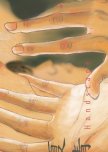
A touching portrait of two identities: that of deaf people and that of queer people
The touching story of a 17-year-old boy who must fight against the stereotypes and prejudices of a narrow-minded mother, under the symbol of fingers moving to the beat of music he can't even hear.Xia Qing is different from the others. He is different from the others in that he wears hearing aids due to a hearing loss, that he loves to dance, and that he also likes to paint his pinky finger with red nail polish just for that glimpse of beauty; and, even more different from the others, in that he implicitly reveals a queer identity. But he has the same power to pursue his dreams and is subject to the oppression of a widowed, deaf, and overprotective mother, who feels trapped in the noise, fears, and insecurities of her homophobic prejudices.
Our protagonist, who dreams of auditioning for his favorite dance company, seeks the approval of a mother who associates dancers with homosexuality or "girls only", and yearns to overcome this dark identity crisis through the silent language hidden in his fingers.
The short film, written and directed by Yiru Chen (also known for directing 'Paulo and Ripo' (2019) and 'Pizza, Believe It or Not' (2020), tells a story set in contemporary Shanghai, China, where a boy, instead of fulfilling his mother's wishes to be like other children, study and go to university, wants to dance.
Starring Zhengyu Tang as Xia Qing (a real-life boy with hearing difficulties), 'Handscape' addresses two identities: that of deaf people and that of queer people, that is, it reflects two minority groups at the same time. Likewise, the film is linked to adolescence, social constructs, social mandates, the role of family, education, and more.
Premiered at the 2020 Shanghai Queer Film Festival, where it won the Grand Jury Prize, it was awarded Best Student Short Film at the 2020 Sydney International Women's Film Festival, an award that went to director female Yiru Chen.
The story is told with sensitivity and musical flair, with memorable moments like the scene, beautifully photographed by Huang Yichuan, in which Xia Qing dances alone on the most mundane of Shanghai streets in the middle of the night with no one around—undoubtedly the dream of many.
'Handscape' portrays the triumph of perseverance and dedication in a believable way, with just two characters, very human, not archetypal. The role of her mother is presented with restraint, in the setting of a house where they miss their father, who died at a young age.
I find this short film interesting to analyze because it highlights Xia Qing's to builde their identity, far removed from stereotypes, prejudices, and family mandates.
'Handscape' is a film about the need to be who one wants to be, self-esteem, acceptance, facing and overcoming prejudices, while narrating a process of personal self-affirmation and confronting homophobia and social resistance.
Finally, this is an experimental short film about the inner voice of a human being struggling to connect with their physical self using dance and a universal sign language.
Was this review helpful to you?
This review may contain spoilers
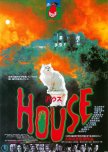
It's cheesy, very fever dream like but that's what makes House, House.
I'd expected something else from it, but honestly, I had no idea what I was getting into, and I'm glad for that. It's a perfectly fun watch and you'll have lots of laugh-out-loud moments of slight absurdity (if you're like me anyway). It's very good at doing what it wants to do, which is poking fun at american horror movies and having a bit of fun with it. I slightly wish it did a bit more to conclude it other than just one scene, but it wouldn't feel like such a fever dream if it did. Over all it was a fun ride. I don't think I'll ever find myself rewatching it personally, but I'm sure others will enjoy doing so. Make sure to watch it for yourself. You'll probably have the best experience if you watch it with friends and don't take it seriously. Try it for yourself.-Spoilers beyond this point.
Tons of good practical effects, delivers on a lot of subtle things while also doing the large ones perfectly. The piano eating scene was very legitimately creepy with its tangled limbs, and well worth watching the whole movie for. The special effects done were, unfortunately, funny rather than scary in the modern era, though. I can't quite be sold on obviously painted backgrounds or fake plastic limbs (special shout out to those, they were hilarious). You can still appreciate the craft a lot with just doing it all on film, attempts at greenscreening that, while a bit poor, did make for more action to happen. The acting and other characters kind of didn't really need to be spectacular since the absurd and wild way the story played out was enough, but I can't not mention how grand the aunt's acting was. She did all kinds of small things to really sell it all. Kung Fu was absolutely my favourite. She fought a ghost with bare fists, kicked the cat with just her legs, and she stole the whole show just by doing that. The plot itself, I slightly wish had a little more to it? The teacher really could have had a lot more to do than just turn up, but neither was he the focus. Slightly wasted potential in my view. Overall, I don't feel like I would have changed much of it, though. It had ways to do some things a bit better, but it serves itself well, and it's probably other people's perfect movie, not mine.
Was this review helpful to you?
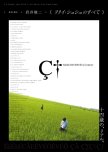
once u know the story it hits deep
ngl i was confused as hell like the whole movie. timelines jumping, random internet chats, some dude floating in the ocean — i was like wth is going on. but then i looked it up, pieced it together, and damn. this movie hits deep.it’s got that soft, dreamy vibe — like you’re floating in a nightmare but it’s somehow beautiful? the music is ethereal, the beach scenes feel like peace before everything goes to hell, and the whole thing just feels like being trapped in your own head. nothing’s ever said outright, but you feel everything. especially once you realize who’s who online and what actually happened off-screen.
though i wouldnt give it a 10/10 (even though it does have 10/10 vibes IMO) because its not good as the other movies/dramas i watch. but its kinda creative too in a way..
TRUST ME GOOGLE IF U ARE CONFUSED. HELPED ME UNDERSTAND IT!!!
it’s messed up. it’s sad. it’s cold. but it’s also so real. not in a dramatic hollywood way — in a quiet, slow, soul-crushing kind of way. definitely not for everyone, but if you like haunting, broken beauty? this might wreck you a bit.
Was this review helpful to you?
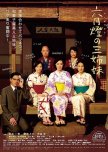
Three Sisters' Relationships with Men
For a film that is supposed to be about three sisters, it was more about their relationships with the men in their life than about them.This is a slice-of-life story that unfolds in Kagoshima where people prepare for their Summer Festival, a week-long festival where shrines and streets are decorated by beautifully hand-painted lanterns. And, as expected by a film chosen for the JFF Theater, it's very well done in these two regards. The ordinary interactions between the cast, the awkwardness and the unintentionally funny things that happen, as well as the background characters and their slightly sexist remarks -- they all feel very realistic. The cityscape with its old-fashioned trams and little shops, and with the lit lanterns during the festival makes for a vibrant background.
If only it wasn't for the story.
A better title would have been "The hetero relationships of three women" -- because the film does not explore the sisterly relationships very well -- and if it does, it's always in the context of the relationships to men. Even when the two older sisters talk about being sepearated during childhood, it wasn't about their own experiences, or how it shaped their relationships as sisters, no, it was about how it was living with (or without) a father. Even when the two older sisters try to lift their youngest sister's spirits, it's with the thought in mind that she is good enough to deserve a good man.
The shop and its problems stay part of the colourful background, the familial bonds are solely defined by their talks about the men in their life. The eldest sister has no character at all (except that she is divorced and a nice person), the middle sister does have an interest outside of family, but it's mainly mentioned in the context of her meeting another man, and only in the last minutes does the youngest sister show that she has an aspiration that is solely her own (and which needs her father's approval, although the shop belongs to the mother).
I *think* this was not the writer's goal. I *think* what he or she *wanted* was to tell a tale about three sisters and her mother, their familial bond and how they decide to live independently or with a man by themselves and solely because of their own feelings, and not because they feel pressured (by outside expectations) to do it. And, yes, that might be a story that is worthy of telling -- but maybe not to the detriment of the women's own characterization.
Was it good? -- The film probably passes the Bechdel test. Barely. The lanterns were pretty though, and the slice-of-life aspect was well done.
Did I like it? -- It think the story the writer wanted to tell is not the story we got to see. I found it incredibly frustrating to watch a film about three women that was not about them.
Who would I recommend it to? -- Maybe to people who like to see women's relationships with men?
Was this review helpful to you?

Living Is Beautiful
This is a beautiful and important movie. A mix of war with comedy, made with soul, for the one Korea stuck in a paradoxical war and division (as we see all around the world) so this movie is perfect to understand the moral behind the Korean War, but it can be applied to everywhere where brothers fight against each other.This is not a perfect movie, but it shines in very aspects so it even has blockbuster qualities. It has great production and visuals that hold well even now in 2025. The actors are also great. A little clumsy but that may be on purpose since this is also a comedy. The emotions are here, and as I said at the beginning, the message of the movie is noble and true. We can reflect on the tragedy of war by following 2 enemy soldiers going together through all kind of experiences. I am so glad this movie came to my way today and helped me rediscover the beauty of being alive.
Was this review helpful to you?

A young woman watches as a couple move in next door. The new neighbors have no idea what her evenings consist of, if they did, they would turn around and speed away. Yet they, too, are hiding a gruesome secret. One night the attached horrors will collide.
“Female creature who flew into the night hunting for pregnant women…and their wombs…craving the one thing her own body could never produce. For her body feared by many was split in two.”
I had to do a little research to figure out what the intro was talking about and the hints in the film. This was an updated folktale about the manananggal, a usually female creature that fed on pregnant women and/or their fetuses. It could split in half at the waist, leaving its lower extremities behind while it hunted. In some stories it could sprout bat wings and this character did indeed have scars on her back and waist. The screen was split, with the manananggal on the left and the pregnant neighbor on the right. No words were spoken aloud, the music and the action telling their stories. Serrano did a great job of pacing the story so that the viewer could follow both halves as they played out. The music, while simple, also created the perfect mood as both halves’ horrors were revealed.
I found the theme for Dikit hard to follow at first. In fact, I went back and watched it again. As I watched I remembered that a woman is most susceptible to partner violence when she is pregnant. In real life pregnant women’s injuries and deaths are not caused by demons. Unlike some humans who are evil, there are monsters who can transform into heroes.
7 May 2025
Was this review helpful to you?
The Dilemma of Choosing Between Oneself and One's Family
Xiao Lin is experiencing the development of his gay identity, a recently emerging term that has permeated societies globally. Our young protagonist has begun to realize that he could be homosexual, that he is attracted to young people of the same sex. Like many other people in this period of self-discovery as gay, precisely the first stage of accepting homosexuality, the Shanghai University student fears confronting his homosexuality under pressure from his family.During a short vacation, he travels back to his hometown where his father and paternal grandmother are waiting for him. Under the influence of Ouyang Fu Gui, a more radical and visually more open young writer, Xiao Lin begins to accept himself. He even goes so far as to reveal to his new friend the possibility of being homosexual or bisexual (the Second Stage or Comparison Stage, according to Vivienne Cass (1979), a criterion widely recognized worldwide), and what that would mean if it were true. Thanks to Ouyang Fu Gui, he visits gay clubs while still suffering from Confusion.
Whether internally or with his friend, Xiao Lin expresses his fear about the consequences that being gay will have on his life.
However, after returning home and seeing his family's expectations for his marriage grow, Xiao Lin finds himself trapped in the dilemma of choosing between himself and his family.
Writer-director Wu Xuan, who trained in Film and Television Direction from the Shanghai Theatre Academy, films a short film that delves into the contemporary gay community, which is still on the verge of self-identification, and develops the story through a realistic audiovisual style and the perspective of young college students.
Rather than focusing on a sweet, sexy gay romance, as seen in Thai BL, the film by Production Company: Shanghai Theatre Academy takes a more realistic social context, showing their psychological processes and encounters, focusing on the plight of gay youth today.
Starring young Chinese actor Liu Haoqiong as Xiao Lin, the short film reflects on gender and the social constructs that have been built around homosexuality.
Was this review helpful to you?
The Match is Certainly A Go!
I was reluctant to watch this movie, because I don’t especially care for sports, games, true stories or historical shows. So, what pulled me into watching this? Yoo Ah In, my most favorite actor.Result? I loved it! I loved everything about it! The acting, the story, the OST, and the whole production.
To start off, the viewer doesn’t have to know much about the game Go.
This true story, set in the 1980-1990’s is about a famous Go champion, played by Lee Byung Hun (as Cho Hun Hyeon) and his pupil, Yoo Ah In (as Lee Chang Ho).
It starts with Chang Ho as a child Go prodigy, being discovered by Hun Hyeon and their remarkable relationship as teacher and student as they progress through life.
What makes this true story unique is the relationship between the two Go champions. They both thought they were the best Go players around, until they played against each other, until one of the two looses, and how each one accepts the loss.
I sat at the edge of my chair, watching this true story unfold – please, don’t miss this treasure of a movie.
Thank you for reading this.
Was this review helpful to you?
Beautiful movie
Emotional movie with good story and great acting. Best part is how they keep screenplay fast throughout movies, but still have some moments where actors sit quietly and we can see emotions.one of my favorite scenes is teacher and student sitting together and acknowledging each other.
I think this show is fresh outlook on sports dramas, reminded me of one of all time chinese greats hikaru go which incidently is also about teacher and student.
Overall great movie with no big flaw, highly recommended
Was this review helpful to you?
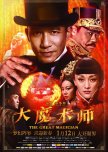
"If you believe it, then it's real"
Director Derek Yee’s The Great Magician was set around 1920 China when the warlords were carving out their territory. Japan was angling to get a foothold by supporting various warlords with weapons. In the midst was a buffoonish warlord, his unwilling 7th wife, and a magician with more than cards up his sleeve.Warlord Bully Lei has his hands full. In order to stay in power, he needs soldiers. In order to feed and arm the soldiers, he needs money. And money is in scarce supply. His assistant, Liu Kun Shan, is an illusionist whom he doesn’t trust. On the family front, his 3rd wife is always vying for his attention, but it is his 7th wife who will have nothing to do with him that he adores. Wife Liu Yin is only hanging around until she can find her father. Yin’s ex-lover, Zhang Xian returns to the country from Europe and sets up shop in a local inn. He is a magician and also in league with rebels planning to kidnap Lei in order to have prisoners released. Zhang wants Yin back and is determined to free her father who was his magical mentor. Liu Kun Shan is working with the Japanese and also after the SECRET SCROLL Yin’s father had possessed.
The story was okay and tended to wander around too much and honestly, was too darned long. This film could have easily been 90 minutes and not lost anything. I will admit that my kung fu movie loving heart was thrilled to see the Flying Guillotine have a guest role. And of course, you have to have a secret list or in this case secret scroll, though in this case it was a bit of a bust. The comedy occasionally veered into slapstick but not overly so.
What made this film entertaining to watch was the enemies to lovers, I mean friends, of Bully Lei and Zhang Xian. Lau Ching Wan and Tony Leung Chiu Wai had a delightful chemistry whether they were ribbing each other or conspiring together. Poor Zhou Xun’s Liu Yin was the third wheel. Aside from her amazing kung fu introduction, the rest of the film she had little of interest to do. I was disappointed she was given short shrift in the story department. Wu Gang (Joy of Life!) and Yan Ni played the dangerous but comedic foils to the trio.
The Great Magician had a little magic, a little action, and a little fun. It was lighthearted bordering on times on silly. Zhang and Lei showed that illusion and perception are part of life whether in politics or entertainment. It’s hard to trust your eyes with those skilled at weaving deception. At least 30 minutes too long and too short on significant Zhou Xun time, this film still had enchanting moments to offer.
“The truth depends on your perspective.”
7 May 2025
Was this review helpful to you?


