An excellent choice of a movie to watch at the cinema. Personally, I loved it, however I would suggest someone watch some other chinese movies before that, because I have the impression that they would not quite get the importance of the numerous symbolisms.
Was this review helpful to you?

Gorgeous art direction (surprising and fitting use of ONLY black, white and grey), beautiful camera work, excellent action sequences, terrific performances and morale ambiguity....all trademarks of his films. He’s an expert film maker and an expert movie maker. It’s exciting, suspenseful, surprising, heartbreaking and all the emotions.
It’s a smart and sophisticated popcorn movie for cinema buffs and for those looking for a fun movie, too.
Was this review helpful to you?

This review may contain spoilers
"Never have I witnessed the beauty of the world"
Zhang Yi Mou is renowned for his use of brilliant colors and vibrant scenery. In Shadow he showed he could strip it all away and lay bare the story in a gray and white world. The story that seems simplistic at first peels away layer after layer revealing desire, betrayal, and greed.Two kingdoms have signed a peace treaty but only the Yans have control of the great walled city of Jing. The Pei clan yearns to reclaim Jing City against the wishes of their king who wants to keep the peace at all costs even if it means wedding his sister to the Yan heir. The Pei Commander has challenged General Yang to a duel, one he doesn't believe he can win with the winner claiming the city for his clan. The Pei king strips the Commander of his rank for putting the peace at risk, reducing him to a commoner. Early on it is revealed that the Commander is only a shadow named Jing. The real Commander stays tucked away in an underground cave slowly dying from a wound rendered by the Yang general. Soon the characters set up the play they wanted, never knowing if they were the puppet master or puppet.
Shadow's dark underlying mood reminded me of an emotional mash-up of Kurosawa's Kagemusha and Throne of Blood. Jing had grown up in the darkness and even in the light was someone else's shadow. Aside from the Commander's wife, was there something else he desired? The Commander (like a good Kurosawa character) had gone nearly mad trapped below ground scheming and planning. Deng Chao played both characters so well I could scarcely tell they were the same person. Madam was torn between her loyalty to her husband and her feelings for Jing. Other than his longing for Pei to reclaim Jing City, Capt. Tian's loyalty was murky at best. Was Pei's king short-sighted or playing the long game? Characters with the greatest conceit would pay the greatest price. Zhang Yi Mou took his time revealing the hidden truths beneath the characters' facades.
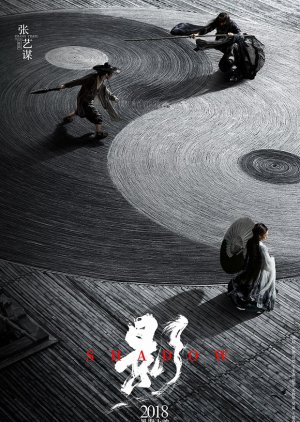
Zhang may have stripped his palette of bright colors but the film was no less stylistic. Though the film at first glance appeared monochromatic, he judiciously used color---patches of green on the hills, the luminous glow of skin, the golden heat from candles, warm brown tones in the Yin and Yang and of course the crimson flow of blood pooling in the rain. His use of color and architecture were, as always, a wonder.
Umbrellas are no stranger to kung fu movies. Zhang, however, took them to new heights. One scene with the army sliding down the cobblestone street doubly armed may have defied gravity but not wuxia magic. The fights were brutal and deadly. Ku Huen Chiu has an impressive track record as a martial arts director and his work here was exemplary. One fight managed to combine dangerous combat into an erotic dance. Feminine moves were created to combat masculine ones to great effect. A surprise knife or sword to the neck always works, too. The great battle accompanied by a zither duet was reminiscent of Hero and just as effective.
The climax dragged on as the endgames became apparent and who would ultimately come out on top was left up to the viewer to decide. Shadow was at its heart a martial arts film complete with betrayals, schemes, lust, and revenge served on a blood-soaked platter. Few directors could create a more aesthetically pleasing film or take an old genre and make it feel new. Zhang Yi Mou is one of my favorite directors for being able to do all that and more. Shadow's breathtaking use of color and creative cinematography was the perfect setting for the ancient story of man's pyrrhic need for power.
9/26/23
Was this review helpful to you?

A Guqin-Driven Cinematic Experience
This is one of my top-shelf watches, but I don't think it is for everyone. Interpreted as black-and-white, and grey with mist-covered picturesque backdrops, soft dialogue, and an ongoing guqin, it’s a performative feature that’s somewhat silent. But the notes are charged and tense. The soundtrack and choreography are as powerful as the visuals and play a significant role in shaping the narrative. I can definitely see myself watching this again—which is one of my key criteria for a top-shelf watch.Was this review helpful to you?

This review may contain spoilers
A visual masterpiece that will take your breath away.
Shadow is a genre-bending costume drama set in a mythical past in 2nd century China, which was then ruled by three kingdoms in a fragile balance of power. It is an epic heroic tale with spectacular battle scenes and incredibly beautiful cinematography throughout the film.The background story to director Zhang Yimou’s epic masterpiece Shadow is taken from the 2nd century, when China was ruled by three kingdoms in a fragile balance of power that was constantly threatened by war. The story centers around the rulers of the Kingdom of Pei, with a particular focus on its royal commander Yu (Deng Chao). Yimou, who also wrote the screenplay with Li Wei based on Zhu Sujin’s model, imagines that Yu has been so badly injured in battle that he must retreat to a secret space in the palace so as not to show the world any outward signs of weakness, which would make the kingdom vulnerable.
Instead, Yu's double, or shadow Jing (also Deng), takes care of his daily appearances. Only Yu's wife (addressed as Madam throughout the film, played by Sun Li) knows the truth – Not even the king (Ryan Zheng) can tell them apart! But in the opening scene we get the first clues that something is amiss. Yu/Jing is to duel with General Yang (Hu Jun), who controls the city of Jing, against the king's will and thus risking war. The king is furious but forgives him, and asks him to sit down and play the zither with his wife. Jing declines, thus risking the king's wrath again. Why these challenges?
As the puzzle pieces slowly but surely fall into place, we understand that the zither game would have exposed him, and eventually the purpose behind the duel challenge is also revealed, which will have enormous consequences and lead to some of the most spectacular battle scenes we have ever seen on film. A side plot that complicates the situation further is the king's offer to marry off his beautiful sister (Guan Xiaotong) to General Yang's son Ping (Wu Lei), and thereby strengthen the influence over the city of Jing that they possess. However, the plan does not go as planned... The result of all the scheming gives exciting twists and turns, but above all visual spectacles that make you lose your breath.
These are well worth waiting for, because before that the story is told through long monologues that can feel a bit patient, even though we can console ourselves with visual pleasure throughout the film. The cinematography is spectacular! A colorless palette of black-gray-white tones is sparingly mixed with warm skin or red blood. Every single frame of film is so incredibly beautifully composed that it could be printed out and become a painting on the wall. The patterns of the clothes that are reminiscent of old Chinese ink drawings, the slow-motion fluttering kimono fabrics and the castle's wall decorations. The constant rain and the yin and yang symbols that almost become their own essence in this epic wuxia work.
The essence of the story, however, is a mythical heroic tale, or a Chinese costume drama if you will, with accompanying elements of melodrama. The tight corsets and fluttering curtains may have been replaced with the secret hiding places of kimono sleeves and shadows dancing on the walls, but these are the same ingredients of grandiose castle environments with secret hatches where forbidden love is spied on.
The magical attraction of the piano as a catalyst for hot passions has been replaced by the zither, and when the couple Yu and Madam play with such obsession that the kimono sleeves fly and the hair stands on end, it almost becomes a little funny, which is probably not the intention. Likewise, where the feminine is supposed to balance the masculine and the rebels move forward with their parasols like mannequins on the catwalk, the scene has a similar effect. In the film's defense, however, it must be admitted that I was probably the only one who laughed, and otherwise I greatly enjoyed the film, which transcends genres and is suitable for anyone who is attracted to the grand. Because I haven't seen anything this spectacular in a long time. Recommended!
Was this review helpful to you?

This review may contain spoilers
Something totally elegant, beautiful and mesmerising about the Martial Arts with the umbrella. It’s like a perfectly. choreographied set of dance moves, enthralling the mind and senses. I just love it and worth watching the movie for these delicate and classical parts. Simply the best. It is taught as a feminine movement. All of these gestures and positions seem to be taught in secret to only the very talented students. Their trainer seems to be a crippled old man but what outstanding skills that he has honed his body to such a high level of competencies. His student have such a high respect and admiration for this man. He has trained one of his student to be his shadow and fight in his replacement. He is in the background guide those he has trained. Love is the motivator of many of these warriors.Such an interesting maneuver as even the Princess goes to take part diving into the water to go into the enemy territory. She’s a wilful girl betrothed to the enemy Prince. While the “shadow” fights on the platform above the troops swimming to secure their positions against their enemy. Its quite an eerie battle as the hero fight one on one with the champion on the wet and slick Zin Yan platform. It’s pouring down with rain and their warriors find their places. There is only about one hundred of them with their tiny arm held cross bows sneaking about in the rain in their dark coloured clothes. There is a mixture of men and women. They move with silent swiftness. Each cross bow has only 12 arrows so they make them count but they have their deadly umbrellas. They are like slingshots in the rain and go spinning towards their target. Impressive. It’s like a dance down the wet streets, primitive and cool.
Such a sad ending for the Prince and the Princess. The General and his wife played a sad but stirring duet together on their zithers as the shadow fighter for his life. They take the city and cut down the flag. The wounded hero returns to his home to find his mother killed and assassins await. The kings man saves him. The King finds his sister dead.
The black and white filming adds another level of mystic to an already magical scene. An electrifying, emotional , gripping and provoking movie. Watch it folks there is nothing like it to keep you galvanize for the whole two hours. Well acted by some well known Chinese actors.
Was this review helpful to you?

More Than a Wuxia Film—A Beautiful Story of Power and Sacrifice
Directed by acclaimed filmmaker **Zhang Yimou**, *Shadow* is far more than a martial arts epic. It is a visually breathtaking story of power, loyalty, deception, and the price of ambition. Set during China's Three Kingdoms-inspired era, the film follows a kingdom desperate to reclaim a lost city. Behind the political struggles lies a dangerous secret—a powerful commander has hidden himself from the world, allowing a carefully trained "shadow," or double, to stand in his place. As the battle for power unfolds, every character is forced to confront questions of identity, honor, and sacrifice.The male lead, **Jingzhou** (Deng Chao), delivers one of the film's most compelling performances. As the commander's shadow, Jingzhou has spent his life living in another man's image, surrendering his own identity for a purpose he never chose. Deng Chao masterfully portrays his quiet transformation from an obedient replacement into a man determined to control his own destiny. His emotional journey is every bit as gripping as the film's spectacular action sequences, making him a hero whose greatest battle is fought within himself.
The female lead, **Madam Xiao Ai** (Sun Li), is far more than a supporting character. Intelligent, observant, and emotionally resilient, Xiao Ai becomes the moral center of the story. Caught between loyalty to her husband and growing compassion for the man forced to live in his shadow, she navigates impossible choices with remarkable strength. Sun Li delivers a nuanced performance filled with quiet emotion, allowing Xiao Ai's inner conflict to unfold through subtle expressions rather than dramatic speeches. Her relationship with Jingzhou adds emotional depth to a story otherwise dominated by political intrigue and warfare.
One of *Shadow's* greatest achievements is its extraordinary visual style. Zhang Yimou creates an almost monochromatic world inspired by traditional Chinese ink-wash paintings. Shades of black, white, and gray dominate every frame, making bursts of movement and bloodshed feel even more striking. The choreography is equally mesmerizing, particularly the inventive use of umbrella weapons and fluid combat techniques that transform every duel into a work of art.
Beyond its stunning visuals, *Shadow* explores timeless themes about identity, manipulation, and the human desire for freedom. It asks whether a person defined by someone else's life can ever truly become themselves, and whether power is worth the sacrifices required to obtain it. Every alliance is uncertain, every victory comes with a cost, and every decision carries lasting consequences.
If you're expecting nonstop action, *Shadow* may surprise you with its thoughtful pacing and intricate political strategy. But for viewers who appreciate intelligent storytelling, unforgettable cinematography, and layered performances, it stands as one of the most visually distinctive wuxia films ever made. It is a film where every frame resembles a traditional Chinese painting, and every character leaves a shadow upon your heart long after the story ends.
Was this review helpful to you?

It was hard for me to watch it since I didn't care for much for characterization and the plot seemed like it was trying it's hardest to be purposefully mysterious and symbolic. I suggest fast forwarding thru the first half.
Was this review helpful to you?

Questo film non è una semplice perla nascosta : è una intera collana di perle !
SHADOW del maestro cinese Zhang Yimou è una storia di intrighi di corte cosparsa di duelli ornati e vertiginosi, dalla forma così esorbitante da far apparire la pur ottima serie "Shogun" quasi un prodotto amatoriale (sto esagerando... ma fino a un certo punto).Sono passati quasi quarant'anni da quando i registi cinesi della Quinta Generazione, come Zhang e Chen Kaige hanno dato vita a un movimento di modernizzazione attraverso tecniche sperimentali ed espressione personale. Ma in tutto questo tempo, non c'è mai stato nulla di simile, una variazione della stilizzazione wuxia (film di arti marziali) con un radicato simbolismo Yin-Yang che si insinua nei personaggi, nei temi, nelle ambientazioni e nell'estetica del film.
La dinamica di buio e luce, femminile e maschile, passivo e attivo, nobiltà e contadini e, in questo caso, di reale e ombra, si ritrova nel design e nella storia di SHADOW. Ne imbeve ogni sequenza. Ogni personaggio è contrassegnato da un colore predominante che condivide somiglianze visive con il suo opposto, riconoscendo il rapporto duale Yin-Yang.
Come suggerisce il titolo è un intero film in scala di grigi. Un film affascinante che non smette mai di stupire con la sua trama di lealtà, tradimento e potere. E poi nel finale una coreografia di arti marziali che è poesia del corpo, estasi del movimento, perfezione del gesto.
In un'epoca in cui le aspettative per lo spettacolo sul grande schermo sono diminuite e i "contenuti" hanno sostituito il cinema, ci vuole un maestro per ricordarci ciò che è andato perduto.
Vedere per credere. Su PRIME
Was this review helpful to you?