This review may contain spoilers
Park Chan Wook's most entertaining movie yet. Maybe one that finally earns him his Oscar nom?
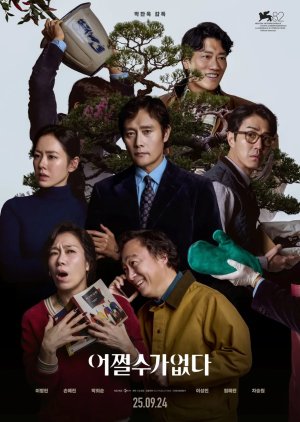
No Other Choice is one of those rare films that made me laugh, squirm, and quietly question how far I'd go if pushed into a corner. It's darkly funny, beautifully made, and a little too close to home--a story about pride, desperation, and what’s left of us when survival becomes the only goal. The title insists there's "no other choice", but that's the cruel irony, there are always other choices, just not the kind that let you keep everything you've built your pride on.The setup hits hard. Man Su (played by Lee Byung Hun) loses his job and starts to unravel, and the fear isn't just about money but also identity, about what is left when the work that defined your worth disappears. In a capitalist world obsessed with efficiency and cost-cutting, and how human labor can be easily replaced by robots/AI, that anxiety feels sharper than ever. [Ironically, Park Chan Wook was expelled from the WGA just two months ago for continuing work as an editor during the 2023 WGA strike, which protested the use of AI to replace writers. Timing doesn’t get sharper than that.]
No Other Choice treats unemployment as transformation, but for the people living it, it still feels like failure. The job competitors Man Su meets along the way mirror parts of himself, and the less time we spend with them, the less human he seems to become. Even his toothache, throbbing whenever guilt creeps in and ending in its removal, quietly tracks how far he is willing to go.
The movie walks a fine line between empathy and irony, treating the absurd premise of "eliminating" job competitors with the dry rhythm of office bureaucracy. The humor doesn't come from punchlines, it comes from restraint--the awkward gestures, the small silences, the moments that feel too human to laugh at without guilt.
Park Chan Wook lets those moments breathe. He stretches time just enough for the absurdity to hit, so you end up laughing and immediately wondering if you should have. It's darkly comic in that uncomfortable, Park Chan Wook way.
There's one scene I keep thinking about: a tense confrontation that should've been horrifying but somehow becomes comedic. The music swells until it drowns out all dialogue, leaving only gestures and anxious movement. It's one of those moments where you're half-laughing, half-holding your breath, wondering if you even want him to succeed. It's the movie's tonal centerpiece, the best example of how Park folds comedy and dread into one perfect beat.
Visually, No Other Choice is stunning. It's a full cinematic experience. Every frame feels intentional, even when no one’s speaking. The cinematography is so deliberate that the images often carry the story themselves. The direction is precise almost to a fault. Every camera move, cut, frame and screen transition suggests control, even as the story unravels underneath.
Light becomes its own character. The film starts in warm sunlight, matching Man Su's illusion of stability, and slowly fades into gray and artificial tones as his humanity erodes and his world turns mechanical. Even in the opening barbecue, when clouds slide over his smiling family, the coming darkness is already there. The autumn palette--all muted golds and dying reds--turns beauty into warning. Everything glows because it’s decaying.
The camera placement is equally purposeful. It doesn't follow Man Su, it watches him. It's like we're standing behind a window or bushes or trees, quietly complicit, as he prunes away his conscience, just like the bonsai in his greenhouse.
Characters are often shot through glass or metal reflections, showing not who they are but who they pretend to be. One shot splits the frame with rocks: on one side, a storm rages; on the other, Man Su carries out his plan. It's a simple composition, but it captures everything the film is about, the inner storm of a man convincing himself he has "no other choice".
If the direction is the engine, then Lee Byung Hun is the heartbeat. His performance is all about the quiet breakdowns and small, painful attempts to stay composed. The guilt shows in his eyes, in the smile that never quite fits, in every hesitation. Even his comedy comes from that restraint, until he suddenly breaks it with an awkward dance or clumsy movement.
Son Ye Jin doesn't need big gestures to leave a mark. You can see her thoughts shift across her face as she processes everything quietly falling apart around her. Her smile tightens scene by scene, her wardrobe fades from bright to muted, and that subtle change says everything about what she’s holding in.
Yeom Hye Ran is the scene stealer for me. I've always loved her in everything, and this is no exception. I'm used to seeing her in more ordinary ahjumma roles, so it caught me off guard how elegant and beautiful she looks here. She brings a sharp, unpredictable energy, switching from tense to funny in a heartbeat, and she makes every darkly comic moment land without ever breaking tone.
The rest of the cast fits perfectly around them. Lee Sung Min’s quiet desperation made me feel for him, Cha Seung Won brings a worn out melancholy, and Park Hee Soon adds just the right amount of smugness. Together, they make the movie feel deeply human. It's not about heroes or villains, just people trying to survive and losing small pieces of themselves along the way.
Compared to the operatic violence of Oldboy, the seductive chaos of The Handmaiden, or the quiet yearning of Decision to Leave, No Other Choice feels like a more grounded Park Chan Wook, more deliberate, and less interested in shock than precision. The violence here is quieter but hits closer to home.
In some ways, it reminded me of Parasite: that same perfect balance between arthouse and crowd-pleaser. It might even be Park Chan Wook's most accessible film, and honestly, his funniest. And really, if anyone deserves an Oscar nomination at this point, it's him. This could finally be the one.
On a cerebral level, there's almost nothing to fault about the movie. Maybe the third act stretches a bit long, or the final twist feels a bit tacked on, but those are minor personal quibbles. What stuck with me most was that slight sense of detachment while watching this move. It's fascinating, funny, and beautifully made, but I never felt fully immersed in its world the way I did with Parasite.
That said, just like Parasite, you don't have to catch every symbol or metaphor to enjoy the movie. It's engaging, darkly funny, and sharply observed in a way that lingers. I'm giving the rewatch value a 10, because I'm sure seeing it again would reveal more, the small visual cues, the quiet ironies, the things I only notice when I already know how it ends.
Was this review helpful to you?

Buried Choices
Let me say first: this movie had me morally split during its runtime, but the ending was so satisfactory that I have to give it a perfect score of 10. Director Park Chan-wook shows that he is a master of the art, with great cinematography and an unusual, unique approach to storytelling. Some people call this a comedy, but for me it was not comical. It was soul-crushing in the way it showed the spiral of choices that lead one man and one family through life’s challenges.From the technical side, the movie is very enjoyable, with a few hard-to-watch moments, but if you know the director, this is nothing. The best part for me was the music and the symbolism of the plants that beautifully grow from the secrets buried underneath. The actors also deserve all the praise.
What makes this movie perfect for me is that it has many layers and a rich complexity that provokes the viewer to think about it. It speaks about our capitalistic society and serves as a mirror to reflect on our own choices and everything we have buried in the fight for survival/success. I needed a few hours to settle my thoughts before writing this review. The movie poses two big moral questions: the illusion of inevitability that masks our choices, and the justification for sin. (Actually, there is no sin if there is no God, so in a world without moral authority everything becomes permitted and justified.) I won’t go deeper here so as not to spoil the movie, but I will surely have a lot of conversations about it.
PS. Do trees have a choice?
Was this review helpful to you?

Is society the problem, or was this man just a failure?
There was a specific vision and style to this movie, and even if it did not match my taste, I do appreciate it more than a movie that is made with no specific viewer in mind - for everyone and for no one.Sadly even if I respect the distinctive style of directing, the movie with all the attempts at social commentary, felt rather empty. Capitalism - bad, pressure put by social norms - bad, greed for success with no actual values behind it - bad. No real nuance, no depth. I do like how No Other Choices focuses on the struggles of men and how, even if we slowly give up on outdated ideas, the thought of the man being the head of the family that has to provide no matter what, as if that was their only value, can still affect many people. I just wish they presented that in a less obvious and in your face manner. Making Yoo Man Su even a tiny bit likable would be great too.
I honestly think Yoo Man Su was the biggest issue I had with the movie. Because no one had it supposed to have a larger social commentary, but at the end of the day it’s a story about a man with low self esteem that acts like a permanent victim trying to justify every action he takes. I want to feel bad for him, but he was so dislikable I actually wished him failure. Making your main character both unlikable and morally corrupt is a risky business. For how long the movie is, I wish they spent more time establishing that Man Su is in fact just a normal man, and not a complete failure. And yet, I kept thinking - society sucks, true, but in this story this man is the problem, not the society.
That said, performances for sure carried the whole movie. Especially Son Ye Jin as Mi Ri.
I don’t really have many grand thoughts about this title. Went to the cinema, considered walking out maybe 2 times, finished watching and that’s it. I would not call it food for thoughts, it was decently entertaining.
Was this review helpful to you?

This review may contain spoilers
A Hollow Attempt at Dark Comedy
Not Other Choice” is a film that never justifies its own length.From the very beginning, it becomes clear that Park Chan-wook does not have a grip on dark comedy. The film mistakes boredom for depth and builds a structure that is scattered, heavy, and unfocused. It tries to criticize everything—family, society, ethics, justice, media—but ends up saying nothing.
The so-called humor is completely absent. Every line feels clumsy, improvised, and painfully forced. After the first thirty minutes, the movie becomes almost unbearable. The characters are surprisingly unlikable—rare for Korean cinema—and the protagonist goes from being laid off to committing murder without any believable motivation.
The attempt to adapt Western satire to a Korean context simply doesn’t work. The values, tone, and moral foundations don’t translate, and the story collapses under its own confusion.
Lee Byung-hun tries, but never looks natural.
Son Ye-jin is the only redeeming element: every scene she’s in carries more emotional truth than the entire script.
In the end, the film feels like a mix of Breaking Bad and Ozark—but with none of the intelligence, tension, or moral clarity that made those works great.
Was this review helpful to you?

A Literal Cut-Throat Competition in the Hallways of Survival…
I expected the usual Korean workplace chaos people dragging each other down to climb one step higher but this film tightens that idea into something more focused. It shows exactly how exhausting, competitive and unforgiving the ladder really is…It’s pure Park chan-wook’s madness masterpiece!What works best is the quiet nod to the future…AI waiting around the corner, not loudly threatening, just silently preparing to take over the jobs everyone’s fighting so desperately to keep.
A neat, grounded reminder that sometimes the system itself is the villain, not the people caught inside it…
Was this review helpful to you?

We had no other choice
Electrifying dark humor and classy satirical reflection of society's cruelest reality, the cutthroat job and career struggle, also the only means of survival in this modern humanity, all masterfully crafted into pin point accuracy of irony that is deep down at our heart. Director Park Chan Wook's signature touches at the panning and transitions are still as significant as ever, he is literally the acclaimed king of cinematography in Korean cinema. The plot is really exhilarating to follow and with character design that properly resembles the dread in this reality, the acting performances definitely injected the soul needed for this movie, it's a complete package of audio visual feast loaded in clever ridicule of how fragmented this world we are in.Was this review helpful to you?

A Strange Mirror of Modern Anxiety
No Other Choice is definitely an interesting watch. Its pacing and the way events unfold won’t appeal to everyone ~ it is, after all, very much an auteur film. But if you find yourself invested in the characters and open to what the story is trying to say, you’ll discover a compelling narrative carried by strong, memorable performances.The film walks a fine line between the absurd and the relatable. Beneath its unusual tone lies a reality that feels increasingly familiar: in a time when job security is fragile, especially with the rise of new technologies and the shift toward automated labor, it’s easy to connect with the characters’ struggles, even if you wouldn’t make the same choices yourself.
What stands out is how the characters, while often colorful and eccentric, are still grounded in a sense of realism. This balance keeps the film engaging throughout, as you’re constantly wondering what unexpected turn might come next ~ and whether the protagonists will find a way through it all.
If you’re drawn to unconventional auteur films and don’t mind an offbeat rhythm, this one is well worth a try. It may not aim to be a masterpiece, but it doesn’t need to be ~ it has enough to say, and enough to show, to both entertain and leave you reflecting on where we’re headed as a society.
Was this review helpful to you?

Park Chan-wook — a name I will never forget
Every time I watch one of his films, I’m reminded why he stands in a league of his own. No Other Choice is no exception. It feels fresh and unpredictable, yet it unmistakably carries that classic “Chan-wook touch” — stylish, sharp, morally complex, and darkly funny.What struck me first was how unique the film felt. It doesn’t move in a conventional way, and just when you think you understand its direction, it shifts — sometimes subtly, sometimes brutally. That unpredictability is part of what makes it so compelling. Park has always had a gift for blending tones, and here he balances genuine humor with some very heavy themes in a way that never feels forced. The humor often comes wrapped in discomfort — you laugh, then immediately question why you’re laughing.
At its core, the film dives deep into the idea of the “man of the family.” What does that role actually mean? Provider? Protector? Decision-maker? The movie challenges the traditional image of the ideal family and exposes the pressure cooker beneath it. The expectation to be perfect, stable, successful — especially in a capitalist system — becomes suffocating. There’s also an undercurrent of commentary that feels tied to capitalism and possibly even AI, as if the characters are trapped in a system that reduces human worth to productivity and replaceability.
One of the most disturbing ideas in the film is how evil can disguise itself as good intentions. The belief that you’re doing something “better” for your family can slowly justify darker and darker choices. That moral spiral — where love, pride, fear, and ego intertwine — is handled in a way that feels both intimate and unsettling. Park doesn’t present villains in a simple way; instead, he shows how ordinary people can become destructive when cornered by expectations and systems.
Was this review helpful to you?

Park Chan-wook is a master
This was immaculate.The things capitalism will put you through. Love how this film turns a mirror to its audience to decide what’s moral. Who to root for? At what act do we decide to become horrified and who gets chastised? No one wins. There is no right or wrong under this system. Just eat or get eaten. It’s a tragic reality.
The approach to these topics reminds me so much of Memories of a Murder. The tone will go from outrageously silly to petrifying within a blink.
Amazing sound design, beautiful cinematography, impeccable editing. The best stuff is coming out of Korea and has been for quite a while.
Was this review helpful to you?

The Weight of a Life
This is my first review here, and I felt compelled to write it because this film left an ache that wouldn’t fade. Some films don’t ask for your attention, they quietly take hold of it. This one does exactly that. It doesn’t rely on grand gestures or loud statements; instead, it unfolds with a calm, unsettling clarity that stays with you long after it ends. It reveals a truth we usually step around, a truth that feels too sharp to look at directly.What struck me most is the film’s attempt to level the hierarchy we have built between ourselves, animals, and even trees. It quietly challenges the viewer: if your heart aches at the death of a human, do you feel even a fraction of that sorrow when a pig falls, or when a tree is cut down? And if their loss can so easily be dismissed with the phrase ‘no other choice,’ then what keeps us from using the same justification for a human life?
This question unsettles me because it exposes how selectively we apply empathy, how readily we excuse one death while mourning another. It makes me wonder: are our feelings only based on familiarity, or on the assumption that human life is somehow more valuable?
Is the value we assign to life truly inherent, or just a comforting idea we cling to?
Was this review helpful to you?

This review may contain spoilers
Life Through A Grey Decision
No Other Choice is what would happen if you put a dark character into a comedy. The story always revolves around grey area. You will ask yourself multiple times whether you should root for the main characters or not: "Ain't there really no other choice for them?". All the actions, characters and decisions are morally questionable. On top of that, they were still able to add comedic touch to the story, the unique comedy that isn't slapsticks. Visually, the cinematography is excellent, all of the dark agenda happened with minimum light. No need to talk about the casts, it's very outstanding here especially Son Ye Jin.For a dark comedy that highlighted a harsh truth about job competition, I still feel this one only delivers minimum number of messages. I also don't like the storyline about doctor Oh that left out hanging.
I recommend this to be watched at least once, and enjoy the cinematography.
Was this review helpful to you?

Good Script, Great Cast
There has been a lot of discussion surrounding the performances of Lee Byung Hun and Son Ye Jin, as well as the directing by Park Chan Wook. However, what I would really like to highlight is Yeom Hye Ran’s supporting performance. She perfectly balances the realism and surrealism of Lee A Ra, the failed actress who, I would argue, is the second most important character in the film. Without such a strong supporting performance, this film simply wouldn’t have worked.Was this review helpful to you?