



This review may contain spoilers
"La tristesse durera toujours"
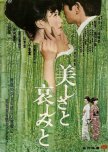
Toshio Ōki (Sō Yamamura, in an absolutely well-placed part), an established middle-aged writer, husband and father, travels to Kyoto in the days leading up to New Year’s Eve; In his thoughts always returns Otoko (Kaoru Yachigusa, perfectly at ease in the role), his former lover from decades earlier, who at the time, when the girl was barely 16, had also given him a daughter, who died soon after her birth...From this experience, Ōki wrote a deeply autobiographical book ("The Sixteen-Year-Old Girl", the title quoted in the novel) that became a bestseller.
After being abandoned by Ōki (who has returned to the family fold), Otoko is now an accomplished painter and lives in the company of the young and perturbing Keiko (Mariko Kaga, stunning), her pupil and lover; Keiko, as beautiful as well as enigmatic, is obsessed with “bringing justice” to her partner, engaging in a destructive game of massacre that will not spare even Ōki's son Taichiro…
Beauty and Sadness ("Utsukushisa to Kanashimi to", 1964) is one of the most significant novels by Yasunari Kawabata, the great Japanese master who won the Nobel Prize for Literature in 1968; His compositional style, poetic lyricism and the themes expressed in his works are ineluctably interwoven with Japanese culture and tradition, but also with that profound and complex sense of universal melancholy that afflicts -inesorably- the human soul, especially in the face of the passing of time and, therefore, of life itself ...
The material available in the novel offers so many insights that it would be perfect for a film adaptation.
Due to the immediate public success of the book, the Shōchiku film company cleverly decided to produce an adaptation for the big screen, relying on the skilful flair of Masahiro Shinoda, one of the most representative names at the disposal of the company founded in Tokyo.
Shinoda (born in 1931, died in early 2025) had joined Shōchiku in 1953, at a very young age and, like so many of his colleagues, had gone through a several-year apprenticeship as assistant director for many prestigious colleagues (Ozu too, among others) and, finally, in 1960 he made his debut as a film director, immediately distinguishing himself thanks to a non-conformist style, detached from the cultural movements that engaged his more “politicised” colleagues (Oshima etc.).
Eager to change the basic language, as well as the content and themes, Shinoda had started a productive collaboration with both Shuji Terayama, great author, poet, playwright, director and a thousand other things, and also with avant-garde composer Toru Takemitsu, deconstructing cinematic materials, especially in Yakuza and Crime Movies such as “My Face Red in the Sunset” (which seems to anticipate certain Seijun Suzuki-esque mockery and experimentation) and, most of all in the beautiful "Pale Flower”.
To use the words of Chris D. in his immense essay “Outlaw Masters Of Japanese Film”, Shinoda revealed an almost pictorial style in the composition of the images, managing to miraculously merge music with imagery, lights and camera work, resulting in a rigorous style and realisation…
With these assumptions, in the skilful hands of the Gifu-born director, Kawabata's novel comes to life, converting the pages of the book into images and perfectly reproducing the sensual and aestheticising world of the work of the same name, without, however, giving in to perhaps easier sensationalism (as in Masumura's “Manji” of the same time, nudity is extremely limited here).
We are in the presence of a multifaceted and complex love story involving all the tormented characters portrayed and where all the most significant themes of the novel find expression; The past that suddenly resurfaces, suffering and regret (because “Love is a wound that never heals...”), sense of guilt, but also desire, obsession and, of course, love itself (also in its predominant homosexual aspect).
All these elements are highlighted by Shinoda with an extremely geometric style, elegant in its attention to detail and in the search for atmosphere; A style capable of alternating very close-ups with long shots, as well as crab shots and the use of refined long takes; Those in Otoko's house are beautiful, with the two women/lovers confronting each other.
Refined visual aesthetics and a great display of technique even in static shots, almost with a cinematographic cut à la Ozu; Shinoda also fills the scenes with mirrors, somewhat in the manner of Orson Welles, almost as if to reiterate, in metaphorical form, the complexity of reality, truth and the shattering of the identities represented, particularly in the multifaceted nature of Keiko.
Thanks also to the perfect use of colours and beautiful locations, the clever temporal fragmentation - excellent flashbacks alternating past and present - the contribution of the music - and introspective silences - and the use of elliptical editing, the essence of the original text, as well as much of the dialogue, is well represented, especially in the last segment, which diligently avoids risky didactic cascades, restoring all the pathos and relative emotional tension of the book's dramatic crescendo.
The choice of the cast, perfectly assembled, is a very satisfying decision; The idea of making Keiko the fulcrum of the story is interesting, thanks also to the remarkable attractiveness of Mariko Kaga (already the protagonist in ‘Pale Flower’ who, moreover, with those eyes, would make anyone vacillate!). Especially in the sequences with Otoko, Keiko is remarkable in amplifying her obsessions and her mad love for her teacher, at times disturbing in her iron will to achieve her purposes;
Almost as a counterpart, Otoko interiorises her own suffering and her painful wounds, trying to find a reason for being in the realisation of the painting (“The Child's Ascension” is the highlighted title in the novel) which, in a cathartic way, should help her overcome the events she has experienced over the years, as well as the “beauty and sadness” of her unfortunate love for Ōki.
Ōki, played by Sō Yamamura, (the same age as his character in the novel at the time) especially in the first section, is well centred and conveys the anxieties and existential condition required by the role, tormented by remorse.
Perfectly functional Yamamoto Kei, in the role of Taichiro and Watanabe Misako, in that of Fumiko, Ōki's wife, torn by grief and resentment…
As a curiosity, the film was distributed in Italy with a decidedly distorted title, ‘L'Amaro Giardino di Lesbo’, something like ‘The Bitter Garden of Lesbo’, too explicit and moreover misleading in its contents; An opera perhaps not to everyone's taste, also due to a certain coldness or contemplative “slowness”, ‘With Beauty and Sorrow’ proves perfectly capable of honouring its magnificent source (the novel is absolutely essential) in an intense and refined manner, subtly cutting as well as painfully beautiful... and sad.
8 ½
Was this review helpful to you?
This review may contain spoilers
Two's couple, three's a crowd…Four is a cross
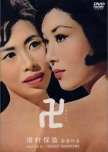
* Sonoko, the bored wife of the lawyer Kakiuchi, attends a private art school and during her lessons, while portraying the Bodhisattva divinity Kannon, she meets the young Mitsuko, being fascinated by her... Soon an unstoppable passion breaks out between the two women, which sees the more mature Sonoko obsessed by the manipulative Mitsuko and which will see the two women find themselves entangled in a torrid sexual labyrinth that will end up involving even the ambiguous Watanuki, Mitsuko's promised husband, and Sonoko's own husband…Among other things, 1964 was the year that saw the remarkable encounter between the outstanding narrative style of the master Junichiro Tanizaki and the peculiar and unconventional cinematic vision of the great Yasuzo Masumura, a director capable of translating one of the Tokyo writer's masterpieces, the famous “Manji”, into images, rendered correctly in Italian as “La Croce Buddista” (The Buddhist Cross) and also released here as a movie with the adapted (but not taken out of context) title “La Casa degli Amori Particolari” (something like “The House of Unusual Loves”) and later also reworked by female director Liliana Cavani in a version transposed to World War II and titled “Interno Berlinese”...
Masumura inherited the project from Kon Ichikawa, who was in turn filming his work on the Tokyo Olympics. He enlisted the help of Kaneto Shindo for the screenplay and, more than faithfully respecting Tanizaki's novel (set in the late 1920s), he dried and compressed the pages of the book, dropping everything into a contemporary setting (recognisable by the clothes of the protagonists) with an almost theatrical feel, or a kammerspiel if you prefer…
An incredibly oppressive and claustrophobic setting (there are practically no outdoor sequences) with a skilful use of the flashback structure (just like in the novel), supported also by a beautiful chromatic rendering that emphasises the colours, but, above all, relying on his directorial dogmas, often criticised by artists such as Oshima, who had devoted more than one critical essay on Masumura's style to the method of the master of Kofu.
Masumura had formed in Italy, at the "Centro Sperimentale di Cinematografia", a Roma" (CSC) in the two-year period from 1952 to 1954, and this experience had allowed him to associate with other colleagues of the calibre of Federico Fellini, Roberto Rossellini and Michelangelo Antonioni, to name but a few; Returned to his homeland, he immediately distinguished himself by his unconventional approach and a style that went against the trends of classical filmmakers, but also of his younger colleagues (such as Oshima himself) with an anti-naturalistic style that made no concessions to spectacle and the desires of the audience
"Manji', in the hands of another director, could have lent itself to an easy reading as a canonical melodrama with a tragic background, but Masumura's extremely direct -and concise- treatment combines formal radicalism (non-conformist vision) and adequate psychological tension, as well as emphasising the peculiarities of his directorial style...
Despite the sensitive subject matter, which would lend itself to even more daring representations, the direction avoids any possible voyeuristic complacency (the few nudities are extremely chaste, it must be specified...), focusing mainly on the characterisation of the protagonists, particularly Sonoko (Kishida Kyoko, perfect), the more mature of the two women, who, inexorably overwhelmed by the attraction and desire for Mitsuko (a beautiful and very excellent Wakao Ayako, a true muse of the director) progressively falls into a spiral of madness, without shame or any concern for -relative- consequences, including social ones.
Sonoko, a “bourgeois” woman with a rather conventional life, dissatisfied with the greyness of a loveless marriage, ends up suffering -and accepting- the overwhelming sensuality of the younger and more elusive Mitsuko who, with her ambiguities, duplicity and progressive lies, perfectly embodies that character figure who is characteristically anaffective, unscrupulous and cynically anti-naturalistic at the basis of Masumura's cinematography.
In this somewhat hyper-realist short circuit, Mitsuko ends up almost assuming the role of a sacerdotess, or goddess no less, thanks in part to her total identification with the portrait of the goddess Kannon, to whom she had lent herself more or less indirectly as a model, and who will find her reason for being in the concluding self-destructive spiral...
The two male figures, Sonoko's husband (Funakoshi Eiji) and Mitsuko's ex-lover (Kawazu Yusuke), emblematically miserable and devoid of any qualities, will progressively end up “sucked into the self-destructive vortex of a passion that, beyond its erotic dimension, will reveal itself above all as a struggle for the possession and annihilation of the other”.
Masumura's cinema is extreme, disorienting and in some ways disturbing (but he would go even further in subsequent years), capable of bending the rules of melodrama to his sharp vision that plumbs the depths and highlights false bourgeois conventions, even repressive ones on the subject of sexuality, highlighting a radical critique of the hypocrisies of Japanese society.
It is not known whether Tanizaki was able to see (and appreciate or not) this reduction of his beautiful novel (the writer died the following year, in 1965), but it must be said, beyond the personal tastes of each spectator, that Masumura offers a decidedly respectful and even faithful representation of the most important passages, allowing us for once not to turn up our noses and find a pleasant exception to the age-old dilemma of the quality of films based on novels, more or less representable in cinematographic format...
8 ½
* I would like to indirectly thank the author Beniamino Biondi for his courageous work ‘ Giganti e Giocattoli - Il Cinema di Yasuzo Masumura’, for the many news and interesting insights; And, as always, for the beautiful catalogue ‘Racconti Crudeli di Gioventù’ (Nuovo Cinema Giapponese degli anni 60), Marco Muller and Dario Tomasi; Their essay is an inexhaustible and irreplaceable source when writing reviews…
Was this review helpful to you?
This review may contain spoilers
When You get a rent-free house, the catch is around the corner...
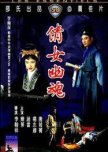
Just arrived in a small town, the tax collector (or scholar, depending on the translation A/N) Ning Caichen (Chao Lei), unable to find accommodation for the night, chooses to take refuge in a temple outside the village limits, despite the warnings of many people, who are convinced that the place is haunted by evil presences.The villagers' ominous superstitions prove correct: The temple Jinhua appears to be cursed…
And from the manor house near the temple, a delightful young girl (Betty Loh Ti) sings, accompanying herself on the koto…
An essential classic born from the fertile creative forge of the Shaw Brothers studios and the talent of director Li Han-hsiang (also author of the subsequent and magnificent ‘The Love Eterne’), which is not always fully recognised, “The Enchanting Shadow” is an imaginative work that transcends genres and styles, thanks to its fluid and modern staging and truly exquisite use of photography, with magnificent visual effects and colour schemes.
A true pivot point in fantasy productions (a definition that, much like black, wears well with everything), the movie, which draws inspiration from Pu Songling's collection ‘Strange Tales from a Chinese Studio,’ it was released in the summer of 1960 and also competed at the Cannes Film Festival that same year, and it is certainly not pure fantasy to think that the work sparked some ideas in the minds of directors, producers, etc. in the Western film industry as well.
Considered by Riccardo Esposito, in his seminal book “Fant'Asia”, a sort of Oriental “proto-horror”, as well as an undeniable source of inspiration for Tsui Hark and his “A Chinese Ghost Story” (which is in fact a remake of it), ‘The Enchanting Shadow’ (but the original title is “Qian Nü You Hun”, which we will not translate so as not to reveal too much!) after so many years, it continues to prove itself well structured and highly enjoyable to watch, thanks to its appreciable, decidedly classic narrative structure (widely replicated and exploited over the years), which manages to condense the tale into less than 90 minutes, while also allowing for interesting genre mixtures that help to keep the viewer's attention alive throughout.
A striking mix of melodramatic and supernatural elements, enhanced by a fundamental musical complement and interesting horror digressions, the film captivates with its charm and evocative power, which, despite a context that is certainly not rich and perhaps even a little naive and hand-crafted, undoubtedly achieves its objectives of interest and entertainment, thanks not only to the remarkable work of the authors, but also to the clever use of ellipses and off-screen sequences and, of course, the excellent contribution of a perfectly cast ensemble.
Chao Lei, in the role of the initially timorous Ning Caichen, is the archetypal character of this genre of movies; A curious intellectual, attracted by the mystery surrounding the temple—which is truly creepy at night—guided by honesty and moral rectitude against fear and popular superstitions, he meets Yan Chixia (Yang Chih-ching), a sort of swordsman/hermit (and also a singer) who immediately makes it clear that he knows a lot about the terrifying voices surrounding the ruined building.
Ning thus inevitably and progressively becomes the “perfect prey” of Nie Xiaoqian, a mysterious young woman played by the captivating and irresistible Betty Loh Ti, who, thanks to her excellent performance, ends up being the real focus of the movie.
From her first appearance, the beautiful actress exudes a magical aura, placing her character in a decidedly “fantastic” dimension, so much so that we immediately wonder whether Nie Xiaoqian is a real woman or perhaps “something else”.
Each of her “appearances” (it is appropriate to write it this way) deeply affects – and progressively more and more – poor Ning, who desperately tries to resist the young girl’s enchanting exploits from the seductive temptations of the flesh to those that are decidedly more materialistic (his goodness, one might say!), especially as he discovers, as the story advances, unthinkable truths about the aforementioned girl, truths that will inevitably shake his most firmly held convictions.
The work of the director of photography is truly remarkable, playing with the colours, contrasts and shadows of the night in the temple, in a happy chromatic combination with the beautiful clothes of the protagonist (each time in different colours variations), particularly the blue tones at the moment of the (not too surprising) “confession”.
This is a detail that should not be underestimated and that allows me to digress briefly:
In the years that followed, American director Roger Corman, thanks to the contribution of his extraordinary director of photography Floyd Crosby, would often replicate this visual trickery, especially in his series of movies based on the stories of Edgar Allan Poe and, also in Italy, Mario Bava - who, curiously, released his extraordinary classic ‘La Maschera del Demonio’ [“Black Sunday”] in the same year, 1960 -, will amaze with his subsequent horror productions, exploiting visually ‘colourful’ techniques not unlike those appreciated here in ‘The Enchanting Shadow’;
As if to recreate a metaphorical bridge capable of highlighting the wonderful ability of the seventh art to transcend boundaries and find happy stylistic points of encounter...
Undoubtedly a pivotal work in the development of Hong Kong genre cinema, ‘The Enchanting Shadow’, as a classic, continues to be enjoyed thanks to its old-fashioned charm, or ‘vintage’ appeal, if you will, which many may find outdated or obsolete, but which, to me personally, makes it formally exemplary, thanks to the right atmosphere and the skilful hybridisation of different genres (a feature that will later become recurrent), capable of being appreciated by the most willing and discerning viewers...
8 ½
Was this review helpful to you?

This review may contain spoilers
"Climb every mountain, ford every stream, follow every rainbow, till you find your dream.”
As an extraordinary example of passion, strength of spirit, resilience and sense of sacrifice, surrounded by a eulogy to friendship and team work, “Once in a Lifetime, Kilimanjaro” is a highly successful and beautiful representation of great television at the service of the viewer, exciting and moving, passionate and amusing, capable of concentrating in its nine -extraordinary- episodes all the characteristic elements of an adventure through one of the most fascinating places in the world; The true protagonist of this saga is Mount Kilimanjaro, one of the most enchanting peaks on our planet, as well as the highest mountain - a sleeping volcano, it must be remembered - on the African continent (5895m)...Brilliant was the idea of forming an absolutely heterogeneous team by bringing together three idols of different generations, from the veteran and very talented Yoon Eun Hye (38 years old during the show's production) to the relatively younger colleague Uee (a revelation!) to the “little” - and surprising - Choi Hyo Jung, as well as the excellent Son Ho Jun, perfectly cast in the part of the oppa always chivalrously ready to do anything for his fellow adventurers...
Having passed without any particular effort the phase of getting to know each other and finding team cohesion (which will prove to be absolutely granitic), the four protagonists, who had never met before and who freely establish their respective roles and assignments, are also prepared from a medical point of view, about all the risks and eventualities they will -presumably- encounter and then catapulted into the extraordinary scenery of Tanzania, and us with them, to appreciate all the beauties and peculiarities of a world so fascinating and in many ways quite distant from the lifestyle of many of us;
It is precisely this exquisite and highly successful melting pot of seemingly distant worlds that delineates the first part of the journey to Tanzania, during which the four characters will find themselves interacting with the local residents, in a multi-faceted socio-cultural exchange that will not fail to recreate conditions of friendship and mutual collaboration, which will also be fundamental during the climbing of the mountain...
Without prejudices or cultural barriers, through even daring linguistic adjustments (the only flaw is that the four Korean artists display a limited knowledge of English), the first days of their stay in Tanzania will allow the protagonists of the adventure to enjoy some of the most beautiful experiences possible, from a photographic safari through the boundless Ngorongoro National Park, to a walk to the majestic Materuni Waterfalls, to a dip and a swim in the natural oasis of the beautiful Chemka hot springs, as well as appreciating the culinary delicacies of the characteristic cuisine of those places
But the days go by and the beginning of the adventure draws nearer and nearer, with the relative and growing tension;
Kilimanjaro is there and watches majestically, ready to take centre stage in the following episodes; and it is here that the show displays all its beauty and drama with a change of narrative register that, of course, takes into account the extraordinary difficulty of the mission that will last for several - endless - days...
It would be unfair to dwell on particular episodes, moments or situations because it would detract from the charm of the vision; personally, I trembled for all the last episodes, possessed by an almost “Herzogian” cinematic visual power (Werner Herzog being the most immediate reference); The great German filmmaker often portrayed in his works the disruptive force of nature and as a counterbalance the fragility of man often helpless in its presence, at the mercy of events - even mortal ones...
Here, one can almost perceive a metaphysical dimension of what can be defined as a journey that is not only physical and corporeal (and absolutely gruelling for the body, moreover!), but also interior and extrasensory, with an almost Zen-like awareness of one's goals, objectives and limits, which one always strives to push beyond. An experience that is at times almost psychedelic, thanks also to the incredible landscape - moon-like or Dante's Inferno, just to be clear - of Kilimanjaro and the changes in appearance and climate as you climb towards the summit.
With a heart-wrenching ending that leaves no one indifferent, ‘Once In a Lifetime Kilimanjaro’ perfectly completes its incredible mission, winning the challenge of the spectacle and conveying a wide variety of truly unique emotions.
There were many memorable moments in the show; at times, it almost seemed like a Yoon Eun Hye show, given how the actress—who is truly amazing - manages to discipline herself into the role of the perfect Unnie, putting her completely at the service of her younger companions and her peer Son Ho Jun, with a sense of duty that is truly unmatched in terms of organisational skills and discipline, as well as giving us sincere and personal moments that also seem to sum up an artist who has been in the spotlight since a young age (she made her debut at 16);
Uee is perhaps the most surprising of the bunch, coming into her own in the long run. The sketches where she plays a swimming instructor or the chance encounter with her personal fans are really enjoyable. The idol grows in willpower and determination throughout the show, as does the younger Choi Hyo Jung, who is gorgeous and cheerful, always smiling, even in the most extreme moments, and appears very determined, thanks in part to the responsibility she has taken on with her surprising appointment to her role.
Son Ho Jun, also without frills or too many words, will prove to be extraordinary during the climb, significantly placing himself at the head of the variegated group; between singing jam sessions that once again demonstrate the extraordinary unifying power of music that breaks down barriers and knows no boundaries, improvised performances of the famous local coffee (with funny digressions on “Coffee Prince” and “Coffee Friends”), solidarity and friendship, personal crises and progressive defections, the incredible physical endurance of the local guides and carriers, the non-stop whirlwind of emotions makes the nine intense episodes fly by, giving us a wonderful adventure, at least for me, which I highly recommend to everyone.
9/10
Was this review helpful to you?
This review may contain spoilers
“In a black and white world murder brings a touch of colour…”
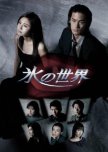
The sudden death of a young school teacher, at first classified as ‘accidental’ is treated as a murder, when an anonymous letter kindles suspicions in maverick policeman Takeshi Ujou (Toru Nakamura, perfectly in part), stubbornly determined to pursue the investigation. The discovery that the victim had taken out an insurance policy for 5 million yen also alerts the ‘Rose Life Insurance’ company, determined to find out whether there might be some controversy or irregularity behind the teacher's death; The young Eiki Hirokawa (Yutaka Takenouchi, excellent), investigating on behalf of the aforementioned insurance company, makes the acquaintance of Touko Egi (Nanako Matsushima, very beautiful and subtly ambiguous), another teacher and colleague of the victim, a woman who seems to be involved in other similar cases and who seems to have an unfortunate relationship with men... and with insurance policies...An excellent noir with an evident hard-boiled derivation, ‘Ice World’ is a journey into the tortuous twists and turns of the human mind, capable of growing exponentially as the episodes pass, involving the watcher in a story with infinite facets, where, in full compliance with the rules of the genre, nothing is left to chance, and where tension and the search for truth go hand in hand with the doubts and ambiguities dictated by the complex psychologies of the main characters...
There is an undoubtedly old-fashioned vibe, the kind that was very trendy -especially in U.S.-made productions. towards the second half of the 1980s and the early 1990s, which provide the ideal frame for the series, those soft lights, mainly nocturnal, and a cold, livid, not to say chilling atmosphere, with photography tending to turn blue - especially in the scenes at the bar - and where even the daytime moments are often played out in contrast, with backlighting effects, almost ‘blinding’ the gaze as well as the minds and reasoning of the main players, gripped by a thousand doubts, even of a personal nature...
This atmosphere is amplified also by an effective use of striking images and symbolism, such as the sea, photographs, and that repeated reference to the ice pick (so ‘90s-esque), as well as a decidedly remarkable job by the entire cast, which, working in subtraction, with an extremely suffered and interiorised acting, increases the narrative's charm; Nor should a particular voyeuristic component be underestimated, characterised by the ambiguous relationship established between the policeman and the suspect, as well as the repeated viewing of photos and footage, aimed at finding possible solutions...
Cold, seemingly detached and ambivalent characterisations become a fundamental narrative peculiarity, since the ambiguity displayed by all the main characters in the story considerably complicates the unravelling of the classic ‘whodunit’, leading the viewer towards false tracks, revaluations and various twists and turns, which serve to reshuffle the cards on the table and confuse -even more- ideas, given the rather elaborate plot...
The narrative climax, in my opinion, is reached in the tenth and penultimate episode, decidedly of excellent quality and narrative writing, where - in the first portion - all the suspicions, the investigations carried out up to that moment, and even certain ‘evidence’, tend towards a solution that is undoubtedly ‘justified’ and well explained, but then, in the final part of the story, a logical reversal will lead us to the excellent closure of the story, well thought out and in some ways saddening, where the fatalistic dimension of hard-boiled American literature mentioned above is really manifest...
Undoubtedly enjoyable even years later thanks to a definite narrative strength and the excellent cast already mentioned, the serial lends itself to further viewing, especially in order to unravel more easily the intricate and engaging story
Waiting for a remake Made in South Korea
8/10
Was this review helpful to you?

This review may contain spoilers
Come Spy With Me...?
Adventurous North Korean wannabe secret agent Myung Wol's whirlwind mission to South Korea (Han Ye-seul), amidst capricious Hallyu stars (Eric Mum), spy stories centred around mysterious papers, kidnappings, blackmail, lies and confessions, as well as the discovery of love, with the glittering world of show business providing the backdrop for the whole story...This dizzying spy-derived rom-com starts off rather well but ends up - unfortunately - deflating a bit like a soufflé. It manages to get a number of cues right, starting with the setting in the gilded and ephemeral world of South Korean showbiz and - as an amusing counterpoint - the impeccable practical military education of their North Korean brothers, filling it all with adequate subplots and good secondary characters, and through a good narrative rhythm that for most of the series keeps the attention threshold quite high...
And there is undoubtedly a certain sympathy for the story, at least at first, only that, once the initial euphoria has passed a little, with the character definitions of the main figures, a certain mechanicalness inevitably takes over, which makes the whole thing get bogged down into a conventional action spy drama that is rather repetitive and even predictable in its conclusions...
Too bad, with the good premise of the first half and a more than successful cast of characterisations as a whole, a shorter running time (why not the classic 16 episodes instead of these 18!?) would certainly have benefited, which would probably have limited so many unnecessary lengthy episodes as well as recurring repetitions, especially in the last episodes of the series.
Was there any need for so many sentimental bounces between the main characters, in addition to the constant reversals of situations linked around the mysterious code!? It triggers a tedious back-and-forth that inevitably loses intensity and bite, with continuous betrayals and rapprochements that in the long run tire without ever really getting to the point, even if, by the way, in the wedding scene some pathos is fortunately recovered, although directing the series towards a clichéd and decidedly half-hearted finale...
Han Ye Seul offers a portrayal that personally reminded me of certain fine characters from 1980s Cold War period cinema, a bit like some James Bond of the Roger Moore era; the transition from the uncompromising North Korean agent, a real fighting machine, to the rising star of South Korean cinema is so dizzying that one cannot help but smile with amusement at so many narrative twists and turns…
Moreover, these junctures allow the stunning model actress to bring out a wide range of nuances of her excellent repertoire, synthesised in the actor's audition scene and, as fortunately happens from time to time, to make us admire her in all her extraordinary beauty (absolutely unforgettable in mini shorts for much of the show!).
Eric Mum has a somewhat peculiar role, in some respects it reminded me of Rain's character in ‘Full House’; all the nervousness and excesses of capricious stars used to bossing everyone around, only to come up against the inevitable reality of feelings, it's a character however not well centred, he has the inevitable trauma related to his father (which will later intertwine with another fundamental juncture of the drama) but personally does not arouse any particular character sympathies in me even though several moments with Ye Seul are undoubtedly intense and beautiful, see the scene in the cave with the ‘advanced survival course’ which is really funny and successful!
Interesting enough are the roles of Lee Jin Wook and Jang Hee Jin, who clearly share a similar fate in terms of overt sentiments, perhaps not sufficiently deepened, she especially deserving of a slightly more ‘’temperamental‘’ part even if her artistic-sentimental outbursts provoke just the right amount of amusement…
The ‘married’ spy couple is very good, with the whole ‘vintage’ secret agent corollary, which, underneath it all, does not deny the comforts of the South, compared to the ‘military greyness’ of the DPRK, and Lee Deok Hwa is perfect as always - priceless in the duets with his niece - who, with that scowl and charisma, can sustain any role!
It would have taken more courage and better synthesising skills to put on a gem of a drama, but even so it is
a series that still provides good entertainment and guaranteed involvement, personally a more than generous
7/10
Was this review helpful to you?
This review may contain spoilers
The Golden Age Of Bloodshed
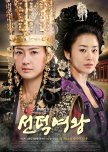
The epic, troubled and adventurous story of Kim Deokman (Lee Yo-won), daughter of Jinpyeong (Jo Min-Ki), 26th King of Silla; Twin sister of Princess Cheonmyeong (Park Ye Jin), abandoned at birth to avoid a nefarious prophecy about the kingdom, raised by her servant/putative mother Sohwa (Seo Young-Hee), pursued by guardian/concubine Lady Mishil (Go Hyun-jung) and her hitman ChilSuk (Ahn Kil-Kang); From her disguised return to Seorabeol, to the war against the Baekje kingdom, to the recovery of her royal status, torn between her repressed love for Lord Kim Yushin (Uhm Tae-woong), valiant leader of the Hwarang militia, and Bidan (Kim Nam Gil), repudiated son of noble origin, through the complicated mission of reunifying the three kingdoms of Silla, Baekje and Goguryeo...Fluvial, titanic, grandiose and impressive storytelling, decidedly exciting, at times even quite confusing, especially for a westerner like myself, unfamiliar with such particular events in Korean history due to the paucity of available sources, ‘Queen SeonDeok’ inevitably has all the merits, but also several defects of a truly impressive production for the material represented.
A mixture of the most disparate genres, Sageuk, Wuxiapian, Chamber drama, War movie, Comedy, Historical melodrama, Coming-of-age story, Family drama (it should not be forgotten how it is already, from the very beginning, the story of a family abandonment), Spy story, Study of Astrology and Astronomy, Treatise on Science and Popular Traditions, Politics and Agriculture, Military strategy, a sprinkling of Fantasy that never hurts, a combination of genres miraculously in balance, at least for most of the tale, thanks to an exciting story, never banal and always capable of relaunching the action, keeping the spectator's attention.
Very difficult to describe, it would be unfair and reductive to try to bring order to the river of events that manages to effectively romanticise historical veracity with legends and traditions, real characters with others of dubious correspondence, as well as genealogical timings adapted to narrative consequentiality and fluidity...
Perhaps the most fascinating and engaging aspect of the drama, in my opinion, is this multifaceted storytelling, whirlwind of events, with multiple subplots and jumps between genres, put in place precisely to involve every type of viewer as much as possible, given that in the 62 episodes everything and the very opposite of everything happens repeatedly;
Mind you, this is a great and adventurous epopee, inside there are whole episodes with extraordinary battle scenes employing hundreds of perfectly coordinated characters, blood flows like a Sam Peckinpah movie, and chaos -well organised- reigns supreme;
But the violence is never an end in itself, aesthetised or magnified, but sublimated by military sagacity, as for example in the siege of fortresses, in the reciprocal ambushes or in the use of the formidable archers, absolutely astonishing for their dynamism and thrilling involvement, even with night scenes of extraordinary filmic rendering; or through a sort of chivalrous code, as in the endless duels with swords, undoubtedly indebted to the universe of Kurosawa's cinema...
This alternation of action with only apparently more reflective moments, such as the repeated meetings of the opposing clans -the ‘official’ one of the King and the would-be usurper one of Lady Mishil- is decidedly fascinating, where strategies, betrayals, subtexts, countermoves and even murders dictate the political agenda of the troubled Kingdom of Silla, and where Go Hyun Jung's extraordinary charisma reigns supreme, portraying a Lady Mishil capable of subduing anyone with the sole force of her gaze (which is otherwise beautiful! ).
Then everything inevitably begins to get tighter and tighter, between the growing role of the people of Gaya, infighting that generates palace intrigues, betrayals, escapes and imprisonments, a resounding coup, as well as determining the prodromes of a civil war with the Custodian Mishil who, by now, no longer even hides her royal aims; it is a rather interesting moment in the drama that finds vigour and narrative thrust thanks to greater dynamism and repeated twists and turns, some absolutely implausible, but forcibly necessary for narrative continuity...
But ‘Queen SeonDeok’ is above all an articulate inner journey into the soul of Deokman, a complex character with many facets, tormented, marked by an inevitable fate made up of family losses and forced renunciations, also rich in contradictions and choices imposed by the role assigned to her; the beautiful portrayal of Queen SeonDeok of Silla, magnificently rendered by a Lee Yo-won perfectly suited to the part, restores to us all the pathos of a woman always poised between reason of state and emotions, determined, erudite and open to novelties in the most disparate fields of human knowledge;
Undoubtedly proto-feminist in her iron independence, fighting against the prejudices that would have her unsuitable for the role, she emerged as an ‘’illuminated‘’ sovereign with a ‘’modernist‘’ spirit, even of a ‘’socialist‘’ kind, in certain respects, thanks to certain decisions that were perhaps unpopular with the noble court, but openly favourable to the common people of the kingdom...
His sentimental torment, however, reveals an ill-concealed inner affliction, when the two male main characters, Yushin and Bidan, alternately, cause his soul to waver continuously, in what can be considered to all intents and purposes the most classic of tormented love triangles, where the two leads, the more intense Kim Nam-Gil and the (all too) compassionate Uhm Tae-woong will also see all their certainties redefined...
As they say, ‘Behind a great woman there is always a great man’ and it is interesting, in this case, how these two characterisations flourish directly under the cone of shadow of the two prima donnas, where Hwarang Yushin's total devotion to Deokman will be so unwavering that it will allow him to face and overcome the most daring missions and vicissitudes, while Bidan, excellently characterised by Kim Nam-Gil, progressively emerges as an absolutely tormented and contradictory character, in a multi-faceted love-hate relationship with Lady Mishil and, ironically, with an existence decidedly specular to Deokman's - both were abandoned at birth - and linked to her by an inevitable fate that will result in the most sheer melodrama of the last beautiful episodes...
As an extraordinary counterpart to Deokman's role we find, for a large part of the drama, Lady Mishil, concubine and custodian of the kingdom, a sort of uncrowned Queen, played by an extraordinary Go Hyun Jung; weaver of complex palace plots, a sort of priestess, sorceress, witch, manipulator, almost a female mafia chief in her determination and ruthlessness, Mishil more than once finds herself confronted and clashing with Deokman;
This is an extremely complex ethical-moral vision that is only partially divergent, since, through dialectic, repeated justifications for unlawful actions carried out for the survival and security of the kingdom, the two women, of clear cultural stature (Deokman, in one passage even goes so far as to quote Plutarch and his ‘Parallel Lives’) engage in a metaphorical chess game that in the course of the episodes will often overturn the dynamics and narrative junctures, leading to more than one doubt in the mind of the Queen-designate...
Besides Yushin and Bidan, mentioned above, some nodal figures emerge in the storytelling, such as ChilSuk, faithful servant of Lady Mishil, unstoppable assassin, for years in pursuit of Deokman, excellently rendered by the imperturbable Ahn Kil-Kang, his character has more than one point of contact with certain characterisations of Toshiro Mifune in the movies of Master Kurosawa...
The Princess Cheonmyeong, perfectly portrayed by a beautiful Park Ye Jin, absolutely perfect in the role and decidedly regal in her bearing, is a particular case in point. She is afflicted, along with her twin sister, by a destiny of mourning - the ‘curses’ thrown at her by Mishil are unbelievable! - and abandonment, because it must be reiterated, this is a story of loss and family betrayal that spares no one, where resentment between parents and children emerges repeatedly and dramatically, directly or indirectly, as in the specific case of Prince Kim ChunChu, son of Cheonmyeong, well portrayed by the young but already charismatic Yoo Seung-Ho...
Obviously, this is not a perfect drama, considering its massive length, the narrative fluidity is frayed at several points, there are various moments of tiredness, even tedious and repetitive, an off-screen voice of the simple narrator -maybe a character from the drama itself- could have streamlined and clarified the tortuous narrative better or added the right emphasis to the story, considering that more than once it is Mishil's brother, Mi Saeng (Jung Woong In, with a constantly querulous voice all the time, moreover) who reiterates what we have just seen;
We get embroiled in abstruse astrological theories or very long (and frankly tedious) fights between the Hwarangs that add little or nothing to the pathos so far determined; Incredible but true, there is even a certain superficiality in the close personal relationships: The family dynamics should definitely have been deepened with a more extensive use of flashback, absolutely effective for example on a highly dramatic episode of Bidan's youth, especially the relationship between the two twin princesses deserved more depth and more minute-length, in addition to the mother/son relationship between Cheonmyeong and Kim ChunChu, hastily resolved with a handful of letters, nothing more...
It is also quite evident the narrative forcing after the fiftieth episode; Logically, if the story were to end here, there would be nothing to object to, we have a Queen, defeated villains (or not!?), everyone happy and an ideal framework which, however, given the success of the series, was evidently not the intentions of the creators, who pack a new shuffle of the story, where the glorious people of Gaya (a sort of partisan rebellion towards Silla) and its most important representative return to the forefront, with a reversal of roles in which, however, everything seems sincerely forced, with even the Queen herself who does not seem to understand anything anymore, amidst malicious double-dealing councillors, Hamletic doubts, wrong governmental choices and even an exasperated irritation of Deokman herself...
Personally, the perceptive confusion grows as well, the years pass, but there is no visual evidence (probably, some dates or temporal ellipsis would have helped), certain characters grow old, others miraculously remain young, one guesses that about 10 years passed between the two wars against Baekje, all the main characters are invested with the highest offices, grow big beards and adopt the same hairstyle, as well as wearing the same armour;
But at least in the first period, a bit like football teams, the Hwarang wore different colours that made them immediately recognisable, good and bad, as Bidam also reminded us in his initial entries; but here, at a certain point, it looks like a Fukasaku yakuza movie, there is some confusion, which is the team of Mishil's family and which is the Queen's?
It shifts decisively towards the more intense romance, but there is no lack of countless battles, with decidedly clever tactical and ‘military technology’ gimmicks, the show regains its original vigour and moves towards a truly excellent ending;
The final balance is decidedly brilliant, but the feeling remains that, with a shorter length and less scattershot and repetitive lengthiness, it would have been an absolute masterpiece.
Truly many and beautiful unforgettable moments, amplified by an extraordinary variety of locations exploited:
The desert escape and chase, almost a western movie in terms of visual narrative, the endless battles between the Kingdoms of Silla and Baekje with excellent mass scenes, but also episodes of deep intimacy -which often determine the calm before the storm- such as the encounter between the two twins, their identical clothes and the comb, the cave and a diptych of intensely beautiful and tragic episodes...
The embrace with Sohwa, the summit between Mishil and Deokman in the open air, among the hills of the kingdom, the absolutely regal departure of one of the pivotal characters of the story (which, inevitably, loses much in the continuation), the last intense episode, with an almost Shakespearian breath and the beautiful finale - ‘I want to see the land, the sky and everything in between"- are just a few moments of an undoubtedly dense drama, at times truly unforgettable, supported by a magnificent cast at the service of a story that justifies -imho- the excellent overall rating expressed here on MDL, a wonderful experience, perhaps not easily revisable (but you never know! ) but certainly recommended to all!
8/10
Was this review helpful to you?
This review may contain spoilers
Was it ever settled, Was it ever over, And is it still raining, Back in November
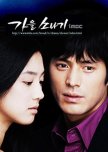
The two best friends, the aspiring architect Yeon Seo and the scientist researcher Gyoo Eun (respectively Jung Ryeo Won and Kim So Yeon, both very excellent and gorgeous), by a strange twist of fate, and, ignoring randomness, they find themselves meeting and dating, at the same time, the architect Yoon Jae (Oh Ji Ho, excellent) who, like in an Eric Rohmer movie, with playful complacency, unwittingly flirts with both of them, but ends up choosing the more passionate Gyoo Eun;Yeon Seo, despite her disappointment at the coincidence and relative ‘sentimental defeat’, accepts their union, in the name of the very strong friendship that binds her to Gyoo Eun, but a very tragic accident, during the honeymoon, will disrupt the lives of the three protagonists forever, bringing about dramatic and lacerating changes...
“TRY TO REMEMBER WHEN LIFE WAS SO TENDER WHEN DREAMS WERE KEPT BESIDE YOUR PILLOW.
TRY TO REMEMBER WHEN LIFE WAS SO TENDER WHEN LOVE WAS AN EMBER ABOUT TO BILLOW.”
As a product of a unique and, perhaps, unrepeatable season, ‘Autumn Shower’ is a beautiful and heartbreaking melodrama, marked by an underlying realism and a profound understanding of human frailty, capable of avoiding any easy moralism, circumventing the dangerous meshes of simple manichaeism, thanks to a remarkable script and an exemplary staging, capable of preserving such an equidistance that each (beautiful) main character in the story is confronted with his own weaknesses and his own reasons, in accordance with a deep understanding of human dynamics and, above all, of his own mistakes...
Ideally structured in two distinct segments (there is, of necessity, a ‘before’ and an ‘after’), with a first part of uncommon intensity, at times unbearable for the level of suffering represented -physical, of course, but also psychological - we are shown how a dramatic event - the incident and the coma - destroys the life not only of the victim, but also of the people most directly connected to her, with Yoon Jae, her husband anguished by guilt (he is directly responsible for everything that led to the incident), blamed by a livid Yeon Seo, but in fact ‘dumped’ even by his own family, who, in a moment of chilling selfishness, even proposes that he ‘abandon’ his wife (the marriage has not yet been officially registered) and immediately find for himself a new partner!
Love, duty, loneliness and repeated difficulties, even at work (total dedication to his wife, to the detriment of his own profession), on the shoulders of an all in all ordinary man, forced to face what is in any case considered a huge mistake and where the unpredictability of life can trigger a chain reaction, for which the moral condemnation is very little compared to the suffering already endured...
What may originally appear to be the ultimate act of unconditional love towards his bedridden wife, i.e. the subsequent registration of the marriage (‘Gyoo Eun, we are now officially husband and wife’), as well as the realisation of the dream house, will, on the contrary, represent a sort of ironic contrappasso in the development of the story...
And it is precisely in this desperate context, in this juggling of love, melancholy, discomfort and duty, between the despair of a possible extreme gesture and the promise made to his wife (‘I will wait for you, I will always be there for you’), that Yeon Seo slowly slips further and further into his life;
A tormented character on the verge of self-flagellation, Yeon Seo is initially torn by despair at her beloved friend's plight, but then by the inevitable torment at the betrayal perpetrated against her; the Australian interlude, an impossible ‘escape’ from feelings, even from those towards Soo Hyung, the doctor friend who has always been hopelessly in love with her, is only a postponement of the inevitable, all the more so because the deception is manifold, for in addition to the liaison, there is also betrayal of Soo Hyung himself, disillusioned by a naive and impossible acceptance of his love, and the consequent betrayal of the friendship between the two men, the doctor and the architect, who had for those two years formed a fraternal friendship.
“WE'RE TWO PEOPLE CAUGHT UP IN THE FLAME THAT HAS TO DIE OUT SOON”
At the moment when passion can no longer be repressed, where the selfishness derived from the awareness of feelings and the attainment of happiness predates, the clandestine couple flees from the world and their responsibilities (‘If we cannot go back in time, we must only follow our hearts’).
Escape as a necessity of life, as an impossible dream of a new existence, of a possible ‘familiar’ alternative in a fishermen's village, almost a ‘two hearts and a cabin’, as in the Italian expression, perfectly representative of the metaphorical separation from the outside world, sublimated by the renunciation of their telephones, and by their sincere and mutual confession recorded on an audiotape.
It is in this whirlwind of emotions that, ironically enough, the ‘miracle’ happens; the awakening from the coma is also an awakening of the senses in the two fugitives, who see their dreams of happiness shattered in the face of their new awareness; is a relocation of the story's pawns in the chessboard of life, the healing spell ‘condemns’ the players to their responsibilities, the husband must fulfil his duties and the lover flees again, going so far as to exclude herself from the general newfound happiness, avoiding the best friend who, unaware of everything, repeatedly seeks her out...
It is the moment when deception and guilt become unbearable, igniting the flame of suspicion in Gyoo Eun, initially unable to comprehend what everyone -except her- already knows, and which will be confirmed in the most direct and cruel way...
Yoon Jae is slowly squeezed between the two extremes, which plunge him into a vortex with no way out; he has no freedom to manoeuvre, only the fear of causing pain to one of the two women (wife or lover), the male protagonist, unintentionally cruel, forced by cowardice and insecurities to hurt the people he loves.
The female counterpart is split into two opposing and complementary characters (is she, on the whole, the image of the ideal woman!?), the lover, fragile and lonely, the wife who is determined to save her marriage, even at the sacrifice of friendship...
Adding salt to the wound is the unexpected pregnancy that carries much of the narrative scaffolding along the second half of the drama, decidedly unconventional in the way it relegates the male character to the background, leaving room for Yeon Seo's existential subjectivity, and the drama of the abortion, evidently sparked off by the stress arising from the confrontation-clash with Gyoo Eun, who is also, at this point, marked by feelings of guilt towards her (ex!?) friend who, once again, condemns herself to a wandering, a voluntary exile reminiscent of the existential path of a heroine from an old-fashioned melodrama...
“I'M LOSING MORE THAN I'LL EVER HAVE”
Does time heal all the wounds!?
After all this tourbillon of emotions, the question arises, because ‘Autumn Shower’, at least for my personal taste, is an all-encompassing experience, a sort of umpteenth interior road movie that leaves more doubts than certainties; a delicate study of feelings, a metaphor of maturation and - once again! - end of youthful dreams, well exemplified by Yeon Seo's touching letter;
Probably nothing seems destined to last, but the memory of past happiness is still alive in her heart and she will not accept to let it go. Who knows, with the course of time, maybe...
‘I loved them both, I am sorry because I loved them. And I am sorry because I could not be there for them.’
Magnified in its beauty by an absolutely brilliant cast, perfectly assembled in all the roles, with the two prima donnas playing a giant role in a splendid competition of bravura, with an excellent soundtrack that is so ‘out of time’ it manages to describe a world that perhaps no longer even exists, with those showers of rain that accompany the most touching moments of the story, 'Autumn Shower' seems to reflect, perfectly, that idea of the caducity of life, a sense of poignant melancholy (it is impossible to think of the story in another season!), the ideal passage from the season of joyful and unbridled vitality to that of calm and reflection...
Yet another significant piece that legitimises the multifaceted greatness of the Dramaverse.
8½ / 10
Was this review helpful to you?
This review may contain spoilers
Diamonds Are a Man's Best Friend...!?
At the time of the release of his ‘Underworld Beauty’ in 1958, Seijun Suzuki had already been, to all intents and purposes, a director employed by Nikkatsu for a couple of seasons (his debut dates back to 1956); this role, which we could define as a ‘ alimentary’ one, saw him engaged (or rather, obliged!?) in the production of at least three/four films a year (it seems to be a sort of Rainer Werner Fassbinder ante litteram...), given the enormous demand for movies of the period.In order to satisfy the tastes of the new film-addicted generation, Nikkatsu had embarked on a rich production of action/noir/gangster-style movies, inspired by American cinema, where often the stylistic/narrative themes of US-made genre films were adapted to the typical Japanese style and situations, so as to achieve a strong impact on the local audience (who got the message) with minimal expenses.
These were in fact low-budget works, perhaps of little artistic importance but perfectly functional at the box office and capable of bringing out a decidedly interesting generation of actors; To already established leading names such as Ishihara Yujiro and Akira Kobayashi, were soon to be added other performers such as the very ill-fated Keiichiro Akagi (who died at only 21 years of age, a sort of Japanese James Dean), Wada Koji and above all, Shishido Jo, who thanks to his connection with Suzuki himself succeeded in increasing his fame even outside the national borders.
In the midst of such a considerable amount of productions (in 1958 alone, Motion Picture Association of Japan, Inc. refers to 504 domestic productions and 169 imported films!), it was rather complex even for film critics to follow all the productions in circulation, all the more so as these genre films were often hastily classified as ‘B’ productions; but it was clear that in the midst of perhaps repetitive or easily forgettable films, it was plausible to find the classic ‘hidden gem’.
It is therefore interesting to observe how, in the context of a narrative structure that is still rather linear, at least at the outset, decidedly indebted to gangster movies made in the U.S.A. (Suzuki, by his own admission, has always been a lover of ‘Hard Boiled’ novels), ‘Underworld Beauty’ is characterised as a product of a high level, capable of also providing ‘in nuce’ several characteristic elements of our master's inimitable style:
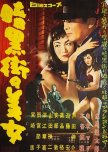
Released from jail after three years following a robbery, the gangster Miyamoto recoups the diamonds from the crime, conveniently hidden, with the aim of reselling them to help his comrade Mihara, who was badly injured on that occasion, and his sister Akiko, a young woman with no prospects; his boss Oyane arranges an exchange with buyers, but the deal is scuppered when mysterious masked armed bandits appear; Mihara, in an extreme gesture of desperation, swallows the diamonds, but then falls from the roof of the building, dying of his injuries. From that moment on, a war breaks out between Miyamoto and his former accomplices to recover the precious stones, with the ex-con also working to protect the young and restless Akiko...
The starting premise is decidedly interesting and from the very beginning, the style appears clear, immediate, without frills or wasted time; Miyamoto -played by the mature and impassive Michitaro Mizushima- is a sort of lone wolf (exemplary synthesis of Chris D. in his fundamental ‘Outlaw Masters Of Japanese Film’) who, after having paid his debt to justice, feels obliged to ‘compensate’ his friend Mihara, who has suffered the highest price for the heist; from the very first lines, the ex-con appears to us as a sort of ‘modern Ronin’, alone against everyone, with few words and a lot of concreteness, an attitude that immediately leads him to set himself against his ex-criminal companions (and obviously the boss) who just don't want to give up the precious booty.
Curiously enough, in this ‘Underworld’ of criminals (real or could-be) where greed and lust for wealth, mixed with explicit primordial pulsions, seem to be the only values sought after, it is Miyamoto who comes out best of all, guided by an unshakeable ethic, nourished also by a double sense of guilt (first the incident and then the death of his friend) that leads him to risk himself in order to save Akiko (Mari Shiraki, perfect and always abundantly undressed), who, for her part, does not really represent the model of the ideal woman, but rather, with her youthful arrogance, sexual frenzy and unregulated life (she bullies and takes advantage of schoolgirls), she seems like a character straight out of the novels (and movies) of the Taiyozoku universe (‘Sun Tribe’), coming to characterise a sort of prototype of the more classic ‘Dark Lady’
If for Eric Von Stroheim money is always at the origin of all evil, here it is diamonds (3, in number... ) that unleash the most belligerent instincts of the characters who, in order not to renounce their earnings, are ready to do anything to recover the precious stones, triggering a series of situations that allow the skilful Suzuki to show his already characteristic technical skill, as well as his ability to synthesise (editing cuts, close-ups, sudden changes of camera angle), mixed with a good dose of his classic black humour that will distinguish him throughout his career; Emblematic from this point of view is the entire sequence with the mannequins as key figures, of great effectiveness and even amused mockery.
As far as the purely stylistic aspect is concerned, Suzuki works for the first time in widescreen, using a remarkable B/W that tends to emphasise the grey scales, with a result that is, to say the least, ‘brilliant’ (it is really appropriate to say so...) that amplifies, especially in the night sets (the majority), in an excellent play of light and shadows with an expressionistic cut, the ‘hard boiled’ dimension of the story; All this with a skilful and unconventional use of locations, including nightclubs, bars, rock ‘n’ roll, artists' studios and morgue rooms, as well as the boss's Turkish bath where the “incandescent” finale is set (in every sense of the word...), filmed with the master's decidedly distinctive trait, with clearly unconventional doses of sadism, explosions of violence and masterful shots even using a crane...
In his mature interviews, Suzuki will even refer to ‘Youth Of The Beast’ (1963) as the first film that can be considered entirely of his own from the point of view of narrative and directorial originality, but it is clear that already from this ‘Underworld Beauty’ (but in some points even from ‘8 Hours of Terror’ [1957]) the director began to set up that operation of ‘inner demolition’ of the genre which was to become his distinctive trademark, but which was to lead him, in 1967, to be sacked from the same film company for irremediable ‘artistic differences’ following his most famous picture, ‘Branded To Kill’.
9/10
Was this review helpful to you?
This review may contain spoilers
O Foolish Heart
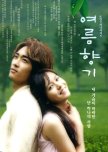
‘Summer Scent’ is the story of Min Woo, a man, an architect who has lost his love, Eun Hye, who died in tragic circumstances on their wedding day; he is completely devastated and decides to give up everything and move to Italy, to try to forget, to try to get by.After three years, however, he decides to return, after all he is an architect and has a family in Korea, maybe through work he has overcome the trauma, maybe he has forgotten Eun Hye;
‘Did you meet any girls?’ his best friend and co-worker Dae Poong asks him, ‘No, no girls’ he replies, ‘I tried to stay alive’ or something like that, says Min Woo, who seems yet another desperate case of tele-filmic misogyny.
He's bound to be your first love and that's it, there's no other possibility of new love....
But since all this stress has to be relieved somehow, Min Woo decides to go to the mountains, to one of those beautiful peaks surrounding Seoul, and at the top of the mount he meets Hae-won, a beautiful florist who is there to document rare plants and species;
Hae-won is not only a florist, but also a girl who has also been ‘reborn’ because she has undergone a life-saving operation, a heart transplant that now allows her to live a ‘normal’ life; she has found love, at least she thinks so, with Park Jun Jae, who has been her rich boyfriend since her school days, she is full of vitality, she wants to make up for everything she lost in her youth, in hospital rooms and deprivation, only the moment she meets Min Woo, her heart begins to stir and send her messages... And what could it be! ?
Due to a minor injury suffered by Hae-won, the two are forced to spend the night together in a small cabin in the mountains, not in the biblical sense eh, it's still a drama, but as two travellers who will say goodbye to each other the next day; only in this short time Min woo detects a variety of particularities of Hae-won that remind him of his deceased beloved...
‘Sometimes I feel like there are two people living inside me,’ thinks Hae won often, who of course still doesn't know it, Min woo doesn't either, but the heart beating in his chest is that of Eun Hye, Min Woo's deceased love; sounds familiar!?
Of course it is, in a nutshell it's the premise behind Return To Me, the lovely movie starring Minnie Driver and Dave Duchovny, so there's a good basis for a nice love story, but of course this is a drama and here things get terribly complicated, because on the horizon there's also the intrusive Jung Ah, who loves Min Woo without being corresponded, she too has returned from Italy to follow her (desperate) love;
‘She's like a little sister to me,’ says Min Woo, and this is the final nail in the coffin for any chance of a relationship between the two in the Dramaverse; but Jung Ah also happens to be Hae-won's best friend and sister-in-law by extension, being also Jun Jae's sister...
What a mess! But it's a pretty good mess, indeed...And we're only at the beginning!
Greetings and goodbyes and everyone goes back to their homes, end of drama, right?
But of course not, because Park Jun Jae and his family have to restructure a resort and this will take them the whole summer; architects are needed for the restyling and guess who, out of 11 million Koreans living in Seoul, a city agglomeration of 25 million (practically half of Italy) and who knows how many thousands of professionals who will win the project?
Obviously Min Woo and his partner/friend Dae Poong who will find themselves working throughout the season with Jun Jae, Jung Ah, Hae-won and even Jang-mi, Hae-won's Unnie, a sort of bizarre ‘stalker’ who collects photos of good-looking men...
Min woo and Hae-won, after the initial surprise and embarrassment, become closer and closer...
Over the years, I have resumed watching ‘Summer Scent’ several times and with different moods, even having been busy to translate the subtitles, but to this day, this drama of the Seasons cycle is the one that gives me the most headache;
towards the last episodes of the drama, there is a scene during which Hae-won and Min woo get together and confront each other, bringing into focus what I think is the moral dilemma of the drama:
Hae-won states that her love is destined to remain hopeless, because she believes that Min woo continues to love the late Un-Hae, who is alive in her trasplanted heart...
‘Summer Scent’ is then the story of a man who continues to love his dead girlfriend through another woman who is a kind of empty shell, a ‘wrapper’ or ‘container’!?
From the very first encounter in the mountains (the sequence at the airport is only an introductory frame and indicative of the subsequent dynamics), one undoubtedly has the feeling that the authors want to ‘trick’ us into confronting the dilemma of ‘who’ or ‘what’ acts as the fulcrum of the attraction between the two younger.
Is it Un-Hae's heart that ‘plays’ with feelings through the calla flowers, Schubert's ‘Serenade’, the flower petals in the tea, the references to rain in the clear sky, the house with the glass roof, introducing a pure fantasy subtext, so as to increase the spectrum of eventualities!?
It is Min woo who, desperately, projects the image of his deceased beloved onto Hae-won, even going to the extreme of recreating with objects and soundtrack an eerie ‘ideal scenario’ in the proposal room at a dramatic moment in the story!?
Or perhaps, much more conventionally, ‘It's destiny... If love is predestined your heart will beat fast even at the slightest touch’, as the more mature Jang-mi argues in an exchange of views with her florist friend...
Perhaps the beauty of this drama lies specifically in its unresolved narrative linearity, in a sort of enveloping haze - as in the sequence, beautiful! at dawn, near the house of Min woo's mother, a sequence that generates one of the many ‘misunderstandings’ that will later provide the definitive ‘proof’ of ‘guilt’ - a haze that does not allow us to clarify all the sentimental implications of the two main characters, but personally, much more prosaically, I like to think of a circle -the classic circle of destiny, yes- that opens with that beautiful initial consideration of Eun Ha and, ideally, closes exactly on the very final sequence:
‘...If my heart still beats when I am older, I want to meet the love of my life on a rainy day...’
‘Summer Scent’ has various flaws, but also many virtues that make it really attractive still after all these years, starting with the easiness of small gestures and the essentiality in the pursuit of building memories by two sincere souls who, inevitably, find themselves alone against the world.
The encounter in the mountains, the beautiful hills with the endless tea fields, the proposal room, the football pitch with the scene of the silent dance, the flowers, Schubert and his ‘Serenade’ also in the beautiful version by Nana Mouskouri (it must be said that Schubert did not exactly lead a blameless life...), the ‘forced’ stop on the island, all those extraordinary little things that make life worth living, those objects, sort of love fetishes that take on a central role in their lives, as well as that ‘slow’ rhythm, apparently not much appreciated by many viewers, but essential for contemplating and getting in tune with the central role of nature that, once again, underlines the work's magical lyricism.
And then all those big walks; throughout the summer, Min Woo and Hae-won do nothing but go, alternately, to Un-hae's poor parents who have gone to bury their despair in the middle of the woods, to grow all kinds of tea and to get there, or to Un-hae's grave they are forced to constantly grind miles; how can one not love these two pure souls and their yearning in the midst of those landscapes! Does such dedication not deserve due repayment?
It is yet another classic premise - two people whose existences are conditioned, who are not allowed to live their love - based on a possibly implausible event, (but aren't all melodramas ‘extraordinarily implausible’!?) which nonetheless leads us to ask; ‘Who governs the feelings! The heart or reason!?’
Perhaps not the best of the four segments, for it certainly isn't, it pays a little for the lack of an introduction, the powerful and well-articulated preamble, which, at least for my personal taste, usually takes up a couple of episodes and serves as an ideal building block for pathos. But these are small details, and ‘Summer Scent’ has a great cast:
Son Ye Jin, so beautiful and moving both in her enthralling joie de vivre and in the heartbreak following the unveiling of the truth, with the relative and inevitable sense of guilt towards ‘her’ family, with a split personality (‘You know, after the surgery, my personality has changed’ she tends to repeat) that makes her doubt even herself ('Is it me or is it Un-hae who rules me! ?"), she has all these intense close-ups that as soon as her eyes begin to moisten you're already starting to cry, not because it's a drama and therefore plays the easy pathetic card, but because every time she puts her hand on her chest you're afraid it's going to break -yet- her sweet heart, absolutely stunning!
Ye Jin finds a perfect partner in Song Seung-heon who, possibly because of the summer look with tan and rebel hair, looks even younger than in Autumn In My Heart; he too is messed up badly (the subject matter, in itself, provides for this) and unable to give Hae-won the sincere reasons for his love, evidently tormented by doubt, for much of the drama, about the sincerity of his own feelings (‘At first I was attracted to you because you looked like Un-hae’) he really is a soul in pain.
I mean, Min Woo, do you love Hae won!? Or his simulacrum!?
I absolutely adore the scenes and dialogues between the two main characters; we move from an initial phase, where Min woo has an attitude of almost controlled superiority towards Hae-won, where the first skirmishes are mostly dictated by frivolous situations, to a sort of role reversal, as the story proceeds and the truth comes out, with the beautiful florist reaching a greater awareness and determination, compared to a Min woo sinking into the darkest depression, definitely worn out by his inner turmoil.
Remarkable Han Ji-hye, in a crabby and obnoxious character, that of Jung-ah, the hopeless lover, able to make herself even ‘ hateful’ in her behaviour towards her almost sister-in-law friend, but also capable of pissing off Min-woo several times with her petty tricks to try to win him over; As I often like to say, when an actor (woman, man is indifferent) makes me angry about his or her role, it means that he or she has done his or her job very well.
Ryu Jin's work as Jung Jae is also well articulated, I would say unpleasant as well, for much of the drama, with his arrogant feudal-like sense of possession and his unbelievable coercions towards Hae-won, at a distance he brings out unexpected aspects of his own personality.
Jo Eun Sook (Jang-mi) and Jung Hoon Ahn (Dae-poong) are likeable and skilfully functional in the plot, but special mention must be made of the always superb Kim Hae-suk and, especially, Ha Jae Yeong as the missed in-laws, absolutely perfect in their respective parental afflictions...
Truly outstanding is the soundtrack not only as an ideal accompaniment for the story but, as in the case of the aforementioned Schubert ‘Serenade’, functional to the development of the plot itself.
‘Summer Scent’ is a roller coaster of emotions that has undoubtedly aged as well as good wine, I was pleasantly surprised to see it again and I think it can be considered an evergreen, decidedly more articulated and complex than one might expect, perhaps initially tricky due to the themes and dilemmas addressed, in addition to that ‘placid slowness’ mentioned above -which for me is a great virtue- and a cast of excellent level at the service of a very fascinating story...
Essential - like all segments of the ‘Endless Love’ cycle - for understanding and loving the Korean Wave phenomenon, ‘Summer Scent’ is a classic genre drama to watch, (re)watch and be loved.
8/10
Was this review helpful to you?
This review may contain spoilers
Gift For The End
In the somehow archetypal structure, we can recognise one of the greatest qualities of ‘Forever Yours’, a 1998 drama that is still able to captivate even after many years, thanks to a well-defined narrative construction, as articulate in its form as it is fluid and linear in its execution, well supported by an excellent cast at the service of the story, full of (future) stars...The drama's development has continuous references to other famous productions that will arrive in subsequent years and is a real feast for all lovers of vintage television of the Asian country
We have the female character, Suh Hee (Kim Hee Sun) who is an orphan; she has been abandoned by her mother who, in one of the saddest scenes of the drama, disposes of her daughter, with the false promise to return soon to take her back; the headmistress of the orphanage who takes care of Suh Hee has a son, Sae Joon (Ryu Shi Won), with the highly promising talent of a future Doctor; Sae Joon and Suh Hee love each other, tenderly and innocently, as they do for many youngsters of their age, but Sae Joon's mother is a real witch who stands in the way of their love, because she wants her son to marry a girl from a middle-class family background...
It is a classic plot theme, one of the cardinal principles of movie and television melodrama; the absolute love that must overcome all boundaries and prohibitions, but it doesn’t end there:
Sae Joon has a friend (or supposed to be), the wealthy and vicious Min Hyuk (Kim Ho Jin) who, of course, falls head over heels for Suh Hee, falling madly in love with her (not hard to believe, given Kim Hee Sun's extraordinary handsomeness); Suh Hee is wracked with guilt, she is the indirect cause of an injury that compromises Sae Joon's life and future, she wishes for a better future for herself, she struggles with various jobs to scrape together enough money to live and, although she loves Sae Joon, ends up succumbing to Min Hyuk's advances, in a toxic relationship where the spoilt rich man's not only physical violence gets the better of the fragile character of the unfortunate orphan:
The result is the most classic of triangles with a continuous back-and-forth between the heroine and the two suitors, but it doesn't end there:
Suh Hee is pregnant by Min Hyuk; we've previously witnessed a horrible scene of violence and it's easy to see that this is the cause of conception, so what to do!? Have an abortion, or keep the baby in the hope that Min Hyuk will decide to marry her, perhaps finally growing up and taking responsibility!?
In the meantime Sae Joon tries to get on with her life, but he can't forget his first love; it's an incredible back-and-forth, with Suh Hee partly with one, partly with the other and partly running away, seeking comfort from her friends at the orphanage,
but it doesn't end there, because there's a further twist, absolutely tragic...
It is a drama that treads hard on the emotional foot pedal, all great dramas overflow with emotion, it is inevitable; they tell of human emotions, especially those that accompany difficult choices that require great courage, and love experienced in extreme circumstances or love thwarted. And the characters, of which there are many, even in the minor parts, accompanying the main story, find themselves lost, full of hope, but also locked in their own feelings, unable to manifest them;
As in the case of the friends from the orphanage, who are often unable even to find the right words to express their emotions;
In all the portrayals, the desire for a little happiness prevails, even if only for a few moments, because, as we have learned from so many other dramas, behind the brief moment of calm and happiness, unfortunately, the harshness of life immediately reappears, even ironically, by antinomy, and takes a toll...
Kim Hee Sun plays a character with a submissive nature, decidedly passive in submitting to the dictates of adults; Sae Joon's harpy mother is also a kind of surrogate mother for Suh Hee and in fact sees the two youngsters as ‘’siblings‘’, a further reason for opposing their love. The orphan is often level-headed in front of her and other respected adults (in terms of social status, etc.), responds in a low voice, unable to look them in the eye, weighed down by an atavistic sense of guilt that paralyses her even in her feelings and conditions her personal choices...
The Eun Suh of ‘Autumn In My Heart’ takes its cue from here, after all.…
The Hye Won of ‘Summer Scent’ also has several points of contact, as does the Soo Jung of ‘What Happened In Bali’.
Ryu Shi Won in the role of Sae Joon is probably the best defined character, because he is resolute, obstinate; the audience often needs to find itself, to identify with a figure, with a role, and in fact Sae Joon is this; We can describe him as the true protagonist, the hero of the story, decisive and direct; His love for Suh Hee is his North Star, even at the cost of going against his own family or his bright future; almost a work of abstraction from Shi Won who limits the dialogues to the essential, concentrating on gestures and expressions, with a personal style that he will replicate a couple of years later in the excellent ‘Secret’ with Kim Ha Neul and Ha Ji Won...
The Cha Song Joo of ‘Stairway To Heaven’ owes so much to the Sae Joon of ‘Forever Yours’...
Kim Ho Jin in character as Mun Hyuk is another good one; He is decidedly obnoxious and arrogant from the very first scenes, he arrives with an absurd tuft of hair, in the style of Brian Gregory from the Cramps, or Japanese anime of the 70s and 80s, which is perhaps the same thing, he plays the tough guy, but in the end his harshness derives mainly from his conflictual relationship with his father who considers him - not so wrongly - a perfect slacker; he too, unable to express his feelings in words, ends up translating them into bodily action with the absurd pretence that violence -goodness to him!- is nothing more than a different kind of love; He attempts a belated road to redemption but is too self-destructive a character and of spoilt rich dandies with self-destructive impulses the streets of the Dramaverse are paved...
Accompanying the main cast is Kim Sun Ah, young and already very pretty in the role of Ji Young, a female student of good social standing, suffering from a stutter, at the centre of a ‘secondary’ triangle that introduces rather interesting points of reflection on class differences, and also Kang Sung Yun, also a pleasant presence in the ensemble, in the unhappy role of the hopeless lover...
The lovely music theme, a kind of nostalgic, cadenced waltz, performed in various arrangements, is one of those tunes that immediately gets into your head and stays there; of course, it isn't Leonard Cohen, but it has that dose of unabashed old-fashioned romanticalism that adds just the right pathos to the story...
But then, is this drama good!? It's good yes, it's not perfect of course, here and there there are some slightly tired and repetitive parts, something in the characterisations also gets lost along the way, every now and then we even forget Sae Joon's invalidating condition, but fortunately in the last episodes the central theme comes back and the drama regains depth, putting the focus of the story back on the original love of the main characters, and closing well, with that very nice ending that can't leave anyone unmoved...
It does not have that aura of classics such as ‘Autumn In My Heart’, or ‘Stairway To Heaven’, ‘The Snow Queen’ and comparable masterpieces, but it has the great credit of having helped to mark out a way, to define some guidelines for undoubtedly more successful and celebrated series (and movies) and definitely deserves more favourable appreciation.
7½
P.S. I preferred to follow the title variant ‘Forever Yours’, in my humble opinion more pertinent than the perhaps too magniloquent ‘To The End Of The World’ used as the main title here on MDL
Was this review helpful to you?
This review may contain spoilers
Journey Through the Past (Lives)
Next can be considered a successful experiment in unconventional or ‘alternative’ scriptwriting in the endless world of Korean series, in that the usual narrative construction of dramas here finds happy intuitions capable of relaunching the unfolding of the events in an engaging and exciting manner, thanks to a skilful expedient that finds in the inclusion of elements of psychoanalysis, suggestive keys to readings linked to the profound and fascinating theme of reincarnation.Starting from a rather common plot, the fortuitous encounter between the eminent young surgeon Ki Beom (Ryu Soo Young) and the beautiful theatre actress Jung Hwa (Jang Shin Young), the immediate love at first sight that ensues triggers a whirlwind of events with a snowball effect that also involves the two's respective partners, psychologist Soo Hyun (Park Ye Jin), who has been engaged to Ki Beom since school, and Ki Soo (Lee Jong Soo), a fellow actor unluckily in love with Jung Hwa but - watch out! also younger brother of Ki Beom himself
Jung Hwa's frail state of health, prostrated by a debilitating condition that effectively prevents her from sleeping, leads the actress to the office of Dr. Lee Soo Hyun, a psychologist who, unaware that Jung Hwa and her partner Ki Beom have in the meantime fallen in love, takes the patient to heart and, through repeated hypnosis sessions, manages to bring out what appears to all intents and purposes to be a case of reincarnation from past life experiences...
Almost as in certain Hollywood movies of the 1940s, or as in the coeval productions of the British company Gainsborough, where the main characters find themselves ‘’trapped‘’ between dream and reality, past and present, through the very fascinating element of psychoanalysis and hypnosis, the spectator finds himself catapulted into the previous lives of the four protagonists, thanks to another successful writing device, i.e. the inclusion of a story within a story, a movie within a movie, practically whole episodes, that will reveal the destinies of the characters' previous lives, through the different centuries and in the most varied sentimental concatenations.
A journey through the past, into different historical epochs such as the Mongolian invasion, the Joseon dynasty, the 20th century Japanese occupation, etc., where the ineluctability of fate will put the lives and loves of the characters to the test; The viewer is also left with the pleasure of choosing which moment in history has the most fascinating plot. Personally, the 13th-century segment with the ferocious Mongolian invasion (and a truly stunning Park Ye Jin!) and the 1900s under Japanese occupation, which is really beautiful thanks to the touching performance of the excellent Jang Shin Young, are among my favourites, while the last one, although it has a good initial idea, is a little more mechanical in its development.
Jung Hwa's inner voyage also involves the psychologist Soo Hyun who, inevitably overwhelmed by events, faces a process of self-discovery, resulting in an exploration of the unconscious, as if we were in an Ingmar Bergman or Robert Altman movie, which can bring about inevitable consequences...
The drama is also rich in recurring elements and symbolism (in addition to a particular figure that appears at certain times in front of the characters) such as the small mirror, representative of various metaphors and allegories, but also the principal instrument of female beauty and vanity, and the ancient knife, a death-bringing item that, on several occasions, becomes a ‘tool’ capable of triggering or determining the events of the stories themselves...
It has to be said that the quartet of performers is decidedly on form and offers truly remarkable characterisations; the two leading actresses manage to provide a great acting performance, truly multifaceted, capable of alternating moods and states of mind depending on the moments and perfectly in line with the development of the story; Park Ye Jin and Jang Shin Young are decidedly excellent both in the ‘contemporary’ roles and in the ‘historical’ segments.
On the other hand, Ryu Soo Young is particularly able to make the character of the surgeon Ki Beom complex, decidedly tormented by doubts, remorse, guilt, and so on, while Lee Jong Soo is very skilled in giving a nervous, even uncomfortable interpretation of the actor Ki Soo, with a strongly impulsive character and also decidedly tormented by his brother's relationship...
The brilliant ending, which, I imagine, must have displeased many, definitely breaks with the classic drama trend, but is in my opinion the only really possible one in terms of coherence and narrative logic.
The music is beautiful, providing just the right emotional soundtrack to a truly engaging and well executed story. In my opinion, this is an ‘8’ drama, which stands the test of time (obviously if you ignore the dresses, the phones and Ryu Soo Young's peculiar Tom Cruise haircut) and deserves its place on the roster of dramas to be rediscovered...
Was this review helpful to you?
This review may contain spoilers
Among My Swan
A much-anticipated action drama, not least because of its outstanding cast, ‘Red Swan’ unfortunately ends up betraying expectations, turning out to be a mid-level, almost routine release that fails to innovate the genre, slipping into an accumulation of entirely predictable narrative clichés.Apart from the good start, a solid first episode that, as is often the case, plays its best cards with a skilful use of various locations, the development of the drama wearily deals with narrative stylistic features that have been abundantly exploited in every makjang represented previously;
The most classic of the rich families, the usual viper's nest where everyone is ready to eliminate each other, slaves also to their own vices and unmentionable secrets, with a despotic and unbearable matriarch (a Seo Yi Sook decidedly over the top), an all too ‘efficient’ official in the administration of the family companies (a calibrated Yoon Je Moon, one of the best things in the drama) and the usual round of more or less legitimate children, concubines, lovers, etc.. all in the shadow of the patriarch, who obviously died in ‘mysterious’ circumstances and around whom the whole affair revolves, considering also the obvious inheritance that triggers the most unthinkable actions...
Obviously, a victim of circumstances, we find the main character O Wan Su (Kim Ha Neul), a former professional golf player, now Chairwoman of a charity created to help the most needy in the world, married -it is easy to imagine with what degree of happiness- to the eldest son of the rich family; Of incredible sadism is the choice of the writers, who force poor O Wan Su to face and accumulate over the course of the 10 episodes a catastrophic series of calamities so unbelievable and ridiculously absurd, with the beautiful Ha Neul who, untamed and imperturbably covered in blood (literally! ) advances through the accumulation of misfortunes with a temper of steel, backed by the policeman/bodyguard Seo Do Yun, played by a functional Rain, also an all-out hero -never a smile, at least until the final moments- determined to vindicate his friend colleague, killed while investigating the death of the aforementioned patriarch...
So, intrigue, espionage, crimes, double-crosses, betrayals (real or presumed) and all the typical repertoire of the genre that never gets going, never reaches the climax, proceeding along a banally predictable path, where all the elements end up converging on solutions already known; sin and guilt, expiation, justice, love, etc.. In the end, everything finds its usual repositioning in a kind of reparatory justicialism that leaves a bitter taste in the mouth, with a reflection on the true intention of the plot;
I don't know if it is due to Disney's production, it must be said that there is anyway a lot of violence that clashes sensitively with the image of the film company, but I had the feeling that the authors chose to play on a safe path, widely experimented in similar previous series, without any courageous or innovative choices, perhaps to please international producers, maybe to facilitate their export, but ending up offering an average product, quite forgettable, where even the supposed ‘chemistry’ between the two main characters struggles to come out, but at least Rain has the chance to show off some physicality with a few rather well choreographed action scenes, while Kim Ha Neul limits herself to a performance of ordinary administration; rather modest and often pedantic musical choices (there's even the requiem!) and an ending, after the inevitable temporal ellipsis (‘a year later’) of staggering ordinariness.
To be honest, not more than 6.5 overall, because it still makes itself watchable and does not drag on for long, for a drama on which I was betting so much and which in the end, in my eyes, turned out to be extremely disappointing
Unless I have missed something, even metaphorical, as was also the case with the titles of Italian thrillers of the 1970s that often mentioned various animals, there is no trace of red swans...
6,5
Was this review helpful to you?
This review may contain spoilers
Love Is All Around
I approached this show without any particular thought and with a bit of curiosity, I am not particularly familiar with everything related to reality shows, talent, cooking shows and the suchlike (I am not interested in them and have never watched any of them), but I was especially curious about Sung Yu-ri who I adore to madness and who I missed a bit, I wanted to see her in fresh productions and since she seems to be less interested in movies and dramas at the moment I agreed to follow her in this variety show...I must say it was a pleasant surprise with an idea that may not have been very original, but was certainly well developed, thanks to a remarkable cast that provided the right brio to the show; since there is no need to repeat the plot of the TV program (it is so linear that there is no need), I would like to make a few observations on the development of the variety.
First of all, I appreciated the changes made during the show, which improved the quality of the stories told and also the television timing; In the early days, the programme seemed a bit static, with the entire cast sitting on their sofas discussing relationships, break-ups, new loves, etc. (the references to their husbands, wives, etc. were also hilarious), but fortunately, over the course of the episodes, a more dynamic approach was adopted, which allowed the variety show to be even more engaging;
Both the use of the car, with the hosts taking turns as taxi drivers-narrators of the events, and the adoption of the 'drama-style' television format with the fictional events (often funny! ) created a greater engagement with the romantic stories told...
Clearly, it often happens that I identify with the stories of the couples narrated; beyond generational divergences, it is interesting to note the similarities and discrepancies in the birth of love stories and the causes of their break-ups;
I have often found myself a little baffled by certain motivations deriving from economic/work problems or even linked to alcohol consumption, but as I was taught by people wiser than me, one should never judge another culture with terms of comparison, in my case 'western'.
Ethnocentrism and widespread ignorance are so exasperated in the west that they often cause cultural blocks and prejudices towards the countries furthest away from us (I write as an Italian in love with the cultures of Asian countries... ); I have read enough about Korea to understand the social dynamics behind certain customs, especially in the world of work (and undoubtedly the movies and TV productions of dramas also contribute to a good extent), so I have been able to limit the background prejudices that occasionally linger in my mind.
As for the changes in the course, I appreciated less the use of the concluding video-call to see if the couple could have a second chance; I found much more romantic the opening of the door of the first episodes, with the appearance or not of the loved one, but they are still details that don't affect the quality of the show; for me it absolutely deserves 8½, it would be nice if it would be revived someday, there's always a need for love and hope, we live in really awful moments and programs like "Love Recall" are really a nice way to talk about love and maybe try to overcome the difficulties and start again.
Well done everyone, with a special mention for Jang Young Ran, really funny!
8½
Was this review helpful to you?
This review may contain spoilers
Essential Masterpiece
In 1960, at the time of the release of 'Cruel Story of Youth', Japan was in the midst of a series of protests against the renewal of the Japan-America treaty (Anpo) and the related growing student movement; Oshima, like many of his contemporary colleagues, not even 30 years old at the time, was a keen observer of the ongoing changes, perceived this new feeling of revolt that would even lead to a split in the Japanese Communist Party towards even more radical ideas, and succeeded in making two other features that were strongly integrated in that historical moment.The picture is produced by the major Shochiku, a legendary company founded in the 1920s, which enforces the use of CinemaScope and colour, not particularly favoured by the new generation of filmmakers; The film studio is perhaps convinced that it can exploit the late 1950s phenomenon of the so-called "Taiyozoku Eiga" (Sun Tribes), movies based on Ishihara Shintaro's novels about the angry and dissolute youth of that period, but "Cruel Love Story" ends up by upsetting the cards, literally overturning the Japanese film table and pushing the pedal even deeper, highlighting the general traits of what will be defined in a simplistic way, Nūberu Bāgu, in response to the French ‘Nouvelle Vague’ film scene revolution , definition is certainly not appreciated by Oshima since, like other filmmakers of the time such as, for instance, Masahiro Shinoda or Yoshishige Yoshida, he feels more artistic (and political) affinities with the Polish cinema of Andrzej Wajda, in especially his 'Popiól i diament' (Ashes and Diamonds).
The plot is well known: Shinjo Makoto, a young under-age female student, and Fujii Kiyoshi, an idle aspiring gangster who met in the middle of a tragic situation, fall in love and decide to set up a racket where she picks up unsuspecting drivers who offer to accompany her (with obvious ulterior intentions) while he, on a motorbike, breaks into the scene at the right moment, threatening them with prosecution and beating them up, with the aim of extorting money from them... Of course, the consequences will have a price to pay...
The picture was a huge success with audiences and was critically read as the Oriental response to “À bout de souffle”, the first masterpiece by French director Jean-Luc Godard, starring Jean Paul Belmondo and the stunning (and very unfortunate) Jean Seberg; Behind the undoubtedly obvious analogies, starting with the style, the cinematic approach, the use of the hand-held camera (however with stylistic variations and more 'natural' movements than Godard or even the Brazilian master Glauber Rocha, who was also shortly to become the forerunner of the 'Cinema Novo' movement) and the display of close-ups, there is however a whole series of aspects that make Oshima's movie memorable:
"Cruel Story Of Youth" is characterised by a whole series of stylistic innovations and breaking elements, contravening the rules established by the masters, 'fathers' of Japanese cinematography such as Ozu, Mizoguchi etc. Pervaded by an existential pessimism that spares no one, Oshima portrays a generation, that of the twenty-somethings, of outcasts, completely lost in an absolute nihilism, in rebellion against any moral, social or political convention, devoid of dreams or ideals and with a self- destructive, absolute anarchic inclination to crime. Practically 'rebels without a cause', and without the extraordinarily melodramatic romance of Nicolas Ray's masterpiece with James Dean and Natalie Wood.
A revamping of conceptions capable of shifting the focus from the 'classic' representation of the family - think of Ozu and its role within the modernist changes in Japanese society, or Naruse for his work on ordinary people and the condition of women in the Land of the Rising Sun - towards a representation of identity and individualistic logics, linked to the new post-war and unconventional generations.
"Adults Don't Understand Me" ('Otona Wa Wakatte Kurenai') is the translation of the Japanese title of Truffaut's "Les Quatre Cents Coups" and behind this simplification one can summarise the confrontation-generational clash with the movie's adults, well represented by Makoto's older sister and her ex-lover, the doctor Akimoto, in a dramatically representative moment, in which all the disillusionment of the two mature ex-lovers emerges, aware of a generational failure that has wiped out all their youthful dreams (it almost brings to mind Ozu's movie of 1932), which is counterbalanced by Kiyoshi's spiteful observation that he has no dreams whatsoever and therefore does not risk ending up like them...
But there is also the deep frustration of Makoto's older sister Yuki, who admits to envying their freedom, even sexual freedom (explicit, in the truly adult dialogues that stand out from the start), along with the authorial inability of their father, practically reduced to a caricature incapable of any adult decision and, figuratively speaking, placed on the fringes of the conversations (and the frames).
Alone and aware that they are condemned to a sad, sordid existence, estranged from the strict rules of Japanese society, the two young lovers wander aimlessly, in the beautiful Michelangelo Antonioni-style pre-finale, 'lost' in their city, on their way to their inevitable fate....
It is easy to imagine the cultural shock the picture may have caused in 1960 in a country deeply lacerated by student revolts, by the wounds of World War II, in its attempt to raise its head again, opening up to the world in an attempt to show its best side;
Oshima, an exceptionally sharp master, manages to remove that gloss of respectability, almost of whitewashed sepulchres, taking what, in the hands of another filmmaker, could have been a noir or a conventional yakuza movie and providing the representation of a cynical world, without pity and hope that, in countless thematic variations, will pave the way for a truly rich cinematic decade for Japan. As far as I am concerned, it is one of the first Japanese cinema auteur movies that I have been able to appreciate since my youth, it was often televised at night, paired with Seijun Suzuki's 'Gate of Flesh' (another seminal director for me); the DVD version (on which I based the review) displays superior attention to subtitles, making more explicit the depth and rawness of the dialogues that were decidedly adult for the time.
Essential masterpiece
Was this review helpful to you?


