

 10
10 42
42 15
15


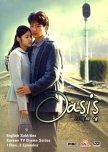
Close to the protagonists - format may be 'old', but script is round, coherent and flawless
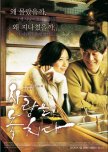
I stumbled across "Oasis (2003)" or "Desert Spring" in the context of "Oasis" from 2023. I was curious if there were any parallels (besides the title). There are. Whether they are random or not, I don't know though. The 1940s/50s (in "Desert Spring"), like the 1980s/90s (in "Oasis"), are neuralgic phases of liberation from oppression in recent Korean history. HERE the last years of the Japanese colonial era and the Korean struggle for independence as well as the time under the occupying powers (e.g. USA) form the framework of the story, THERE the time of the dictatorship in the face of an increasing democracy movement. HERE it is radio, music and broadcasting, THERE film and cinema, that open up space for hope, visions, resistance and dreams. Here as there is a rival (who is HERE written more three dimensional than THERE) who refuses to see that the heart of his beloved already belongs to someone else. In both cases, the rival is on the side of power. In both cases the male protagonist is a talented but penniless young man who is in danger of getting underneath the wheels of the influential. Here as there, the female protagonist is a patent woman who knows what she wants.Apart from that, however, many things are different. In particular, the narrative style in "Desert Spring" is a lot more poetic, more visually impressive and with the camera emotionally closer to the protagonists than in "Oasis". Style and format may be 'old', but the script is round, coherent and flawless. HERE (more than THERE) the feelings (and struggles) of the two leads for each other take up most of the space. Almost the entire first episode tells the budding relationship between the two leads in impressive, emotional scenes with plenty of ambience of that time. The time from childhood to adulthood is sensitively sketched without many words. The sequencing and entanglement of events is suggested rather than worked out. However, the story is always close to the two young people who gradually come closer to each other over the years through a chain of coincidences. HERE the way to go is the goal. This was always against the background of Japanese colonial rule, the Korean followers on the one hand and the underground struggle for independence on the other. Music and radio form the context in which the two protagonists develop, prove themselves and finally meet and commit to each other as man and woman. But they don't live in a vacuum. For various reasons, Gi-hyun is a thorn in the eyes of the pro-Japanese collar & tie-wearers from the executive floor. Suddenly, Gi-hyun is on a red list. And even the end of colonial rule does not erase the past.
The KDrama only has three episodes, but they pack a punch. The third actually comes as a double pack with two hours. Impressively told, the story definitely leaves its mark. Even if the leads may not be so familiar to Western audience (compared to superstars from the newer KDrama productions), at least Song Il-gook has cult status in his own country, since "Jumong" at the latest.
A KDrama that uses creative means to reappraise a piece of bitter history in passing while telling a touching love story.
I stumbled across "Desert Spring" almost entirely by accident. Thanks to "Oasis" (2023) I found "Oasis" (2003). At this point, my sincere thanks go to the KDrama "Oasis" (from 2023), because without this reference to the namesake, the more than 20-year-old 'precursor' would certainly not have fallen at my feet.
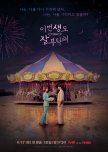
Charming hanger, to tell the same old story about Cupid's arrow in a refreshing crisp new way
"See you in my 19th Life" is first and foremost a love story. However, there is this particular, dramaturgically appealing impulse, since the protagonist has been incarnating on this planet again and again since 980 AND is actually able of recalling all of her 19 multifaceted lives so far quite well. So the protagonist is neither ghost nor demon, but a human being like you and me – only with more knowledge and experience from her previous lives with different gender. She brought all she has ever learned and known along with her.A nice hanger, I think. A great (not necessarily brand new, though,) idea to tell the same old story about Cupid's arrow in a refreshing crisp new way. The idea goes back to a web toon. As tvN-KDrama it comes along in 12 episodes. Here Shin Hye-sun once more took the chance to break down female stereotypes, as she had already successfully stirred up gender-specific behavior patterns with her acting in "Mr Queen". Wonderful.
I think the concept overall works very well. The KDrama presents a Rom+Com in a light-footed pace. However, the protagonists certainly have their bags to carry. So the story doesn't just sail along on the surface. And then, of course, there are also mischievous characters, e.g. in the Jaebeol milieu, adding some extra excitement. In addition, the subplots are quite elaborated in a charming manner, too.
So: If you're in the mood for Rom+Com, you'll be well taken care of with this KDrama. The story draws with pleasure from the large pot of possibilities that arise from the idea of awareness in reincarnation, thus lovingly spicing up a solid love story. Predictable it may still be, yet it is fun, heartwarming and including some surprising twists, too.
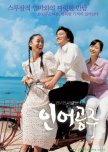
A little gemstone of its own kind
"My Mother, the Mermaid" is a KMovie gemstone. Old school it may be, however offering a sweet and empathic, yet down to earth (love) story without any polish, instead with a little bit of magic mixed in. Overall, the KDrama is ruthlessly rooted in the normality of a fairly simple (and also very South Korean) life.The most important about "My Mother, the Mermaid": A fantastic Jeon Do-yeon in her double role, a Go Doo-shim in top form, authentically rustic Haenyeo and Jejudo flair of the 1980s and the 'wonder´-ful story about a daughter, Na-young, getting to know more about her rather brash mother and her great love - Na-young's emotionally rather absent and ultimately disappeared father.
Sometimes there are worlds dividing (happy moments in the) past and (perhaps quite sad, desolate) present. But even if the present may now look completely different and happiness may seem to have long been lost, the happy, beautiful moments of the past somehow live on, well protected and guarded within the heart.
And sometimes we may evaluate a situation, a person or a relationship completely incorrectly or at least completely inadequately. Simply because we don't know everything yet...
The KMovie turns out to be an almost tender encouragement to approach life a little more humbly and calmly: Less judging and evaluating - because it kills the moment between here and now. Being open more often - because in doing so we give life a new chance with every moment.
-----------------------------------------------------------------------------
SIDE NOTE: --- On time, context and background ---
The KMovie from 2004 begins with a sequence that is set in the past during Asian crisis (late 1990s) - the son is inheriting his deceased father's debts... in that case however, his money mainly comes from his wife...
At first we can't understand why the mother insists so much that her large share of money she brought into the marriage was earned by herself and belonged to her, not him - and why it is so important to her that it was intended for her daughter's studies...
…The protagonist's mother was Haneyeo on Jejudo Island. These women of the sea – 'mermaids' – may not have had any formal school education in the past, but they always earned well because they dive for the sought-after, expensive seafood on the deep seabed and harvest it laboriously by hand with their spatulas. (Until today apparently only women can do this freediving job well.) The Haenyeo are people of respect on Jejudo, not least because of their financial independence. They are perhaps the only truly self-confident women in South Korea who are traditionally respected to this day and also have a naturally developed self-esteem as women (not just as potential wives!)...
A homage to all those unhappily in love! (Wherever. Whenever.)
I´d say this is a homage to all those unhappily in love! (Wherever. Whenever.)Calm, like the water on windless days. Bare in words, instead told with images, well-placed scene settings and metaphors.
The protagonists are not so good with words, rather insecure and awkward when it comes to sharing their feelings. (But actually, nowhere in the movie is there any role model, whatsoever, from whom they could have learned better - how to deal with feelings openly, sincerely and appropriately.)
The original title was "Lost Love" or "Missed Love". But the international title “Lost in Love” is also appropriate, as the protagonists don´t seem to know how to navigate their feelings of love. This brings us back to the calm – becalm, with no wind to fill the sails. In fact, there is no tension between the protagonists - it is the drama of bad or missing timing in love. It is no coincidence that bus terminals become a structuring leitmotif.
The story of "Lost in Love" is not spectacular. On the contrary, it is the essence of a non-story. A story about a story that just doesn't want to happen. Nevertheless, it goes deep - because it relies on the effect of the blank, on the space between, on what works in the background and constantly gnaws at the heart. And this, actually, is an all too familiar, well known, painful experience for many people. It doesn’t have to be explicit. It is even more precise that way.
The KMovie has nothing to do with a typical RomCom. Nevertheless, "Lost in Love" is poetic in its own way - with an affectionate look at the unfortunate lovers on this earth: their hopes; their fear of self-confidently standing up for their feelings and thus maybe provoking the dreaded, outspoken “No!” or “Go!”; their inability to let go.
Water is the leitmotif in several ways. There is the rowing school and the fish farm representing dynamism and movement. And then there is the rain and the tears, shed or non-shed. But “Lost in Love” is also expressly colorful. With an eye for the banal details in everyday life. Authentic. Without makeup. The smell and the humid air of the monsoon summer are almost penetrating through to the audience. The landscape was handpicked, the radiant nature representing the beauty of life - even despite being unhappily in love.
The KMovie has its own idea of pacing. It develops its idiosyncratic charisma. It is the story about the non-love story, quietly told in a meandering way, as feelings are nothing one can be persuaded of... they can only be experienced... and, at best, shared... Or maybe empathized/sympathized with.
Immersive in its own way. Not for every mood. But if the timing (yes, again…) is right - for me it was a rainy autumn day - then (in my opinion) it's definitely worth seeing.
Others might say its dull and boring. Being from 2006, it is rather ´old´, too.
Well, check it out for yourself.
P.S.:
For the private lives of the ML and FL, though, it obviously worked out quite well.
They are married since 2009...
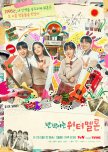
"Twinkling Watermelon" radiates warmth and knows how to touch. Cheers to life. (And to magic, too.)
What a nice surprise in 2023!Full of heart and love for music, too. Though neither major, nor minor, but plenty of both. Fresh, cheeky, cheerfully playful and yet with complex substance. RomCom inclusive. “Twinkling Watermelon” follows the trend of 2023 productions: time travel. A journey into the past, into the parents' late youth - as a gift that offers the chance to understand a little more about them and thus at best make peace with life here and there. Charming magic is also involved, as life is full of surprises if you just open and follow your heart... that's the wonderful motto that offers balm for troubled souls. Viva la Vida!
In fact, the story's ostensibly cheerful melody is supported by an emotionally serious basso continuo. This gives this KDrama a warm, complex, lasting depth, despite all its youthful playfulness. The protagonist is a hearing child of deaf parents (CODA). He is an extremely talented, eager, responsible, loving son and brother, but he is inevitably somewhat overwhelmed by his responsibilities (as a child), out of guilt loading even more responsibility on his shoulders. He feels lonely at times with his experiences of the acoustic world that he cannot share with his parents. And he also suffers from the social marginalization that he and his family experience.
Eun-gyeol (for all his positive approach to the challenges of his life) embodies the psychological conflicts of any CODA, that he, too, has to deal with by living between the worlds (with and without acoustics). He does it quite well, yet deep down he understandably suffers from the great responsibility he has to bear as a child already. Sooner or later he has to come to terms with this conflict in a self-loving and self-confident manner, so that he may allow himself to go his own way in life, too, despite the challenge. Basically, it is precisely this inner psychological dynamic that is the dramaturgical driving force of the story.
It is not uncommon for CODAs to seek professional support or ask for help, if the emotional burden feels too heavy. (Just like anybody else would as long as they acknowledge.) Here the support comes unexpectedly in the form of a magical journey through time, and there is help, too. But significantly, Eun-gyeol got so caught up in his trained behavior pattern that he (almost obsessively) only sees the time travel as another challenge to prove himself and being in charge - no matter what the cost. It is almost verging on megalomania to believe that he might now be responsible for the fate of his parents in their past, too. (However, throughout the series this aspect opens up room for fun and comedy.) On the other hand, the immense inner psychological pressure that he puts on himself also subtly reflects the sad dilemma that keeps him trapped. (Which in turn latently contributes to the emotional depth of the KDrama.)
In fact, “Twinkling Watermelon” opens up space for even more serious topics in different storylines. Aside from the social stumbling blocks in the lives of deaf people, there are child abuse and suicidal tendency, too. Thus, overall, there are pretty profound themes that the KDrama tackles bravely and plays through with a lot of feeling, yet still in a digestible manner - despite all the seriousness, embedded in colorful joy of life. "Twinkling Watermelon" radiates warmth and knows how to touch. Cheers to life. (And to magic, too, that can re-shuffle the cards of time and space... who knows?)
PS:
Would have, could have... if only the sign language hadn't been processed acoustically... but authentic silence was probably too daring... and would probably have neutralized the lively esprit of the music band's approach towards life... hmm... everything altogether probably doesn't work...

More than a classical romance this is about the elite education hype, Gangnam mothers & scandals
"Crash Course in Romance" ... well.Starting with the title, makes me jump right into my criticism. Don´t get me wrong. It doesn't concern the KDrama itself. On the contrary! Yet, this international title business... again I don't know why... (well, I'll probably never understand it...) Why does the international title have to suggest a completely different story? Why does (in this case) Netflix for the international audience want to present something completely different than the tvN (co-)production? Why can't the story announce its story for what it is in the first place? In this case: A KDrama about the one shot scandal involving Gangnam's one shot math teacher. A story about Gangnam rivalries between students, between mothers, between teachers. A story about Gangnam scandals that can easily destroy lives... There is also a love story (or two) on the side, but if you tune in specifically for the romance, you have to see how you´ll deal with what is actually offered. (I would guess that might be a bit disappointing.)
Surely, a romance is brewing, but in fact it's the characters, the story and the context around it that create a substantial with plenty of life of its own – apart from the amorous relationship dynamics. There is something like a criminal case, too. It get´s more and more dramatic. Gripping, even. Overall, as a dramaturgical leitmotif, with a socially critical wink it nonchalantly pokes fun at the recent education hype. At the same time condemns, too. So, in fact, this is something completely different than the title suggests.
I last saw, experienced and appreciated actress Jeon Do-yeon almost 5 years ago in the KMovie "A Man and a Woman". She is not an international superstar, but a nationally respected and recognized actress in film and television. Besides her mostly profound and meaningful play, here she also shows a clownesque, quirky, yet adorable side. She is actually 50 by now. However, here she plays a woman in her 30s. Imagine that. Here (as well as most recently in 2022 in the KDrama "Twenty Five Twenty One", where the main actress, as a 31-year-old, slips into the role of a senior high school student,) it is working. In fact, this gives the characters more lifelike substance, apart from just being 'young and pretty'. At least that's my opinion. Some may be more critical about this casting-philosophy. However, in South Korea it probably bothers less. The number of viewers has exploded over the course of the 16 episodes: from almost 1 million to more than 4 million.
The competitive advantage here, that generally carries this KDrama and sets it apart from the Rom+/-Com of many a style, is substance and grounding that comes with life – a life which is hard enough, for the protagonist at least. She may run light-footedly down the streets and take life's challenges in a sporty manner, but she has also lost some feathers along the way and made severe sacrifices. She´s past her youth by now. But she stands in the middle of a sound and solid life.
The male protagonist, too, has already experienced a lot in his vita, including some unpleasant encounters with life – despite everything he seems to be living in the fast lane at the moment. Among other things, with his stress-related eating disorder, he brings in a topic of the time that is comparatively rarely addressed in series - if only marginally, and certainly not among men. Here the eating disorder is even the hook for the encounter between the two protagonists...
Nevertheless, "Crash Course in Romance" has a upbeat side to it. ...It´s the clown's job to bring some jokes and fun into bitter seriousness – some say that you should be able to laugh about your own life, otherwise you are probably not taking it seriously enough... Others say, you should be more serious about bringing wit and humor to your life… Whichever you prefer, this KDrama here and there contributes to that, while the background against which the plot unfolds is actually peppered with serious jabs at the normal madness of South Korean everyday life in Seoul, south of the river - in Gangnam: The educational stress and pressure to perform among the students, among their mothers, among teaching staff, as well as in tutoring academies. It´s serious stuff. There is stalking vs. MeToo, social media terror, escape tendencies up to suicide, you name it. Bitter seriousness here becomes the hook for plenty of drama. And these dramaturgical stumbling blocks (or rather metal balls in this case) keep getting in the way of two hearts that want to beat faster. Nothing compares to a scandal in Gangnam. That keeps the characters within the story on their toes, and the KDrama audience superbly entertained.
Re.: Romance... yes, there is.
The two of protagonists sort of stumbled into it. That wasn't on the agenda for either of them. Besides they aren't the youngest any more... (Don't worry: for the younger generation among the viewers, the KDrama also offers a touch of amorous teenage vibes in the subplot with the 'daughter' of the protagonist and her two admirers...) In any case, the love story of the protagonists is told with delicacy, sensitively, but humorously, maturely and at the same time chastely. Given the circumstances under which the two protagonists led their lives, this is quite authentic. In general, unnecessary cotton candy is avoided.
As so often, I initially had no idea what to expect from this KDrama – at least there was none of the totally hip superstars and no incredibly new or exciting story. I almost overlooked the KDrama because it's rather inconspicuous. I didn't have high hopes at all. And yet, just because everything seemed so banal about it, it made me curious. It's fascinating how this story was able to wrap me up with its idiosyncratic dramaturgical narrative style. Once again one of those productions that are becoming spectacular in their unspectacular way...
Well, if only it weren't for the title...
…but I already mentioned that at the beginning...
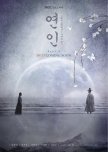
Another milestone of epic love story & a new aspirant for the hall of fame of historical KDramas
Now that another 11 episodes of the second season of “My Dearest” have come to an end, I have a couple of additional thoughts, that I would like to add to season 1.First.
In my opinion, the mission (I am here referring to the side note of my review for season 1) was a complete success in terms of the haunting dramaturgical interlinking of personal fates, love stories and a historical context, whose traumatic shadows for the national self-image extend to this day. Therefore I consider “My Dearest” as definitely belonging to the hall of fame of historical KDramas. And as a milestone of epic love stories, too.
So, on the one hand, there is the never-ending, tragic roller coaster of this fateful lovers... at times you may even become impatient that this (hopefully!) has to come to a happy ending soon, shouldn´t it? On the other hand, it is precisely because of those two significantly insignificant contemporaries and their personal context that we are cleverly torn ever deeper into the actual historical and political framework of that time. Whether we like it or not. Basically, we are of course primarily concerned with the touching dynamic between the two :-) but, nevertheless, we inevitably get closer to the dilemmas of the people, their problematic king and the political framework of that historical chapter, too... Thus, the emotional intensity of the love story kind of also serves as the cream topping for an audience, who is going all the way through this humiliating (preferably repressed) time for Joseon.
This brings me to the second:
I was positively surprised, how Confucian moral values (based on ruling authority, especially morality and loyalty) are openly pilloried in this production. Actually, the MBC KDrama production “My Dearest” from 2023 takes a pleasingly liberal stand, when it comes to a conclusion. Officially, in the narrative of the story, authoritarian values are upheld, but for the audience, this supposedly unerring path to ´order´ and ´harmony´ is clearly revealed to have failed.
It is said that the fish rots from the head down. Eventually, when it comes to such a stench, the noble, ethical-political teaching of Confucius must fail, too, if authority (embodied by the king, the teacher or the father) is weak, sick and delusional. Loyalty to a delusional king or an almost fanatical adherence to principles obviously borders on stupidity. Thus, it doesn't accomplish anything. On the contrary. Dramaturgically speaking, “My Dearest”´ haunting dynamic is driven by exactly this officially ethically legitimated, but then in fact again personally motivated 'stupidity' of some, who call themselves scholars or nobles. Practically speaking, it is about stranded traditional Confucian values… and therefore, as far as Joseon at that time is concerned, highly self-critical, too. (E.g. it is neither ONLY the Qing, to be blamed, nor ONLY the Joseon king…)
P.S.:
And as a third:
In my opinion, Ahn Eun-jin in the role of Gil-chae has really catapulted herself into a new league of acting over the course of the series - with her increasing presence, depth, authenticity and overall growing charisma. Respect! I'm definitely looking forward to further productions with her as female lead...

If you´re ready for what lies beyond the obvious & don´t mind a gloomy scenario, go for it
For those who don't blench from paranormal dimensions, "Revenant" is certainly a must-see KDrama. Pretty much everything is done right here. "Revenant" is a crime thriller that transcends time and space, embracing a world that is more than meets the eye and the rational mind. “Revenant” also belongs to the genre of supernatural, even horror-mystery productions. However, to reduce it to that would not do justice to this KDrama.Demons, ghosts of the deceased, people who can see such entities, and people possessed by these entities are all traditionally deeply rooted in South Korean culture. Folk religion and shamanism are still present today – sometimes more, sometimes less, sometimes not at all relevant to the individual, yet nevertheless present. "Revenant" is deeply rooted within this national culture, with Shamanistic rituals being explicitly involved here. In the mass consciousness, the supernatural world has retained a firm place over the millennia. "Revenant" specifically refers to that, (unfortunately without going into detail regarding its backgrounds.) In that sense, "Revenant" is not an unusual SBS-KDrama production for the South Korean audience. At the same time via Disney+ Streaming-Platform this series is exporting a piece of its rich national culture across the border, too - superficial as it as such may remain.
In "Revenant" Kim Tae-ri and Oh Jung-se, however, show high-end performance. Actually overall, this KDrama is in general characterized by its great casting. The acting alone makes it worth seeing. The story is unpredictable and complex, so are the relationships. Additionally, it draws from the long tradition of South Korean folk beliefs, ingeniously mixing it with a modern, rather scientific, investigative approach.
Be prepared for a suspenseful plot. The attraction of "Revenant" lies in the dramaturgically intelligent and fascinatingly presented interweaving of crime thriller and multidimensionality of being. It is obscure, too. In “Revenant” people are possessed by ghosts of the deceased, who are acting in an almost criminal manner. With conventional police investigation, murder executed by such astral beings, who materialize their intentions through their mental occupation of human bodies, are difficult to uncover.
Should you watch it? If your are ready for what lies beyond the obvious, yes. If you don´t mind a gloomy scenario, yes. It is different from your ordinary KDrama, though.
PS:
For me, however, "Revenant" is not just another highlight in a KDrama tradition that is rather fearless regarding the paranormal. The production is also one of a noticeable number of KDramas, that transcend time and space as well as this world and the afterlife, which are increasingly flooding the screens. (Especially in 2023 with i.e. "Island", "My Perfect Stranger", "See you in my 19th Life", "Heartbeat", "Durian's Affair", "Miraculous Brother" … and the year is not over yet). Ghosts, demons, reincarnations, time travel, you name it – the worlds overlap and mix, with time and space having become relative. The curtains between different dimensions are increasingly lifted. The paranormal is becoming more and more normal in the worldwide mass consciousness. Multidimensionality is a topic that people obviously increasingly like to deal with. It isn´t necessarily horrifying anymore. Not in South Korea, nor elsewhere on this planet.
In general, I find that quite inspiring, since dealing with multidimensional spaces, times and beings, has a potential to opening up new perspectives towards life. (Even if it may not all be logically satisfying yet.) It is offering a potential towards a more conscious appreciation of what makes us being human, too.
PPS:
One appealing, even salutary message that "Revenant" (somewhere along the line) would have to offer: the 'evil' intentions of the astral beings can only be as evil as the human 'hosts' allow. At some point the human has to give his or her 'Ok'. If a person has no resentment or greed and is at peace with the world, then there is not much harm wandering ghosts or astral beings in the near-earth realms can do. That would be good news, wouldn´t it... yet… compared to ghosts, eventually human beings can easily be the more frightening creatures here...
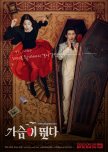
Not world-shaking at all, though it can be quite witty at times
It's about a vampire who wants to become human. However, fans of vampire stories alert! "Heartbeat" is at best Vampire-'light'. First and foremost, this is ´Rom´ with double ´Com´. It is casual entertainment, its topping made of tried and tested patterns, and clichés, too.Essentially, "Heartbeat" thrives on the special relationship dynamics between the two protagonists, with a rather intractable young woman crashing into an old vampire, who has been robbed of his supernatural powers/resources and who, due to a mishap, is now neither really vampire nor human. The humor and charm of the story lies in this somewhat awkward constellation. Determined female protagonist meets bewildered, somehow lost within identities male protagonist. The whole story is embedded in a stylish, handsome ambience as well as this and that (four-dimensionally knitted) subplot. Romantic vibes are guaranteed and on top of that a bit of suspense, too.
"Heartbeat" isn't world-shaking at all, though it can be quite witty at times. It's fun when you're in the mood for it. With a down-to-earth female protagonist whose everyday life (for a pleasing change) is not predominantly structured by wardrobe and make-up.
Here and there, however, production obviously chose the striking to the logical: No money but the large property always in festive lighting? The protagonist's gothic chambers always bathed in the candlelight of countless candles, regardless of whether he is there or not? (And who would be in charge of this? He never has to light it up, nor blow it out when he leaves... they are always burning.) Well. Ok, let´s not nit-pick…
"Heartbeat" obviously doesn't take itself too seriously when it comes to such details. If you can overlook this and that, then it´s fun@work... as fun and light entertainment are clearly the goal. So, don´t expect more than that.
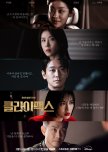
Nothing Sugar-coating: A Noir Masterpiece
For me, the KDrama "Climax" stands as one of the most courageous and socially critical works of recent times.Forget the wave of "sugar-coated" productions that have flooded the recently. Climax is a drama that isn't afraid to play to its strengths. You could describe it as a high-end social thriller that, over the course of 10 hours, reveals the dark underbelly of South Korea’s entertainment industry without any filter.
The cast is phenomenal. Beyond the top-tier performances of Ju Ji-hoon and Ha Ji-won, the supporting cast – Nana, Cha Joo-young, and Oh Jung-se – are equally haunting. In particular, Cha Joo-young as Lee Yang-mi pulls out all the stops, delivering a masterclass as a high-end schemer par excellence.
The storytelling is uncompromising and intelligent, actively challenging the viewer through the sophisticated use of flashbacks and shifts in perspective. We find ourselves empathizing (not necessarily sympathizing) with different sides, only to gradually grasp the full scale of the corruption. Here, the "heroes" are simply traumatized humans with their own darkness, and the "villains" are, strictly speaking, no different.
Greed, trauma, and personal vendettas are consistently wrapped in a "Noir" atmosphere. The story builds tension relentlessly, escalating from one crisis to the next. The central theme revolves around systemic abuse of power in the media—specifically the sexual exploitation of rising stars and the tyranny of agency CEOs. The depiction of the "shadow connections" between politics, jaebols, and the media serves as a painfully realistic and necessary commentary on the industry. While 2025’s My Troublesome Star touched on similar themes, it softened the blow with slapstick and a touch of magic. Climax is far more ruthless, keeping its finger firmly in the wound.
Respect is also due for a genuine milestone in the KDrama world, especially with a cast of this caliber. This is perhaps the greatest progress Climax represents: while same-sex relationships have appeared as subtext in recent years, here it is the driving force of a central plot motif. It’s not just thematic; it’s explicit and authentic. That this was possible in 2026 is truly progressive for the South Korean media landscape. While conservative circles continue to debate it, this story was told—and it never flinches. Major respect to these celebrated actresses for taking on such roles and paving the way for LGBTQ+ visibility in the mainstream.
Finally, this drama returns to its "core competency": soul-saving. Here, "saving the soul" is interpreted as the moment of total revelation and reckoning – a cathartic moment for the audience that goes far beyond your typical revenge epic.
Happy ending? No. We aren’t in a fairytale; we are in the real world. The ending remains true to itself: consistent until the very last frame. I find it "reconciling," even if it isn't in the traditional sense. It’s honest. First: in the fight for the top, you might have to sell a piece of your soul – but not necessarily the whole thing. Second: breaking established structures is nearly impossible. It’s David vs. Goliath without superpowers or magic. It demands everything and more, and yet, they don’t give up. They keep getting back up and rolling up their sleeves.
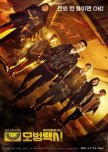
Being a victim in the face of injustice is the worst – revenge promises release of suffering
Dealing with some actual crimes in South Korea, "Taxi Driver" retells them from the perspective of the victims - a variation of vigilante justice is the driving force and explosive in the plot development. A lot of action is guaranteed. The pace is high. There's nothing tear-jerking about. Romance has no place here. However there is room for emotions.Although the crimes are extremely brutal and unscrupulous as well as the fights and chases don't sugarcoat anything - Taxis Driver is overall fun to watch (not in the sense of ´funny´ though!). On the one hand, this is because the perpetrators are caught and the victims actually get 'help'. On the other hand, and above all, it is the actors. Not only the team around Kim Do-gi, also and especially the individual villains in male and female versions. While on the one hand turbulent action fills the time (yes, for me personally less would have been more, but that's probably a matter of taste), it's actually the theatrical performance of the mimes that characterize the esprit of the series. The fact that Do-gi has to slip into new roles for his assignments has a certain charm - i.e. sometimes he mimes the inexperienced substitute teacher, sometimes the gallant, wide-legged criminal with a fur coat...
It's still quite a brutal TV serial. That's because of the cases. Yet they aren't invented. It helps that there is room for a pinch of humour, harmless situation comedy and a wink every now and then.
Despite all the vigilantism, which is the driving and fundamental premise of the entire series (and probably also of the 2nd season that is already planned), it is respectable: there is also a serious examination of justice/injustice, law/judiciary and the state's monopoly on the use of force. The brilliant public prosecutor Kang Ha-na in her idiosyncratic way and her team are excellently suited to this. The heroic deeds of the 'exemplary taxi crew' are thus not only whitewashed, but also rightly confronted. The script has in that sense hit a fine line that doesn't take away the joy of satisfaction, but still puts a question mark behind vigilantism, and thus gives credit to honest, committed and highly motivated law enforcement officers - because the country needs them. Vigilante justice, that should be clear, cannot and must not be the solution. (Human history is full of cultures of lynching and blood feuds - certainly this never did and will not promise a better world.)
And then: the heroes of the story are human beings, too. Flashbacks provide an insight into the taxi team's traumatic, formative past while tying them into current cases. They too are victims. On this earth there is probably hardly any person who does not have had the experience of being a victim in the course of their life - more or less traumatical. It is an ugly feeling, a deeply shameful experience, as it reminds mankind of its greatest weakness: the ultimate loss of control and helplessness inherent in the finitude of being, the inevitable surrender that sooner or later everyone awaits.
Accordingly, forgiveness and reconciliation are also a topic of this KDrama. However, this is ruled out as a serious option quite early on. A nice concept, yes, but rather not practicable, because people prefer to thirst for revenge. In this story, the emphasis is on the satisfaction of such. There are others, emphasizing that the pain doesn't go away with revenge. Because the fact remains: For a victim, the past cannot be reversed - in fact, the pain associated with it and the feelings surrounding it are rarely in the past anymore. They shape life from that moment on, become a part of it in the here and now. The experience cannot be erased or undone. In this respect, revenge on the perpetrator doent´t help either.
Taxi Driver gives less importance to this consideration. That's actually my only (but not insignificant) criticism. The series prefers to ride the obviously successful Speed&Action wave. Because otherwise that would have robbed the KDrama of the basis for the second season, so to speak. Consequently, they want to build on the success of the first. (Without Esom in the role of prosecutor Kang Ha-na, by the way, since she apparently left the actors´ crew due to other appointments.)
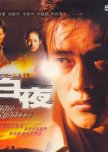
North against South. One (if not the first) Spy-KDrama, atypically action-packed… but hard to get
In 1998, "White Nights 3.98" as a TV production for the first time ventured into completely new territory - not only spatially but also in terms of content. It is about the espionage activities related to the development of advanced nuclear weapons, as well as conflicts between the United States, Russian secret services and mafia, which are carried out on the backs of North and South Korea. The title "White Nights 3.98" on the one hand refers to midsummer nights in northern latitudes and thus to the scene of action: Mongolia. On the other hand it relates to the supersonic flight speed measured in the ´Mach´. Here '3.98' denotes the speed at which one of the protagonists is traveling in a key scene.------------------
As a child, Min Gyeong-bin had actively witnessed the heroic death of his father, who was able to foil the assassination attempt by North Korean Unit 124 on President Park in 1968 while deployed by the Jongro police. His childhood dream is to become an Air Force pilot, dancing through the air at high speed. Gyeong-bin actually manages to be trained as a pilot, but due the circumstances he ends up being deployed to the secret service. His target is nuclear researcher Anatoly Jang, who is deputy director of the Institute for Atomic Energy Research in Irkutsk, Russia. The FSB, the Chechen mafia and the North Korean secret service are also interested in him, secret information and the latest generation of nuclear bombers. The Nort Koreans mobilize one of their best snipers: Kwon Taek-hyeong.
Taek-hyeon's father was part of Unit 124 at the time. As the black sheep of his family, Taek-hyeon usually had a hard time. After helping his first love Anastashia to flee south through the Imjin River as a teenager, he also lost his heart along with her. He learned how to shoot as a soldier, and as an unscrupulous sniper he can now be bought around the world - including a terrorist rebel group in the Arab world, far from home. Now, however, he is hired by his own people. He's supposed to eliminate Anatoly Jang. Far too late he realizes his target being the father of his first and only love, who in turn is now an agent of the Russian FSB...
-------------------
This KDrama is atypically action-packed: with flight scenes reminiscent of Top Gun, a trigger-happy sequence where the North Korean protagonist shoots himself free in Rambo-style, underwater scenes in the Imjin River (that flows through the demilitarized zone), explosions, and more. The KDrama actually opened up a spectacular new genre in the South Korean series world. And yet. "White Nights 3.98" had a difficult stand in South Korea in several ways. Ratings started high and then plummeted.
There are several reasons that tell us more about South Korea, than about the KDrama. "White Nights 3,98" is based on the novel of the same name and is an exciting and thoroughly entertaining, at times well-done as well. It is also documenting, that in spite of Cold War having already ended, North and South Korea with their particular political dynamic represent the last and still red-hot stronghold of a Cold War that is actually still going on. However, the KDrama comes to TV at a time when the North and the South just startet to look to the future with more optimism, with their hopeful, positive "sunshine politics" and the newly created Kŭmgang-san region dedicated to South Korean tourism in North Korea. "White Nights 3.98" might present a hot topic that is always up to date, though it completely missed the social topic of the time. People didn't really feel like giving their hearts to warring spies - North against South. So even though at the beginning, the series was still in third place, its ratings rapidly went down.
There is another reason for this. A considerable part of the scenes (3 out of 12 months of shooting time) were shot abroad, mainly in Russia and partly in Uzbekistan. This brings exotic flair to the series orbit, which in KDrama is otherwise concentrated on the peninsula. (Compared to other KDramas, the total production costs were accordingly three times as high.) However, the international subject matter, the dramaturgical interdependence with the secret services of the USA and the Soviet Union, also required native speakers who could easily find their way around the South Korean set. It repeatedly seems to be a problem to find a suitable cast - a problem that I already encountered in "Sad Love Story". Eventually, the acting performance of the Russian and American casts can´t keep up with the rest of the production. That's really a shame, because it not only offends the eye, but also the ear.
Yet, the production had to take another criticism. Director Kim Jong-hak, who excited the masses with "Sandglass" just a couple of years before, now caused offense by working with deliberate reminiscences of that earlier production - with similar or even the same scenes. One or the other seemed strangely familiar to me, too. But those who don't know "Sandglass" won't mind. And even so, it doesn't really have to bother. Nevertheless, it was not well received as a 'gag' at the time. The South Korean audience was 'not amused' about it.
Additionally, criticism referred to the rather sloppily drawn central character Kwon Taek-hyeong. In the original novel, the protagonist, who is difficult to grasp, is probably a lot more understandable in his ambivalence and complexity. The series massively simplifies/slims his profile. There is comparatively little left of his dark, evil, unscrupulous side in the script. Little remains of his ambivalence either. You also learn practically nothing about that background. Finally, the story of how he went from being a teenager to an unscrupulous terrorist is simply left out. Only the painful loss of Anastashia remains. In the series version, Choi Min-soo had to make up for a few things with his presence in order to convey a strong profile to this tragic character.
"White Nights 3.98" may be a spy thriller, but it's not a about male heroes only. There are plenty of women involved as events unfold. Of course, there are also tragic entanglements in love. Ultimately, the driving dramaturgical forces are not ideologies, people and homeland, but heart and pain, impulsive and human decisions. Whatever one may accuse "White Nights 3.98" of, it comes up with strong emotional moments in the proven KDrama manner.
By the way, here you can see Park Eun-bin making her acting debut as a six-year-old, and Song Hye-kyo was still in the starting blocks of her career back then, too... if ever you get to see the KDrama. With subtitles it is (currently) difficult to get...
----------------------------------------
Historical SIDE NOTE:
For me, in connection with "White Nights 3.98" (besides all the entertainment and star encounters), the historical context was ultimately interesting - not only in relation to the contemporary critical reception of the KDrama, but also regarding the true historical prelude storyline:
In 1968, North Korean Special Forces attempted to assassinate South Korean President Park, thus a special ´Unit 124´ had advanced as Black Op on South Korean soil. They had dived through the iced Imjin River and left the demilitarized zone behind. On their way to the Blue House, 7 km east of Paju, the group was spotted by four passers-by and reported to the police. However, the special unit was prepared for this and changed into the uniforms of the local 26th Infantry Division of the South Korean army and split up. Unnoticed by the police and military, they were able to penetrate as close as up to 100 m to the Blue House in Seoul. However, by chance or good intuition of the local police chief, the assassins were confronted at Checkpoint Jongro and engaged in a shootout. 29 of 31 members of the special unit died trying to escape or killed themselves as a precaution. One of two survivors was caught and defected to the south. The other, Pak Jae-gyong, made it back to North Korea and to the top of the military and political ranks.
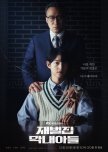
A snappy series, definitely worth watching.
"Reborn Rich" brings a breath of fresh air to the Jaebeol milieu. The story plays with "time and space" and at the same time deals with a highly topical inssue of the time: the meanwhile flattening turbodynamics of economic developments, which as a result of the Asian crisis positioned South Korea as a pioneer of the digitization age at the top of the world. The story comes at a time when the first melancholic fatigue is spreading in the country. It is fascinating how the creative industries at this point in time cheerfully holds up a positive, optimistic, innovative blueprint (i.e. the web novel “Youngest Son in the House of Jaebeol” was followed by the film adaptation as a series).The country's audience ratings went straight through the roof. After half the episodes they had already tripled and there was no holding back. The story hits the mark. The rights have also been generously released on international streaming platforms. The story about far-sighted, intelligent, courageous, ambitious and at the same time ruthless entrepreneurship draws wide circles and inspires worldwide. There is a lot of optimistic esprit in it, all about a spirit of growth that is actually predicted to be in danger of dying out in the form we are familiar with. In any case, lively ideas for innovation and intrepid capitalists rock the show in "Reborn Rich". Brilliant dramaturgical move: the patriarch of the very first hours of the Jaebeol meets with the young, new, digital zeitgeist. Charming. Tough. Mischievous. And in their mutual intention to increase profits far-sightedly, grandson and grandfather are one. The recipe works: relaunch and remake of the Jaebeol heroes from the very beginning. That gives hope and a good mood. Just in time.
In fact, the government actively decrees and supports innovations, subsidizes technical subjects at universities with large sums of money, cuts humanities institutes and puts 'all in' on the growth sectors. However, even though two-thirds of young people have a university education, 12.5 percent of the employable age group up to the age of 29 cannot find a job in the early 2020s. The last time the figures were so sobering was during the Asian crisis. And: society is aging. Although the gross domestic product is currently (in early 2020s) still growing, at almost 3% per year, it is far removed from the dizzying dynamics of the post-Asian crisis years and their GDP figures, which were three times higher.
South Korea's conglomerate founders still have hero status. But the proven system is exhausted. The following Jaebeol generations make life difficult for each other with inheritance disputes and live out their practically ennobled status with self-love. They have long since lost sight of promising, visionary growth, social responsibility and national well-being. New promising impulses are needed. "Reborn Rich" finds a successful form of expression for this difficult national emotional mixture.
Born into the Jaebeol Dynasty, the youngest grandson of the Soonjang Group's founder is not a spoiled Jaebeol, but an intelligent, hard-working, creative-thinking, adaptable young man who originally (before his sudden rebirth) was employed in 2022 as a CEO assistant in the service of the Soonyang Jaebeol (actually as a Senior Finance Manager) - he was not only quite smart and busy but got harassed a lot too. The founder of the company and now (in his second life) his grandfather was actually a role model for him. The ´grandson´ thus already knows his biography almost by heart. Reborn again under the Jaebeol sky he becomes a clever lawyer and investor who can hold a candle to his 'grandfather' at eye level.
(Admittedly, there is somehow also a bit of cheating, because the youngest grandson distinguishes himself with his considerable entrepreneurial genius based on knowledge from the future, which gives him not inconsiderable advantages in competition with the rest of the Jaebeol clan...)
Nevertheless, the ambitious fake Jaebeol grandson would be one that the country needs today. Socially responsible. Grounded. Visionary. Brave. WITHOUT (!) the filth of the otherwise mostly elitist Jaebeol offspring. Instead, WITH the fearless, highly motivated and visionary esprit and good/lucky timing of the first Jaebeol, who brought prosperity and prestige to the country in the people's narrative.
The issues, challenges and problems facing the Soonyang Group mirror an entertaining historical outline of South Korea's turbo-dynamic development phase, which led the country into the highly digitized consumer paradise of the last almost 2 decades. On top of that, Justitia may also take some space in her difficult fight against corrupt networks.
In "Reborn Rich" old energy meets the current moral of the times and, practically in a combative spirit of sport, struggles about the constructive economic attitude for new, forward-looking impulses. "Reborn Rich" promises plenty of fun, sanity and series enjoyment against a serious background. The poignantly portrayed grandpa-grandson dynamic is also brilliantly cast with Song Joong-ki and Lee Sung-min.
A snappy series, definitely worth watching.
-----------------------------------------
SIDE NOTE: --- Background: Asian crisis in the 1990s and the IMF in South Korea ---
The Asian crisis of the 1990s brought South Korea to the brink of national bankruptcy. Banks, as well as large and small companies had to file for bankruptcy, many people lost their jobs, their assets and their prospects.
In South Korea, however, there is significant talk of the IMF crisis. That's because people saw the tough conditions imposed by the International Monetary Fund (IMF), which amounted to massive interventions in the country's existing structures, almost as colonialist attacks - like the Japanese did back then. In fact, the IMF provided South Korea with the largest loan to date ($57 billion) to save the country from ruin. At the same time, the people, motivated collectively by patriotism, made unique sacrifices that went as far as selling their own gold in the service of national gain and the consistently disciplined renunciation of export articles. The combination of financial help from outside, internal discipline and willingness to make sacrifices as well as targeted economic restructuring measures maneuvered South Korea out of the recession at amazing speed and torpedoed the country into the unimagined prosperity (on credit card basis) of a first-class digitalized consumer society. The country is still living from this today, but the air is slowly getting out...
-----------------------------------------
PS:
Never mind the ending...
it could be this
or that
or something else,
here it is this...
quite mind blowing...
whatever...
the circle is round after all...
and the journey is the reward, isn´t it...
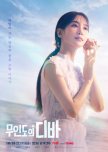
A balanced mix of pleasant feel-good with sad life challenges and social grievances
"Castaway Diva" tells the story of a musically talented young girl with a very deep passion for a particular South Korean singer and her nationally acclaimed songs. “Castaway Diva” also tells the story of a lifelong childhood friendship.The plot summary implies a survival challenge with the promising scenario 'lonely girl for 15 years on a desert island'. Survival challenge may be the topic, but as far as the protagonist´s years alone on the island is concerned, the KDrama spends only a comparably short time on that aspect. It is rather about the (lifelong) challenge of ´some´ to survive their family burden...
'15 years on a lonely island' (however - don´t be mistaken - not in the South Seas or anything like that...) is a nice, original hook that once again introduces us to an attractive side of South Korea (in you like, there is a see side note below). Those years on the island basically form the cleverly knitted background for a firm, characteristically differing profile of a young woman who is intelligent, but comparatively not as consistently socialized in South Korean society and its strong traditions as the rest of the population. Due to her youth, which was for 15 years free of parental upbringing, school instruction and social comparison, yet inevitably well-grounded in everyday survival in the great outdoors, the protagonist brings refreshing clarity, simplicity and directness back to the modern lives of those around her in South Korea 2023. With her almost at the same time naïve and outrageous freedom in thinking and acting, the FL conveys independence and self-reliance in the midst of a society dominated by class, hierarchies and patriarchal family structures. In the midst of modern South Korean society, she hasn´t lost her authentic, creative spirit along the tiring path of competitive education while growing up. She is not, like so many others, gagged by acquired decency, and certainly not disillusioned or frustrated. She impulsively acts on instinct and follows her heart. This has worked for her so far, e.g. surviving her time on the island (and largely overcoming her childhood experiences, too.)
Within this framework, the KDrama is embedding the issue of domestic violence. In fact, this unfortunately still quite widespread, extremely sad problem is dramaturgically tackled in a resolute, rather offensive manner. This topic in its frighteningly powerful might is actually the source of the story´s suspension that runs through all 16 episodes in a tirelessly consistent, incredibly sticky manner…
And the music... yes, the music... This always becomes a balm for the soul. Even if competition in the music business might interfere here and there, music as such inevitably brings heart and soul together. The music brings light into the darkness. For the story overall it becomes the source of life force and healing, too. (Regardless, whether I personally dearly like the songs or not.)
So actually, “Castaway Diva” has quite something to offer. A KDrama that (for a change) isn´t set within the world of the fashionable upper class, and doesn't target the usual RomCom style (however, doesn´t dare to do without it either... well.). Instead, “Castaway Diva” is facing common life with its socially problematic issues in a fairly grounded way and in the process tells a likeable, bright story.
In would recommend "Castaway Diva", if you do not want it to be that intense, yet nonetheless some (easy to digest) profoundness is desired, too. Despite the commotion, with this KDrama an overall positive radiation prevails, i.e. thanks to the consistently positive charisma and straightforward demeanor of Park Eun-bin (- as well as Lee Re as young FL.)
I consider the heartfelt development dynamic of the relationship between the two women - the fan and her star – to be quite felicitous. As is the affectionate patch work family vibe. And always inspiring, the cheerfully thrown in bits and pieces of wisdom that life in nature (as opposed to school education) has taught the FL...
Overall, a balanced mix of pleasant feel-good with sad life challenges and social grievances.
-------------------------------------------------- -----------------
SIDE NOTE:
--- Stranded on one of the 1,000 islands in the southwest of South Korea (and NOT somewhere in the South Seas...) ---
In the Yellow Sea in the southwest of the South Korean peninsula, there are well over 1,000 islands of different sizes. Many of them are downright mini and not even inhabited. It might happen that no one sets foot on one of them for decades.
In recent years, between some of the larger inhabited islands bridges have increasingly been built. Yet, many of them can still only be reached by water. On the islands you can find an ecosystem with virgin forests, wetlands and mudflats that has remained largely untouched by modern human life to this day. Accordingly, this region of 1,000 islands, which extends to over 3,000 km², is now listed as a UNESCO biosphere reserve.
Life between ebb and flow is determined by agriculture and fishing. Thus life is simple, slow, and for some people rather boring. Accordingly, the young are leaving... and the region is overaging.
However, the gifts of nature offer pure abundance. Fishing is often done with bare hands. Mussels and crabs can be collected from the mudflats. Mung beans, soybeans, sweet potatoes, rice, chili and sesame grow abundantly. There are also a variety of findings you can collect on the beaches. You might literally stumble upon small and large treasures. For several centuries, trade with the West took the route through the Yellow Sea. After heavy thunderstorms, many ships have capsized over time up to this day. This is why the maritime region has now been officially listed as a historical site. Deep sea diving for treasures from the Song and Won dynasties of the Chinese Empire, which have been well preserved in shipwrecks in the salty mudflats, has therefore become quite popular. (The FL in "Castaway Diva", however, is more interested in the very mundane, modern flotsam that keep washing up on shore after thunderstorms...)
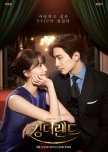
Maybe being so focused on success, King-The-Land almost lost track of the core of a KDrama´s heart
As far as I am concerned, "King the Land" triggers extremely ambivalent feelings. I'm still undecided whether to classify this KDrama as a Trojan horse or as a successful prototype AI product. In other words: is it deliberately engineered brainwashing (that at times comes very close to even insulting the human intellect), or is it the result of an AI (programmed for max audience share) as showrunner in its first, but surprisingly successful test run?"King the Land" is a Rom+Com. A fairy tale we have known and loved for generations. The unthinkable becomes possible: the hard-working girl next door finds Knight in Shining Armor - a Jaebeol offspring who can afford the luxury of not even being interested in the rich heritage of the conglomerate. Well, if you feel like something like that, you get a highly polished version of a cheerful, trivial (and conservative) love story that opens up clichéd insights into the upper segment of the shamelessly high-end luxury world.
Here my criticism. My irritation. Even annoyances.
--> These days, we can (and obviously have to) get used to product placement. That´s nothing new. However, "King the Land" undauntedly puts an almost obscene shovel on top of that. It goes so far that at times I felt like I was stranded in a 16-episode commercial, which I consider quite intrusive. Shameless. Apparently it can always be worse.
I rarely fast forward. But rarely have I fast-forwarded as much as in "King the Land". Usually, I'm ready to get involved in moments - looks, gestures, stand still, in my opinion all of that can be part of the dramaturgy. But here the long takes far too often serve a product placement or a Lifestyle-Statement being deliberately staged on the occasion, or some triviality that may or may not be considered nice, yet without any impact for the story. Just for fun, so to speak, because it is (supposedly?) so pretty. Most of the time it's about a haunting, almost mean display of a lifestyle in the highest-priced luxury segment, which will probably never play a role for the vast majority of the audience. Then I get angry. Not because the story is set in an exclusive social class, but because it is staged in such an oversized manner, while giving it a lot more screentime than would be necessary or coherent for the feeling and understanding of the story.
My understanding goes like this: The high-gloss, stylized luxury lifestyle of the absolutist elite hides a message between the lines that is addressed to all classes below: “”” You'll never get there! Forget it. Enjoy what you have. Make an effort, then it could even be a little more. Yet, be aware: WE play in another galaxy, light years away from you. Give up. Surrender. Let us do it all. Then it shall not be to your harm.”””
---> Additionally: The KDrama chooses a nasty mixture of proven dramaturgical elements and links them with another hidden, questionable message that might be hardly noticeable, yet effective.
There is the world of the employed, that so many people in the country (and elsewhere in other countries) share. In particular in South Korea this is often enough about an authoritarian hierarchy within a corporate structure. This includes almost as a matter of course: bossing around, exploiting, abusing, and some more exploiting. This goes through all instances. It is nothing new. This is everyday life for many.
Thus, a rebellious protest is always welcome in KDrama. “King the Land” also grabs into this box - courageously and with some humor as the hero immediately counters the frustration that nothing ever changes. He rebels. Dares to speak back. Pushes through, with vigorous means when necessary. And keeps the upper hand. How wonderful! … It's just too bad that he happens to be the chairman's son and can afford to do that... Here, and there, and almost everywhere...
So, the positive, rebellious (democratically inspired?) message turns into the (autocratic) opposite: “””Only those who swing the scepter of (monetary) power can change something, because they are the ones, who actually have something to say. The ones at the top. An this is, because they are at the top for a good reason, because they have the background, the stamina and the right genes to de facto be responsible for the rest.”””
“King the Land” never tires of throwing this message into the audience's eyes and ears - in all its possible epic breadth. In particular, embodied by the protagonist's stepsister and antagonist, but even by the protagonist's trusted secretary. Sure, our hero ticks differently, but (this is the harmless insight to take home with us): “””It's not the evil chairmen, but there is an economic reality with which all people who think and act halfway responsibly have to put up with. Period! These are given contexts that one cannot escape from when in such a responsible position. Ergo: THOSE up there are no worse than we down here. On the contrary: THOSE up there bear responsibility, we down there don't. And THOSE up there actually mean well with us. We can actually be happy: we are doing well after all...”””
Yes, it may be true, that many are better off than others, that they lead a more comfortable life than their parents or grandparents did. Nevertheless, I feel this message (that so often resonates in this KDrama) as one that basically wants to keep people little and hold their potential down. I personally don't like that.
Therefore: Is “King the Land” trotting along as a Trojan horse of the autocratic backroom masterminds, selling their notion for a modern absolutistic society?
Or - with a wink:-) - another assumption: Is "King the Land" an AI product? An AI, which with all its algorithms, its heuristic search for solutions and its logical conclusions, yet blind for socio-political nuances, reaches into the colorful pot of success guaranteed dramaturgical determinants, inflates those for even more success and breathes life into it with popular (success-guaranteeing?) mimes, music and light. However, one can sometimes get the impression that the heartbeat is missing. Its rather forced here and there. (Some even reproach the KDrama for lacking any cross-cultural sensitivity.)
In my opinion, the 'done with love' of this KDrama bobs back and forth between 'yes' and 'no'. A pretty face has to be enough, a harmonious tune, a touching gesture, a look, a kiss at the right time to make amends for the rest. Towards the end, the KDrama tries hard again, the amorous and yet tricky relationship dynamic emotionally comes to the fore a little more (e.g. as a relationship that isn't appropriate for the Heir), and some processes come across quite promising, to the extent that maybe something actually might possibly change about the cemented corporate culture of King Group. Nevertheless, being embedded within the absolutist brainwashing of the overall scenario, it loses some of its charm. (For me) A bland taste remains.
--> However, the good news at last:
I cannot say I totally wasted my time. If in between I was able to ignore all of the above-mentioned allegation (which was actually possible!), then the KDrama also delivered: a nice, clichéd love story in the Jaebeol milieu, with some cat-and-mouse games, without much depth, but with extra (!) cream. Simple as that. (By the way, some are already treating "King the Land" as the KDrama with the best kissing scene...)
--> Conclusion:
Maybe being so focused on success , “King of the Land” almost lost track of the core of a KDrama´s heart. However, at least a few within the production team obviously tried to put quite some effort into emotional finetuning, too.
So, I'm ambivalent. In spite even the unabashed style I criticized, I watched to the end. Not only out of professional curiosity. Despite all the indignation that inevitably spread through me again and again, at times I eventually enjoyed it, too. (Otherwise I would have dropped it - and then quite early.)
For all that, that's KDrama, too...


