


 10
10 42
42 15
15


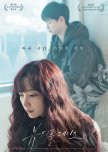
Intensive. Rough. Monosyllabic. If you don't let that put you off: Definitely worth seeing!
On average, every month (!) around 1,000 North Koreans flee to China in the hope of thus escaping hunger and persecution. Around 80 percent of the refugees are women. In many respects they are dependent on their unfamiliar environment - due to the uncertainty regarding residence law they practically live in a legal vacuum. Their fate all too often ends in the hands of smugglers and human traffickers who shamelessly exploit their insecure situation and ruthlessly make use of this for their own profit. The women are kept in brothels under slave-like conditions or forced into marriage. The bribes are increasing in view of tightened border controls. And unfortunately, China delivers all the refugees it identifies as such back to North Korea, where they then await torture and death. They live in constant fear of attacks, violence and deportation."Beautiful Days" tells the true story of a North Korean woman who makes it out of fear and dependency into an independent identity and a new life in South Korea. Her new life not rosy either, but it's free and self-determined.
Lee Na-young convinces here in a true-to-life and unembellished depiction of a bitter, merciless development process - from the abandoned teenager, who is forced into sex work and marriage, who is then threatened with taking her child away to sell it, and then despite all the hopelessness, persistently and unswervingly manages to escape her pimp, emancipate herself and earn enough money as an independent woman to support her family in China from afar.
By the way: In "Beautiful Days" there are actually no "beautiful" days. The title is pure irony. Dialogues are minimized. There is hardly any room for closeness and tenderness in this rough, monosyllabic world. The few loving gestures can practically be counted on one hand, but their effect is thus even stronger.
Intensive. Rough. If you don't let that put you off: Definitely worth seeing!
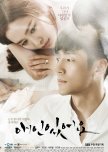
Touching, moving, stirring, rousing, exciting: Makjang, yes. And Rom+/-Com. And more. Fabulous.
Truths just want to come out. Thus, sometimes they find quite miraculous ways."I Have a Lover" features Makjang. However, the KDrama also and above all offers an unusual love story over 50 episodes.
It also tells about the creeping drama of marriage after the 'point of no return', when secrets and/or feelings of guilt, disappointment and reproaches have long barricaded the couple's way to each other and marriage has become a stale shell or facade, with hardly any space for dear affection left. Eventually, with all those hidden emotions it becomes increasingly difficult to lovingly respond to each other. At last, it may seem impossible to pave a new way towards renewed trust, closeness and genuine intimacy.
Moreover, "I Have a Lover" tells about the trauma that couples as parents suffer from the loss of their child. This KDrama is about painful emotions not being shared, getting in the way of a trusting, loving, intimate relationship. In the most desperate moments the one you need the most seems the furthest away. Missing a comforting connection makes it even worse. Finally, the insincerity leads towards sadness, anger or even indifference and detachment regarding the hollow relationship.
Drawing human characters with their shadows and radiance, the KDrama tells of the whole range of emotions people have and share in intimate relationships. "I Have a Lover" portrays an extraordinary character development process. Will the couple thus be able to reconnect?
The side plots add to the sophisticatedly composed symphony of complex, conflicting emotional worlds. It's about pain and hope, disappointment and forgiveness, sincere love and betrayal, above all about romantic love, but beyond that about love in all possible facets. Family in its ambivalence as bonding and bondage, as an ambiguous place of trust and obligation, forms a creeping leitmotif that holds all the narrative strings together.
The scenarios effortlessly switch between different living environments. The focus is also on lawyers - those 'footmen' serving the elite big corporations and those 'upright' serving the little folks.
At first, I wasn't sure if I wanted to follow an exhausting relationship between estranged spouses for 50 episodes. But it quickly became apparent that the story and its two perfectly harmonizing leads invite you to depart on a wonderfully refined emotional trek through the human emotional worlds.
"I Have a Lover" is touching, moving, stirring, rousing, exciting. It is Makjang, yes. It is Rom+/-Com, and more. Fabulous.
Ps:
The KDrama (despite the 50 episodes) suits for a rewatch, as many aspects and details might then become even more meaningful...
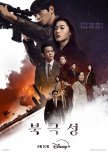
A KDrama that began politically sharp and atmospherically rich collapses into the banal. WHY?
At first glance, Tempest delivers everything one expects from a high‑budget political thriller: a gripping story, two charismatic leads, and a production that brings cinematic quality to the small screen. Jun Ji‑hyun as former diplomat Seo Mun‑ju and Gang Dong‑won as the enigmatic mercenary Paik San‑ho carry the narrative with a presence that works both in action and in silence. Direction and cinematography rely on clear, elegant images that convey tension and atmosphere in equal measure.The series scores with a genre mix of political drama, action, and character study. Particularly striking are the variation on the bodyguard motif, the international dimension, and the women at the head of politics—not as decorative figures, but as strategic actors. Seo Mun‑ju embodies a form of strength that is quiet yet unshakable. Paik San‑ho, meanwhile, breaks the macho mold: respectful, restrained, emotionally intelligent.
Tempest tells of Korea’s desire for security autonomy—and of the bitter realization that such independence is hardly attainable within the current geopolitical order. It shows how deeply international power interests penetrate national politics, and how self‑determination shatters against invisible dependencies.
BUT:
A finely tuned orchestra that began with complex tones was, in the second half, drowned out by an unmotivated, deafening rock band. The carefully developed threads were not woven together but torn apart in a “very American‑like,” loud and metallic, black‑and‑white blockbuster finale.
What remains is the impression of a missed opportunity. A KDrama that began politically sharp and atmospherically rich collapses into the banal. WHY?
A pity for the outstanding cast, who deserved more.
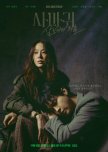
More than a remake. And more than a thriller.
A woman locked away because she dared too much. She is called “Queen Mantis,” and the name itself is a portent—or a threat. The praying mantis, after all, is known for devouring the head of her mate once he is no longer useful. A provocative metaphor in a society that prefers to see women as victims, but not as avengers.The Korean remake of the French La Mante transplants the original plot into distinctly South Korean terrain: abandoned mining towns that lie across the country like open wounds. Places where children once grew up, only to become perpetrators or victims later—or both at once. Here, the hunt is not only for a serial killer, but also for a social catastrophe: domestic violence so widespread in South Korea that it has become almost invisible. The police, who should protect, look the other way.
The women in this series are no saints. They are opaque, contradictory, dangerous. Go Hyun‑jung plays the Mantis with brilliance—her presence both magnetic and repellent. A woman one is not meant to love, but impossible to forget. The other female characters, too, are layered and elusive. By contrast, the men appear as clichéd shadows: policemen, perpetrators, fathers, all in familiar costumes.
Perhaps this is deliberate: a reversal of the usual roles, where women are mere decoration and men drive the plot. Here, the crime drama is solid—its subject matter not entirely new, but its execution striking.
Queen Mantis is more than a remake. And more than a thriller. It is a mirror of Korean contradictions: between victimhood and vigilantism, between patriarchal violence and female resistance. It shows that murder—even as revenge—does not lead to justice, but only opens new abysses.
The series poses an uncomfortable question: when institutions fail, when private violence goes unpunished—does vigilantism become a crime, or a necessity? The answer is as clear as it is unclear: murder remains murder, even when disguised as justice. Yet viewers are invited to linger at this moral precipice, to look into it, perhaps even to understand.
At the heart of Queen Mantis lies not only the pursuit of a serial killer, but also the fractured relationship between mother and son. Jung Yi‑shin and Cha Su‑yeol meet like strangers—bound by blood, yet separated by silence and guilt. Their conversations are less investigative work than tentative steps through the ruins of a shared past.
The series reflects this damaged bond in other parent‑child relationships as well: fathers who could not protect, mothers who wounded while trying to shield, children who inherit not only trauma but also silence. A web of reflections emerges, showing how violence does not remain isolated but travels through generations, warping love and corroding trust. Queen Mantis offers no solution, but leaves viewers suspended—between closeness and repulsion, between connection and rupture.
One thorn remains: the portrayal of a trans character, framed in proximity to mental disorder. In a country where trans identity is already marginalized, this feels like a relapse into old patterns. A small but not insignificant shadow on a series that otherwise illuminates social fault lines with such precision.
Overall: Remarkable, and worth watching.
----------------------------------------------------------------------------------------------
SIDE NOTE: The End of South Korea’s Mining Towns
Until the 1970s and 80s, South Korea had numerous coal and ore mines, especially in Gangwon‑do (Taebaek, Sabuk, Hwangji) and Chungcheongbuk‑do. With economic restructuring and the move away from coal energy, many mines closed in the 1980s and 90s.
What remained were “ghost towns”: half‑abandoned settlements, decaying workers’ housing, sealed shafts. Entire generations crumbled along with the homes they once inhabited. Alcohol, violence, loneliness—the social aftershocks were as reliable as the tremors that once shook the ground.
Some places, like Taebaek or Jeongseon, later reinvented themselves as tourist destinations (ski resorts, festivals). Others remained melancholically hollowed out. These towns carry an aura of social trauma: unemployment, out‑migration, fractured communities. That is precisely what makes them so charged as settings for thrillers and dramas.
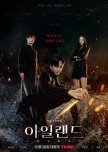
Mythical worlds, demonic realms & human tragedy mixed with luminous impulses + even humorous tones
'Island' is a KDrama released on streaming platform TVing.Alas! The unspeakable bad habit à la Netflix is obviously spreading rapidly: break series into half and then wait a couple of months before the story continues. Really? It's frustrating. Not just for me, obviously. And not for the first time. Same here. KDrama has always been doing great with solidly telling a story in one season, how long it may take... (In that sense, going global turns out to be an unnecessary step backwards.)
I would also like to mention in advance, I was a bit disappointed. Something was missing. A spark of whatsoever. Maybe another streaming-platform-malady: a compact binge-worthy story is often (I think) paying the price by losing some of its intensity. The story doesn't grab me that much, I rather watch. So there's a loss of potential there (I think).
Still it is entertaining to watch and has its moments.
In "Island" time and space become relative in many respects. What the still remembered past is for some, a past, long-forgotten life it is for others. What is a demon for one person can be a human being for another, since both forces are at work. What is 'here' can be a completely different place at the same time. The KDrama provides insights into archaically cruel initiation rites for demon hunters and also presents a contemporary exorcist who combines youthful KPop freshness and traditional priestly garment. There are also the traditional haenyeo - female divers who for ages have been diving just like that for abalone and the like. (After "Everglow" and "Our Blues" Go Doo-shim has probably subscribed to this role for life :-) so it seems...)
Well, demons are rarely a pretty sight when they do show their true colors. Yet, assigning "Island" to the horror genre to me seems exaggerated, as zombies & co. nowadays regularly show multimedia presence. Let's call it fantasy. Still, it's pretty gloomy overall. The night is in no way inferior to the day when it comes to screen time. In addition, some people fall victim to gruesome, demonic transformation processes and sometimes, if possible, hunt for human flesh themselves. The good news: there is no shooting around. Rather, the sword is drawn. Either in forged iron decorated with rich ornaments, or the lightsaber, or the crucifix, which should also not be underestimated thanks to its symbolic power, or - if all else fails or no one else is around - a few movements versed in self defense should do.
(Note: Some may locate the KDrama with its demonically inspired story in the world of fairy tales. In the tradition of Buddhism, however, evil in the form of demons (who prefer to eat human flesh) has its solid place. Likewise in the ethnic religion of shamanism, which is still practiced in South Korea today. Eventually the Catholic Church has also recognized the existence of demons with the tradition of exorcism of devils or demons since ancient times.)
Apart from the exorcism of demons, "Island" also contains complex and dramatically intertwined relationships, karmic guilt and the principle of hope. Then there are feelings that are far more than just sympathy. And in it, underneath and around, there is humor and depth, heart and pain, plus something for the eye.
"Island" combines a KDrama-like successful mixture of moods that knows how to unite mythical world, demonic realms and human tragedy with luminous impulses, heroes in a wide variety of robes and even humorous tones. The pace might pick up at times, yet the KDrama isn't about frenzy, but more of the grave kind. It offers an epic story, that transcends time and space and is excellently entertaining at the same time, if you are not deterred by the somewhat spooky characters that inevitably appear every now and then.
With the first season alone, the story (unfortunately again) is not yet told to the end. So it could break down quite a bit in the course of the second season. However, I doubt it. In any case, I'm looking forward to it.
----------------------------------------------------
EDIT: After the end of Season 2:
Luckily the story doesn't collapse. It consistently ties the threads to a coherent ending... or: who knows what the end would look like... I would say, a third season might not be completely absurd...
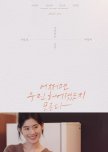
Powerful in its authentic acting & realism combined with dramaturgical abstinence
Does love have an expiry date? Or is it we humans who persistently fail to create a living co-creation from the promising 'WE' for which Cupid's arrow once set the course? "Maybe we Broke Up" doesn't have an answer to that. But! In impressive dramaturgical abstinence, the KMovie encourages us to think about it."Maybe we Broke Up" is also known as "Someone you loved". It documents in fantastic realism the unspectacular 'ending' of a relationship – like so many others. Almost as if couples in crisis could have applied to a reality show, whereas the camera team followed one of them through this difficult time and also for several months beyond. Everything seems real and lifelike and familiar. At the same time dramaturgically abstinent with neither comedy nor jokes through embarrassment, nor suspense, nor eroticism, nor violence, nor action being staged to get tempers boiling.
The couple's relationship story takes its inexorable course. And the problem with this relationship is that it has lost all its appeal. Habit, everyday familiarity, and being taken for granted have taken the place of tingling love. Concepts, expectations and relationship dynamics, which are now well trained from behavioural patterns, keep the radius of emotional highs and lows in check. The KMovie is consistent in this respect and doesn't try to sugarcoat anything. The camera just stays on and the viewers stay tuned to the action. We don't get emotionally involved, we just watch. Maybe we take a stand for one or the other. But that's our business.
The film doesn't want to push us into any corner. It just wants to take us along. Documenting. And it doesn't actually tell us anything new: A relationship gets more and more out of balance. Actually speaking out about the situation eventually brings it all down. There is no turning back. The 'WE' has become two individuals again, who now have to sweep up their emotional shards themselves and thus get the chance to learn the best from their mistakes.
The power of "Maybe we Broke Up" lies in the authentic acting combined with dramaturgical abstinence. The author is also the director. He stays true to his idea. There is no evaluation. And it is precisely through this simple authenticity that the realistic story spirals so poignantly into the mind, leaving the audience with their own record - their thoughts, emotions, questions and well-known stories, be it their own and/or those of friends and/or relatives.
--------------------------------------------------------------------------------------------
Side note: ---- Gosi Civil Service Exam in South Korea ----
The civil service career has been a priority in Korea for centuries. It stands for social recognition, but even more for financial security, up to retirement. Since the 14th century, candidates for civil service have had to pass a state examination. There are nine levels of officials. For the lowest ninth level, all you need today is a high school diploma. The competition is massive. The ninth "Geup" is for those, who get accepted, the start. With years of service and performance, or a degree, the civil servants can then advance to the middle civil service career. But for a higher career up from the fifth "Geup" you have to take the "Gosi" admission test, which only takes place once a year. It is quite demanding, but can be repeated indefinitely. Needing several attempts is not uncommon (and the high demands of the exam are always a popular topic, even in KDramas).
The Gosi exam is only the door opener. After that, the training takes place. A degree is also mandatory for the upper Geups, especially law, economics or political science. Since civil servants are/should be the pillars of society, only the most talented citizens are traditionally selected for this. In fact, most of the top five Geup officials hail from one of the three elite SKY universities (Seoul National University, Koryo University, and Yonsei University). An enormous market for tutoring institutes has now grown, not only for the university entrance exams, but also for the Gosi exam. In these, the candidates are intensively prepared. For many, this means nothing other than: study and study even harder, period. For one year. The better the preparation, the better the chances. However, you can get a lot of support for a lot of money.
The Gosi exam wants to separate the wheat from the chaff. For some, money may help, for others, iron will power, diligence and a certain amount of talent/intelligence must suffice. This combined with a supportive social environment, because in that preparatory year (and possibly subsequent preparatory years) there is hardly time for part-time jobs and everyday obligations...
--------------------------------------------------------------------------------------
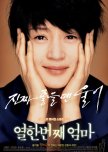
Soulful and at the same time ruthless KMovie at its finest
Wonderful actors are showing us their full range in "My 11th Mother" / "11th Mom." It's a shame that we haven't seen much from the young talent Kim Young-chan since then... Together with Kim Hye-soo, he offers chamber theater at its finest, going under the skin for long stretches. Here, action takes place inside sort of. So even though without much (seemingly) happening on the outside, time flies by just like that.In this KMovie with deliberate realistic appeal, South Korea shows one of its rather bleak living environments at the lower end of the social pyramid. "11th Mom" offers space for a twisted, basic, yet truthful love amidst a fundamentally desolate setting in this rundown neighborhood of Seoul, where there seems to be no place for the sun to shine. Thus, eventually the faces of the hopeless nevertheless start to shine, too. All of a sudden, their everyday life is no longer just dull, as there is actually some happiness for the protagonists coming along their path. True enough, there is still plenty of sad stuff going on, however there is this joy all around the awareness of being loved, too.
The bonding between the eleven-year-old Jae-su and his 11th stepmother-against-her-will is giving both their lives direction, is offering warmth, and is even healing their wounded hearts. Actually that much so that the tormented Jae-su can somehow forgive his blustering, abusive, gambling-addicted, screwed and irresponsible father in the end.
Soulful and at the same time ruthless KMovie at its finest! Despite plenty of makeup, we are presented with unadorned, bruised, yet amazingly still intact human hearts. Fantastic: the finely nuanced, rough, and at the same time frail rapprochement between Jae-su and his stepmother against expectation.
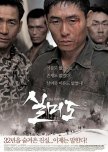
Secret SK military unit, drilled solely for assassinating Kim Il-sung, becoming victims of politics
“Silmido” is a KMovie that generated enormous public impact in South Korea. A 2003 production that used dramaturgical means to bring a previously unknown, small but rather blatant chapter of South Korean history to public awareness, that had long been kept secret and filed away. The KMovie “Silmido” had its mission fulfilled – at the box office, among the people and among those, who ultimately make decisions.“Silmido” was apparently more popular in South Korea than the Lord of the Rings trilogy or Titanic. To this day, the KMovie in South Korea is considered one of the most successful productions ever. The cast is first class. The focus is on the training camp for the secret military special unit 684 - its soldiers, its commanders, the training and living conditions. In the end we see where this all is leading to – this at that time particularly fatal involvement of the military with domestic and foreign policy, plus and foremost always at the forefront, yet hidden behind the curtain: the secret service.
The story is contrasting ambivalent attitudes towards feelings of national solidarity. On the one hand, an emotional patriotism based on the connection to one's personal origins and South Korean homeland, and on the other hand, a politically instilled national identity of “democratic South” against “communist enemy in the North”. On top of that: Unconditional obedience within the chain of command struggling with common sense...
Overall, it's about a brutal man´s military world. It is about hardline drilling methods. Yet , it is not about heroes and villains, nor about the good guys against the bad guys. Over time, the protagonists are increasingly gaining a profile, that shows some softer heartbeat, too. Camaraderie, bromance and respect for each other are in it as well. The showdown is rather disturbing.
PS:
Eventually the KMovie had its impact: in 2010, the central district court in Seoul ordered that the equivalent of around 188,000 euros in compensation should be paid out to the families of the former members of Unit 684 - the forgotten, denied unit that “Silmido” is about. The court comes to the conclusion after following public pressure and thus officially investigating the case: The Silmido soldiers had not been sufficiently informed about the hardship and dangers of the training camp, the training conditions had violated their basic human rights and the government at the time (1971) would have brought great suffering to the families of the bereaved by covering up the events.
---------------------------------------------------------
SIDE NOTE: --- Secret special Unit 684 ---
The film title "Silmido" refers to a very small, actually uninhabited island in the Yellow Sea, southwest of Incheon. Here (in response to the failed North Korean assassination attempt on South Korean President Park Chung-hee in 1968), between 1968 and 1971 a special military unit was trained at the instigation of the secret service, with just one goal: to eventually efficiently assassinate North Korean President Kim Il-sung. The circumstances surrounding Unit 684 are still not all clear. One thing is certain, though: the unit was created in April 68 (68-4) and trained in the utmost secrecy on the island of Silmido under almost inhumane conditions.
For the script quite some extensive research was done in advance. The story is based on rather thin officially existing information, added up with a few eyewitness reports, whereas gaps were filled with poetic freedom. For example, it is not clear how Unit 684 was actually recruited. However, among the specially trained elite soldiers there were obviously some with previous convictions, although not serious criminals. The KMovie ultimately decided to freely use a narrative that all the men were doomed criminals who, in their desperation without hope for an alternative future, had seized the last straw of becoming members of this particular secret unit.
The three years of elite training on Silmido had been extremely tough. Those who were not suitable simply did not survive the highly demanding torment. However, when the 31 soldiers were ready for deployment, the government decided to refrain from carrying out an assassination attempt and instead rely on a political solution for peaceful coexistence with the North. What had happened? US President Jimmy Carter hoped for a peaceful agreement. The South Korean policy followed that agenda, too. Accordingly, the head of the secret service was replaced by someone who also supported this peaceful approach. The link that was supposed to open a new dialogue between North and South was the Red Cross, not the military...
What may sound respectable, however, consequently led to the immediate disbandment of Unit 684. As of now, it officially should have never existed. Thus, 31 elite soldiers lost their right to exist. Their meaning and only goal for which they had lived (or rather survived) for the last 3 years, was trampled on... They were no longer useful, on the contrary: a disruptive factor. But politicians had made the calculation without the fighting machines they had specially drilled... this all led to a showdown in the outskirts of Seoul. As its result, however, Unit 684 went incorrectly down in history as a group of heavily armed communists... until 2003.
From 2010 onwards, it became finally official that actually those men were a South Korean secret elite military unit that had been drilled solely for the planned assassination of Kim Il-sung – until plans had changed at short notice for political reasons and some man in suits had decided to wipe out the life of 31 (in this context innocent) men in uniforms without any trace...
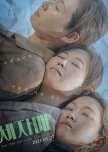
An all round ambitious work. (However, 'beautiful' is different...)
"Three Sisters" has won numerous international awards. 12 to be precise. But I'll say it right away: it's overall rather painful to look at. It's even painful to the point. Again and again. So true-to-life that it even hurts some more. Some might seem crass being focused that intensely. But at the same time it's not that crass, actually. It is the normality shining through behind the story, that is almost the most painful part of this KMovie.Three sisters, each in their unique way coping and trying to live with the pain that forces their souls into a corset from which they don't know how to free themselves. They live with their trauma. Are alone, captured within their traumatic past. They don't talk about their trauma. They are emotionally rather surviving than actually feeling alive. They are still trapped in their unresolved past today, because they don't recognize or acknowledge the corset as such. But as long as that doesn't happen, they can't put it off and thus learn to approach life, experience life without a corset...
Haunting portraits of women! So intense that the pain reaches the audience, as vicarious emotion so to speak. Fantastic actresses. An excellent KMovie in all aspects... lighting, scene, shot, cut, etc. too... An all round ambitious work. (However, 'beautiful' is different...) About a topic that is one worldwide. About a topic that is also a big one in South Korea with such a strong patriarchic family hierarchy. A trauma that far too many people on this earth learn to endure. Have to cope with one way or another. Suffer from for the rest of their lives. Being ashamed of it. Yet, actually rather being ashamed of themselves. Because they can't explain the incomprehensible in any other way. Thus they remain trapped in the ineffable.
No movie for every mood.
Yet, when the time is right, then definitely worth it.
------------------------------------------
Spoiler alert:
Here the unspeakable is spoken out at last. There is an unexpected showdown that has it all. Something that is liberating. Yes, it hurts, again – just like cold fingers starting to feel the warmth… True enough, healing is a process. (Life hardly becomes smooth&easy overnight.)
Acknowledging the corset. That is the first step. Feeling it, joggling it. This is the next step. Then get on the trail of your own feelings. Find some expression for it. Surrender to your vita and what you sur-vived so far. Let go of the corset, by now being grown and old enough to stand by your side. Grab your inner child´s hand and allow yourself to be who you are, embracing the feelings you have. All of them. The anger, helplessness and desperation, too. Be proud of who you are. Daring, step ahead. Longing to be. Being free to be. Being palpable. Being. Sharing. Communicating... giving life a second chance...
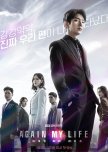
A bit of magical impetus needed to effectively counter autocratic networking and corruption
"Again my Life" is about a personal revenge campaign and at the same time a fight for the rule of law. David is once again up against Goliath. In his first life, the young prosecutor fails - and dies. But miraculously he gets a second chance. Eventually, in this second attempt he sophisticatedly works on a supportive network. ´David´ no longer fights alone."Again My Life" is part of a kind of law-and-order series invasion that swept over the KDrama world in 2022. The country seems to be crying out for justice. There is obviously a growing urge for real justice and effective punishment for the backroom masterminds, who are holding the true strings of power. A yearning for an end to eternal corruption. At the same time, there is great frustration that it seems so extremely difficult, almost impossible, to truly say goodbye to the old autocratic structures. There are laws, but they still don't seem to equally apply to everyone. For some time already, KDrama creatives (and their sources like webtoons etc.) have been fervently exploring the possibilities for a new horizon. In 2022, however, we see an unprecedented abundance, almost a climax, on a desperate path of effectively and/or morally defying the machinations of the powerful and the injustices and loopholes within the practiced legal/societal system. E. g. "Military Prosecutor Doberman", "Juvenile Justice", "Why Her", "Insider", "Doctor Lawyer", "Law Cafe", "The Empire", "May it Please the Court", "One Dollar Layer" and even "Extraordinary Attorney Woo" mercilessly bombard the audience with the same basic structural problems over and over again. In doing so, in their own individual way they juggle with the possibilities, opportunities and limitations that the legal system and the rule of law have to offer. And so does "Again my Life".
"Again my Life" is one of those productions that, bottom-line, choose a rather sobering, almost pessimistic perspective. A pessimistic tone might come from the fact that the protagonist actually needs a magical impetus to even get a minimum chance to clean up the ailing, corrupt and mendacious system: with a second life. Time is practically turned back and he gets the opportunity to live once more - to make it better with the advantage of his knowledge about connections and context.
Pessimistic might also be the fact that in the end the outlook is a questionable one. The audience may be satisfied in many respects, yet the basic problem can´t be thoroughly resolved - which I would think is pretty close to reality. The audience is mercilessly confronted with the question: is real democracy an illusion? Is democracy just a modern marketing gimmick that secretly hides the old concept of autocracy that has been tried and tested on the peninsula for centuries? A new, beautified skin for the old wine?
Is the message therefore a pessimistic one? Almost, but then no. Because even if it feels (and really) requires rather superhuman efforts (or circumstances) to counter the old autocratic domination effectively, it can individually still succeed. The evil resides in each individual human being - in our seductibility and venality. Everyone has to face that. Again and again. It's not something that's rooted in the system, but in people. People fill community with life. Everyone contributes to it. This is partake and participation. However, this is only possible with mature, responsible, self-responsible, upright citizens who cannot be bought - and thus degraded to bowed lackeys.
Autocrats (= powerful private individuals within the given democratic framework conditions) need appropriate lackeys who give them power by supporting them in undermining the existing legal system. Therefore: what may come across as a pessimistic message at second glance turns out to be a rousing warning finger: Be vigilant! Stay alert! Do not give up! Take your chance, every day! Prove to yourself that you are a sincere citizen: Self-determined. Independent. Responsible. This is the only way, democracy and the rule of law can actually work. Otherwise, we agree with those self-proclaimed autocrats - and then we don't have a right to grumble and complain... Against this background, "Again my Life" offers a compelling, exciting story and at the same time a vivid lesson in 'responsible citizens versus corrupt lackeys'.
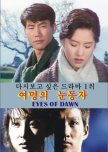
A story full of humanity in the face + despite blatant inhumanity. An epic about love & compassion
"Eyes of Dawn" marks a quite spectacular milestone for South Korea Television Series as well as the kick off for a new era of TV production – ambitious in terms of time sensitive content as well as an artistically valuable approach. The production dates back to 1991… South Korean life is just cautiously starting to be a bit less suppressed."Eyes of Dawn" is the creative script and cinematic processing of a novel, which deals with the tragic relationships of the three protagonists Choi Dae-chi, Yoon Yeo-ok and Jang Ha-rim as well as the bitter history of their time. The story takes place during the Japanese colonial rule, during the last years of the second world war and reaches up to the liberation of Korea and the time of the Korean War.
The KDrama begins its story during the last years of World War II – with Yeo-ok, a comfort woman, who like cattle is being shipped to northern Manchuria, and Ha-rim, who is drafted into the military as a student. Yeo-ok meets and falls in love with soldier Dae-chi, while serving as a comfort woman for his Kwantung Army unit. (With Ha-rim she only meets much later. )The world war and the subsequent struggle in Korea for a new political identity grind the three protagonists mercilessly through somewhat traumatizing mills. Love and passion accompany the three on their dramatically entangled paths, where they sometimes meet, sometimes separate, meet again and separate again within the turbulent swell of their time. Showdown is during the Korean War at Jirisan Mountain – in the ´eyes of dawn´…
For this KDrama MBC spent a lot of money – more than 5 times as much, compared to other TV series. It was shot at original or similarly exotic locations abroad. (If you like, see also the side notes below.) The project feels more like an approx. 36-hours-long movie. With "Eyes of Dawn" MBC celebrated its 30th anniversary with a bang, so to speak. The KDrama was enthusiastically received by the audience. For director Kim Jong-hak, "Eyes of Dawn" was the breakthrough. The former journalist came to MBC in 1977 and worked his way up the ranks with historical dramas in a politically turbulent time full of rapid changes (in series production, too). However, "Eyes of Dawn" is his first truly self-responsible of two innovative, groundbreaking masterpieces (the other being "Sandglass"). Thus, Kim has unsparingly reappraised the latest history of his country and his compatriots with a confident original signature and thorough, artitistic determination. At his side, screenwriter Song Ji-na provided a well-rounded, coherent script with depth and complexity. A team of talented actors and an intensely lingering soundtrack rounded off the ambitious projects with a high entertainment value.
Fantastic actors. The three leads in particular, but not just them. This applies to everyone else – there were an impressive 270 actors as well as around 21.000 supernumeraries involved...
"Eyes of Dawn" and "Sandglass" are actually both (in contrast, for example, to the younger KDrama "Faith or The Great Doctor", which Kim Jong-hak also had directed) reduced to the essentials when it comes to dialogues. Passionate, but also ruthless in the authenticity of sometimes ugly, even brutal details. Gross and austere, yet visually stunning, too. With selected camera angles that often say more than words, and scenes, that burn into your memory. The KDrama wants to show life as it was, back then... 'Nice' is rare. Sincere it is, though. Serious. A great piece of series culture. A dream of a historical drama, aiming at bringing history to consciousness in a memorable, authentic way. Thus, what happened is not forgotten. It is a cinematic monument: Take a look! Feel it! Recognize what happened! Estimate! (Too bad, it's not widely circulated with at least English subtitles... however, apparently there's a musical now... well... let´s hope.)
The story offers merciless insight into the suffering of the comfort women who, even as teenagers, were often brutally physically abused for the pleasure of the Japanese soldiers – a war crime that has not been adequately investigated and atoned for to this day. In principle, people of Chōsen were systematically oppressed back then. The Chōsen soldiers in the Japanese army, thus also had a particularly hard time, as the KDrama bluntly shows, too. And then there is the turmoil and ruthless brutality of diverse war sites in inhospitable locations around the Pacific Ocean, and later between brothers and sisters as the Korean Peninsula was coldly caught by the increasing Cold War. With the uprising on Jeju-do becoming part of the story, an up until then rarely discussed aspect of the late 1940s comes to mind. As well as another, often suppressed war crime that Japan had committed against its international prisoners in connection with Unit 731: mostly deadly ending medical experiments on several thousand men, women and children in one of the coldest places on earth, in northern Manchuria. (In case you didn´t know, you may see the side note below.)
But "Eyes of Dawn" is also a story full of humanity even in the face and despite all blatant inhumanity. An epic about love, friendship, connection and compassion. There were plenty of awards. I line up there. This KDrama production is particularly valuable…
(...especially from a historical point of view for me as a European. Although I did take history as an advanced course in school, I somehow had never considered a lot of these events and topics really seriously before. But even beyond its historically enlightening ambitions, "Eyes of Dawn" consistently and purposefully tells a powerful story about three (ordinary) people of their time and their tragic fates, complexly woven into an emotionally touching love triangle.
(For the sake of completeness: as this KDrama is from 1991, visual and acoustical quality obviously can´t be compared to recent standards...)
----------------------------------------
SIDE NOTE
--- Some background information on the Pacific War and the filming locations at the original historical locations ---
- War sites on the Chinese Mainland – Northern Manchuria
World War II began in Asia with Japan's invasion of China in 1937. The Second Sino-Japanese War was fought almost exclusively on the Chinese mainland until the end of 1941. Only with the Japanese attack on Pearl Harbour on December 7 in 1941 did it spread to the entire Pacific and had the US allies also intervening in the war against the massive Japanese expansionist policy. Thus, in the course of 1942, the balance of power shifted towards the USA. However, the warfare was difficult. The scenes of the battles were often in impassable swampy areas and rain forests, where tanks and heavy artillery could not be used. So there was a lot of fighting in the air and on the water. In November 1943, the Soviet Union also opposed Japan and opened a second front in Manchuria. The air for Japan was getting thinner and thinner. The army motivated their soldiers by employing 'comfort women', practically forcibly recruited from their colonies, who accompanied 'their' troops as sex slaves and had to ensure their good morale. Among them were minors, too (like the fictional Yeo-ok).
- In the jungles of Burma
In its large-scale campaign to conquer all of Southeast Asia, after the effective invasions of the Philippines, Indonesia and Malaysia, Japan was also able to take Burma in the spring of 1942. China was thus cut off from supplies. Starting from Ledo in British-Indian Assam, the USA had an extra supply road built through Burma's jungle – the "Ledo Road". In the meantime, the Japanese troops were pushing the British further and further back into the north of Burma, ultimately driving them out of the country for good and even pushing forward into India in a further offensive. The Japanese army had now themselves fallen victim to the lack of replenishment with supplies. They originally only had food for three weeks. After that they had to see for themselves. (These jungle fights become the operational area of the fictional Dae-chi.) In this context, in 1944 the fierce hand-to-hand combats at Imphal and Kohima south of Ledo marked a turning point in the course of the Second World War as the British reinforcements arrived just in time.
- Saipan: Strategically important Mariana island in the middle of the Pacific Ocean
In mid-June 1944, the US Marines landed on the south-west coast of Saipan in the bitter struggle for the strategically important island chain of the Mariana Islands in the Pacific Ocean. This also becomes the setting in "Eyes of Dawn", because Ha-rim is stationed in the field hospital here and Yeo-ok was also shipped there as a comfort woman.
Three weeks after the US Marines landed, the heavily fortified island with its three airfields was owned by the Americans. From here, the neighboring island of Tinian could also be taken, from where the atomic bombers in the direction of Hiroshima and Nagasaki actually started about a year later.
- From Liberation of Chōsen to Korean War
The Japanese surrender in 1945 was followed by the liberation of the Chōsen colony. Contrary to the Western view of this 'liberation' of Korea and the role of the USA in supporting/forcing a democratic South, which for me as a German is more Western, in "Eyes of Dawn" you get a non-Western portrayal. The post-colonial struggle of the people of Korean origin for their political sovereignty, previously stolen by Japan, began even before the (rest of the ) world recognized it as the Korean War in 1950. "Eyes of Dawn" portrays the time of the tussle between the USA, Russia and China on the one hand and the search for a new national Korean political identity on the other. The KDrama emphasizes this in a dramaturgically moving way using the example of the fatal triangular relationship between Dae-chi, Ha-rim and Yeo-ok in the back and forth of their pro- and anti-communist agent activities and in the service of the army of the newly installed Republic of Korea on the one hand and those who resist this government on the other partisan army on the other hand.
----------------------------------------
----------------------------------------
SIDE NOTE:
--- Jeju Uprising 1948/49 ---
A notable sequence in connection with the resistance against the US-sponsored Rhee government is the April 1948 to June 1949 uprising on Jeju Island. The KDrama had its scenes shot on location. Just consider, that at the time of the uprising almost every family on the island had probably lost someone, but for decades silence was officially decreed about this mass murder launched by their own (new South Korean) government. Surviving 'activists' were banned from working throughout South Korea. "Eyes of Dawn" is one of the first public confessions and the cautious approach to coming to terms with the past with regard to that dark first chapter of this young republic.
The USA categorically rejecting any kind of communist orientation regarding a political future as South Korea or all of Korea, were faced with plenty of riots and guerrilla actions in the course of the national resistance against an (yet again) unwanted paternalism. The uprising on Jeju Island is arguably one of the most shocking examples. After expressions of dissatisfaction with the planned elections for the US-sponsored government and resistance to renewed foreign rule, the population was ruthlessly massacred by the Korean army and the help of the US-Army´s occupying forces. The people fled to Hallasan mountain area while their coastal villages (270 out of 400) were destroyed. There is disagreement about the number of actual casualty – the numbers vary between 27.000 and 140.000.
In 1991, when "Eyes of Dawn" was broadcast, this topic had not yet been officially dealt with – but with this KDrama the uprising got an unmistakable voice and recognition for the first time. It was not until 1999 that the government convened a thorough investigation. In 2006, the government officially apologized. However, police and the Department of Defense only came up with an apology recently, in 2019.
-----------------------------------------------
------------------------------------------------
SIDE NOTE:
--- Region of Harbin in northern Manchuria and Unit 731 of the Japanese Kwantung Army, which experimented with biological and chemical weapons on humans and then used those on civilians as well ---
Japan had already secured influence in northern Manchuria during the course of the first Sino-Japanese War by building the South Manchurian Railway. The valuable raw materials mined here were transported to Chōsen and shipped from there to Japan. The railway was under the protection of the Japanese Kwantung Army. Between the first two world wars, Russia, Japan and China fought for supremacy in Manchuria. Eventually, with the Japanese occupation of this economically viable region in 1932, they established the puppet state of Manchukuo, with Harbin being its largest city. Here was the stronghold where Unit 731, led by Ishii Shirō, began their spooky experiments. At last, after the end of war, between 1945 and 1948, the Communist People's Liberation Army, strengthened by its anti-Japanese resistance concentrated its forces in Manchuria.
Surgeon General Ishii Shirō and his Unit 731 were busy starting 1932 in and around Harbin with experiments on living people. Around 3.000 mostly bacteriologists worked for Unit 731. An estimated 3.500 mostly Korean and Chinese civilians as well as Soviet prisoners of war were victims of their cruel human experiments.
The experiments of the Imperial Japanese Army's secret Kwantung Army Unit 731, disguised as the "Department of Epidemic Prevention and Water Supply Department" laid the groundwork for a wide variety of horrific war crimes during World War II. Among this ´research´, for example, were investigations concerning varying effects of grenades on the human body depending on distance and position, investigations into the effects of bombs filled with a variation of bacterial powders, of pest bacteria or anthrax bacteria, or bombs filled with fleas being contained by such bacteria. It has been proven that Chinese prisoners of war were given food that was deliberately contaminated with typhoid pathogens. During the final years of the war, around 130 kg of anthrax warfare produced by Unit 731 was used to contaminate lakes, rivers and wells on enemy soil. Finally US prisoners of war were 1943ff used for experiments of Unit 731, too. E.g., for research about the susceptibility of 'white' people to epidemics. During the course of the war, another tens of thousands of mostly civilians died from rat induced epidemics of plague, of anthrax and of typhoid pathogens as a result of ´field research´ and by the use of thus produced biological weapons, based on the 'medical research' in Harbin.
And for further information:
Unit 731 always had the full support of later Japanese prime ministers, and the Japanese imperial family was aware of it, too.
The main perpetrators of Unit 731, including Ishii Shirō himself, ultimately remained unpunished after the war crimes trials – in exchange for the research results that they handed over to the USA.
----------------------------------------------------
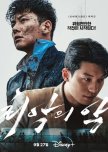
Brutal, merciless milieu of gangs & drug cartels. Stirring, gloomy but with soulful strings, too
What a positive surprise. For all those who are not afraid of the brutal, merciless milieu of gang wars and drug cartels: "Worst of Evil" offers intense characters with dynamic profiles, especially of the two protagonists - the rural police officer who joins a new Gangnam gang as an undercover agent, to help uncover the organized drug trade between China, South Korea and Japan, as well as the boss of that Gangnam gang.In particular, Ji Chang-wook as Park Jun-mo alias Kwon Seung-ho puts his heart and soul as well as quite some muscles and fighting into it. Whatsoever, he is impressive. But so are the others. It´s well cast and Disney+ apparently didn't skimp on anything...
For me personally, gang stories like this one aren't really my first choice. Too much crude violence, too much highly concentrated testosterone... "Worst of Evil" is no exception. Sharp blades and baseball bats are in high demand, especially in the first half. Nicotine seemingly acts as nutrition and even the fanciest suits can't hide the fact that a lot of blood is being shed unscrupulously...
Nonetheless.
“Worst of Evil” features complex characters and highly explosive relationship dynamics that is touching, gripping and, more importantly, provides emotional substance, too.
Eventually, undercover operations are psychologically demanding. The boundaries between true and false identity are blurring. A solid compass for right and wrong can easily be lost. The reality of living the undercover life creates new truths in which even the 'false' identity becomes a ´true´ part of one's own life. Coming to terms with this obviously is not easy. The return to the old life as it was before, even less so. In the case of "Worst of Evil", these internal and external conflicts of our undercover investigator become even more difficult by the fact that his wife has a history with the gang boss that he knew nothing about. She, his wife, herself a police officer and officially not ´his´ wife in terms of the new undercover identity, is now drawn into current affairs in a way that the small special investigation team could not have foreseen.
Not to mention the fact that the drug cartels involves powerful partners, not only in South Korea, but also in China and Japan. At last, the homicide police also get involved in dealing with everyday gang activities and murder cases in Gangnam. None of those involved is squeamish whatsoever. So danger lingers everywhere. Not only fists and fights, but also intelligent, diplomatic solutions are required. High-end improvisation is on the agenda for our hero.
"Worst of Evil" is thrilling, stirring, gloomy and – despite all the blood that boils over and over again (and all the copious amounts that are spilled) – it has its soulful strings, too. It's about trust, loyalty, bromance, the relativity of 'right' and 'wrong', and ultimately the ethical question of which end justifies which means...
Is the story predictable? Well, I can't fully deny that. But in "Worst of Evil" the journey is clearly the destination - what the undercover special operation DOES with this once "mother-in-law's favorite" and how he comes to terms with it. In addition, his counterpart, the self-proclaimed, brash, brilliant gang leader, is also quite interesting. With his vita, his goals and desires, he doesn't really fit into the usual cliché and thus brings additional dynamism. In addition, several other characters in the cartel (and police) environment impress with strong profiles, too.
As I said, I was pleasantly surprised. "Worst of Evil" had me. It's pretty well made all around and has actually more to offer than just ruthless gangs and action. (Nevertheless, be prepared, it still is about the milieu of ruthless gangs...)
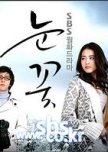
Timelessly dealing with crucial mis-communication issues in families. (Here: single parenting, too)
In a way, the title "Snow Flower" symbolically refers to a time when the love of the protagonist´s parents was still full of happiness. However, the KDrama actually comes along as a study about communication difficulties and misunderstandings between a single mother and her young daughter where the daughter is struggling with the question: why can't she grow up with mother AND father, like other children do? There must be someone to blame for this – The father? The mother? Or even herself... "Snow Flower" dates back to 2006, yet dealing with crucial educational issues in a timeless manner.In KDrama style, the story is enriched with a variety of dramaturgical colors. However, the sticks and stones are (unfortunately) not all absurd. This and That may be culture specific, but overall I think "Snow Flower" offers a wonderful (though not so fun to watch) study about mis-communication, which are (varying in intensity and severity) experienced by many families (and relationships) all around the world. Go Ara won Best Actress at Baeksang Arts Awards, i.e. for her great performance as a rebellious daughter. At her side strong as usual: Kim Hee-ae.
SBS tackled a topic that washes unloved laundry, because in South Korea family issues in education are a private matter, happening behind closed doors and being nobody's business. Actually, the family here is quite progressive. The mother is a single parent and successful writer, dating an art professor. Two neighbouring families, with their doors always open for each other – practically an extended family with no room for secrets.
Yet, a progressive attitude towards life alone has very little to do with the communication traps in family life. The mother falls into these traps, and so does the daughter, having inherited her mother's temperament. It's sometimes painful to witness, how one or the other keeps reacting to another and another red flag, blindly fighting back within seconds and thus creating conflicts that cannot be resolved, as the explosion has already been set off before communication is possible.
The offering of this KDrama: while we have to listen to their fights, we are also do participate here and there, in what they are quietly thinking and feeling, too. Thus, "Snow Flower" does not ONLY want to stage DramaDramaDrama with this conflictual mother-daughter relationship, but is also committed to an educational mission. (You may also want to check the side note below.) The background is embedded in the world of the filming industry and rooted in the handicap of single parents and divorced families.
So in "Snow Flower" the deeply disappointed and insecure daughter pushes her thing through, while the mother doesn't succeed in letting go of her well-meant (those are the worst) templates. Up to the bitter end. That's impressive. Startling, too.
p.s.:
Some may say – and I agree – the mother-daughter communication is most of the time so off the charts. It's scary sometimes. Nevertheless and actually because of that, (in my opinion) the script and the actresses do their job quite well. (However, one does not have to like it...)
Due to the given occasion: here is a side note on the communication problem between Dami and her mother, which (unfortunately) many families struggle with more or less severely. (By the way, as such conflicts are happening within the ´best´ families, professional coaching is available – and might have been a solution for Dami and her Mom, too.)
------------------------------------------------------------------------------------------------------------------------------------
SIDE NOTE --- on the widespread communication problem between parents and children ---
Even though opposition is rather due to attitude, position or opinion and is nothing personal as such, emotionally this can be hardly distinguished in the heat of the moment. How liberating it would be, if both parent and child would listen carefully, ask questions, and try to reach mutual understanding. Some call it communication…
In many conflicting situations, it is first and foremost about being noticed and understood by the other person. Thus you have to show yourself. Self-confident in who you are and what you want or are afraid of. As a result, the conflict resolution in the matter is actually not that difficult anymore.
Win-win, so to speak.
(Easier said than done… Most of the time, a more or less pronounced self-doubt, for example a thorn of guilt or inferiority, subtly gnaws at the foundation of a sincere, self-confident presence - in parents and children alike.)
However we my look at it, most of the time we have to do something for mutual understanding. Yet, more than other relationships, mother and daughter are probably predestined to believe that they can take this 'understanding' for granted without a process of understanding – after all, it is about 'their own flesh and blood', isn´t it.
Incorrect! These are two individual people with their own will, their own memory, their own experiences, their own desires and their own interests. Blood/love aside... Thinking that you know the other person well does not replace the need to invest time, patience and a willingness to cooperate in understanding again and again.
'Are you making a relationship statement here?', ´Are you trying to be practical?'. ´Is that a request?´, ´Do you actually want to reveal something about yourself right now?´, ´What do you want?´, ´What do I want?´ … All this requires consideration. Again and again! And 'again and again' means, strictly speaking: 'often' or even 'constantly'. After all, parents and their children usually share the apartment, show themselves without make-up in many respects, see each other first and last every day and plenty in between. There are many chances of contact/friction. Annoying communication can get on your nerves, yes. You have no time, you are stressed already, you are not in the mood...
Consequently we mostly choose a quick judgement, because that is more economical. A preconceived notion, a prejudice that doesn't seem worth trying to test. But in doing so, we might be hardening the fronts, and thus the roller shutters go down. There is no forward (e.g. solution) and no backward (e.g. bonding). Lose-lose, so to speak.
"Snow Flower" impressively portrays how such confirmedly unresolved conflict situations encourage the child (here the daughter Dami) to finally repay the parents (here the mother) at some point. This crucial moment was actually (as so often) triggered by a key event.
Suppressing her need to be close to her mother and to wanting to feel connected and loved, Dami now deliberately treats her mother the way she FEELS treated herself (without having confirmed any of that, of course). The need and longing hasn't gone away. It's just relegated to an unconscious level for the time being. Consciously and outrageously she rather strikes back in defiance, deliberately wanting to hurt – just as she feels hurt. "I don't do any university entrance exams". "I don't even want to study." "Then I'll just move out." And underneath (pronounced or not) linger disappointment and self-doubt, e.g. "I'm probably not worthy of being loved." "It would be better if I didn't exist at all"…
Dami navigates between the roles of perpetrator and victim and doesn't get what she actually wants in either of them. Yet, both are ROLES, and not her true SELF.
Additionally, in her newly discovered role as a perpetrator Dami even worsens the situation in an almost fatal way, because such a defiant reaction is considered extremely immature by parents. In the case of Dami´s mother, this inevitably leads to the conclusion that she should actually take more even control. However, by boldly taking her parenting responsibilities back into her hands, she only adds fuel to the fire.
The past that led to this dilemma is long history for both of them. Both feel they did their best. In terms of communication, however, this is not the case. They may have 'meant well' for the sake of peace, but they didn't communicate what´s actually on their MIND. Well, what´s on my mind is 'Mine' and not 'Yours', until I let you know.
To disagree is not the problem. Different perspectives and intentions are normal. Unfortunately, a cooperation oriented process of communicating is not...
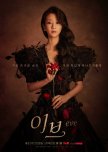
Dynamic with high intensity caused by a sheer impossible tension between self-control & surrender
Revenge and KDrama obviously go extremely well together. TV productions are full of it. Actually, the revenge-motiv appears to be eternally young, being grippingly re-staged over and over again. "Eve" from the year 2022 is one of them - idiosyncratic, with an unmistakable coat of paint. "Eve" is about a long-planned vendetta against one of the most powerful Jaebeol clans in the land. "Eve" may join a long list of KDramas in the revenge genre. However, this KDrama scores with its very own charismatic aura.Premise of the revenge-plan against the most powerful: Perfection should be brought down by perfection.
Maximum control should be conquered by maximum control.
If one wants to control life to perfection, what remains is a lifeless, loveless shell. The price of power is transcending one's humanity. The little Jaebeol preschool daughter vividly fights the emotional price of power: she's already learning to play golf, but she's still peeing her pants - she´s overstrained ... Living the Win are her parents and grandparents: feeling and behaving like deities... The perfection of arrogance finds its direct expression in the control, the unscrupulous abuse and the brutal oppression of others. It goes hand in hand with self-control. Yet, the extent of the staging of their 'beauty' and ´perfection´ becomes downright repulsive and turns 'beauty' into its opposite - disgust.
The (dramaturgically chosen) valve grounding the human being in his earthly transient body is the dance. Here especially the tango. Exotic, erotic, heavy, deep, dark. The dance, the rhythm and the music bring you back into your own body. You have to listen to it - in tango to the body of the partner, too. So it's also about perfection here, but it consists of perfectly balancing your own body movements with personal authenticity, feelings and perception. THIS ´perfection´ draws from itself and is not at the expense of others. It culminates in a state of relinquishment of control - an altered state of consciousness. This condition only lasts for the moment of the dance, for the moment of encounter. (The Andalusian flamenco even coined its own term for bringing the dance to perfection: 'Duende'. This concept stands for an almost ecstatic state of consciousness that results from surrendering to the interplay of different brain areas, physical dance technique and emotion.) This moment makes you feel alive - intense, true, pure and innocent.
Throughout the individual episodes the revenge-hungry protagonist (a fantastic So Yae-ji) maintains an extremely high tension between the poles of maximum possible emotional self-control (in the service of the elaborate revenge plan) on the one hand and complete surrender to the sensual, invigorating movements of tango dance on the other. As the dance draws its power and charisma from the depth of the subjective, authentic emotional world, maintaining this tension is almost impossible. In fact the KDrama thrives on this very special dynamic (of the sheer impossible bearing of the tension between self-control and surrender). The result is a consistently high and gripping intensity.
I have read some reviews that accuse this KDrama of the (missing) chemistry of the protagonists or the ending or the resolution of the revenge motive, or even the revenge motive at all. Well, that is of course a matter of taste, too. In any case, I think the motive for revenge suits South Korean authoritarian society. Even today. I also consider the character of Kang Yoon Gyeom being drawn (and acted) extremely well - if the protagonist were sympathetic, open, tangible (and, if you like, more classically attractive), then the relationship dynamics would be more predictable. His repulsive, calculating side suits him. The fact that he is 40 already plus he doesn't really fit the image of classic male love interest suits the role, too. So do those very subtle nuances that reveal his other (touchable, needy) side. He is not extremely likeable. I agree. Yet, thus the provoking relationship with him subtly, unintentionally and unexpectedly develops its own dynamic. The ambivalence - attractive vs. repulsive - comes across quite well in my opinion. A strange chemical mixture, an unknown factor in the revenge plan equation. The reactions triggered by this in turn leads to an ending, that is what it is. ... Either way, revenge NEVER makes you really 'satisfied'. Because the pain of the old wounds or the memory never goes away, and the loss cannot be reversed either. On the other hand, with revenge new karma comes along and is guaranteed to be saddled on top of everything else, which one has to spoon up ... (This is usually overlooked when one sets out to take revenge...)
From my perspective, "Eve" is a haunting KDrama - with a lasting impression for sure.
It might also be worth mentioning:
The staging of the cruelty within the Elite world, their madness as well as the space given for the sexual dimension of the relationship are exceptional for a KDrama. However, these deliberately staged rather animalistic or even archaic aspects of the human species (which are assigned to the evolutionarily older brainstem or reptilian brain) set a sharp contrast to the hypocritical, superhuman self-portrayal of the Jaebeol elite...
---------------------- SIDE NOTE: --- Revenge motive and KDrama - for once wanting to control the elite 'authorities' who otherwise control the rest of the country ---
South Korea (with its comparably recent dictatorship history) is probably one of the places on earth where (perhaps a little bit more than in many other places where rule of law has already gained a somewhat more solid footing) rules still mainly apply to 'simple' people, the masses. The influential Elite, the Jaebeol in particular, namely play their private, own, elitist game. They are isolated from the rest of society. They seem to own the world. They live and rule as they please in their own orbit. When their world collides with the masses, it's annoying, but rarely turns out bad for them. They simply get rid of disruptive factors (or better: let others get rid of them). They enjoy all the freedoms. For them, ordinary people are actually of no worth. They can be substituted. They can be controlled by money or violence.
The state should actually be responsible for objective justice. But 'state' is made up of people. And the less binding the objective rules are handled by these people or the more rules can be bent, stretched and interpreted in favor of the 'perpetrators' from elite circles, the greater the subjective dissatisfaction and the stronger the desire of the 'victims' for vigilantism - the desire for revenge!
However, there is a difference between the desire for revenge/subjective justice and the realistic possibility of actually getting it. For the influential powerful, a few phone calls may suffice. The common people have to be a bit more subtle and sophisticated. Vigilante justice needs to be well planned. Especially if you want revenge on a person from the orbit of the Jaebeol. It costs time and money to be able to penetrate their world at all. In most cases, sworn helpers are also necessary. After all, it is to be expected that the same applies here: a plan is there to be discarded... Not everything can be foreseen. Details have to be improvised. The space for the unexpected can only be calculated with a degree of blurriness.
Against the background of authoritarian South Korean social structure, KDrama and revenge motif often and happily enter into a dramaturgically promising connection. It offers a vicarious valve for the emotions of the many ´victims´ of a corrupt system...
---------------------------------------
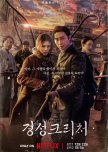
In its monstrosity hardly dealt with war crime pulled off the dusty shelf in vividly stylized mode
The Netflix production “Gyeongseong Creature” turns out to be quite an idiosyncratic mix. Studio Dragon had the opportunity to experiment and make full use of an illustrious cast. Despite some clichés, "Gyeongseong Creature" is not a banal K-drama that you quickly forget.Basically it's another hero´s quest of some hero against his will, discovering unexpected sides of himself. It´s another ´mission impossible´ right into the lion's den - in this case: the military hospital of the Japanese colonial army base in the middle of the capital of the Chōsen colony in 1945. It is not the fair maiden who is to be saved, but the kidnapped, impregnated courtesan of the chief of the Japanese police. It turns out that a 'dragon' - in this case an artificially created monster - also has to be overcome along the way. The hero is flanked by a motley crew of long-standing and spontaneous companions...
Now this old wine comes in a freshly spiced-up Korean-style bottle. The personal touch of "Gyeongseong Creature" is precisely that Gyeongseong in those final months of the Pacific War, when Seoul bore that name. The historical setting as well as the historically and socially significant issues of Japanese colonial rule give the plot its selectivity and a quite serious foundation, so that "Gyeongseong Creature" does not simply offer interchangeable run-of-the-mill entertainment. Here, a painful chapter of South Korean suffering is intertwined with personal fates in the form of loosely interspersed critical events during colonial rule that is officially (by Japan) to this day preferable neglected, not to mention rehabilitated. With this Netflix production it has been nonchalantly thrown onto the World Channel to be proclaimed and acknowledged in HD.
This involves in general: the arbitrary racist violence and oppression against the Koreans as well as the systematic torture and execution of suspected resistance fighters in Sodaemun Prison; the forced military conscription and bullying of Korean soldiers within Japanese units; the forced recruitment or abduction of comfort women for (mass rape for the pleasure of) frontline soldiers... And specifically in the case of this story: the monstrous machinations of Unit 731 as part of the Imperial Japanese Army, which went down in history for its inhumane experiments on human subjects. Although these experiments actually took place mainly in Harbin in Manchuria (see side note below), they were for this KDrama also imported to Gyeongseong for a compact narrative stringency.
Against this background, "Gyeongseong Creature" tells its fictional story with artistic license. In some scenes you may get the impression that you have lost your way in a parody. Despite of such incomprehensible human menace and distress, the story presents itself at times completely unimpressed by any seriousness. There is room for humor and coolness, (which sometimes made me think of a parody of 'James Bond' or alike production). There is this reluctant hero who sometimes appears naive, sometimes quite cheeky and self-confident. He´s someone who has learned to achieve his goals, but who prefers to stay out of any trouble, wearing a stylish suit. And then, out of nowhere, he can withstand torture and injuries as if it were nothing at all. You can't really take this seriously. And yet...
In contrast, there is plenty of objective seriousness and expertise from the two foreign travelers on their detective mission. Pleasant extra: a clever, self-confident FL who is quick-witted in every respect.
In contrast, there is also the extremely dark world of medical experiments (and their artistic documentation) – underground on the military site.
In contrast, there are also the monsters, the army and the imprisoned test subjects.
And in the middle of the perfidious chase, the great feelings of humanity shine through: familial bonds and solidarity as well as wounded pride and jealousy act as driving forces, flanked by patriotic resistance and questionable scientific ambition. It's hardly surprising that Cupid also shoots his arrow in passing.
Not only do the individual characters at times feel like caricatures of themselves, Gyeongseong's production, choreographed in light and colors, also seems to come from an unreal fairytale world. While the pawnshop shimmers in all colors, the Japanese research laboratory is stylized as a dark dungeon beneath the military prison. And then there is the Moonlight Bar on the one hand and the police chief's property on the other - each of them control centers with a certain (political) impact. All of this is impressively aestheticized again and again in hand-picked scenes and settings. Sometimes you can feel like you're in the theater and then again like you're in the high-resolution digital world of a computer game.
So is the KDrama worth watching? On the one hand, "Gyeongseong Creature" takes itself very seriously with regard to its historical contemporary themes, but on the other hand, in the clichéd exaggeration of the individual characters, it apparently doesn't. This KDrama mix chosen for "Gyeongseong Creature" is, in my opinion, quite daring. However, I mean this in a benevolently positive way, in the sense of 'feeling free to experiment'. You might have to get used to it - but easily so. The (let´s say) rather 'banal' entertainment element - the Mission Impossible in view of the numerically superior Japanese military and the monster creation - is effectively intertwined with painful historical reality in a strikingly piquant and catchy manner. During the action-packed and visually stunning ride through the episodes, the KDrama subtly but consequently throws its barbs of memory at the audience.
The KDrama surely is offering cinematically solid entertainment with a star cast, but at the same time, based on the different personal backgrounds of the main and supporting characters, it demands acknowledgement of how the Japanese dealt with Koreans at that time. By stylizing the manifestation of Unit 731's monstrous experiments and research in the form of a concrete monster with superpowers, "Gyeongseong Creature" symbolically brings the unsatisfactorily dealt with war crime off the dusty history shelves in an unmistakable monstrosity.
...
Well, a second season has already been announced.
This will obviously be set in contemporary Seoul, though. We´ll see...
---------------------------------------------------------
SIDE NOTE: --- Unit 731 of the Kwantung Army of the Imperial Japanese Army ---
From 1932 onwards, Unit 731 of the Kwantung Army of the Imperial Japanese Army under the leadership of Ishii Shirō was stationed in Harbin, the largest city of the puppet state of Manchukuo in northern Manchuria. Around 3,000 mostly bacteriologists carried out experiments on living people there. The test subjects imprisoned and tortured there were predominantly Korean and Chinese civilians as well as Soviet prisoners of war. Later, including American prisoners of war, too.
Unit 731 of the Kwantung Army of the Imperial Japanese Army was disguised as the “Main Branch of the Epidemic Prevention and Water Supply Department.” In fact, Unit 731 in Harbin is responsible for the most cruel experiments on living humans. Later, field research was also carried out using the biological weapons developed in Harbin. The victims based on this research alone were mostly civilians - tens of thousands came together over the course of the war years.
I would like to ad that the main perpetrators of these war crimes by Unit 731, who had the full support of the later Japanese prime ministers and the Japanese imperial family, remained unpunished in exchange for the research results that they handed over to the USA...
PS:
There was no offshoot of Unit 731 in the fictional Onseong Hospital in Geyeongseong. That's fictional.
There was no Onseong Hospital in Gyeongseong either.
However...
---------------------------------------------------------
SIDE NOTE: --- Gyeongseong Japanese Military Hospital ---
The main KDrama setting is a colorful look and feel of Gyeongsong (Seoul at that time). The focus is on the architecture of the Republic's former Defense Security Command Center. On the area between the palace and the old town of Bukcho a military hospital was built by the Japanese in 1928. The Onseong named Hospital in "Gyeongseong Creature" is fictional, but the architecture that takes center stage is in fact related to a real Japanese military hospital before later actually becoming part of the Republic's Defense Security Command Center.
Until about two decades ago, this area was an urban area closed to the public and with bad memories for the people - not only of the activities of the colonial rulers, but also of their own military, which staged a coup against the people here in the 1970s. Furthermore, many South Koreans were tortured and mistreated there (by the security officers of South Korea's dictatorial regime). Until recently, human rights was an unknown concept behind those walls.
The ensemble could have been demolished, but the people decided to preserve the building as a memorial. The historical witness is now part of the National Museum of Modern and Contemporary Art. The bloody past is thus being countered with something positive: the imagination and emotional power of modern art.
Here, with the KDrama "Gyeongsong Creature", the dark past of this military area bearing a bloody and painful past, which began with Japanese colonial rule and was later continued by South Korean government officials, comes to life again with artistic license, too - as representative contemporary witness in HD.


