

 10
10 42
42 15
15


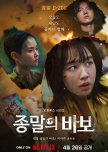
Slow paced & soulful slice of life - HOW we are living being more important than surviving
Beforehand: Anyone who expects "Goodbye Earth" to be a 12 episodes long doomsday blockbuster in the face of an impending apocalypse is completely wrong here. The KDrama has nothing to do with a fast-paced, action-packed and adrenaline-arousing desperate fight against an approaching asteroid.Plus: Yoo Ah-in's lead role, due to a charge of illegal drug use, was reduced to a minimum during production. So somehow it had to be improvised in terms of content. But in my opinion, a stronger focus on the female lead (played by Ahn Eun-jin) didn't hurt.
I would say "Goodbye Earth" is a ´slice of life´ centering around a bunch of rather ordinary people in a rather ordinary residential area in the city of Ungcheon. The remaining city population is expecting the crash of an asteroid that is on a collision course with the Earth and, according to calculations, will hit the Korean peninsula. Other than that, people live their lives - which, compared to before, obviously are not quite the same... So this dystopian KDrama is not about averting disaster. It's about continuing with life - until the end. Together. But, now, what do all the noble, dutiful, corrupt, holy, street-smart, arrogant, simple, life-hungry, in love, pregnant, believing and criminal variations of human beings do with this knowledge of their collective death?
Significantly, the looming asteroid isn't the worst thing at all in “Goodbye Earth”. In this particular scenario, the political order had already largely collapsed. Those who could afford it, had tried to save themselves. Eventually, the power vacuum was filled in no time. But fortunately, "Goodbye Earth" does not medially exploit the dystopian scenario to gleefully indulge into man's cruelty, unscrupulousness and insatiable greed even in the face of the bitter end. In fact, the KDrama gives its time and space mainly to interpersonal dynamics of a certain community - a diverse collection of people, young and old, who know each other from their community life, from school, from childhood. Only over time, little by little, in interspersed flashbacks, do we find out how they are all related to each other and what actually connects them. We walk along with them - during their last days, which are unstoppably shrinking in number… until the collision with the asteroid. Thus, emotionally, episode by episode, we get to know the people and their neighborhood better and might even grow fond of them, too.
The people in Ungcheon are actually less concerned with the approaching asteroid itself than with why and where their priest had disappeared or what had happened to the church money. And then there is this gang of criminals who among others specialized in child trafficking. The pain, fear and hopelessness felt by the people of Ungcheon is more likely to be caused by the collateral damages beforehand of the asteroid collision, than by actually facing their end.
It is slice of life in the context of a rather bizarre, extraordinary life situation. While people have to process their traumatic, crucial life experiences, talking and sharing might actually help to overcome emotional alienation or even frenzy. Yet... This is beautifully demonstrated in several examples. Sooner or later, close to the end the question arises as to what really counts...
In my opinion, this is a quietly gripping and complex KDrama. So complex that a few questions might remain unanswered at the end. But for me they are not so important here, therefore I can leave it at that. I´d say “Goodbye Earth” is rather about the personal processes that all those different characters have to go through, while dealing with those obviously extraordinary challenges their ordinary life is confronting them with.
For all those who expected e.g. “Deep Impact” in a series format, "Goodbye Earth" is certainly disappointing. For fans of slice of life, however, an almost unique scenario opens up in this rare dystopian context. The focus is on a former teacher who had to helplessly watch the children of her mid-school class becoming the greatest collateral damage in the run-up to the asteroid collision. For her this is representing the actual catastrophe.
"Goodbye Earth" lives from subtle interpersonal dynamics, coping with everyday life in a state of emergency and the daily struggles for emotional balance, for humanity and structure, for law and order in the midst of chaos. The KDrama is primarily a soulful and slow-paced study about the people of a neighborhood in Ungcheon bravely continuing with their lives in the light of their definitive collective death date. Because it's not over yet. Well aware about day X, life goes on. Until then. Together.
Bottom line: In the end, HOW we are living is more important, than surviving no matter what.
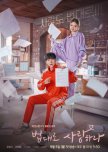
You can look forward to a spicy mixture of fun and seriousness
For all the law-and-order series that the KDrama Orbit has so far produced in 2022, Law Café romps on the more witty, hilarious rom+com side. A web comic served as a template.Nonetheless. For all its playful wit, it is also a production that has its serious moments as well. In the background wafts an ugly (as usual) Jaebeol mess at the expense of the honest simple people. In the foreground, the protagonist fights for the rights of ordinary people with a lot of passion, intelligence, courage and the active support of old and new friends as well as her (after all) love interest. The legal cases dealt with are close to everyday sorts of topics and provide an up-to-date overview of perennial issues such as bullying, child abuse, sloppiness in construction, etc.
The idea of setting up a Law Cafe away from the usual law firm business is unique. There visitors can get professional legal advice in addition to barista coffee in a comfy atmosphere. All of the characters are originals, and their quirks and idiosyncrasies are cheerfully staged here and there. You can literally feel the underlying comic.
The focus is on the 'four-dimensional' personality of Kim Yu-ri. (4D in Korean standards means a particularly eccentric, freaky, quite special character. 4D is generally considered a compliment, especially in the teen and KPop milieu.) She meets the ingenious, former public prosecutor Kim Jeong-ho, her school friend from back then and also son of a rich family. He lately indulges in idleness, enjoys his life in tracksuits - as a writer and real estate owner. There's some harmlessly sweet, romantic flirtation of the Korean decent kind, but also concentrated intelligence and creativity in solving some intricate cases. The evil, powerful business bosses and their crazy doings find an appropriate expression in the phrenetically perfidious, exalted, almost insane boss of the Dohan construction company.
Bottom line: You can look forward to a spicy mixture of fun and seriousness. To a love story. To a cast in good mood. To lively entertainment. However, I have to admit that 2 (sometimes 4) episodes a week was quite enough for me. I could easily wait for the new episodes. Thus, I wouldn't call the KDrama gripping. It is rather shrewed and witty in places. Rather harmless. However, it is not completely banal.
Overall, special care was taken to ensure that everyone in the audience understood the seriousness of the legal cases being dealt with. The deliberately sincere, almost missionary approach to e. g. the topic of sexism and "Yes means Yes" is remarkable. The KDrama obviously wants to be more than just good entertainment. And I think that the production succeeds in this mission quite well: A rom+com K-Drama, derived from a comic, that gently but firmly grabs society by the collar, in a good mood and optimistically presenting creative ways, how despite all the existing corruption business surrounding the machinations of the powerful, justice could actually be possible. It wouldn't be due to the law, because that would at least actually be available...
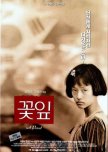
Relentless, almost radical in its puristic, rigorous realism. Not pleasant, yet haunting.
“A Petal” is heavy fare. Momentous. Crass. Intense. Disturbing. Yet deeply symbolic, too.Haunting.
It grabs the audience by the hand with a beautiful, harmless (South Korean) earworm from the 1970s and mercilessly drags us into the mentally disturbed reality of a 15-year-old girl who is emotionally trapped in the events of a historically bloody day in Gwangju in May 1980. She has been reliving the painful, unbearable, incomprehensible, unfathomable events over and over again since then. Desperately searching for her older brother to tell him everything she has experienced and suffered, and still cannot understand. But he has long since passed away.
“A Petal” is, for all those who know nothing about the Gwangju Massacre, a strikingly vivid, touching cinematic document of post-traumatic stress disorder. As mentioned, the KMovie with its particular combination of color, repeated flashbacks in black and white and animated dream sequences emotionally pulls us into this merciless inner world and makes us feel it.
But “A Petal” is also a historical milestone in South Korean cinema. Here, in a shockingly realistic manner the Gwangju Massacre was for the first time portrayed in film as a symbol of the suppression of the democracy movement in the country. (End of May 1980 in Gwangju the military was sent against demonstrating civilians, brutally tortured innocent people and killed probably up to 2.300 of them. Nobody could get in or out of the city, with telephones lines being shut down, too.)
The 15-year-old girl, innocent and clueless as she was, and now battered, kicked, helplessly trapped in her trauma, misunderstood, and sexually abused, personifies the nation that is still (even 16 years later) at the mercy of the trauma of Gwangju. A nation that does not quite know what to do with it. That has not yet processed it. That had no chance to do so.
The encounters of the girl on her erratic journey through the province of Jeollanam-do, especially the lone man she finally imposes herself on, represents all those who did not experience May 1980 in Gwangju and have never really learned what happened there, or even that anything happened at all. The dictatorial regime ensured widespread silence.
The girl is the personified, living testimony to the great sacrifices of the South Korean democracy movement. The man, rough and abusive, in the daily mire of his dreary life, embodies the still inexperienced, sluggish mass of the people, who in terms of the new opportunities and freedoms of democracy is however still trapped in the old, violence-dominated, dictatorial structures. These two, the girl and the man, are concrete, however nameless symbols of society at the beginning of the still very young democracy in the country, in the early 1990s. The brother's friends, persistently but laboriously searching for the 15-year-old, stand for the necessary reckoning and conscious processing, for perception, witnessing, revealing and communication of ´us´, so that the still open wounds are no longer ignored and suppressed, but given attention, cared for, and thus may perhaps eventually heal over time. In order to create space for new experiences.
Actually, at the time of the massacre in Gwangju, Director Jang Sun-woo himself was imprisoned for his activities in the student democracy movement. It was then that he decided to make politically critical movies in the future. However, this future took another 15 years to materialize. It was not until the 1990s that the democracy movement in the country began to bear its first fruits. It was not until 1996 that it was possible to bring the incredible events of May 1980 to the public's attention.
The film “A Petal” is relentless, almost radical in its puristic, rigorous realism. Especially Lee Jung-hyun, who made her acting debut here, had to go from 0 to 100 to connect internally with this mentally disturbed protagonist and thus convincingly portray her character. Impressive, too: Moon Sung-keun. The intensity of “A Petal” is breathtaking. Not pleasant, tough. Haunting.
Mission succeeded...
There were several well-deserved (and international) awards. However, some cinema-goers may have left the cinema early. It is a quite demanding KMovie. We are supposed to engage with the disturbing psychological situation of the girl. With what led to her becoming like this. And with how her mostly ignorant environment initially reacting helplessly and violently, to her apparent weirdness. Yet it is at last also a relieve to see, how a caring relationship eventually may develop even from the initially dismissive and unrestrainedly abusive one.
The title is the title of a song that the girl likes and sings, back then, before it all happened.
The song “A Petal” tells of how the petals fall, the memory of it is hard to bear, because there was a farewell. However, they didn´t talk back then... and again and again, when the petals fall, there is this memory of this abrupt farewell, which is hard to bear...
The theme of this song becomes the theme of this girl... who is desperately searching for her brother to tell him what happened, what she had to experience, what she still cannot grasp and does not understand.
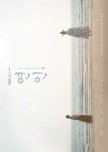
Ambitious & powerful historical epic done with perfection - right down to the supporting roles
Wow! Historical epic. Visually stunning. Magnificent. What starts out harmless is caught up in the merciless story. Please buckle up. "My Dearest" goes all out. Thrilling! Moving! Intoxicating.The excursion leads into a painful chapter of Joseon's past, its historical cornerstones being emotionally successfully captured in striking scenes. Already after the third episode one may have forgotten the harmlessly rocking swings... back when everything was right with the world. On the other hand, the worst at times brings out the best in people. This may certainly be true for our protagonists, because the more hopeless the circumstances, the more persistent their personal commitment.
A dramatic story. A moving love story. An excellent historical drama. Definitely worth seeing. The time around the Qing invasion on the Joseon Peninsula will remain unforgettable for everyone... and the epic relationship of our protagonists too!
What a couple - in the course of their encounters, Namgoong Min and Ahn Eun-jin develop a strong, charismatic attraction for their ambivalent and baffling, yet complex and nuanced characters. All this is visually perfectly staged. Perfection applies overall to the dramaturgical layout of the intertwined personal and political processes. "My Dearest" offers differentiated, touching character portraits right down to the supporting roles. Powerful!
Unfortunately, after the tenth episode, we're stuck for a while before we continue with the second season... But until then, as far as I am concerned, "My Dearest" has been a complete success!
-----------------------------------------------------------------------
SIDE NOTE --- the Qing invasion 1636 ---
The historical context of “My Dearest” is quite an issue for Joseon history! For the Korean national self-image the impact of the Qing invasion of 1636 can be reckoned even more traumatic, shameful and dramatic than the unparalleled Japanese invasions of the Imjin Wars in 1592 and 1598. This is because Joseon finally had to ignominiously submit to the Qing and eventually remained their vassal state until the First Sino-Japanese War end of the 19th century. (With Imjin Wars, Joseon was actually able to repel their invaders - at that time with the help of the Ming - and thus could preserve the grandeur of sovereignty.) That second Qing invasion in 1636 went down in history as a truly disastrous defeat. Who likes to remember such a 'weak' king and such unspeakably embarrassing humiliation?
Apart from its touching epic love story, "My Dearest" thus also deals with the narrative of the people of Joseon back in the 17th century - their different positions, either pragmatic or idealistic. That time of the invasion is well documented in diaries of contemporary witnesses. Historical scholars to date, however, have discussed the Qing invasions in Joseon mostly from the perspective of the Qing against the Ming and the political power struggles concerning the Chinese empire. In “My Dearest” the Joseon perspective is given its own emotional narrative. And this is characterized by personalities, ideals, value systems, symbolic gestures, as well as those small and large deeds and sacrifices of inconspicuous people who often fall through the cracks of historiography. So "My Dearest" isn't just heartfelt entertainment. To a certain extent, the KDrama has an identity-forming, great mission and takes it very seriously and right into mass consciousness. Its intention is to be suitably great. It offers portraits of the people at that time an how they were processing historically questionable/questioned decisions, too. It brings us close to the dilemma of that time. And greatly so.
-------------------------------------------------------------------------
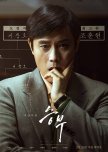
Because sometimes the quietest films leave the deepest marks — through glances, silence, and soul
The Match – A Silent Duel and the Echo of a GameA board, 361 intersections, two players — and between them, an entire life: The Match is many things at once. A biographical drama about two icons of South Korean Go. A quiet tragedy about pride and letting go. And not least, a poetic exploration of a game that, in Korea, means far more than victory or defeat.
What captivates critics and fans alike is the film’s restraint. No dramatic bombast, no artificially inflated tension. Glances speak, cuts breathe, and silence lingers. Experts praised the precision: how actually real matches were re-enacted with exacting detail, and how the psychological depth of competition was rendered authentically. It is a film that resonates long after the credits roll because it speaks in subtleties: of ambition, betrayal, affection, and quiet determination.
At its heart: Lee Byung-hun as the driven veteran Cho Hun-hyun, defending his throne from his own protégé — and Yoo Ah-in as the gentle, reserved Lee Chang-ho, who speaks only through the board. Both deliver brilliant performances without pathos. Their glances are statements. Their hands speak louder than words. Especially striking: a scene where Cho sits alone in the dojang, sensing his student’s shadow — in silence. Yet thus he reveals everything. Supporting actors like Kim Kang-hoon (as young Lee) or Heo Sung-tae blend seamlessly into this atmosphere of quiet intensity.
So what is The Match really about? Not just Go. It’s about the fragile bond between mentor and student. About the question: when does leadership become control? When does gratitude become a shackle? And perhaps: how do you respond when your own “clone” becomes better — and turns your strategies into revolution?
Only against this backdrop does Baduk in The Match reveal its true meaning. It’s no coincidence that Korea's national heroes are born not on soccer fields, but at the Go board. Because here, the game is not mere competition, but a quiet cultural treasure — a space where personality reveals itself, even when lips stay silent. The Match is not just a story of two players — it’s an explanation of why that story matters.
------------------------------------- side note on baduk ---------------------------------------------------
MORE THAN A GAME: BADUK IN KOREA
It’s fascinating how such a quiet sport can shape the thinking of a society. To outsiders, it might look like a dry ritual: two players leaning silently over a wooden board, fingers poised over black or white stones, a soft click on lacquered wood — and seemingly not much happening. But in Korea, Baduk is far more than a game. It’s a mindset. A way of life. A mirror of character. And for some, a destiny.
Its roots reach back to the 1st century BCE, yet it’s more alive than ever — on TV screens, in schools, street cafés, and quiet dojangs. Millions watch live tournaments on television, narrated by experts who analyze every stone like a line of poetry. Children attend Baduk academies while their peers elsewhere take to soccer fields. Because here, it’s not about goals — it’s about thinking in long arcs.
What makes Baduk in Korea so unique is its philosophical depth. It shows how character takes shape: Who takes risks? Who builds with foresight? Who sacrifices wisely? It rewards patience and long-term strategy — often across dozens of moves. Koreans don’t call it “waiting,” but ´insight´.
The rules are simple — capture by encirclement, passing, the K.O. rule — and yet it unfolds into a universe with more possible games than atoms in the cosmos. No match is the same. And when two evenly matched players meet, something poetic happens: a poem in black and white.
In a country marked by speed, change, and technology, Baduk feels almost anachronistic. And yet that’s where its power lies. It represents the contemplative, disciplined, and introspective Korea. It teaches us to leave space — and still be present. To anticipate setbacks — and turn shadows into strength. To play Baduk is to learn more than rules: it’s to learn posture.
Lee Chang-ho, around whom The Match revolves, was known as the master of silence. He didn’t win through aggression — but by avoiding mistakes. His style was almost invisible, yet unstoppable — like water. It’s no wonder he became a hero. And the film, a mirror of that quiet greatness.
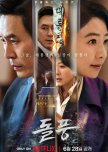
A very well done, substantial, self-critical, thought-provoking Korean-style political drama.
In “The Whirlwind,” the old masters of Korean film and television use their strong aura to demonstrate what it means to truly want to represent transparency and democracy in South Korea 2024. Even after several decades of 'real' democracy, the political apparatus still feels like a vice in the hands of a few in a backroom and every idiosyncratic move inevitably leads to pain. Here we see the top-class veterans Sol Kyung-gu and Kim Hee-ae and a few more in a Netflix production that has substance and intensity and decisively highlights a major dilemma within the South Korean political scene. A great script with characters who are not just black or white, but full of shades of gray.2024, as I said. Unfortunately, the struggle to act politically honestly, or to curb corruption and illegal influence by the Jaebeol conglomerates, obviously still is a Sisyphean mission... But there is this longing in the country – a desire that politics will at some point be done by responsible, accountable citizens and not manipulated by this 1 percent of the Jaebeol elite, using the system for their own benefit. ((On the other hand, as a mass, that is all too easily manipulated by misleading information the (in theory powerful) people ultimately doesn´t impress as a source of hope... Sobering. Unfortunately.)) Obviously it is difficult to change the sluggish but powerful apparatus. However, the more scandalous conditions and dynamics are clearly communicated through the media, the more the shiny elite may become disenchanted (as in "The Whirlwind"). And perhaps - the more this happens - at some point the general public will no longer be so easily swayed and deceived. Perhaps, slowly but surely, the number of those, who dare to oppose the whims of the so-called elite, no matter the cost, is against all odds growing. And maybe more and more will follow over time. This is, where “The Whirlwind” is coming from...
In 2024, South Korean politics is no longer just a male affair. Nevertheless, the world of decision-makers is still a world of cliques, and if one person is not willing, then force will be chosen. The pattern seems to be the same forever.
And yet. In this KDrama we are dealing with a protagonist, who doesn't care about all the headwinds. He isn´t impressed. He doesn't want to be bought and is resisting temptation. He might become a role model, yet he is driven by his own interest. He cares about the cause, the idea, his political values, and he risks everything for it. The end - the good, honest one - justifies the means. And suddenly an upstanding citizen also attracts others, too. He embodies a longing, stands for a hope that is truly shared by many - even those who have learned to function well within the corrupt apparatus. Where there is a will, there may be a path, but it can be rocky, swampy and, in some places, hopeless. Once again a brave David has faced off against a complacent Goliath. And if he's not careful, even our ambitious David may imperceptibly stray from the right path on his way to an honest goal. Because in fact, not every means justifies its noble end... When it comes to a world of responsible citizens who are equal before the law, then it is at the same time and first and foremost about accountability and about taking (lawful) responsibility for one's own actions. In all consequence. This equally applies to everyone, too. Uncompromising. Without exception...
So, overall I consider “The Whirlwind” a very well done, substantial, self-critical, thought-provoking Korean-style political drama.
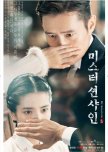
This KDrama is more like an epic movie that (fortunately) doesn't want to end over 24 episodes
"Mr. Sunshine" is pure epic! Visually stunning! Heartbreaking. With a fantastic cast! In addition, there is a vivid and at the same time gripping history lesson (dealing with the turn of the 19th / 20th centuriy). The KDrama is more like an epic movie that (fortunately) doesn't want to end over 24 episodes. Complex characters, interwoven developments with sudden twists, cinematic camera, unforgettable soundtrack, everything seems handpicked, nothing off the shelf. The budget was correspondingly high, but it isn't just good because it was expensive. Rather, it is made with a lot of love from front to back and down to the last detail. There are hardly familiar motifs that we have often seen in variation. Everything is precisely coordinated in all scale levels. The personal decisions that the protagonists make over and over again in the course of the story remain unpredictable until the end.Historically we learn about the relationship between Joseon and the Japanese, but also with the rest of the world. The story takes place before the country becomes a Japanese protectorate - in that brief window of time when Joseon (after a long period of isolation) became the Greater Korean Empire and then opened up to the rest of the world. For this reason, the USA also play a role in here, because the States - like Russia and Japan - are ready and waiting to get involved in the imperialist competition for the largest slices of the cake Joseon is offering. The country is rich in raw materials and therefore hot property. "Mr Sunshine" provides a vivid and gripping introduction to those geopolitical complications.
------------------ SIDE NOTE --- Historic setting: Joseon and the rest of the world ...
Since the 17th century, Joseon rather had itself isolated from the outside world. This rigorous attitude ultimately led to the first military confrontation between Joseon and the USA, which marks the kick off point to the plot of "Mr. Sunshine". In 1866, an American ship, the SS Sherman, entered Korean waters via the Taedong River. Since it did not turn around immediately when asked, there were violent arguments in which the ship was ultimately set on fire. This was followed in 1871 by the battle off the island of Ganghwa-do, in which the USA wanted to rescue the survivors of the shipwrecked crew and at the same time establish the first prerequisites for trade relations. However, since the desired diplomatic gesture of the Korean apology did not happen to take place, the Joseon garrison on the island was radically wiped out by the American warships and their crew. This first conflict with the USA went down in history as 'Shinmiyangyo'.
King Gojong came to the throne in 1873 and, in contrary to previous national policy, decided to open up his country in the hope of flourishing trade and technical innovation. Japan pushed ahead and forced the Japanese-Korean friendship treaty of 1876 on the king, including military pressure, too. However, this was a contract between unequal friends... In the course of the international processes that had been initiated, King Gojong also sought contact and trade agreements with Western countries.
---------------------------------------------
During this time, "Mr. Sunshine" stages its main plot, in which protagonist Eugene, as US officer of loathed Korean descent, is supposed to sensitively, competently and diplomatically represent the interests of the USA with a consular mandate. But there is always more life has to offer... Eugene has to meet the love of his life, face his roots and reconsider his values in life. He can´t help it: he has to take a stand...
It is said that not everything is historically 100 percent precise, but the historical circumstances provide plenty of material for pure epic drama at its finest. Thrilling. Unforgettable.
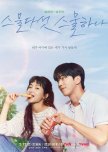
Full of vitality, vigor & inspiration. Love & passion apart from clichés - tender, true & touching
Wonderful. Just wonderful. A highlight among the KDramas of 2022.I would rate it "particularly valuable". On all levels. Right down to the soundtrack.
The story has a stimulating, inspiring, at times downright thrilling effect, above all thanks to a brilliant Kim Tae-ri. She was 32 at the time of shooting, but effortlessly she plays a teenager with an ambitious dream of her own in times of adversity.
"Twenty-Five Twenty-One" is packaged as a teen story told in two timelines. Then and now. The protagonist from back then is today's mother. Today she is at odds with her daughter, who wants to give up her ballet career. In her grandmother's house, the rebellious teenager finds access to her mother's youthful past, who in turn also had difficulties with her mother at the time, yet courageously pursued her dream of becoming a fencer on the national team.
Romantic feelings are inevitable as the story progresses. Yet this storyline develops quite idiosyncratically beyond expectations, not least because of the two timelines told in parallel. Here, Love is shown more in the quality of an inspiring, encouraging, empowering 'rainbow', as the two protagonists so nicely state. It's a shame that you can't leave love like that, but sooner or later want to capture it, tie it down and pack it into a rather common concept of 'partnership' - with all the expectations and disappointments that come along with it...
"Twenty-Five Twenty-One" doesn't see itself as a Rom+/-Com fairy tale. From the start, it's not a fairy tale. Here the goal in life isn´t the happy-ever-after-family-life as such. It tells about what it means to have a dream and to follow it courageously, even if you wonder why at times. It talks about following your own precious heart, even if it might break the hearts of others in the process. It tells of passion. And of love in its very different shapes and sizes. "Twenty-Five Twenty-One" has its unique focus on love in a very tender, true and touching way - apart from clichés. It's about romance as a formative force in life, yet the story doesn't focus on glorifying romance.
In fact, the story is full of vitality, vigor, hope and joie de vivre in the face of one of the worst post-war economic crises South Korea has gone through.
In this respect, the KDrama also offers an explicit insight into the social and societal effects of the economic crisis of the 1990s.
(So here's a also side note on that context, if you are interested.)
-------------------- SIDE NOTE: ---The Asian crisis of the 1990s, the structural adjustment program of the International Monetary Fund (IMF), and the nationalist sentiment of the people that paved the way for South Korea's neoliberal globalization---
In the course of the Asian crisis, the IMF implemented its structural adjustment (SAP) in South Korea from December 1997 to December 2000, which is still considered a great success today. Others say the rise is due to the people's disciplined national consciousness. However, the massive economic slump that South Korea experienced in the vortex of the Asian crisis is undisputed. Neighter ist the impressively successful recovery since 1999.
After international investors withdrew their loans in the face of the uncertain crisis situation on the Asian continent, South Korea fell into a balance of payments crisis. This is where the IMF came into play, putting together its most comprehensive rescue package to date, with bailout loans totaling around USD 58 billion. The condition: the country was to fulfill an SAP program for three years: In addition to a consistent policy of high interest rates, government austerity measures, complex capital market liberalization and the restructuring of the financial system were required.
As a result of the balance of payments crisis, numerous banks had already filed for bankruptcy or had been nationalized. Due to the IMF's high-interest policy, countless corporate insolvencies followed in the first three months of the SAP, including some Jaebeol conglomerates. South Korea paid the price of its economic boom of the past decades, which was founded on high debt and growth rates. Unemployment tripled. Gross domestic product fell by 6.7 percent within a year.
The impressive recovery that has followed has been possible at the expense of the general population. South Korea's rapid return to the top positions in the world market is a special case worldwide, which was probably achieved less by the SAP of the IMF than by the nationalistically highly motivated South Koreans. They have written the possibly questionable, but at the same time fascinating economic success story on their backs.
First: People became victims of far-reaching processes of rationalization and concentration. On the one hand, this led to mass redundancies and, on the other hand, to a more flexible labor market. Many of the demoralized unemployed didn´t even try to find their way back into the world of work anymore. Others were employed as irregular temporary workers (e.g. with less pay, security and rights). After the crisis, these ´irregulars´ made up more than half of the workforce and their share still is far higher than in other OECD countries.
Second: The benefit of a very unique South Korean nationalism motivated many people to be willing to make personal sacrifices: they consciously avoided consuming imported goods, while at the same time the export of their own goods increased significantly. The need for foreign capital for the upswing is actually estimated at only 5 percent. The share of exports in GDP increased from 25 percent in 1996 to 41 percent in 1998. 95 percent of the net inflow of foreign exchange during the lifetime of the SAP came from the current account surplus. This was made possible by a disciplined population, who did not try to storm banks in a mass panic, but were even willing to exchange their private currencies and savings themselves, including in large gold collection campaigns, in favor of the national reserves in the weak national currency.
The macroeconomic success that has grown out of this nationalist attitude at the expense of the population is enormous. Many lost their jobs and their fortunes. Nevertheless, the South Koreans mostly got involved in the Buy-Korean campaign and avoided imported consumer goods. I.E. incidentally, the market share of South Korean films in cinemas has increased in this context from 23 percent in 1996 to 50 percent in 2001. (An aspect that also gets its own space in this KDrama...)
-----------------------------------------
Quiet, adagietto, yet impactful. With plenty of heart hidden behind an apparently repellent shell.
Unsentimentally but lovingly, "Springtime" tells about people at the lower end of the social pyramid. They live a simple life. They also have dreams, but not too much hope. Nevertheless, "Springtime" offers soothing, encouraging positive vibes. Soulfully beautiful.Slowly and deliberately, we glide into the world of the protagonist. (Don't be put off by the pacing!) Once we arrive, a story full of heart takes its course unobtrusively, true-to-life and down-to-earth. Authentically idiosyncratic: Choi Min-sik, as a passionate musician and anti-hero with principles (as well as a warm heart).
However, these principles make the protagonist's life quite difficult. He feels he cannot afford his girlfriend, which is leading to their separation. His music is sacred to him, and he does not want to prostitute himself with his trumpet in any no-name establishments. But with his stubborn ego he also cannot get into any of the prestigious orchestras in Seoul. He is broke and in debt. Even though it is hard for him, he has to take a job – in this case, as a teacher for the school orchestra of a middle school in a mining town.
The protagonist's life changes when he has no choice but to let go of his concepts. In that mining town, he inevitably engages with what life has to offer: the people there. He steps out of his comfort zone and teaches the mediocre but committed boys. He opens their hearts to music... and in turn, his heart to them and their lives. They become more important to him than his principles and thus for him, ultimately, is opening a healing bridge to freedom.
One of those quiet, adagietto, yet impactful KMovies, with plenty of heart hidden behind an apparently repellent shell.
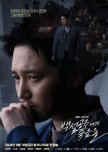
Multi-layered plot, strong acting & perfectly tailored with minimalist aesthetic, up to the OST
Complete memory gap after too much alcohol - a wonderfully promising step stone for a gripping, solid, emotionally complex (psychological) crime thriller in the high-end segment. "Black Out - Snow White Must Die" is the multi-layered dramaturgical documentation of the protagonist's desperate urge to remember that particular night, that he´s bond to since then.Life with such a drastic memory gap may be difficult enough, yet even more difficult to digest could become what emerges while looking behind shiny facades. "Black Out" is, so to speak, a study about human chasm that lurk and seduce even behind the cleanest of vestments. And then it is also a solid, multi-layered, gripping crime thriller in KDrama format. Just great.
It is based on the 4th volume of the Bodenstein-Kirchhoff series by the German writer Nele Neuhaus from 2010: “Snow White Must Die”. The setting is not the Taunus, but an inconspicuous town in the wider area around Seoul. The scenario works just as well there.
Strong acting and perfectly tailored with minimalist aesthetic, right up to the OST.
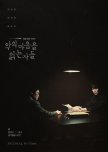
Facing the dark side of humanity. Slow Food for Thought. Intense. Powerful.
"Through the Darkness" takes an experimental approach within the crime genre. It is the serial adaptation of the autobiography of the first South Korean specialist in criminal psychology case analysis, Kwon Il-yong - about his pioneering work in the profiling of serial killers. His extensive research work was inspired by the methods of his American role model Robert Ressler of the FBI's Behavior Analysis Team, who also contributed to the introduction of the term 'serial killer'. The original title is "Those who read in the hearts of evil". Accordingly, the story essentially revolves around the approach of the young investigator to a 'new' form of criminalistic work: tracking down serial killers and their motives, backgrounds and intentions differs from the police work that was common up until then (1990s), since the selection of their victims appears at first glance to be arbitrary, motives are not immediately apparent and their 'gain' in the act is mainly of a psychologically peculiar nature. In order to be able to understand these psychological processes, a database of known psychological offender profiles first had to be created on the basis of comprehensive behavioral analyses. There is a lot of hard work behind it. It took a good decade before a separate unit for operative case analysis based on the American model could be created in South Korea, too - despite a great deal of opposition."Through the Darkness" is about approaching the darkest, most abysmal world of feelings and thoughts of the most brutal serial killers. While the story is also experimental in terms of pioneering the profiling itself, as far as KDrama goes, I mean mostly the way the real cases are processed and presented. There is no superficial plot about the story of the protagonists (let alone a romance). Nevertheless, relationships among colleagues develop over time. It is not 'suspenseful' in the sense of a thriller, because the perpetrators are always known in advance, at least to the viewers. Together with the investigative team, however, we set out to learn to understand the behavior in order to get a 'grab' for the investigation and arrest. This is quite fascinating and captivating. Inevitably, the viewers also enter the psychic worlds, which seem to be devoid of any humanity, and learn to grasp the pattern of loose threads.
In the beginning, the perpetrators were also just people (and not monsters). Not any longer though? When did something decisive change and why? The existential questions and the confrontation with his own darkness, which the protagonist is forced to face during his field research, do not go unnoticed by the viewers either. Kim Nam-gil embodies the lonely path of the profiler in a minimalist, haunting, and compelling way. Thrilling! But not exciting in the classic sense. Powerful. Deep. Slow Food for Thought. Highly valuable. But to be enjoyed in moderation (risks and side effects for the minds of those who 'read the hearts of evil' cannot be ruled out...).
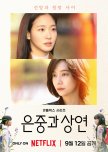
Told with a creeping, unsparing intensity whose force only reveals itself over time
You and Everything Else is no feel‑good drama.It is a precise, sometimes merciless analysis of a decades‑long friendship between two women. A fateful friendship.
At first I struggled, because the series feels so austere – but that very austerity drew me in more and more.
Told with a creeping, unsparing intensity whose force only reveals itself over time, the series refuses sentimental shortcuts. Kim Go‑eun and Park Ji‑hyun do not embody cliché “best friends,” but two women who love, envy, wound, and yet cannot let go of one another. Layer by layer, the show strips away the surface until only the raw weave of dependency, power, and guilt remains. Female friendship is placed at the center here—in all its ambivalence, as love, as rivalry, as entanglement. A theme rarely portrayed in Korea with such uncompromising clarity.
Particularly striking is the character of Cheon Sang‑yeon—and Park Ji‑hyun’s performance with her. She appears as the emotional echo of her brother, but in inverted reflection: charismatic, aloof, full of inner fractures. Her motives remain opaque, her closeness never certain, her distance never final. Psychologically, she bears traits of a pathic personality—someone who seeks intimacy, but only under conditions she herself controls. One might speak of narcissistic vulnerability: a mixture of grandiosity and deep inner emptiness. Her background explains much: a wealthy, detached family where status mattered more than affection. The brother’s death shakes the family to its core. The Asian financial crisis of the 1990s adds an economic rupture—challenges the family fails to withstand. Sang‑yeon is left alone.
Eun‑jung, by contrast, comes from humbler origins and seems almost naïve in the best sense—grounded, loyal, down‑to‑earth. She is by no means weak: emotionally stable, but conflict‑averse. Her “decency” is not conservative but empathetic. Her naïveté serves as a shield against Sang‑yeon’s manipulative complexity. Eun‑jung is the moral compass of the series, the conscience that wants to help without controlling. This contrast intensifies their bond: here the pathically charged, manipulative daughter of the elite; there the empathetic, steadfast daughter of the middle class.
The series touches on social taboos rarely addressed openly in South Korea. Assisted dying is one such sensitive theme. Even subtler are the queer undertones. Tellingly, the KDrama never ventures beyond hints and subtext. At times, Sang‑yeon’s feelings for the same man as her friend seem less like romantic rivalry than a proxy conflict. Between the lines shimmers a repressed longing for Eun‑jung herself—a dimension never spoken aloud, but one that heightens the psychological tension.
To grasp the force of this series, one must also look at Korean narrative tradition. The difficult‑to‑translate feeling of han—grief, resentment, unfulfilled yearning—permeates many dramas and is palpable here: in Sang‑yeon’s unfulfilled life, in Eun‑jung’s loyalty that borders on self‑erasure. Those expecting the familiar emotional excesses of K‑drama will find fewer floods of tears. Instead: sparse dialogue, almost documentary sobriety. Yet this only sharpens how close the two women’s fatal entanglement cuts—because nothing is softened or smoothed. And fate seems to heap more weight upon them with each encounter. More drama is always possible. And yes: makjang can be quiet, too.
Formally, the series remains strict, elliptical, austere. Those seeking rapid plot points will be disappointed. Those who surrender to it will see: this is not about sentimentality, but about the fine cracks beneath the surface, about what cannot be spoken. You and Everything Else is more than a drama about friendship. It is a psychological study of attachment and loss, a social commentary on Korean taboos, and a mirror held up to the uncomfortable question of how far friendship truly carries when it matters most.
Intense. Moving.
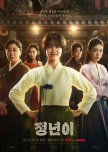
One of the exceptional productions of 2024 in several ways
"Jeongnyeon: The Star is Born" is one of the exceptional productions of 2024: exceptional in terms of the subject matter and the rather specific cultural background, as the KDrama celebrates two very South Korean art forms: the post-war all-female performance theater Gukgeuk and Pansori, a chanted epic narrative rooted in Korean culture. Exceptional also, because this KDrama creates a women's space in which women play the decisive role and are explicitly NOT reduced to their gender role. Finally, exceptional when it comes to the acting performance: in this case in two respects, as the highly committed actresses present us a show within the show. Definitely worth seeing. (At least, I´d say…)The international title is perhaps a bit misleading, because actually no one is 'born' as a Gukgeuk star. This is hard work, even for those who may be born with talent. That is exactly the theme of the story of this KDrama. The historical setting of the 1950s may seem old-fashioned - who cares about such a special theater movement that was there only for a few decades and has by now been almost forgotten? No way! The topic obviously is quite on. The South Korean audience is thrilled. In the viewer statistics, the numbers have multiplied over the 12 episodes. No wonder, because the plot itself could easily be set today, 2024. The Gukgeuk training is actually comparable to the modern KPop idol industry. Accordingly, individual struggles with personal limits and challenges, the dynamics of relationships, as well as competition, infatuation, friendship, love-hate relationships, envy, self-doubt, overestimation of oneself and ultimately the overexploitation of one's own strengths and possibilities are practically timeless.
But due to the fact that these personal processes of the protagonists are located back in the 1950s, they simultaneously bring the art form of pansori and the flowering of the (now almost forgotten) gukgeuk to radiantly fresh, rousing life. By introducing us to three generations of gukgeuk and pansori stars and bringing them closer to us emotionally, we get a lasting impression of the extraordinary South Korean cultural heritage. (If you are interested, see the side note below.)
The original title is just "Jeongnyeon". The story is based on a well-researched webtoon. While the webtoon focuses on the main character and her personal development processes, the KDrama focuses on the relationships that shape Jeongnyeon on her path as well as the other women, young and old alike. The KDrama "Jeongnyeon: The Star is Born" vividly embodies the quality and the (short) history of Gukgeuk using the example of three generations of Gukgeuk artists. Wonderfully done so. The webtoon also achieved this in 2019, and was even specifically awarded by the Ministry of Culture for the outstanding quality of the story and also for its contribution to raising awareness of gender equality in South Korea.
Kim Tae-ri leads a fantastic ensemble. But even if she once again surpasses herself here, she is not alone, but the whole, which is more than the sum of its parts – just as the show on the Gukgeuk stage is a co-creation in which everyone is giving their best, according to their role and tasks, so that something great can come of it. And so all the ladies contribute in their own unique way to the success of this fantastic production.
------------------------------------------------------------------------------------
--- SIDE NOTE: Pansori ----
Pansori is almost unique: a very old form of epic narrative singing that goes back a long way in Korean cultural history and is able to generate maximum emotional charisma using minimalist means. This requires one person to tell a story by singing and one person to beat the drum. The emotional power of the different dramatic moods is characterized by a stylized repertoire of vocal use and expressive performance. This in combination with the equally characteristic rhythms of the drum beat. A one-person opera in which one person plays ALL the roles, so to speak.
The roots of the idiosyncratic sound in combination with the drum go back to Korean shamanism. In the 17th century, it became an art form in its own right to captivate people with a wide variety of stories in street theater. This is also what the name “Pansori” refers to. "Pan" means a place where people come together, while “Sori” means the expression of the voice, the singing. By the 19th century, pansori had the attention of the upper class and was formally refined. It is about the stories that have shaped the lives of people on the Korean peninsula for centuries – highly dramatic and emotionally expressive. It´s fueled by the relationship being established between narrator and audience. No monologue, no lecture. Rather, narrator and audience meet in the intimate, emotionally honest, vulnerable space that the story opens up - in compassion for its protagonists.
Not everyone can just do pansori. This narrative singing is special. The training is hard. In addition to singing, there is a repertoire of facial expressions, gestures and forms of movement that are given in their structure but must be completed individually. Characteristic of the incomparable singing is the anhemitonic pentatonic scale used, in which the semitone steps E to F and B to C are missing. This is used in different emotionally colored modes, each of which is defined by a specific pitch. Frequency, ornamentation and emphasis emphasize the different emotional states even more. The rather hoarse voice quality is also characteristic, especially in the lower octaves. A clear voice is not required in Pansori. The falsetto technique is used for the higher pitches.
Since the 1970s, pansori has had state-recognized status as a Korean cultural asset in the country, and since 2003 it has also been officially listed by UNESCO as an intangible cultural heritage.
--------------------------------------------------------------------------------------
--- SIDE NOTE: Gukgeuk ---
Gukgeuk is not that well known and is not particularly protected as a Korean cultural asset. Gukgeuk refers to purely womens´ theater for music and theater performance. An art world, a theatrical art creation created exclusively in women's spaces. The women also took on the men's roles. In the post-war years, Gukgeuk was extremely popular in South Korea. The fan cult was in no way inferior to today´s idol fan cult. However, not much of that still remains today. The Gukgeuk theater performance began as a purely womens´ theater in the 1940s. It reached its peak in the 1950s and 1960s. But then the decline followed closely with the growing of the film industry, because there the tried-and-tested stars could earn more and the reach was also greater.
Gukgeuk is characterized by traditional Korean performing art forms and in particular pansori, but combines elements from theater, music, song and dance in an idiosyncratic way, like a quintessence. In contrast to traditional Korean opera (Changgeuk), in which men and women perform aside, Gukgeuk places greater emphasis on high quality acting. Expression, grace in movement, facial expressions, all of this is integrated more finely and intensively into the performance. That’s where all-female production comes into play. A great voice alone is not important with Gukgeuk. Rather, it is the ability to embody the mood of the story sensitively and authentically, to emotionally resonate with the audience and to carry them along uncompromisingly, catapulting them out of their everyday world and instead drawing them into the story with all its emotional facets.
The women were celebrated as stars. They were celebrated as artists. Some were perfected in their appearance, language and behavior for the male roles. Thus, the Gukgeuk artists were able to experience themselves outside of their gender roles.
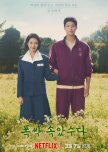
Magnificent family epic set against the stirring backdrop of the last 6 decades of SK history
(Updated)Exceptional. I'm completely thrilled …and after 16 episodes it is hard to say goodbye.
"When Life Gives You Tangerines" is…
...an outstanding enrichment in the KDrama orbit.
...a magnificent family epic set against the stirring backdrop of the last six decades of South Korean history.
...an impressive monument to the almost hopeless, desperate struggle of Korean women for a dignified, joyful, and somewhat self-confident life aside from their gender role - exemplified by fictional Oh Ae-sun from Jeju Island.
...a touching love story that - despite the adverse winds of nasty social, economical and family structures – somehow succeeds to keep love alive.
...a grand masterpiece, brilliantly cast in all instances.
(In my eyes anyway.)
What a wonderful story.
What a fantastically lyric look at life (especially the past six decades on Jeju Island).
What outstanding relationship and gender role models (female and male model alike).
What a remarkable love story.
What a sensitive family herstory/history with all its ups and downs.
What a heartfelt tribute to the past 2-3 SK generations and their tenacious perseverance in defying life's challenges.
"When Life Gives You Tangerines" offers visually powerful, and amidst bitter winds of fate, yet also heartwarming and at the same time realistic, lifelike high-end KDrama. Aesthetically finely composed from A to Z. Complex narrative. Great fitting music. With a generous budget, that obviously was not only used for the illustrious cast.
---------------------------------------- SIDE NOTE -------------------------------------------
The story spans three generations on Jeju island. One might think that the very traditional gender role of women in South Korea should have changed during the last 60 years. However, the extent of this change, socially speaking, is shockingly minimal. Especially concerning the widespread disregard and exploitation of women (even among women themselves), who are condemned to function unconditionally as diligent daughters, even more diligent daughters-in-law, (ideally sons) birthing wives, and self-sacrificing mothers. Above all, the eldest daughter traditionally has the hardest fate.
Among South Korean women, seemingly the women on Jeju Island are the most likely to experience female role models who live with respect as human beings and self-confidence as individuals - as Jejudo´s see diving Haenyeos have always earned a comparatively respectable income through their tireless diving for abalone and other valuable seafood. They substantially contribute to the family's prosperity and can thus experience themselves outside their traditional female gender role among colleagues and even as reliable heads of the family. This may contribute to some slight aura of emancipated self-confidence among women, so they might eventually also muster the courage to rebel. Thus, some women on Jeju island may live a somewhat appreciated, valued variation of the female gender role and function as significant, socially influential role models in their social environment. But even in such a potentially rather 'positive' environment, the trap of patriarchy snaps shut and binds women in tight hierarchical structures. Nevertheless, at least Jeju Island offers a cradle for women (as our FL) who might even come up with the idea of daring to break free... And also for exceptional men (as our ML) who grow up in a social environment where they can experience women as valued human beings, too, who are appreciated for more than just their self-sacrifice for home and hearth.
Post-war South Korea was one of the poorest countries of that time. "When Life Gives You Tangerines" with its international title refers to the fact that life may sometimes seem cold and bitter. But like the tangerine from Jeju, the sweetness can be extracted from it and even a warm tea can be conjured up. Strictly speaking, people at that time had no choice but to make the best of it.
The Netflix KDrama takes us through the last 6 decades of South Korean history, with legends eventually providing orientation about historically significant moments. The first four episodes focus on the lives of the protagonists in their youth on Jejudo – at a time when the young republic was initially ruled by the military dictatorship led by Park Chung-hee, who then officially elected himself president in 1963 and subsequently installed a one-man dictatorship until 1979. In the following episodes, we will continue to accompany the two through the dictatorship of Chun Doo-hwan, who i.e. with the Olympic Games wanted to present a great South Korea to the rest of the world – no matter what the cost. We will stumble with them into the beginnings of true democracy, which, however, was thwarted by the harsh years of the Asian financial crisis and another wave of poverty. Through the eyes of Ae-sun and her daughter Geum-myeong (who is also portrayed by wonderful IU in a double-role) we will also experience the era of tubo-capitalism and digitalization, which ultimately brought prosperity to Jeju Island, too...
Amid these swaying decades, Ae-sun and her reliable partner Gwang-sik are creating a unique, authentic, remarkably heartwarming and encouraging constant.
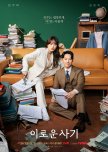
Be ready for a comprehensive script and excellent actors everywhere
Spreading its unique, quite appealing, and in places wittily pointed charisma, "Delightfully Deceitful" surprises with a multi-layered crime fiction, that is set in the milieu of people with extraordinary talents and qualities. Even if the poster may suggest otherwise: it is not a romantic comedy. However, "Delightfully Deceitful" does neither shy away from a little comedy here and there, nor from finely nuanced emotions.At the beginning there are the personality portraits and relationship dynamics of a bunch of (because of their distinct peculiarities) 'a-social' contemporaries, who as such being colorfully thrown together eventually form a group of their own. With time, though, the plot of the crime story unfolds, raising once more the question of whether law&order have anything to do with justice; or isn´t vigilantism more promising? In any case, the story revolves around organized crime, unscrupulous villains, malicious fraud and a lot of money.
Nevertheless, there is this bunch of idiosyncratic, unconventional, angular chessmen on the chessboard. Regardless of whether they are psychopathic, sociopathic or hopelessly empathetic, they are all rarely black or white, yet mostly in rich shades of gray. In any case, with their talents they are beyond the social average. While the KDrama could very well surface along at high speed, with a cool and casual esprit, it eventually comes along with a pleasantly profound grounding, since the socio-psychological premise , that we humans are inevitably social beings, swings the baton in the background. The thing is: we want to belong.
Exposure, stigmatization and exclusion also lead to the realization that the rules of the others do not apply to me. This might become associated with some kind of freedom. It also leads to a feeling of loneliness. Yet, the feeling of loneliness inevitably causes humans to slowly but surely wither away. No matter if it may be considered a gift or a burden, stigmatized individuals have to develop a emotional strategy for themselves in order to escape the sometimes more and sometimes less obvious psychological strain. That’s tough for grownups, let alone children...
This premise is handled from different perspectives. Additionally, the KDrama dares the balancing act of mixing this psychodynamic issue with no less complex interwoven crime fiction. Thus, in terms of the genre, the story may initially sail along in foggy realms, but over time the view becomes clearer.
"Delightfully Deceitful" has a well blended mix of spices to offer. Over 16 episodes it is always exciting, intense, opaque, emotional, also dark, sometimes two-fisted. Additionally: Be ready for a comprehensive script and excellent actors everywhere.


