

 10
10 42
42 15
15


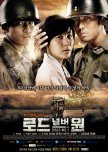
Romance & Bromance at its best in (still warlike) post World War II years on once Joseon´s soil
"Road No. 1" is an intriguing KDrama that takes a close look at the (still warlike) post-war years in Korea after 1945. On impulse we might think of the Korean War of 1950-53, but for the Korean people the struggle between North and South began much earlier (see below if you like).There are definitely plenty of tragic fates and stories to tell from that time. "Road No. 1" is one of them, splendidly captured within 20 episodes full of human struggle for life and love. Here you will find romance and bromance at its best. Emotively staged against a backdrop of uniforms, guns, grenades, explosions, barbed wire, the 38th parallel and Road No. 1.
------------------------------------------------------------------
Side Note: ---- HISTORIC BACKGROUND ----
The 'No. 1' is the road that connects Seoul and Pyongyang - after the end of World War II in 1945, these were the two largest cities in Korea, having been annexed by Japan since 1910 as the Chōsen province. After the surrender of Japan, the province of Chōsen was (like Japan itself) occupied by the Allies. The Soviet Union and the USA, as trustee administrators, had divided the country along the 38th parallel into two occupation zones. In fact, the Korean people weren't too keen on (again) not being given state sovereignty.
With the departure of the Japanese, the struggle for the future of the country began - a struggle between different visions and perspectives. The allies favored the political positions they liked - e.g. Joseph Stalin and Mao Zedong with Kim Il-sung a communist state in which only one politically active party should exist; the USA a Western-style constitution for the South with a Christian-capitalist orientation. However, there actually was also a nationalist, anti-foreign grouping within the country that (by tradition) particularly opposed the American occupation and its Western values. They engaged in a guerrilla war that began as early as 1946. That is, where "Road No. 1" has its roots and starts off. And that's a good thing, because this aspect is sometimes lost in the historical representation of the western hemisphere...
This resistance struggle´s position was much closer to communist ideas than to the western value system, which still seemed rather foreign up to that point. Just because the former colonial ruler Japan was one of the losers of war, the former Joseon doesn't have to be happy to make a 100° about-face towards Western democracy... What the country or its people wanted was actually not seriously considered. The promised election did not come about. It simply fell underneath the wheels of the Cold War. For the Soviet Union and the USA, Korean policy was based on post-war events and global political muscle flexing. However, for the Korean people, who had never been never tired of resisting oppression under colonial rule, things just kind of went on. From the rain in the eaves...
--- People's Republic of Korea - a non-starter ---
In fact, it completely escaped my historical knowledge that BEFORE the division into a communist North Korea (Democratic People's Republic of Korea) dominated by the Soviet Union and China plus a South Korea occupied by the USA (Republic of Korea), there had also been a KOREAN vision for the future of the peninsula. After Japan's capitulation, the 'People's Republic of Korea' (NOT EQUAL to the Democratic People's Republic of Korea alias North Korea) was proclaimed as a provisional government on September 12, 1945 for BOTH zones of occupation. Initially, the basis of the new constitution and government was supposed to be created from a network of people's committees. The program was radically social. The aim was to establish Korea's complete independence and a democratically governed public life for a free people.
In the north, the People's Republic was taken 'seriously' by the communist occupiers (effortlessly, so to speak, due to the similar attitude). In the south, however, the military controlled political events were based on a rigorous anti-communist attitude. Of course, the USA did not like this communist-affine new political perspectives towards the peninsula at all. In 'their' southern provinces, they even went so far as to ban the ´People's Republic´ (purely because of its communist ideas). This fueled resentment... and there it was again: resistance.
--- National Uprising ---
In 1946, the so-called Autumn Harvest Uprising marked the beginning of public, sometimes massive, resistance, which took on further forms in 1947 and finally culminated in a national uprising in 1948. The USA had to react quickly and so they sponsored the lesser evil: the elections for the first 'Republic of Korea' in August 1948: the autocratic Rhee Syng-man. Although he was not in principle friendly to the USA, nor was he an enthusiastic democrat or even an advocate of human rights, he was opportunistic enough to also cooperate in the interests of the USA. He was also anti-Japanese and anti-communist. South Korea was given a Western-style constitution, and from then on it had to be guided by Christian and capitalist values. Of course, after the South voted, the North had to follow suit (with the formation of the DPRK).
The Korean people were thus separated - politically, geographically, economically and socially - and had been incited against each other by propaganda and degraded to the pawn of global political muscle flexing. Industry, resources and energy supply were concentrated in the north, while two-thirds of the 30 million Koreans were living in the south. And they initially fought against the paternalism of the American military. Between 1948 and 1950, guerrilla fights against the South Korean Republic's military and police cost the lives of around 7,500 official security forces and around 34,000 civilians - even before the actual Korean War even began. The people strived for unity. But politically there was only an either-or (communism vs. ultra-nationalism).
--- Korean War with international participation ---
In 1950, Kim Il-sung made use of the situation in the south as well as of his military and material superiority. He wanted unite the country in his interests (and under his constitution). Rhee Syng-man had his military resist as best they could until international intervention by the UN led by the USA actually pushed back the North Korean army. However, in view of the new situation and the global dimension, China rushed to North Korea´s aid. There was fierce fighting, on land and at sea. At the end, the armistice, which is still in force today, includes the concession against the background of the Cold War that there will still be the Republic of Korea in the south and the Democratic People's Republic of Korea in the north.
After ca. 2 million civilians, around 1 million Korean and Chinese soldiers, as well as ca. 40,000 UN soldiers having given their lives to this war, everything remained just as it had been before. In sum: A divided country that had been cheated of its autonomous sovereignty. Patronized Koreans. A people with split identity. Separated families.
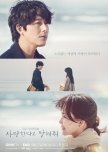
A substantial, mature and exceptionally beautiful love story
For me this is my highlight of 2023.As a phenomenal firework of quiet nuances, “Tell Me That You Love Me” is exuding soulful warmth in graceful silence while creating a soothing atmosphere that takes root deep in the heart. Accompanied by a soundtrack with pulling effect, that could hardly be more harmonious, sincere feelings are conveyed via looks and gestures, while words and thoughts are frequently communicated in sign language, thus telling a story, that knows how to gently touch the audience.
It's not about appearance, facade, coat and make-up, but about essence. Approaching the substantial is exactly what makes this production so exceptional for a KDrama. With Jung Woo-sung, who is once again breathing pure authenticity, certainly a perfect casting for the ML. He also seems to having actually communicated in sign language most of his life. But Shin Hyun-been was also able to effortlessly impress me with her reflected presence. What a couple!
Calm aesthetics and gentle pace intensify the profoundness of the encounters, which opens up spaces for the essential. Even if trenches between the worlds of the hearing and the deaf may be deep and ample at times, loving encounter is still possible. Even if the feelings for each other may be deep and honest, specific barriers inevitably remain. “Tell Me That You Love Me” is gently approaching the dilemma - a desire to face the challenge with confidence, but on the other hand the fear of failure considering the barriers and therefore wanting to run away.
I´d say, anyone who can open up to this rather idiosyncratic “language” of this KDrama will be rewarded by a substantial, mature and exceptionally beautiful love story.
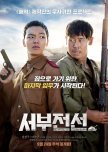
Tackling the horrors of war and the absurdity of the Korean War in particular with grotesque humor
"The Long Way Home" – original: "Western Front" - is a KMovie about the Korean War. But a funny one... if a movie about war might be called funny at all... In fact, it succeeded brilliantly in tackling the horrors of war in general and the absurdity of the Korean War in particular with grotesque humor.As a last resort, even a North Korean student is drafted to drive a tank into battle. A South Korean farmer, in turn, has to leave his heavily pregnant wife behind in order to take part in an all-important, top-secret mission and deliver strategically important secret information to the Allies. Neither are heroes. Neither of them would actually care about the war. But both have dutifully learned the ideological phrases of their 'side' and both, quite by chance, are the only ones in their respective units to survive in an airstrike three days before the truce is signed. The North Korean incidentally stumbles upon the top secret paper and hides it. The South Korean incidentally overwhelms the North Korean... obviously, neither of them being born to be soldiers.
"The Long Way Home" is a kind of road movie back and forth through the empty landscape of the western front line. The student from the north wants to return home with his tank. The farmer from the south, in turn, wants to hand over the secret paper so that he can finally return to his wife and newborn baby. Eventually, sometimes one pulls in this direction and then the other one in that. Only a cow is involved, too. And a bizarre village community in no man's land. Along the way, the two squabblers also stumble upon Chinese troops reinforcing the north, and there is also another airstrike from the south. Then, again and again the cow in the vastness of the natural landscape, in which military equipment and soldiers don´t seem to fit in at all. The war is increasingly losing its meaning and significance. The tank has long been junk anyway, but ironically it becomes their shared cozy home. Enmity becomes friendship. War is crap. This one anyway! Regarding its fatal futility and arbitrariness, the KMovie in conclusion actually goes one better, too.
In "The Long Way Home" infernal war scenarios and powerful chamber drama collide with slapstick and situational comedy. A daring mixture, but quite successful not least thanks to strong mimes - with young talent Yeo Jin-goo and veteran Sol Kyun-gu in a fantastic playing mood.
A different kind of anti-(Korea) war movie.
Not a milestone in cinematics, but quite entertaining in its bizarreness.
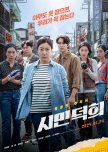
A plot written by real life.
Brilliant. I can go into rhapsodies about “Citizen of a Kind.” About the well made KMovie. About the authentic and stirringly positive energy that the film conveys. (And this despite the fact that the issue dealt with is shocking, cruel and profoundly mean right up to the end.) About the wonderful heroine, who is convincingly portrayed by Ra Mi-ran. About the true heroine in real life, who actually made this story come to life. About the haunting production, which, despite the captivating story and many touching, even quite brutal scenes, still has the touch of a lively road movie.A plot written by real life.
Womanpower and sisterhood included.
Awesome.
PS:
There might be a growing amount among the audience who probably by now has someone in their wider circle of acquaintances who has become - or almost became - a victim of a voice phishing fraud ring. The personal material damage is only one (very painful) side of the ugly coin. Almost worse is the side with psychological injuries, all centered about shame and guilt, which run deep.
In the case of "Citizen of a Kind", the victim out of sheer desperation chooses a rather extreme offensive path of coming to terms with it. However, most victims remain stuck in their trauma. On the one hand, they remain emotionally exposed to the tormenting feeling of the helpless loss of control they have suffered. On the other hand, they torment themselves with persistent feelings of guilt because (in the eyes of themselves and of others, too) they “fell for it themselves” and therefore “made themselves responsible” for their loss. The emotional dilemma is fatal. What makes things even more difficult is that the real perpetrators usually remain in the dark, are difficult to pin down and therefore rarely can be actually dealt with as a real counterpart.
In "Citizen of a Kind" the victim searches for the perpetrator on her own, finds him, and at the same time becomes the savior of potential further victims (of this perpetrator). That feels so good.
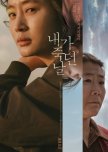
Atypical, yet worthwhile thriller, driven by a unique variety & sensitive quality of women´s power
"The Day I Died: Unclosed Case" is a thriller. However, the KMovie takes its time. It is atmospherically embedded in the slowed down everyday life on an island. The focus is on emotionally approaching the protagonists. In this case, the key characters are all women, who are surrounded by other women. Men are only indirectly involved in the background of the story - among other things as those who stand for the painful wounds in the women's lifes.So you might think: a movie about women's power? As a matter of fact, that's true. However the actual power of women is not men´s power in women's clothes. In this movie, women´s power symbolizes in an idiosyncratic way how the usually devalued "weak" in the 'female' becomes "powerful" and effectively plays out its transforming and liberating quality, yet in a rather calm, descreet variety: silent, subtle, empathetic, unobtrusive.
The story is quite exciting, profound and complex. In the course of the investigation, the detective - strong, competent and at the same time hurt and vulnerable - is increasingly confronted with open questions in her own life. She slowly builds an emotional connection with the missing victim. Although the case seems clear and simple to everyone else, she cannot let it go. She is driven to shed light on injustice of some sort. Is she fighting for the missing victim? Is she fighting for herself? Either way, she finds the answers she's looking for.
In a touching way the strong presence of the two veterans Kim Hye-soo and Lee Jung-eun rounds an exciting story off. Script and direction are also in women's hands here. "The Day I Died: Unclosed Case" is not a classic crime thriller, but definitely worth seeing - with a unique variety and sensitive quality of women´s power.
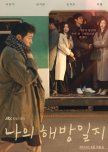
Progressive Message: Quality of life increases with the degree of truthfulness (not scham&pretence)
"My Liberation Notes" is a ray of hope within South Korean series production.In short: The lives of young people in their prime (+/- 30) are at stake here. Considering their groaning under the pressure of the competition in the workplace, the dazzling promises of the modern lifestyle industry, and the claims of society and family traditions, this could all be pretty depressing. But amazingly, it's not. The protagonists manage to give their lives something like dignity - quietly, impressively and with gentle intensity. They walk the way that lies before them, spraying their personal touch, a little bit, but nicely, thus leaving color and warmth on their trail.
The KDrama presents itself as a Netflix co-production and is thus in a certain way 'pimped' for an international audience - you don't see anything of the typical and rather special elements like makjang, slapstick, glitter & glamor of Jaebeol, or traumatic childhood secrets. Just life, every day, like everywhere else. Without spectacular ups and downs. As if someone had blindly reached into a pot full of addresses from a random location on the outskirts of metropolitan Seoul and then simply turned the spotlight and camera on the family living there for a while. In principle, it could be any family living near the terminal stations of the Seoul subway network. This, however, identifies the KDrama as specifically South Korean. Finally, the story is high KDrama quality, when it comes to a carefully, multi-layered narrative with deliberately reduced pace and space for the sensitive moments in between.
----------------- SIDE NOTE: --- Provincial life in the metropolitan area around the capital Seoul ---
So the KDrama simply tells about the normal life of relatively normal people around 30. They don't live in the megacity of Seoul (while almost 10 million people do) or in Incheon (with almost 3 million inhabitants), but in the sprawling province of Gyeonggi-do, which makes up the majority of the metropolitan area around Seoul in terms of space. The provincial population makes up ca half of the population of the more than 25 million inhabitants of the entire agglomeration around the capital Seoul. (And this in fact is about half of the inhabitants of South Korea altogether). An insight into the living environment of those provincial residents thus also offers an insight into a good deal of current South Korean life issues.
The fictional 'Dangmi Station' is actually Line 1's 'Seonghwan Station'. Crucially, most people who work in Seoul (increasingly) cannot afford to live in the city. Every workday they commute about +/- 2 hours to do their job in the city. With the evening company dinners and collegial come-togethers, a day becomes very long. There isn't much time left for a life of your own outside of work. While it is convenient in many respects to remain in the family home until marriage, this further reduces the amount of free time you have at your disposal. Especially if the parents still do a bit of farming and the help of the 'children' is required here and there.
City and country clash, almost every day. Accordingly, different life plans collide, which either fit more into a fast-paced, hip city life or rather into a rural, decelerated provincial life. In reality, however, new hybrid variants are needed that function as a flexible joint between both realities that are equally relevant to everyday life - city and country.
You might want to think about the meaning of life. About goals that you would like to set for yourself. What is life? What does it offer me? What would I actually like to do? Or, wait a minute, is it better not to think at all? It is up to the young people of the recent and the following working generation, to grope, to stumble, to develop new, visionary as well as down to earth attitudes and inspiring blueprints to life in a South Korea from the 2020s onwards...
------------------
"My Liberation Notes" sails in this field of tension. Other than that, tension is not on the agenda. "My Liberation Notes" is processing the wisdom, the questions and the insights that the protagonists come up with over the course of the story - sometimes quietly to themselves, sometimes in conversation with friends.
The focus is on 4 protagonists who practically all live together in the provincial suburb of Seoul. Three of them are siblings and work in Seoul, the fourth is a stranger who helps their father in the carpentry shop and in the fields, eats with the family and lives next door. (A fantastic Son Seok-ko as an inscrutable stranger, as well as Lee Min-ki, Kim Ji-won and Lee-El as very different siblings, are presenting the range of everyday emotional worlds in a wonderfully haunting way.) All four wrestle with life in their very own manner and question, what freedom and quality of life could mean to them under the given circumstances. Promotion? Money? Success? A car? A partner? Marriage? Family? Living in an apartment in Seoul? Where is life? Is this life?
Eventually the aspect of reverence also comes to the fore: To respect and be respected. To be worshipped. To be adored... Yet how to express mutual adoration and respect (in order for your own life to feel maybe a bit more valuable)? ... Maybe just give it more space. That would be great...
The episodes pass as does life itself. The days are the same, and yet each one is new and different from the one before. Happiness is accumulated by the minute. And in the end, life is beautiful after all. Worth living. Distinctive. The quality increases with the degree of truthfulness that they give to their lives. And that's indeed a progressive message (as far as a society like the South Korean with its highly valued tradition of scham and pretence is concerned.)
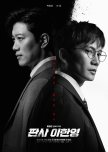
Sisyphus in a Suit
You stare at the screen and can’t help but think: Oh, humanity. Always longing for a restart because, predictably, we messed it up the first time."The Judge Returns." It’s 2026, and the world remains a damp cellar filled with greedy old men. At first glance, it feels like an echo of 2022’s "Again My Life". Has South Korea not moved on since then? (Looking at the current geopolitical landscape, neither has the rest of the world...)
The message is so sobering you’ll want to retreat into a dark room: Without magic, without some metaphysical glitch in the system, you can’t knock these corrupt fossils off the board. It takes a time-reset just to summon the courage for basic decency and integrity. What a pathetic indictment of our species. You take a few pieces off the board, but the Game itself just laughs. Corruption isn't a bug in the system; it is the system. An endless war, a tiny victory—but in the end, does everything stay grey?
Then there’s Ji Sung. He carries that unshakable face of his through every frame. As a judge on his second attempt, he seizes his chance with absolute consequence. For a moment, it feels good to believe that something could actually move.
The Verdict?
• 10/10 for Ji Sung (honestly, just watching him is enough).
• 3/10 for Hope (which, as we know, is merely a lack of information).
But it’s not just about his face. It’s about what that face embodies.
(And thankfully, he isn’t entirely alone in this.)
Amidst the mire, there are these delicate moments where the series actually reflects on the Law. This KDrama (based on the webnovel Pansa Lee Han-young) bows before the Idea of Law. Not because it’s perfect—heaven knows it’s as full of holes as Swiss cheese—but because it’s the only thing standing between us and total whimsy. It is Sisyphus’ work: rolling the stone of the rule of law up the mountain every day, only for it to roll back onto our feet. But that doesn't mean the work is meaningless.
The Koreans have a beautiful term for this: Cheon-myeong (천명). Literally: The Mandate of Heaven.
Embracing the burden of destiny as a call to action, however bleak the odds.
So, would I recommend watching it? Yes. Even if—or especially if—those lying men in suits are increasingly getting on your nerves. It’s an act of defiance to watch someone tirelessly roll that stone up the hill, if only for those few episodes. (I think anyways.)
One of those series whose true beauty unfolds only gradually
Happily, another jewel in the KDrama sky of 2025. Our Unwritten Seoul is one of those series whose true beauty unfolds only gradually—like the secret bloom of an evening primrose, opening quietly under the cover of dusk, revealing its radiance only to those who wait with patience.Many voices have called the series emotionally profound, poetic, introspective, healing… It spent weeks in the global Netflix charts and entered the Top 10 in more than 28 countries. At its heart, it is a drama about identity, self‑perception, and familial wounds. And within it, Park Bo‑young surpasses herself in a dual role as Mi‑ji and Mi‑rae.
What first appears to be a quiet drama reveals itself as a finely woven net of fate, self‑deception, transformation, and quiet hope. It does not show a world that is better, but one that is honest. A world where dreams fail, families grow weary, people live side by side without listening to each other. And yet: there are strawberries. There are warm embraces. There is the possibility of beginning again.
The story of twin sisters who exchange roles may sound familiar, but here it becomes a meditation on identity, self‑worth, and the longing to be someone else.
Park Bo‑young does not merely carry the series—she shapes it. As Mi‑ji and Mi‑rae—and, in truth, as four substantial versions of them: each as herself, and each as the other in disguise. She grows through the subtle distinctions of expression, the quiet shifts in tone and posture, the evolving body language. Rarely has a double role been so convincingly embodied.
Lee Ho‑su (Park Jin‑young) is not the typical love interest. He is a man marked by scars, visible and invisible. Half deaf, half estranged from his own body, he becomes a mirror of imperfection—the very quality that makes the series so valuable. His relationships with mentor, mother, past, and with Mi‑rae and Mi‑ji are told without pathos.
The cafeteria jobs, the small‑town life, the broken dreams—these make Our Unwritten Seoul a counterpoint to dramas suffocated by glamour. Even though its stars come from the KPop orbit, their performances reach a new level: restrained, reflective, human. Even the supporting characters carry their own stories, which gradually draw us in. This makes the world believable and layered. The supporting actresses Cha Mi‑kyung, Kim Sun‑young, and Jang Young‑nam add depth without overshadowing.
And then the deliberate contrasts: city and countryside, high‑rise and strawberry farm. The farm scenes are almost meditative—a place of healing. Han Se‑jin’s departure from the hedge‑fund world is more than symbolic: it is about rediscovering a way of life that does not need to be efficient.
The theme of self‑compassion also finds its place here: the series asks not only how we see others, but how we treat ourselves when no one is watching.
The OST serves as an emotional companion. The visual design is carefully attuned to the story. The series employs a chiastic structure, working with opposites and reflections so that the characters’ development and healing become visible. Even the colors shift gradually, reflecting the inner states of the protagonists.
In the end, the story closes a circle. The characters return to places where they began—changed, grown, carrying their old wounds, which now can begin to heal. Subtle, beautiful. And, indeed: valuable.
about the ´art´ of becoming an egoist
You may consider "Red Balloon" being one of those family makjang stories that come up again and again in different versions in KDrama-land. Tangled ties of fate and trauma that continue to get even more tangled and traumatizing. You might think “Yeah. Makjang again. Family drama again. Forbidden love again. Ok, you´ve seen it all. You don´t need another one.” So should you watch? You definitely don´t have to. But oddly enough: you may want to. The characters, with all their sometimes almost disturbing ambivalence, drag and pull you under their spell. Subtly, unperturbed, whether we're watching or not: they are struggling to function and survive within their dysfunctional relationships and families... and on top of it: they are even longing for far more than that.2022/23 "Red Balloon" infiltrates South Korean homes as the red-hot contemporary document of a complicated ordeal, which society increasingly has to deal with. On the one hand, family is regarded as the highest value in society. On the other hand, within the last decades national divorce rate has reached the tops in worldwide comparison. Yet, divorce is still seen as a shame – a topic for ´other´ families only (if at all). Nevertheless, more and more South Koreans are choosing this path, even the 'elderly' (those over 60 and even over 70) are increasingly opting for divorce. The KDrama juxtaposes the hardened socio-cultural fronts within a fictional story that listens to both sides equally, gives space, allows themselves to be rubbed against each other – sometimes loudly, sometimes violently – and struggles to find solutions.
Throughout the KDrama, events and emotional ordeals continue to get worse. Seasoned with gradually increasing makjang tension, with complex personality portraits, as well as poignant, excellent pleas (sometimes for one, sometimes for the other and sometimes for yet another position), the KDrama screws itself deeper and deeper into the increasingly heated minds of the audience. "Red Balloon" succeeds excellently in taking its often head-shaking viewers into truly impassable, controversial socio-cultural terrain and, with the concentrated confrontational dramaturgical charge of emotional ambivalence, exemplifies what would be, could be, yet must not be, however wants to be possible, (and after all IS possible in South Korea 2022/23).
There are multiple storylines that are heartily intertwined. But they all deal with the same topic: the critical fine line between a so called ´satisfied´ life (as one normally lives / should / has to live / pretends to live) and a self-abnegating, self-deceiving ´dissatisfied´ life; the latter mostly going unnoticed, though, because actually everyone lives that way and it seems to be the most natural thing in the world... Dissatisfaction only becomes critical, if someone can no longer ignore that this supposedly ´satisfied´ life is actually a 'dissatisfied' one. The subtle psychological tension of the KDrama emerges in the conflict between traditionally unquestioned, accepted customs and the individual urge for deviation, which (here) rages more or less intensely in almost all of the protagonists, and erupts in an attempt to break free. Daring to dream, being honest with oneself and eventually even making the necessary efforts... but, alas, also being sincere in respect to the social environment? Ready to disappointing the expectations of others? Prepared to missing duties and responsibilities? To hurting loved ones, too? Has actually anyone ever honestly tried to truly walk along his/her individual path sincerely upright? (At least when it comes to South Korea 2022/23, so far there are hardly if any role models whatsoever.)
"Red Balloon" can be considered a social study using the example of the microcosm of three families, that are connected, among others, through a (not quite balanced) childhood friendship between two female protagonists. Yes, one could bitch and nag about prevalent adultery among the protagonists. On the other hand, in this case I´d like to set a different focus, that is: Collectivism in conflict with increasingly burgeoning individualism. Against this background, it is more about the 'art' of becoming an egoist. (See side note below). In a society shaped by collectivism, social class and hierarchy like South Korea, 'egoism' (=standing up for individual needs, even in the face of social pressure) has so far not been a quality in itself. On the contrary. The development of such an independent and socially recognized value is in its infancy there. The protagonists are correspondingly insecure and sometimes stumble, doubt themselves, look for a turnaround and reflect on the old values... which include: doing what other, older, financially better off fellow human beings say, want, demand. (And thus, often enough being humiliated, too. A life full of sacrifice, humiliation and shame is quite normal. Most people live that way. Accordingly there is nothing wrong with it, right?)
Shameless adultery might be one side of the medal. The other side, however, represents the widespread, customary long ignored individual dissatisfaction for the sake of ´the group´ (family etc.) that some can no longer cope with. The KDrama team draws memorable portraits of people at different ages, who have their quirks like anybody else. At some point, they try to stumble free from the expectations of others and rather follow their gut. They want to, and choose to live up to their own desires... struggling, staggering, falling in the face of the mercilessly blowing headwind. There might be an urge to break free of a tight corset of expectations and obligations – yet, just daring to think in this direction is considered shameless and despicable... Sympathy for family struggles, sacrifices, deprivation and suffering, on the other hand, is widespread, because this individual pain results out of self-sacrifice for the 'group' and in this case is downright virtuous. (The KDrama Orbit has told countless stories of this virtue since the earliest productions.) Sympathy for 'individual' pain however, e.g. suffering from the group pressures and demands, is hard to find. With a newly found egoism and its associated pains one is left alone... Well, has been, so far. Not anymore. This is where "Red Balloon" comes in… at least with an example of role models on fictional playground.
With its tricky, controversial topic, the KDrama hits the mark of many minds in the country. The audience of "Red Balloon" had quickly doubled and after half of the 20 episodes even tripled. Eventually, for the audience throughout the rest of the world it offers plenty of KDrama-Quality, too.
--------------------------------------
SIDE NOTE: --- Life satisfaction in South Korea ---
The latest data on quality of life, published by the Republic's statistical office in 2022, ranks South Korea 36th among the 38 OECD countries. (Only in Turkey and Colombia life satisfaction is worse.)
What feels like exaggerated makjang for some (especially for audience with nationalities of the other 35 member states) is pretty close to everyday life for many (South Koreans) sitting in front of their home TV...
------------------------------------------
SIDE NOTE --- The ´art´ of being an egoist ---
In 1976 the book “The Art of Being an Egoist” by Josef Kirschner was published. In it, the author works out the necessary, ambiguous psychological process and the stamina, the required perseverance, you need regarding individual (=egoistic) life decisions that are geared towards personal needs (=against the interests of the community/group/family). Self-love is a crucial step towards accountability (vs. behaviour determined by others) and thus forms the basis for free, responsible, caring citizens. However, even after all those centuries, egoism is (still) widely devaluated in individualistic Germany/Europe, too.
That´s because, egoism and the group are generally at war. The more submission the family/group/society structurally expects of its members, the less space individual needs have and the more shameful and banished they are. The protagonists in South Korea 2022/23 (which is characterized by collectivism and has a strong hierarchical structure) have to deal with just this problem. The theme here is the struggle for a psychologically healthy egoism for one's own good. The thesis behind: Honestly towards myself and content, I am able to approach others sincerely and freely give of myself, contribute and care about others. That´s because I want to. Not because I have to, (even though I feel wronged, indigent or missed out.) I care for myself. And then, additionally, I can truly care for others, too. Like the sign in the airplane says: you should put your oxygen mask on first before trying to help the person next to you…
PS:
(This 'egoism', which is based on self-love and mature personal responsibility, should not be confused with insatiable, ruthless and mostly immature greed. KDrama-orbit is full of greedy contemporaries, because unfortunately greed is cross-culturally human and can thus be found all over the world. Greed has no social component. With greed, nothing positive flows back into the group.)
--------------------------------------
Quiet resistance becomes power—ordinary lives spark change in this gripping historical drama
South Korea, 1987: a country under the control of an authoritarian regime, where freedom of expression is suppressed and political activists are brutally persecuted. Amidst this repressive atmosphere unfolds the KMovie “1987: When the Day Comes”—a political thriller that not only illuminates the events surrounding the death of student activist Park Jong-chul, but also showcases the collective power of a society rising up against injustice.Director Jang Joon-hwan weaves a dense web of dramatic force, historical accuracy, and emotional depth—creating far more than just a political drama. He delivers a silent outcry for democracy, civic courage, and collective remembrance. The story is staged like a relay race: the narrative jumps between journalists, prosecutors, students, and prison guards, showing how many small steps ultimately lead to a great change. The film for me is not only a cinematic masterpiece but also an emotional appeal to conscience.
Rather than following a classic hero, the film presents a mosaic of individuals who make great change possible through small decisions. Camera work and editing are precise, almost documentary-like, yet never lose sight of emotional resonance. Especially impressive is how the screenplay transforms seemingly incidental encounters—such as between a prison guard and his niece—into milestones of a historic awakening.
Instead of drawing a clear moral line, the film presents ambivalence: journalists who walk a tightrope; a prison guard yielding to his conscience; a student who moves from cautious skepticism to resolute conviction; an official who refuses to look away at a decisive moment. Their actions are subtle, their words sometimes hesitant—and it is precisely this that creates a realism far beyond mere dramatic staging. It is the “little” people—the inconspicuous, sometimes nameless figures—who give the film its depth and authenticity.
These figures serve as moral compasses in a system that punishes any deviation. Their choices are not loud heroic deeds, but quiet acts of resistance that pave the way for change. While the great battles move the audience, it is these moments that linger—because they show how democracy begins in everyday life: through the courage to embrace humanity.
In this, “1987” achieves something rare: the film not only celebrates the victors of history, but honors those who stood in the shadows—without whose actions no light would have illuminated the dark corridors of the past.
-----------------------------------------------------------------------
SIDENOTE:
THE FRAGILE SEEDLING OF ‘DEMOCRACY’ and SOUTH KOREA IN 1987
South Korea in 1987 stood at a crossroads: The military leadership under Chun Doo-hwan clung to power, while the populace—above all, students and intellectuals—had been rising up with growing courage for years. The brutal torture and murder of student Park Jong-chul became a turning point. The subsequent response, the June Uprising, initiated the transition to democracy.
South Korea's path to democracy is remarkable for its dynamism and symbolic power – especially in the pivotal role played by ordinary people. While other countries liberalized slowly, the Korean people fought for their freedoms against a heavily armed and determined regime. The role of students, church networks, and the media was central—an example of how civil society can become the driving force for change.
The film does not depict these developments as a triumphant victory march, but as a difficult, fragile path on which many risked their safety, freedom, and even their lives. This realism makes the story tangible—and relevant.
What makes “1987” so explosive, too, is its current relevance. The film is not a nostalgic project—it flickers as a warning signal in times when democracies around the world are under pressure. Even today, we witness how the erosion of democratic institutions often happens gradually: through indifference, disinformation, and complacency.
How easily we forget that democracy is not a given—that it must be actively lived and defended. “1987” reminds us that you don’t need a “big moment” to take a stand—it is everyday courage that counts.
“1987: When the Day Comes” thus for me is more than a moving film—it is an invitation not only to discover South Korea’s past, but also to question our own present. What are we doing today?
Not a KDrama, but a dramatic Korean story with a lot of Korean heart. (A hybrid?)
Ok, this series tells a Korean story, it´s about Korean destinies. BUT it's not an original KDrama. It is a (western) Apple production in which some (Apple) producers from the US obviously had a say. So, first of all, a bit of criticism about the American serial adaptation of a bestseller novel, which 'coincidentally' has a Korean fate as its subject. (Before I go into praise...)North Americans with Korean family backgrounds may have been involved in the production (the directors, the person responsible for the script adaptation and a lot of actors, for example). Nevertheless, it is and remains a North American production. The sad thing about it: the series production repeats - if you like - the theme of the story in a new media version: in this case, the profitable exploitation of 'Korean stories', 'Korean fates' and even a bit of the KDrama soul...
Using the example of several generations of a Korean family and their personal destinies against the background of Japanese colonization and racism to this day, why reduce a 500-page book to ONLY 8 episodes? Why not use the time and space and retell the story in at least 20 episodes, or even 50?
Quite simply: the series production is not of South Korean origin, and it is not made for South Korean television, but for the international streaming market. The rest of the world isn't THAT interested in South Korea, but it is quite touched by Korean fates. So, the enthusiasm for the original bestseller in a binge-capable, compact format has to be cleverly marketed in a colorful and moving way in order to attract new streaming subscribers to Apple. The world (those who have not yet read the book but have now watched the series) is shocked and touched by what happened between Japan and South Korea, which is still today formative for many Koreans. The rest of the world was hardly aware of this historical chapter. However, in the series adaptation, the individual fates were told less in detail. They were rather reduced to catchy basic emotions, and these were cleverly knotted as a cross-generational leitmotif in key scenes over time jumps. The focus is on Sunja - with the focus on Sunja in her third phase of life. This is embodied by Youn Yuh-jung, who was already able to leave a lasting impression on the international audience with (her Oscar for) "Minari" and thus gets plenty of screen time as a 'star' among many internationally comparatively unknown actors.
Well, that's the way it is.
If you have a background with KDrama, you will find a nice study object in "Pachinko" to compare the different narrative styles (Western style vs. Korean style) with regard to emotionality. Western style would be more like: 'I WATCH the mimes have their feelings'. The individual sequences of different timelines, some of which are strung together at very short intervals, convey this 'Western' handwriting. This is, so to speak, Western objectivity in the depiction of emotionality. The (South) Korean narrative style, on the other hand, deliberately draws the audience into the emotional world. E.g. 'I sympathize. I'm IN there too.'
So, with "Pachinko" there was a lot of Korean heart and soul mixed into the story and series adaptation. You can feel that. This is how an interesting hybrid production actually came about. It's not a KDrama, but a Korean story with a lot of Korean heart. Thus, the spirit of Korean storytelling still blows through some of the scenes. Actually, even the concept chosen for the series adaptation is the strongest element: if such a complex family saga is told in 8 episodes, then through the characteristic basic emotions in the form of impressive scenes - less in plot, action and dialogues. For example: when the mother ceremonially prepares the rice for the wedding, which they are actually not allowed to eat, or the young bank employee throws his expensive jacket into the puddle and dances footloose to the street music on the open street (in Japan!), or the grandmother, completely moved, after decades back on South Korean soil on the beach of her childhood... There are strong scenes like this - lastingly impressive, without words - that (want to and actually do) touch the heart. THAT, I would think, is Korean style in the way of its storytelling. It somehow sneaked into the production (still US production, even if it was trilingual) and confidently took its place. (Perhaps in the same way that people under Japanese oppression quietly preserved their inner dignity and inner defiance despite all bending and suffering.)
And by the way: the title track may be well and good. But! The intro clip is in my eyes most peculiar and completely missing the subject. It's nice that all generations come together here, but the extreme exuberance of the dance performance has nothing to do with the rest of the series. It seems rather strange, how in contrast to the particular, muted, rather gloomy 'Han' (Korean pain/world pain) of the story it comes along in such outlandish US style...
Nevertheless: the series is captivating, moving and over all a rather inhospitable excursion into inhospitable Korean living conditions, which are emotionally shaped for some even to this day by the Japanese colonial era. Even decades later in Japan and the USA, life is shown rather inhospitable. Only a few well-chosen scenes open up in a visually stunning and atmospheric way, as if to remind us that life itself is a gift...
Even if it's only told in 8 episodes (and by now apparently in 8 more for a second season), "Pachinko" offers an unforgettable, visually stunning excursion into a sad segment of recent Korean history using the example of a moving family saga. A concentrated load of multifaceted contemporary rich topics that can at best be roughly touched or tabbed upon in the series adaptation. Nevertheless. It is definitely a masterpiece to compress the 500-page epic into 8 slim episodes and - without having to bend the story too much - to convey a stringent, central emotional attitude even in the face of the inhospitable nature of being: the protagonist despite all the suppression keeping a quiet, inner dignity, grounded and clear - from there drawing the strength to face life and its challenges again and again, in all simplicity.
Lastingly impressive!
"Jirisan" radiates within the slowed down, yet powerful dynamic of the mountain world
"Jirisan" pays tribute to South Korea's first and largest national park and its rangers, who ensure security and order here. The KDrama weaves an exciting story that also takes into account the special aura of the mountains, adding a good portion of mysticism. Actually Jiri Mountain is quite legendary and downright sacred for Korea. It's worth watching the KDrama for that alone.Other quality guarantees are given by the handpicked cast and high-end production.
A joy for some, a curse for others: "Jirisan" radiates within the slowed down, yet powerful dynamic of the mountain world. The story itself is a bit reminiscent of a mountain hiking tour: it's not a stroll. You need the right footwear. Sometimes you might think you've lost your way. The story is told in several timelines. Yet it chooses its own rhythm with a sure step, that leads to the final destination. On the way it is continuously enriched with worthwhile vistas along the entire route... Fast pace and airy love story are not part of the baggage. But exciting entanglement over time, unconditional trust as a topic in the team of rangers, as well as love in its essential form and various expressions (... e.g. for the mountain).
What an outstanding chamber play with two extremely gifted, stellar actors
Father's House" has two episodes only.What an outstanding chamber play, though!
With two extremely gifted, stellar actors. Choi Min-soo, already living acting legend at that time, and Kim So-hyun, then just in the starting blocks for fame. Choi Min-soo and Kim So-hyun deliver an unforgettably intense, mature performance and thus the authentically touching portrait of a dear, profound, yet often clumsy father-son relationship over a period of more than 2 centuries.
Male feelings are the focus. The heroes in "Father's House" are men of simple, humble origin - with either a gruff, rough and rumbling or withdrawn demeanor of hidden feelings that are rather reluctant and probably seldom felt, let alone shown. However, having feelings and showing emotions is allowed in this KDrama. It's difficult to deal with, yes, but it's possible. Necessary even.
Emotional sincerity has a liberating effect. The three male protagonists - son, father (and his adopted father) - actually become role models. "Father's House" came as a distinct year-end television show at the turn of the year 2009 - with reruns after that...
Haunting psychothriller. Rather psycho-logical. Intense acting of a fantastic trio.
"Anchor" is a psychological thriller set in the competitive world of TV news anchor. A nightmare on the edge of a horror trip begins, as Jung Se-ra receives a strange phone call, followed by fatality. Se-ra sets out to investigate herself... Eventually a psychiatrist plays a dubious role, starting to increasingly influence Se-ra´s world. Her manipulative controlling mother on the other hand cannot tolerate this. Increasingly, realities become blurred. What Se-ra finds out in the end is downright shocking.Like I said, this is a psychological thriller. On top of that, it gets mysterious, psychologically complex and a bit uncanny at times. Viewers see the world through the eyes of Jung Se-ra (impressive: Chun Woo-hee), who is getting confronted with her own blind spots. Tugging on one side is her dominant mother (spooky: Lee Hye-young), while on the other side the provocative psychiatrist In-ho (unfathomable: Shin Ha-Kyun) plays with fire confronting Se-ra's psyche with hypnosis.
"Anchor" clearly thrives on the intense acting of this fantastic trio. Haunting.
PS:
Don´t expect to get all the answers straight - the KMovie is rather psycho-logical.
About conscience & courage in a society that appears democratic, but is ruled by authoritarian force
He only wanted to do taxes. Draft contracts. Earn money. Song Woo-seok is a pragmatic lawyer — smart, efficient, unsentimental. But when the son of a woman who once trusted him in hard times is taken by the police, the man who once only saw paragraphs begins to see people. The Attorney tells the story of a man who thought he knew his place in the world — and only begins to truly live when he takes a stand.Based on true events — the 1981 Burim case — the film follows the early journey of future president Roh Moo-hyun, without ever naming him. We witness a successful attorney becoming the defender of students branded as “communists,” tortured, and tried — simply for reading the wrong books at the wrong time. What unfolds is a courtroom drama that reverberates far beyond the trial itself: a story about conscience. About courage. And about the painful awakening in a society that appears democratic — but is ruled with authoritarian force.
Song Kang-ho, in one of his most compelling performances, carries the film with an intensity that makes anger, shame, and resolve palpable in every gesture. His transformation is moving precisely because it isn’t heroic — it’s hesitant, searching, deeply human. And it’s in this quiet where the power lies: when he rises and says, “I’m his attorney,” it isn’t a flourish — it’s a vow.
------------------------------ A historical side note: The long shadow of dictatorship ------------------------------------
In South Korea, the memory of Chun Doo-hwan’s authoritarian rule remains an open wound. The Burim case stands as a stark symbol of a time when civil rights existed only on paper — and disappeared into basements. The state’s orchestration of paranoia, the systematic torture of alleged dissidents, and the suspicion cast on intellectual life: The Attorney captures all of this with devastating simplicity.
And it shows: not all complicity comes from conviction. Some from fear. Others from habit. The film asks what it takes to break out of that cycle — and offers an answer that’s not political, but personal: empathy.
A major box office hit with over 11 million viewers, “The Attorney” is a landmark of Korea’s cinematic reckoning with its past. It reminds us that justice is more than a system — and that sometimes, justice begins with a single line: “I’ll take the case.”


