
 News


An Anti-Romance in the Best Possible Way
The Red Sleeve does something I never thought I’d see in a K-drama - it dares to suggest that love may not conquer all. Most “romantic” sageuks start with the premise that every commoner or court lady dreams of being swept off her feet by a handsome prince, but few look closely at the power dynamics of such relationships, especially in the Joseon era where the patriarchy was so rigid that even the most powerful woman in the kingdom, the Queen Dowager, was essentially under house arrest. To its credit, The Red Sleeve centers this fundamental inequality, suggesting that consenting relationships are impossible if one person is the master and the other, functionally, a slave. It’s also smart enough to feature one of Joseon’s “best” kings as its male lead, emphasizing that the issue is systemic, not individual, and that no ruler, no matter how just, upright and swoony can be an ideal partner as long as they view their love interest as a possession. And when a woman must obey, the line between rape and mutual affection quickly blurs, even if the man is doing it “for her own good.” The discomfort the show induces is magnified by the fact that it includes no easy villains. Everyone has an agenda, but everyone is also trying to do their best in a world where protocol and order take precedence over human feeling. But when human feelings must be excised in the name of duty, the drama reminds us that it’s often women who take the fall. It asks us to reconsider whose lives matter, and argues that agency, even the agency to choose heartbreak, may be preferable to even the dreamiest of suitors.Was this review helpful to you?

This review may contain spoilers
Satisfying series! Highly reccomended.Binged watched the whole series in one night. Engaging from the start till the end., the twelve episodes were used perfectly!
Coming in, you'd think you are watching a semi-fantasy scifi show. Its a story of a missing IT tycoon whose consciousness was mysteriously trapped inside a mobile phone. The phone landed in the hands of a seemingly unlucky jobless man who wasoffered to be the CEO of the company to solve the mystery of the boss' disappearance
I loved that the male princess cinderella transformation wasnt overdone. I specially enjoyed the main lead's boyish charm and acting and his dynamics with his family. I was also happy about the way they resolved the mystery of the trapped boss.
If there's anything con ts the fact that Chae Jong Hyeop's arms are so distracting, cause the guy oozes masculinity even without taking his shirt off.
Give it a go, you'd enjoy it too. Overall its an 8.5.
Was this review helpful to you?
This review may contain spoilers
How a Guy Speedran His Mid-life Crisis: The Movie
Now, I know what it sounds like when I literally rate this a 10/10 across the board but I swear I cannot overstate this when I say this is forever going to be one of my favorite movies for the rest of time. Director and writer Liu Jiangjiang was very humble when he said that some people might think it's an immature movie, with immature/inexperienced staff and actors, and with messages that might be too on the nose -- he went on to say that he just hopes everyone will appreciate the movie, even if just a little bit, because he and the rest of the cast and crew put so much of their heart into it. And you know what? Lighting Up the Stars exceeded all expectations, at least for me. Heartwarming, funny, profound, playful, a tearjerker... This film is the equivalent of finally coming home after being away for a while, of being wrapped in a blanket on a cold winter's day, of sleepovers with your friends in childhood, giggling after lights-out. Words cannot do justice to how this film makes you unlock emotions you probably weren't even aware of -- in a good way.Before I go on with this review, I do want to stress that there's a scene near the start that's extremely uncomfortable to watch, showing Sange basically attempting to sexually assault his ex-girlfriend. It's obviously not shown in a good light, and nothing happens because they get interrupted by her new boyfriend who she cheated on him with while he was in jail. Still, I want to add this warning beforehand, because despite how much I adore this film this was the sole thing I absolutely despised.
It's a very straightforward story, but that doesn't detract from everything else at all, it's one of its strengths. The topics of funerals and death is one that has a lot of taboos associated with them, and choosing to tell the narrative from a child's (Xiaowen's) point of view gives the already novel subject matter a spin you don't often see. While ostensibly a movie about a little girl losing her grandmother and gaining a new family, it's about much more than that. Yes, Xiaowen is at the heart of the story; it is, in many ways, a story about her more so than the adults around her. But it's also about what family really means, it's about what you want in life, it's about love in all its forms, it's about what you do -- and what you don't do. It's about the very outlook on life and death, and how one small change can make the difference. It's about a little girl just wanting her grandma back, and a man who is disillusioned with the world desperately wanting to live up to his dead brother's image finding each other and being what the other needs.
Connected through a series of funerals (of course, what else could it be, when it's Sange's literal line of work), each one is distinct in not only execution but also atmosphere, set dressing, and so on; each one a beat in the movie showing the changes in the characters and driving the story forward. While the ostentatious one with the old man who pretends to be dead is by far the loudest and most colorful (and definitely the funniest), the funeral that stuck with me the most was actually one of the first, with the little girl. From Xiaowen pretending to be Sange's daughter to get her family's approval to manage her funeral to her drawing on the girl's cinerary casket which couldn't be washed off, to the girl's family bursting out into tears of gratitude because their little girl loved to draw and Xiaowen's scribbles are so much better than more impersonal casket it originally was... While to some degree you can see it coming, it definitely sets the stage and does so well to convey the unpredictability of life and death, and human's hearts. Liu Jiangjiang's family is in this business and it shows in the care and details he puts into every one of the funerals depicted, the people who are buried but also their friends and family who are grieving for them.
For a movie of roughly two hours, the pacing doesn't feel rushed or drawn out, and the character development, while at times a little flat for anyone who aren't the main leads, is still very well done. Sange going from "she's my arch nemesis" and "look how you're going to ruin me" on day one to appreciating her place in his life and wanting to keep and protect her not even a day and a half later is, yes, hilarious, but on a fundamental level it's so heartwarming to see his entire outlook on life change for the better because of her, and in such a short amount of time. It shows how much he really wanted something (someone) to care about this much, a sentiment echoed later by his ailing father. Vice versa, when Xiaowen gets adopted by Sange's friends (which happened through a hilarious turn of events, and for a movie about death, there's way more comedy than expected, or, perhaps, just the right amount to offset everything else) and nominally by Sange himself, she starts letting go of her grandmother and starts opening up, all of it culminating in her telling Sange that she knows he lied, but that's okay, she's not scared anymore because she's got a dad now.
It makes their separation all the more painful when he basically lets her mother (who! surprise! is not dead but just had horrible luck in life and hit rock bottom and went to jail like Sange and just wants to be a good mom now and loves her daughter deeply and means well despite everything and-- well. You get the idea.) kidnap her in the middle of the night. One might be frustrated at the lack of communication from Sange, but when you remember how he never really had a childhood growing up in a funeral house, and how he has inferiority issues and a slew of other problems, his actions become understandable even though still not justified. All's well that ends well though, and they reunite with a scene that had me bawling when I first saw the clip months ago, released as promotional material, and that made me bawl again watching the full scene, entirely attached to both characters.
The cast of the movie is phenomenal. Zhu Yilong has delivered probably his best performance yet, portraying a character entirely different from his body of work and doing it in such a way it feels entirely natural and immersive. In interviews, Liu Jiangjiang mentioned how he wasn't sure about Zhu Yilong playing someone like Sange -- isn't he too handsome? Isn't he too pretty? Isn't he well-known for playing gentlemanly, scholarly, soft-spoken types of characters? And to a certain degree, he's right; Zhu Yilong's entire image is that of a prettyboy actor who, despite being fairly well-known as a good actor beyond his looks, and simply does not get cast as an uncouth rogue like Sange. So, a departure from his previous works for sure but in the best way possible. Zhu Yilong as Sange shows once again how versatile his acting skill is, and what range he has as an actor. When shooting, everyone called him Sange; Han Yan (the producer) even said that once he'd cut his hair and they started shooting in Wuhan, Zhu Yilong wasn't there anymore: he was Sange.
The fact that the entire movie was mainly spoken in Wuhan dialect (Xiaowen mainly spoke in a Sichuan dialect, or Sichuan-accented putonghua) or Wuhan-accented putonghua (they couldn't have the entire movie be in the Wuhan dialect, for viewer's accessibility, so han-pu was the compromise) added a lot of depth to the film as well, really showing the locality and anchoring it in a way most films don't consider. From a personal point of view, it's also just such a breath of fresh air not to hear standardized accents from everyone when it's filmed and takes place in a very specific part of China where of course everyone would more likely speak in the local dialect. Zhu Yilong, a Wuhan native, was said to have added a lot of his own knowledge of Wuhan to Sange's character, from when to speak the pure dialect and when to speak han-pu, to which scenes he'd smoke cigarettes and when to mention something specific to the culture there. All of this shows in how real Sange feels as a character. While he's been known to be meticulous when crafting characters, this one, more than any other role he's played before, is the one that cements his status as character actor.
Yang Enyou, the other lead in this movie, was also amazing. While I generally don't approve of child actors (on moral grounds more so than lack of acting skills or otherwise), the fact of the matter is that as Wu Xiaowen she really was the glue that kept the movie together. It was a joy seeing her on the screen and her acting was convincing and emotionally poignant. For a debut movie, this role really made her shine. Zhu Yilong also treated her the way he thinks Sange would've treated her to help her with acting, and interacted with her in a way that was really sweet, as were the other cast and crew members. I will say that from cast interviews and behind the scenes clips there are things I definitely don't agree with in how they handled having a 7 year old on set, mainly how they intentionally ignored her or made her angry by teasing/bullying her to get her in character. While it's no Shelly Duvall in The Shining type of situation, it still feels needlessly cruel to be mean to a literal child purely for a better shot or a more "real" emotional reaction.
The actors for the side characters also did a great job, all with their own motivations and lives and relationships with each other and outside of the scope of the movie, brought to life (or not, haha) by the cast. I especially loved how every character, no matter how minor, was played with the utmost conviction and with every last bit of heart that the main cast had too. Lighting Up the Stars is a work of love, and the way every single actor brought that to their character shined through.
I also adored that everyone looked like quote-unquote normal people. As with the usage of Wuhan dialect over putonghua, the deliberate choice to cast actors who aren't conventionally attractive like idol dramas and movies (it's why Zhu Yilong's casting made such waves), and instead style everyone to look like someone you could meet on the street is probably an understated but no less important aspect of this film. It brings together everything else about the film as well; Liu Jiangjiang said he wanted to focus on the day-today lives of ordinary citizens, the nitty gritty of everyday life, and the styling of the characters reflects that vision. From Sange's floral shirts to the background characters' colorful (but not distracting, more like the bassline that adds to the symphony of the rest of the film) clothes, everything fits and has that feeling of "oh this really is a movie about normal people" to it. The only person who stands out, then, is Xiaowen's mother, who looks sleek and dresses fashionably, and is immediately branded as an outsider because of it. Even without everything else in the narrative telling the viewer she is different, this visual element tells a whole story in itself. And yet, it's also because she cares so much about Xiaowen that she looks like that, perhaps to leave her past behind where she failed her daughter, but more importantly to show that she can take care of her daughter now: look at her, all dressed up, visible make-up, brand name clothing and all.
Xiaowen and Sange being styled after Nezha and Sun Wukong was also a detail I especially loved. Xiaowen's feral little act, especially near the start of the movie, with her red-tasseled spear and her hair in two buns, drives home her resemblance to Nezha. Sange on the other hand doesn't look like a lot like the Monkey King (although the funeral where he's in opera get-up and starts twirling the staff to protect Xiaowen is incredibly reminiscent of Sun Wukong and his golden-banded staff), the resemblance being more narrative- and dialogue-driven. Their stories mimic those of Nezha and Sun Wukong to a certain degree as well, and there are a lot of jokes and references made to Journey to the West, especially with regard to Sange (memorably, "Are you Sun Wukong, always changing your shape so easily?!" because he changed his mind and wanted to keep Xiaowen by his side after wanting to get rid of her initially).
I'm sure there are things I've missed, things I couldn't think of or that I felt didn't fit in this already too-long review of a film about family -- I haven't even touched on the many dynamics in this movie that aren't the main leads' which I nonetheless truly loved. I'm also sure that there are people who think it was much sillier than I make it out to be, or not as good as I've praised everything from the narrative to the acting to the styling. In the end, though, the message of the film is very clear: if you think you hit rock bottom, adopt a child.
And if none of this managed to convince you: Zhu Yilong strips down to his underwear in this film.
Was this review helpful to you?
A fresh Kdrama from a winning script
At first, I have low expectations for this. Business or office drama is not my favorite genre. It can be a boring subject. But this drama seems to understand that and deliver the content in a fresh way. Below are the reasons why you should watch this:1. The chemistry between both lead: Park Hae Jin and Kim Eung Soo is so good, they should get Best Couple Award
2. Every case or problem is solved quickly in an episode or two. I like that
3. Every character is not just a side character, they have their own story. Even the grandma that act as the receptionist
4. The plot twist here and there that make you wanted to watch from ep. 1
5. Even serious event can be a comedic one
6. Lessons on friendships and office teamwork are told smoothly with fresh scenarios
7. Marketing strategies that some of us can relate to.
8. A funny ending and anti-cliche one (I like the ending)
9. The trot songs are refreshing compared to pop songs in all dramas
Hope the writer create more script like this. Kdrama seems to run out of ideas.
Was this review helpful to you?

Romantic and Inspirational
Story:It's nothing new, but it's told in a way that feels so fresh! It deals with the relatable struggles of work life, going with the flow vs. challenging yourself and following your dreams. It seems obvious, but it's actually really hard to take the first step into living a life for yourself instead of living it to fulfill other's expectations.
At the starting point, Umi is overworked and unhappy and doesn't like the person she's become. After meeting Kazao by chance, she begins to want to change herself, and she starts a journey into becoming a person she loves, growing up in the process. There's actually real growth for all characters involved. The story and the dialogues are so well written that the drama progresses very naturally. And, even though the theme may be serious, it has a lot of funny and warm moments.
A few of the most memorable scenes for me were the reccurent after work ramen, gyoza and beer scenes, that created an intimate environment where the main characters were allowed to unwind - these scenes were truly precious and cathartic (and the ramen shop owner was sublime even with almost zero lines haha).
Side note: Don't be fooled by the drama poster into thinking this is another superficial and silly sexyromcom, this is a drama about adults being adults, it has a meaningful message and is filled with the nutritious kind of sweetness. The poster is actually the only thing I didn't like about the drama, because it doesn't fit at all.
Acting/Cast:
This is my first time seeing Suzuki Airi and Honda Kyoya and I loved them as Umi and Kazao, they really became their characters. Suzuki Airi's range was particularly impressive, acing the comedy and making us feel the pain along with her. Honda Kyoya is incredibly charming in a nonchalant way and made me fall head over heels in love with Kazao, breaking all ML stereotypes out there.
I also need to mention Shirasu Jin and Izuka Kenta and their entertaining and heartwarming bromance, as Keisuke and Satoru. I hadn't seen them in this kind of role before and they delivered. Kudos to them.
Music:
There is silence when there needs to be, and there's also music beautifully woven into the scenes, making them even more impactful and emotional. It's really done right.
I have "Gloomy Day" by Lozareena playing on a loop for weeks, now. It's a really great song, and it really fits with the drama.
"Just face forward, run, run until I can run
That's what I thought I should do
I kept fooling myself and losing my confidence
Even though I'm the hero of my own story
I got my mind made up
Run, run and run"
Rewatch Value:
I've already rewatched it, so... ^^
Definitely a drama to (re)watch when you're losing confidence in yourself, when you're feeling hopeless or when you just want to watch the sweetest romance. It will lift your spirits, give you courage and warm your heart.
Overall:
10/10 for me.
On a very personal note, this drama came just at the right time! I finally mustered up the courage to leave my job of 11 years... Oof. On the morning I finally made the decision, I was walking to work screaming inside my head the lyrics to "Gloomy Day" ("HASHIRE HASHIRE HASHIRE!").
I don't know what the future holds, but you only live once, and only you have the power to try to change yourself and chase after your dreams. Ganbatte!
Was this review helpful to you?
Thoughts from an Asexual in her 20s
When most shows or movies advertise being about the teenage experience, you typically see a focus on things like first love, peer pressure, drugs, etc. And don't get me wrong, those things can definitely be a part of the teenage experience. But the topic that this drama decided to tackle is perhaps much more widely applicable. And needed. It's what sex education should be, told through the lives of realistic teenagers.In it, there are discussions not just about sex the deed, but many things related to it (in no particular order): stigmas and pressure, sexuality, desire, terminology, self-gratification, history, STDs, harassment, birth control, periods, pregnancy, abortion, parenthood, parent-child relations, consent, feeling ready/prepared, and even where to find additional resources. It doesn't feel crowded. Nor does it feel like a scare tactic to encourage abstinence (like what was used in my own sex education). It was organic. And realistic. And grounded in real experiences I or those around me have encountered.
It was told through the lives of 3 female leads who all had to learn something or another about the above topics: a sexually-experienced and outspoken female lead, a shy and nervous female lead raised in a conservative household, and the sexually-indifferent to sexually-repulsed aroace female lead who often acts as the voice of reason for the other 2. And at the end of each episode, they come together at their favorite diner to discuss the lessons they learned and to encourage each other once again to keep learning all they can and to accept one another on their different journeys.
At first I wondered why a diner? It's so public. But I guess that was the point. It's effectively saying that this is a normal part of life. One that doesn't need to be discussed behind closed doors. Because when you leave these conversations for only private spaces, you run the risk of not having the conversations at all.
And I say aroace (aromantic asexual), despite the FL in question only being canonically labelled asexual, because she defines herself as not interested in romantic or sexual relations. It was actually my only major gripe with this story. I actually had to stop and put this on hold because the way she handled this label was incredibly irksome and disappointing to me. And I needed to give it some breathing room in order to see beyond this at all the good qualities of her representation.
Here's why it disappointed. There is a big movement in the asexual and aromantic communities to raise awareness about the differences between sexual and romantic attraction. Too often, the conflation of those terms is used to delegitimize us and our experiences. Too often, the conflation of these terms confuse those of us just trying to figure ourselves out. Too often, the conflation of these terms leads us to believing that asexuality/aromanticism are terms that almost fit, but don't. And using a phrase like "there are many ways to be asexual" does not erase the potential harm of ignoring why that movement of awareness exists. And it's even worse when the resources and adult figure informing the FL all describe the term in terms of sexual attraction - but the FL turns around and almost solely uses the term in reference to romantic attraction (instead of perhaps saying both). "It means I do not feel any desire for a romantic relationship." Like I said, it irked. A lot.
Perhaps this could be partially the fault of the subtitles though, because I do think i heard the term aromantic pop up in the spoken dialogue a few times. But as I do not speak the language, I may never know.
That being said, I related to the asexual FL a lot. Her perspective on the conversations her friends had and the pressures she overheard were a lot like mine. Her annoyances and break downs stung, because I have (and even continue to) feel them. She's comfortable with the label, and won't hesitate to support her allosexual friends and advocate for the spectrum of experiences. She's good rep, conflation of the asexual and aromantic terms aside. So it is a great start for asexual rep, and I look at this character with all sorts of fondness for existing.
But one other warning i will give though, is that this is NOT a show to binge. While it does overall have a happy and hopeful tone with great messages, it tackles a lot of heavy, sensitive, and/or uncomfortable topics and experiences. And I don't think it's just my fellow aces who will be itching to hit the exit button after too many episodes in a row. So for the sake of your ability to enjoy and appreciate the story, I highly recommend only watching a couple episodes at a time.
Was this review helpful to you?

This review may contain spoilers
A promising yet unfulfilled journey
Prior to troubling the waters with my critique, I would be remiss not to honor the quiet revolution unfolding on screen. Ahn Ji Ho and Lee Sang Jun, rising stars in Korean cinema, have chosen paths less traveled. They assumed the personae of those whose affections stand in defiance of the heterosexist orthodoxy, and in doing so, they performed resistance. Others in the public eye might be moved to follow so commendable an exampleThe interplay between Ji Ho (Hee Su) and Sang Jun (Seung Won) is, without a shadow of a doubt, endearing. Sang Jun (Seung Won) is a reticent and emotionally guarded suitor, yearning to draw closer to Ji Ho (Hee Su). True to the source material, the glances that linger just beyond propriety, the verbal exchanges, and the physical proximities that tremble with implication accumulate with intentionality and culminate in a long-withheld romantic confession
Seung Won: "I don't like Ji Yu"
Hee Su: "Why did you lie?"
Seung Won: "Because I wanted to keep hanging out with you" (chapters 42-43)
A screenshot: https://imgur.com/a/7ElUfSX
Drama Seung Won, too, nudges drama Hee Su to acknowledge his true feelings and discover the solace and happiness that await him in drama Seung Won's arms
Complementing Ji Ho (Hee Su) and Sang Jun (Seung Won)'s chemistry, the adaptation gains narrative sophistication through drama Hee Su's empathetic disposition. This is exemplified in the first episode (5:10-7:04), where he lends an impartial ear to a woman's self-exploration of same-sex desire/introspective reckoning with her attraction toward another woman. He invites us into a space of uncoerced emotional authenticity
Now, it is conceivable that my observation might provoke dissent; however, I am disengaged by a dissonance between the performers' mature appearances and the adolescent roles they enact. Their mature appearances suggest individuals well into their late twenties, if not beyond. The collision of adult identity with the stylized "immaturity" of high school/teenage tropes generates a dissonance that is, for me, disruptive to the suspension of disbelief. A more coherent and plausible alternative might have been to transpose the setting into a university or workplace
I can be lenient with these matters. What troubles me is the pacing and the straightwashing of the source material to cater to the squeamishness of homophobic audiences wary of encountering too many rainbows on their screens. The central gay relationship spends the bulk of its runtime vying for visibility and relevance against the privileged "straight" script that overshadows it in both duration and execution. "Straightness" centers the stage by force, reasserting its dominance and softening the gayness for broader consumption. It has no rightful place here
The source material refrains from constructing a non-platonic Chan Yeong x Ji Yu storyline. To fabricate one where none exists, and to do so by excising the secondary gay pairing of Sun Woo and Yoo Dahm, is a move I find dishonest and regressive. A screenshot of Sun Woo and Yoo Dahm from chapter 56: https://imgur.com/a/OInfwbQ
How mind-boggling it is that our same-sex ships/pairings are condemned as corrosive to friendships, while society destroys opposite-sex friendships by defaulting to non-platonic arcs with nary a consequence
Some might rationalize the excision of the secondary gay couple by appealing to their placement in the second season. It is a dubious, flimsy excuse at best. Being classmates and friends, Hee Su is acquainted with the secondary gay couple. Their early introduction could have contributed to the exploration of identity, intimacy, or social belonging and accelerated Hee Su's journey toward self-acceptance. Sun Woo and Yoo Dahm need not have been "useless" or "irrelevant"
Timelines are malleable. The screenwriters were afforded the opportunity to recalibrate the timeline of the source material/fine-tune the sequence of events in order to optimize the seamless integration of two seasons into a compact drama format. Nevertheless, their creativity was not exercised in service of non-straight visibility. They delegitimized non-straight modes of subjectivity and relegated them to an inferior, irrelevant, or disruptive status
Those reading might pose the question, "are you a hater?" To which I will respond in the negative. Neither animosity nor resentment informs my evaluation
My contention is that preserving one of the two gay pairings is not a sufficient or ambitious act of fidelity. It is, in fact, justified for audiences to experience discomfort when confronted with deviations from the source material. The phenomenon is not unprecedented. Public discourse surrounding the cinematic reimaginings of "The Little Mermaid" (2023) and "Snow White" (2025) demonstrated how even superficial modifications precipitate public disapproval. By parallel reasoning, it follows that modifications to gay source materials would precipitate scrutiny and disapproval
Questioning the producers' call to accommodate societal prejudices against gay-centered narratives does not amount to prejudice or -phobia. The public dissemination of a creative or intellectual work instigates a dynamic feedback mechanism, wherein audience reception, positive or negative, re-enters the production process and compels producers to adapt to the cultural climate and evolve or risk obsolescence
I do appreciate the effort invested in the part-BL/part-gay adaptation. Moving forward, I would love to see BLs exclusive in focus that center and honor gay love without compromise or dilution
Was this review helpful to you?
This review may contain spoilers
Is it a Perfect Propose(al)?
This is six-episode, too short, yet too realistic episodes of two people coming together against a world full of expectations and responsibilities. Although I thoroughly enjoyed every moment of it and wished they added just an episode or two (or made the episodes 5 to 10 minutes longer), I’m also afraid doing so would change the dynamics of the story. So, I’m just taking in what is given to us, and just enjoy every minute of it.Did that first paragraph make sense? If you think not, then that’s how this show is, starting with the title, shouldn’t it be "Perfect Proposal"? Somehow, a lot of the things shown in this series doesn’t make sense at all too, yet somehow, we accepted and took pleasure in it. I bet that controversial forced h*nd-j*b hooked a lot of viewers in - but who will not be, if a good-looking guy like Kai is giving it to you?
What I related most was the robotic slave nature of Hirokuni's work. Thats how I was in the real world for almost 2 decades - until I realized it was too late to change things and I’ve already missed out on a lot. Kai wasn’t only a person who needed a place to stay - Kai was also Hiro's saviour. I wish someone had saved me like that 10 or 15 years ago.
Both characters have difficulty expressing in words how they truly feel, and it’s frustrating - but that’s how we are in real life even if we don’t even realize it.
But I’m also afraid the show didn’t show me enough to make me fully understand both their situations. Flashback to their youths are so minimal and too edited, and their individual back stories are almost non-existent, that I feel like I’m just starting to unravel the mystery but never really got to the point of really caring about their characters - it’s a shame cause I feel like I want to care and know more about their individual characters and to know what happened to them as a couple.
With that said, is this a Perfect proposal? Not exactly but watching this still gave me a good feeling inside. Would I recommend this? YES! Will I rewatch? I’m not sure yet, maybe when I get bored in a layover or stuck in traffic. I also have a feeling we are going to see a lot more of these 2 fine actors in their bright future as actors. Giving this an overall score of 8.5
PS. While watching the show, i initially thought Hirokuni was being played by Thailand's Din Teerapat Ruangritkul that I had to look it up after the first episode. Their similarity is uncanny.
Was this review helpful to you?
First Disneyplus original Korean drama exceeds my expectations
This show is significant. It’s one of Disney+ first original Korean production, in which they aim to win market share over their competitors. They also managed to get the idol Kang Daniel who is well-known for his dedicated fan base in Korea to star as the male lead in his first acting stint.Rookie Cops has a strong ensemble cast consisting of different personalities. I found it very interesting that the MBTIs of the characters were released before the show - Wi Seung Hyun – ISTJ, Go Eun Gang – ESFP, Ki Han Na – ISTP, Kim Tak – ISFP, Yoo Dae Il – ENFP among others. It’s very relatable in that we see how these different personalities react in such diverse ways in situations and makes for a fascinating study into human nature. Go Eun Kang is very likeable as the female lead. Despite my doubts about idol-actors, Kang Daniel does hold his own in this cast. He manages to have varied expressions yet he does not overact. From the first episode to the last, I can see the improvement in his acting.
I do like the plot as well. It’s not just all fun and laughter shenanigans by students. There are some intriguing threads in this show, such as the beautifully filmed very violent death scene right at the start of episode one, and I thought they did a commendable job tying everything together in only two episodes.
I found this to be a meaningful show with its memorable lines as well as study of institutional police corruption. The show stays consistent to the theme of how friends come to the rescue when all seems impossible and it was touching when ML talked about banging their heads against the wall together.
However, it was a pity that they did not go further into the ML’s family background. There were some allusions to strained relationships between the ML and his busy police commissioner father, which was in contrast to the warm dinner ML and his best friend shared with Professor Cha. I would have loved it if more time was spent developing his backstory. Instead too much time was wasted on the FL saving the day through various small incidents, and it felt unbelievable and repetitive after a while. Like really, why does she need to be in the police academy if she already has all the skills?
I thought the action scenes in the final episode saved the entire series with the right mix of plot twists, adrenaline and humour. I love it that the squad came together with a plan. I would have wished for a longer action sequence, with Kim Tak and Kang Daniel together facing their opponent in keeping with the theme of friends helping each other.
Nonetheless, the action scenes were still enjoyable. I was impressed by Kang Daniel, since he did not need stuntmen in doing those action scenes. He also showed impressive nuanced acting in the final scene with his father. I feel he has a bright future as an actor! He’s also a good kisser (which is important if he wants to do romantic scenes). Somehow, his kiss scenes are not cringey but heart-fluttering.
I would watch this show again for three main reasons. First, the chemistry of the ensemble cast is great, not just between the male and female leads but all 8 of them are very likeable and relatable. You are likely to recognise yourself or your friends in at least one of them. Second, it has some of the most meaningful lines from kdrama imbued with positivity (e.g. “humans can do anything”). Third, the cinematography is the best I have seen in kdramas. Lush green landscape panoramic shots, gritty close-up shots- it has it all. Overall, it’s an enjoyable show.
Was this review helpful to you?
 1
Lee Dong Wook and Lee Da Hae really impressed me with their acting skills. I often find the childishness of the leading women in Kdramas annoying, as I feel it makes them look downright stupid, not cute. Yet Lee Da Hae's portrayal of Yoo Rin was unexpectedly endearing and funny. Lee Dong Wok was amazing in this role and he didn't play the character as too cold and arrogant, but just right.
I don't know what it was exactly about this drama that really grabbed me, but when it did, I was hooked. I usually hate extreme silliness or angst, and but for a few moments, this drama did these elements perfectly. In addition, even the secondary characters' storylines were interesting and captivating. I often find myself skipping through these plot lines, but, here, even the second male lead seemed more than just an instrument of conflict.
Overall, for me, this drama will stay as one my favourites for a long time for its simplicity, clever humour and well developed romance. Some scenes will stay in my mind forever like the orchard scene, the moving elevators or the romantic farts of Mrs In-Sun. I really recommend this drama!
Was this review helpful to you?

And so it goes with Beyond the Clouds, whose central theme is just this. Don’t mistake the drama for a common revenge yarn; though payback might be a driving force for many characters, it’s hard to call it “The Point.” Viewers should instead expect a classy, fatalistic romance, complete with slow-burning melodrama. Will these two deeply traumatized people fall in love despite their cruel circumstances? If they do, will a romantic connection hurt even more—or heal both, becoming their silver lining? That’s more “The Point,” and also the element that works most beautifully.
As to the revenge aspect, it’s fine if sometimes messy. I never fully believed or enjoyed the con-man angle. The “big bad” felt one-dimensional, as did his motivations, while other early villains were the same or even slightly unnecessary. That said, the dangerous atmosphere and situations created by their influence was excellent. It’s an odd combination, but it works.
Yoon Kye Sang stars as Jung Se Ro, a gentle man whose experiences have left him unpredictable and angry. This actor shines in Beyond the Clouds, handsome and magnetic. He grabbed my attention as if grabbing my head with both hands, so striking was his performance. Together with leading lady Han Ji Hye, he shared sparkling chemistry. Ji Hye enchants as Han Young Won, playing emotional and romantic scenes well. However, I often noticed her eyes open too wide too often, or glued firmly to the floor. The character can be meek on occasion, but these mannerisms were not strong choices at all.
Though I wasn't crazy about the whole con-man thing, Jo Jin Woong presents well as complicated Park Kang Jae. He’s the most believable and human of the seedy bunch, even the best connected to the main story. Tearful scenes seem to be his forte; he’s fantastic at them. A special mention is reserved for Kim Young Ok, probably the best “grandmother” actress ever. She made me cry so many times it isn’t funny.
Both cinematography and music embrace an elegant, almost classic feel. Early scenes in Thailand are a feast for the eyes, though the rest of the drama delights as well. Songs were well-chosen and interspersed to optimize emotional effect. Unlike in other melodramas, I never grew bored of any of it. Some great vocals include “Whale” (Zitten), “Sin,” (V.O.S), and “The Full Sun,” (Yang Pa).
Was this review helpful to you?

The male main character Ning Wei Jin is a talented young surgeon, and although unexperienced with love, he is reliable, caring, and mature. I personally didn't swoon over him but he was excellent boyfriend material. I liked his relationship with his younger sister Ning Wei Xuan and his best friend Gao Ren.
The female main character Ding Ding pursues her dream of designing pet toys and I was rooting for her as she navigated the challenges of running her online shop and creating original designs. (If you love cats, you might like this drama because there's cat pillows, cat cartoons, a cat cafe, and a pet cat.) I loved her loyal, humorous best friend, Xiao Feng, who gave the BEST advice. You could always count on him to call her out on her behavior. Basically, anytime the ex-boyfriend came back into the storyline, it would cause an issue between the main leads, but they (mostly Ding Ding) never seemed to learn and grow from it. It seemed pretty hypocritical on Ding Ding's part given how she felt when she saw Ning Wei Jin with his close female friend.
Ning Wei Xuan is a really energetic, lighthearted character who relentlessly pursues her brother's best friend Gao Ren. Their scenes initially are so much fun - the highlight of the drama for me - and had me laughing out loud. However, there was a point when she really crossed the line and I no longer found her antics funny. I really wanted her to reflect over her actions and grow up a little. Also, while I loved Gao Ren, the introduction of the other doctor really showed how immature he was in comparison...
In conclusion, if you decide to give this drama a try and are tempted to drop it halfway through, I recommend dropping it.
Was this review helpful to you?
Padam Padam
38 people found this review helpful
 1
This review may contain spoilers
A shining little diamond! An extraordinary masterpiece that touches the heart in more than one way!
For all those who like three-dimensional life in movies and television. For all those who, apart from the clichés, are open to more complex relationships and personal development processes. For all those who want to get involved with a downright hopeless fate at the 'lower' end of the social pyramid. In this context, one should not allow oneself to be driven away immediately by punches and kicking. "Padam Padam... the sound of his heartbeat and hers" rewards with a touching love story that, by Korean standards, takes its place in an almost sensual, sensitive way.I already got to know Jung Woo-sung in "A Moment to Remember" as an exceptional actor, enriching his encounters and relationships with an almost sensual dimension. That alone is a unique feature that contributes enormously to the quality of this KDrama.
Nevertheless, it wouldn't do justice to the story (which is wonderfully told in all instances) to reduce it to just a romance. It tells the story of an ex-con and his fellow inmate. It quickly becomes clear that Yang Kang-chil actually was innocent. And even after his release 13 years later, he is not free from that momentous act that he did not commit. Rather the real perpetrator would like to finally get rid of him for good, as he had witnessed what really happened back then. And others, too, have not forgotten or even forgiven what happened back then.
Kang-chil, on the other hand, would like to make amends for the lifetime that was unjustly stolen from him in prison. He's a simple, uneducated young man, now in his 30s, who only learned crafts in prison. His vita has taught him to engage 100 percent in the NOW. He may seem simple, yet he sees life in simple terms. However, he is quite capable of comprehending, of taking action and responsibility as well. He choses a simple, direct route. If he is happy about something today, then he gives room for this joy TODAY. Not tomorrow. And he doesn't have to weigh up whether it's ok to be happy or not. It's the same with anger. In short: he follows his heart. And there we are with the title of the KDrama: "Padam Padam". As onomatopoeia, it refers to the heartbeat (and takes up the title of a chanson by Edith Piaf of the same name).
------ SIDE NOTE --- Importance of onomatopoeia in the Korean language ---
The title "Padam Padam" also refers to the fact that the so-called onomatopoeia/onomatopoeia is of particular importance in the use of the Korean language - it is about eight times as important as in other languages. In Korean, remarkably often in narratives one can encounter the simple (yet acoustically imitated in a culture-specific way) onomatopoeic imitation of simple natural sounds. The list of everyday onomatopoeic vocabulary is correspondingly long. With this content communication is expressed more directly, more forcefully, more concretely and more immediately. "Padam Padam" therefore not only refers to the heartbeat - symbolic of the life that one wins and loses again, or for the feelings of the two lovers - but also to the special portion of 'directly conveyed, sensually experienceable feelings', which the protagonist places in all of his encounters.
A lot of heart and soul goes into the hand-picked production design, which also mostly wants to leave a consciously direct impression for all senses. (Mainly we are in the rural areas of the coastal region of South Korea.) The landscape, the sunset, the lake at night, the fireworks, etc. impress through a high degree of aestheticization. Sometimes you have the impression that you can literally smell the sweat of the well-trained young men... At other times some scenes are repulsive, ruthless, almost ugly - yet still highly sensual.
So Kang-chil is sensitive, but he's also a tough guy. He's not your usual appealing protagonist. He is peculiar, impetuous, impulsive, irritating, and also disconcerting. But he quickly grows on you in his sincere, direct and sensual way. This is actor Jung Woo-sung at his finest. His female film partner Han Ji-min can't resist the intensity that emanates from him either. It's a pleasure to watch her being drawn into his spell. (Here I can expressly praise the chemistry between the actors...) And then there is Na Moon-hee, who once again embodies the bumpy, complex and yet emotionally real (South Korean) mother-son relationship in a three-dimensional authentic way. By the way, the men here are above all punching, kicking and spitting as if it were the most natural thing in the world. That may be due to the milieu in which the story is set, but not only. Even if it seems strange to the Western eye at times, the KDrama is authentically filled with life throughout.
The story finally offers a not inconsiderable special feature as an encore for its surprising developments away from your ordinary everyday life: a guardian angel (wonderful: Kim Bum with ponytail) .
An extraordinary masterpiece that touches the heart in more than one ways!
Was this review helpful to you?
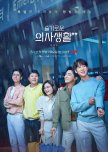
Sweet But A Little Too Slow
The first season of Hospital Playlist was so impeccable that it really set my expectations high for the second season. Hospital Playlist 2 was great but not up to par for a few reasons.One is that the episodes this season felt very slow. I know romance is not the main focus of this drama but I also know that it's one of the reasons why the second season was highly anticipated. Everyone, including me, was eager to see how the stories of the couples will unfold. This part of the drama just seemed to drag on for too long. The romantic relationships of the other couples don't really blossom until the last few episodes. Moreover, some of the couples (*coughs* Chu Min Ha and Yang Seok Hyung) were given way too little screentime. Instead, we get an overabundance of Jang Gyeo Wool and Ahn Jung Won. I found some of their romantic moments cringeworthy even though I shipped them so much in the first season. Maybe it's just me but I felt like they lost their spark once they got together.
Another bummer for me is that the side characters that I enjoyed watching a lot in the first season got pushed aside - the twins, Yong Seok Min and Heo Sun Bin, and even Woo Ju. Yes, they're supporting characters but it felt like their roles became even more minor. Even Min Ha as a doctor and not as Seok Hyung's love interest could have gotten more screentime.
Lastly, the final episode was anticlimactic and unnecessarily long. Perhaps it’s to make up for the episodes that they missed in the earlier weeks but it was just not quite compelling despite that 2-hour running time. Also, a lot of the things that could have happened in the earlier episodes were packed into the finale as if to clearly imply that it’s over and that there will be no third season. And again, characters that I wanted to see didn’t appear that much. On the bright side, I loved hearing all the OST’s play in the drama one last time.
All that is to say, it shouldn't have taken that long for the other couples to get together. In exchange for the slow pacing, I at least wish the other couples and supporting characters appeared more in each episode.
Nevertheless, Hospital Playlist still remains to be a top-tier drama, and even though the second season was not as enjoyable for me, each episode never failed to make me smile, laugh, cry, and sing out loud.
Was this review helpful to you?

THE CASTING & ORIGINAL STORY SET -UP
In a recent interview, PD Ahn said he wanted to work with SYJ. He felt that she was the best actress to play a mid-30s woman at the centerpiece of this realistic drama. “That’s why, from the very beginning, I thought that there was no one else for the leading role of ‘Pretty Noona’ but Son Ye Jin. I only contacted one person [for the role], and it worked out. She decided to take the role even after seeing all the negative sides to it.” He added with a laugh, “I was really surprised.”
SYJ said she also wanted to work with the director. Her fellow actresses gave him high marks. And when she was recruited for the series, PD Ahn promised he would do things so she could meet her goals. As a result, the series was shot more like an independent art film. There were little wasted scenes. And the mood on the set was fun but professional.
SYJ is a professional. Her reputation is to immerse herself in her characters. She was aware of the negatives of JA (her life, her decisions, her mistakes, etc.) He claims the scripts were all read in full in October, 2017 (but does not say if the scripts were changed in the end).
In initial filming before the premiere, JA’s character was described as a hard working person with a lonely personal life where she stares at empty bottles of liquor. She is a typical South Korean woman in her 30s who feels emptiness in her heart because she doesn't feel accomplished in either career or love which every woman around her age can empathize with. Son Ye Jin is showing so much motivation and effort as she is always holding onto her script and having numerous discussions with the director on expressing her character more fully. She is doing a great job in portraying Jin-ah's change of emotion with her detailed acting and really becoming the character. Everyone should be expecting great things to come out of this drama,” a staff member said.
At the beginning, JA’s situation can be summed up as follows:
1. She is 35 still living at home with her parents.
2. She is going out with a terrible BF who has cheated on her after she slept with him (meaning she was serious about the relationship but he was not).
3. Her mother is pushing her to marry the terrible BF because of his status and JA’s age.
4. She is stuck in a dead end job subject to work place harassment and takes blame for others’ mistakes.
JA character is a meek, introverted, weak, hard working but repressed follower of society norms. She really does not talk about goals or a future. It appears she has resigned herself to an unhappy life because she is trapped in a culturally oppressive and socially conservative paternalistic world.
The show was always set up to be JA’s journey to self-awareness and independence. It was meant to be a realistic sad story.
What hooked viewers in the initial episodes was the chemistry between JA and JH. It was an unintended consequence because it masked the original story line and theme. PD Ahn stated in that recent interview that the theme of the show was the simple question:
“Are we really in love?”
THE INITIAL CHEMISTRY
If you look objectively at the beginning of JA and JH’s romantic relationship, it was a quick and burning passion. The reason for JA was simple: she was coming off a dead cat bounce relationship with her cheating ex-BF. Since her mid 20s, JA had been groomed by her mother to go out with a certain kind of man (one of status, means and upward mobility). JA’s only hope with these blind dates was that the man would “like” her. JA went out on those dates not out of a search for love but obligation to her mother. JA must have seemed that this current ex-BF was her best shot since she was serious enough to slept with him but his betrayal left her bitter, angry and alone.
JH returns to Korea after 3 years in USA. He is friends with JA’s brother, SH. He knows JH dates many women (because of his looks and charm). He knows he has a stubborn temper. JH is young and carefree in YOLO life style. JH grew up without parents so it appears that he is still harboring abandonment issues. He had dated many women in the past, but apparently could not get beyond 3 months (which is interesting since the 100 day mark in Korea is a milestone of a “serious” relationship.) He is charming, attentive, but also selfish, temperamental and paternalistic.
In a chance timing of motive and opportunity, JH returned to Korea after three years, and the first cute woman he saw he went after (surprising himself that it was his noona.) The surprise flirtation and familiarity was the spark to set them on a quick path to become lovers.
JA and JH get caught up in the mystery, excitement and secrecy of their romance. So did the audience. It was clear that JA and JH loved being together. It was an infatuation.
Attraction? Yes, they both complimented each other about their appearance.
Escapism? Yes, they both were coming back from negative experiences to find comfort in each others’ arms, away from their daily grind and problems.
Infatuation? Yes, the hot and secret aspect of their intense and short lived passion for each other.
True love? No. Even though viewers were caught up with the initial passion, the couple’s relationship was foreshadowed to be doomed. As reality encroached on their secret life, real serious issues arose between their family members and friends which the couple did not or could not discuss and work out together.
How each character viewed their relationship was telling:
JA did like the fact that a younger man found her attractive and desirable. It may have been a long time since a man approached her (instead of through blind dates). She wanted to keep it a secret because she knew it was all merely fun: companionship with benefits, not a serious relationship. Also, JA wanted to keep it secret because she knew the negative ramifications to her family and friendship with KS.
However, JH did not want to keep it secret. This showed his naivety. His character always lived in the moment, not thinking long term consequences of his actions.
Their relationship turned into a cliche teenage crush. And as the episodes went on, there was no intellectual, emotional or spiritual growth in their relationship. They never discussed a shared future together.
THE MIDDLE CONFLICTS
The greatest problem with the story was JA’s interaction with the people around her. It was an intentional portrayal. She was an apologetic follower. She rarely stood up for herself. Her decision making was mired in self-conflict, self-doubt. She thought the world viewed her as a commodity and not as a person or a woman.
And this was embedded in how she dealt with her personal life, including her affair with JH. The series lacked deep discussions between the characters that is the foundation for serious relationships.
JA was conditioned to be subservient and accept what others told her.
What were the major issues in JA’s life?
1. Her mother’s desire that she marry the “right” man. But after a serious of loser boyfriends, JA had basically given up on a chance to meet Mr. Right, someone she could passionately love while be acceptable to her family.
2. Her job was becoming more unbearable. The demands and blame she took for other workers mistakes were mounting. The harassment of her by superiors was intolerable. She was in a dead end job with no real chance of promotion.
3. She had few friends. KS was her best friend who she could confide in. It seemed that JA had a hard time making new friends. When she does make a close friend, she tries hard not to break that bond, even it means hurting herself in the process.
4. She has a maniac ex-BF who wants to get back together or ruin her life.
How did the couple “work” to resolve these issues? They did not. JA and JH were merely apologetic to JA’s mother about their relationship, but did nothing to convince their families that they had a future together. JH did nothing to help JA resolve her work place issues, or support her if she wanted to change career path. JH brought JA to meet some of his friends (on the overnight trip) but JA did not do the same. (this shows JH was more into the relationship than JA). JH got jealous and violent about JA’s ex-BF which contributed to conflict between them because he did not discuss beforehand with JA his actions.
The breaking point was JH demanding that JA come to him to the US. Of course, JA said no. She felt insulted that JH’s solution was to run away from problems. (Not to mention that it would be impossible for JA to suddenly move to the US with no job, no spouse, and no money with the country’s current immigration policies). JH solution was that JA would be there for him. He was angry that she rejected his solution. He never understood her position, her feelings or her long term goals.
The couple’s initial passion glossed over several important aspects missing from consideration on whether this was heading toward a serious relationship or “true love.”
1. Communication. Their communication was superficial. They did not discuss important issues or ideas which represents mutual immaturity. They never opened up to each other on what their personal goals were (job, career, changes, etc.) or how they wanted to achieve them. They never really understood the other person's emotional state, and they never deeply discussed how the other person felt in a given situation. I recently read a psychological study that concluded that many people told “white lies” early in their relationships as a means of making themselves more “attractive” to their partner. Usually, those minor lies were used to build up a person’s self-esteem or enhance their traits (prospects) to the other person. But in JA and JH case, those lies were meant to hide the truth and real feelings (under the fabrication that they did not want to “hurt” the other person.) Instead of talking things through, they glossed matters over and then began to mistrust each other. The each called the other “childish.” They could not talk to each other about serious matters because they were caught up in the teenage aspects of a romance fairy tale.
2. Compatibility. Sympathy, friendship and like-mindedness are critical foundation blocks to any serious relationship. JH knew about JA’s situation at home and at work, but his support for her situation was tempered and distant. He wanted to control the situation. Likewise, JA did not seek out his advice on how to find a solution to any of her problems. Also, JH did not ask JA for advice on his work, his options or his troubles. JA and JH knew each other before dating, but there is no evidence that they were “friends.” Friends have mutual interests, concerns, ambitions, support, trust, varied experiences to share. JA and KS had serious discussions as friends. JH and SH had serious talks as friends. But JA and JH never had such a connection because such “real life” discussions would have interfered with them hanging out together and having fun as a new, care free couple.
3. Commitment. JA and JH never discussed the big things like their expectations, marriage and family life together. JH’s solution was unilaterally demanding JA move with him to the US. He never asked her hand in marriage. Some women would call this behavior selfish, inappropriate or “clingy.” JA’s solution to move out of her house so she could continue to date JH but not live with him showed that she was not ready to fully commit to him (she would later say she had things she wanted to be independent to become strong.) They never had the heart-to-heart discussion of “making plans” together as a couple. Even though both are adults, they both had serious maturity issues.. (Continuation at the comment section)
Was this review helpful to you?


