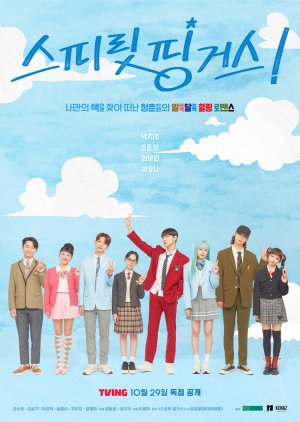
Spirit Fingers

스피릿 핑거스! ‧ Drama ‧ 2025
Completed
15441390
3 people found this review helpful
Nov 28, 2025
12 of 12 episodes seen
Completed 0
Overall 10
Story 10
Acting/Cast 10
Music 10
Rewatch Value 10

The main story

This is one of the best series I've ever seen. I swear it's hilarious, and the atmosphere is fantastic. I wish the second season all the best!🥹🥹🤏🏻🤏🏻The actors are fantastic too; the heroine is very beautiful, the hero is handsome, and the rest of the cast are wonderful. I wish you all the best.💪🏻💪🏻🤏🏻Even when I'm feeling down, I always watch the show. It's truly wonderful; it cheers me up and makes me happy. I watch it without ever getting bored, literally, without ever getting bored at all. I wish the second season was longer, with more episodes. I'm so glad there's a second season; I'm so touched. Thank you.😓😓🤏🏻

Read More

Was this review helpful to you?
Completed
Shiro
2 people found this review helpful
Nov 29, 2025
12 of 12 episodes seen
Completed 0
Overall 8.5
Story 8.0
Acting/Cast 9.0
Music 6.0
Rewatch Value 4.0
There is something about how this drama was put together that hooked me from the very beginning. So much that I could overlook things that usually bother me like people talking to versions of themselves or poop jokes. Partly because they were done decently, partly because they actually forwarded the plot and partly because the characters where just so very lovable.

There is something about putting togeheter not just opposites but people from completely different places in life in a gruop based on mutual respect and an common interest. A group. that sees you and helps you grow all in a fun setting, adorable themes and even though some may seem slightly over the top they do not cross over to over the top pathetic annoying. Not even once. This is not an easy balance to maintain, especially in dramaland and with some of those acors. But somehow they managed to keep that balance. That alone made this worthy of en extra star. I love this club and would love to have one of those of my own even though I am not sure I would actually dare attend one.

The different ways to act as siblings in this is shown really well, and I must say fond siblings as well as biological siblings in this are some of dramalands best. The parents are some of dramalands worst (not something in the rain bad, but bad).

The romance in this is top, sweet, complicated, it has fun development and incorporates both playfulness, insecurity and shows different ways to find romance. But not only does it give me a romance addict the fix I need it also gives me different ways to love (outside of romance) as well as reasons to love even though it hurts.

Other things I love about this drama is the show of a bunch ways to feel insecure, fighting low self a steam, sthere is no quick fix and you can always relapse and self destruct. The show also manages how low self a steam is nurtured, what can make otherwise good girls lie, rebel and want to die.

So much good in this but not all, some parts are wrapped up to fast, specially the ending and family relations. Even though I said they managed to keep an okay balance I can not completely ignore the potentially annoying elements existence and some characters have moments of just a little bit to perfect.

Also I want a spin off with two of the best friends, preferably filmed a broad. ...

Read More

Was this review helpful to you?
Completed
virgievirgie Lore Scrolls Award1
5 people found this review helpful
Nov 29, 2025
12 of 12 episodes seen
Completed 4
Overall 8.5
Story 8.5
Acting/Cast 8.5
Music 8.5
Rewatch Value 8.5

Coming-of-age fantasy adaptation with a lot of Heart and Realism

Is it possible to have a webtoon adaptation that maintains the fantasy and over-the-top humor, yet still gives you a sense of realism with character development? If so, then I think “Spirit Fingers” might have achieved that.

“Spirit Fingers” started with a combination of realism (a topic I disliked in K-dramas) and also a very over-the-top ML during the leads’ first meeting. But the way they are, sets the tone of this drama in the first episode. The first half of the drama is fun but it’s the last few episodes that really hit me with all the feels and bring me on an emotional roller coaster.

Female lead, Song U Yeon (Baby Blue Finger) is a timid 18-year girl who craves love and attention from her parents. She’s the black sheep of the family as an average girl with two genius overachieving brothers. Her lack of self-esteem is displayed front and center in this drama and honestly gives me a lot of frustrations. But also because of this, her character development felt natural and real. She doesn’t mature overnight. In fact, it seems like she moves two steps forward and then one gigantic step backward each time, all the way until the end of the drama. I like her and I want to shake some sense in her. We have a complicated relationship. LOL

On the other hand, male lead Nam Gi Jeong (Red Finger) is the complete opposite. He’s a little dumb and super confident in himself and his looks. When he turns on his amateur model charm and professionalism, he is a bright shining star. He doesn’t care about anything or anyone much, until he meets FL. I am not going to lie, his over-the-topness annoys me in the beginning. But he has the most beautiful growth and you can see how much he has matured, without losing the essence of Red Finger. He complements FL very well. He is her biggest supporter, cheerleader and self-confidence injector.

The concept of the group Spirit Fingers is interesting. It’s a safe space for a group of kind-hearted and unique individuals who just love to draw. I love the themes they have for each week and look forward to the sets, costumes and the ridiculousness of it all. As I mentioned, “Spirit Fingers” does not shy away from its identity, a webtoon adaptation. It kept many of the fantasy elements and I’m glad the drama embraces it all. I do wish I can get to know more of the individual SP members, and not just Mint and Blue Fingers. I do enjoy their friends-to-lovers arc, but it drags on for a little too long. Some screen time could be dedicated to Black and Khaki, or Pink and Brown.

I also love the girl's friendship. They are girlfriends who care and support each other. They will fight and make up. They will yell and beat up bullies for you, and cry while having honest conversations. There’s no evil jealousy or fighting for the same man. What a lovely trio! The boys on the other hand have a more fun bromance going on. A little less ‘feelings’ but more chaotic ‘counseling’.

As much as I love this drama, it’s not an easy watch. It’s really hard to sit back and enjoy the sweet romance and self-discovery, without wanting to strangle some characters, especially the parents. I understand this is a very cultural thing, but I just wish K-dramas can change it up a little without such a strong focus on bullying and strict parental demands and expectations. There’s some satisfaction in the end with the brothers speaking up, but it wasn’t explosive enough and I wanted to see a little more of the aftermath.

“Spirit Fingers” is not just a sweet romance drama. It’s a coming-of-age drama of our leads. Their journeys of growth come with a lot of speed bumps yet also filled with laughter and lovable chaos. This is a great watch that gives me quite an emotional roller coaster ride of laughter and tears. I felt the drama balances the romance and growth aspects pretty well throughout the drama. I would definitely recommend this drama.


P.s. don’t forget to watch the clips after the ending credit previews.
Pps. I did not watch the webtoon


Completed: 11/28/2025 Review #647

Read More

Was this review helpful to you?
Completed
ColourMePurple
7 people found this review helpful
Nov 28, 2025
12 of 12 episodes seen
Completed 0
Overall 7.0
Story 7.0
Acting/Cast 8.0
Music 7.0
Rewatch Value 6.5
This review may contain spoilers

An Easy Watch

It's a kind of coming of age youth romance. There's nothing spectacular about it but it's light-hearted, cute, and maybe a bit cringe at times. I was also rooting for the SML with the FL coz he seemed more mature and level-headed though the ML had his own charm. Problem was certain humour by his character that made me dislike him like joking about wanting to touch the FL's chest because she accidentally placed his hand on his. It put me off him till the end so I couldn't care much for them getting together.

The other thing I disliked was that the mother was made the bad guy because of the father not being present and making everyone walk on egg shells but in the end, magically everyone becomes nicer and happier. It's just not realistic but it's dramaland so I decided to let it go.

The friendships were cute. The child actor playing FL's younger brother was amazing! He made the ML look even more childish. 😂 The ML's friend also didn't get a love plot and was mainly shown hanging out at his home. Waste of talent.

The cafe rooms were amazing designs which makes me wonder how the cafe owner could afford such a place and why it didn't have any business? I expected to see some revelation there but we glossed over it.

Overall it's nice and easy to binge.

Read More

Was this review helpful to you?
Completed
wovewy
3 people found this review helpful
Nov 26, 2025
12 of 12 episodes seen
Completed 0
Overall 9.5
Story 9.0
Acting/Cast 9.0
Music 8.5
Rewatch Value 8.0

THE BEST TEEN DRAMA OF THE YEAR. PERIOD.

never thought Spirit Fingers would be my hyperfixation, but it totally pulled me out of this slump! this is, hands down, the best teen drama of the year. gijeong has completely set my standards, i seriously need a man who's that chaotic and clingy! I REPEAT! I WANT MY MAN TO BE CHAOTIC AND CLINGY LIKE HIM! i'll miss the SF fam so much. i know it's impossible, but please, season 2!!!!!!
Was this review helpful to you?
Completed
ibisfeather
3 people found this review helpful
Nov 26, 2025
12 of 12 episodes seen
Completed 0
Overall 10
Story 10
Acting/Cast 10
Music 9.0
Rewatch Value 10

ultimate cool

Spiritfingers is perfect in itself. The stuff of a thousand rewatches because it is in a category of its own, sui generis, and inimitable. Brightly colored story about imagination and young lovers. A careful and loving adaptation of a popular webtoon.

Shot in 2023, many of the up-and-coming younger actors are in this show, looking their very best and being well-directed. Im Chul Soo and Noh Min Woo in minor benevolent roles are always a sign of a high cool quotient.

Good soundtrack, a highschool-er mainly, with lots of good advice but not preachy. The usual dark moments of family drama. Above all, sharply drawn characters who you will not forget.

Read More

Was this review helpful to you?

Completed
Hanan Anf
4 people found this review helpful
Nov 26, 2025
12 of 12 episodes seen
Completed 0
Overall 9.5
Story 8.5
Acting/Cast 9.0
Music 9.0
Rewatch Value 6.0

Spirit Fingers is one of those K-dramas that feels like opening a brand-new sketchbook

This drama revolves around eight art lovers who meet regularly to paint together. Every time they gather, there’s a new theme, new colors, new emotions, and honestly, the group feels like a little magical world of creativity.
The story follows a shy, unsure girl who suddenly gets the chance to join this group. Being with them helps her grow, gain confidence, glow up, and discover who she really is. And of course… she finds love along the way — soft, warm, and artistic love, the kind that feels like watercolor on paper.
And let’s talk about Cho Jun-young.
He is the quiet highlight of the entire series. His acting is soft but magnetic, the kind of performance that makes you want to pause the episode and say, “Where have you been hiding?” He plays his role with sincerity, charm, and a very grounded sweetness. After this drama, you definitely want to see him in more projects, preferably as a male lead.
It’s perfect for anyone who loves creativity, self-discovery, warm romance, and characters who slowly grow into themselves.

Read More

Was this review helpful to you?
Completed
leangie da goat
4 people found this review helpful
Nov 26, 2025
12 of 12 episodes seen
Completed 0
Overall 10
Story 10
Acting/Cast 10
Music 10
Rewatch Value 10
This review may contain spoilers

CRYING!!

i absolutely have so much love for this drama and cast. the casting directors did their jobs because the way the actors portrayed their characters so accurately definitely blew me away. props to u yeon's actor because she did a great job on giving us the teenager we needed!! i think the only thing that really threw me off was whenever u yeon was like "i think im starting to hate you" about gi jeong but honestly i get it because she was insecure and thats why i say props to her actor because when we needed her to do her job, she did it!! obviously everyone else did so so good and i will be watching more of their dramas ASAP!! 10/10!!

Read More

Was this review helpful to you?
Completed
Cora Finger Heart Award1
28 people found this review helpful
Nov 26, 2025
12 of 12 episodes seen
Completed 3
Overall 8.0
Story 8.0
Acting/Cast 8.5
Music 7.5
Rewatch Value 7.0
This review may contain spoilers

BECOMING SEEN

OVERVIEW:

Song U Yeon has always been “the other one.”

Overshadowed by her genius brother, ignored by her parents, and scarred by vicious bullies, she’s learned to survive by shrinking herself. That is, until she crashes head-first into Nam Ki Jung, the sharp, beautiful, maddening model who comes from a wild but fiercely loving family.

Ki Jung sees U Yeon in a way no one ever has… and suddenly everyone else does too. Old tormentors crawl back, rivals circle, and hidden family fractures crack wide open. Surrounded by misfits, troublemakers, golden boys, and ghosts of past hurts, U Yeon must decide whether she’ll stay invisible, or take up the space she’s always deserved.

_________

COMMENTARY:

• Overall Thoughts

I fell for Spirit Fingers because it understands two things instinctively: how art heals small, private terrors, and how ordinary cruelty shapes ordinary people. The club itself is not a MacGuffin or a stage prop; it’s a living organism. Everything that matters, such as identity, tenderness, protection, belonging, grows from that space where people sit and draw each other. That premise is clean, elegant, and emotionally generous. The club gives the main character a literal room to breathe and a literal group that sees her, and the way that practice-of-drawing becomes practice-of-being is beautiful. I don’t say that lightly. Many stories try to make “a hobby” into spiritual salvation; here, the hobby earns its redemption by changing behavior, vocabulary, and relationships. It’s tactile: croquis practice, sketchbooks, models holding a pose. Those details sell transformation.

• Song U Yeon and Nam Ki Jung

Song U Yeon’s arc is the center of gravity and it’s handled, for the most part, with care. She is not a blank we’re supposed to project onto; she’s a scarred, academic, self-effacing girl who learns to assert herself by making marks on paper and then into the world. Her growth is incremental and believable: she doesn’t leap into confidence, she gets small victories, and those compound into agency. It’s satisfying because the storytelling gives us the micro-steps that justify it.

She steps into the orbit of an art group and is given something as simple and radical as attention directed at what she makes rather than how she performs for other people. That drawing she’s handed, the one from Seon-ho, is less about flirtation and more about recognition. In the story’s logic, recognition is the most subversive act. She starts to practice croquis at school. She asks friends to pose. She makes small incursions into the world she was taught not to occupy. That’s when the seed of confidence, not arrogance, takes root.

Her relationships are true to the mess of teenage life: friends who are unequal in their support, a best friend who scolds from love, a loud friend who barks criticism as a way of caring, an older-brother who’s a trophy more than a companion. Woo-yeon’s feelings aren’t simple: she first has a crush on the artist who sketched her and later, as she actually grows, her heart migrates to someone who has been clumsy and generous in equal measure. That evolution feels honest because it’s rooted in her interior change. She isn’t switching boys for plot convenience; she’s choosing someone who matches the person she’s becoming.

Nam Ki-jeong is the textbook example of a character who seems shallow and gets denied the credit for feeling deep. He’s gorgeous, naturally charismatic, and yet he arrives with a comedic tag that could have reduced him to a joke. Instead, the story uses that comic relief to humanize and disarm him: he’s a hot mess with a tender heart. He parades narcissism like armor, but the armor is paper-thin; underneath, he’s a kid who’s never been properly noticed for who he is beyond surface perks. When he first notices Woo-yeon, it’s not because of her looks; it’s because she treated him differently. That’s devastatingly simple and true. People crave being treated as people, not trophies.

I don’t love the way he initially behaves toward her - teasing, stubborn, immature. The writing gives him room to be obnoxious in a way that realistically works: the boy who bothers the girl is often the boy who flails at affection. But then the story refuses to let Ki-jeong off the hook. He matures by doing the unglamorous work. There is a point when his childishness could have escaled into irredeemable toxicity; instead, it becomes the raw material for growth. He is not remade into a perfect man; he learns steadiness through repeated acts, the very sort of “labor of love” that Woo-yeon deserves.

His relationship with Woo-yeon is the sort of slow, bumpy, convincing coupling people actually have. He confesses in a ridiculous way, “marry me” like someone tripping on sincerity, and his inability to cope with the emotional fallout is sometimes laughable and sometimes endearing. But the important thing is that his actions follow his words. He protects, defends, and, crucially, helps Woo-dol. When Woo-yeon’s younger brother runs away, Ki-jeong is the one who steps between doom and the child. That’s a moment where his growth becomes clear: he is no longer just a charming nuisance; he has chosen to be responsible in the face of pain.

What I admire most about Ki-jeong is that his arc refuses to make us forgive him before he earns forgiveness. He earns it by being present in the violent, unshowy little moments. That’s often harder to write than big declarations, and Ki-jeong’s final reconciliation with Woo-yeon, and their mutual decision to be together, is the honest outcome of their respective arcs.

Woo-yeon and Ki-jung work because they exist as emotional opposites trying to move in the same direction. She’s scared of being seen; he’s scared of disappointing others. He doesn’t pressure her to be more than she is. She doesn’t punish him for coming from a place of chaos. Their love is gentle, earnest, and rooted in vulnerability instead of fantasy. He doesn’t sweep her away; he stays beside her. And she doesn’t depend on him; she chooses him.

• Seon Ho and Geu Rin

Koo Seon-ho and Nam Geu-rin’s slow burn is also a quiet triumph. Seon-ho’s long, patient, unconsummated devotion to Green is something that alters the texture of everything: his attentiveness, his annoyance at Green’s obliviousness, his little domestic acts... they all build the kind of intimacy that doesn’t need a single balcony speech to land. Geu-rin’s stubborn bravado and the way past humiliation shaped her are real, messy, and make her eventual softening at Seon-ho’s enlistment believable.

• Family

Finally, the family dynamics are gorgeously ugly. The Song household is a study in everyday, generational cruelty, not villainous caricature but a set of habits learned and repeated. The mother’s wounded narcissism and the father’s cold complicity feel like a distilled social phenomenon: a parent who lives vicariously through children, who punishes for being human, who masks loss by demanding perfection.

• Where They Lost Me

The first half is good, but then the pacing starts faltering in the second half, and the last three episodes are so rushed that I didn’t feel some of the emotional moments.

A second major problem is the handling of the bullies: they are useful as catalysts, but the narrative resolution is inconsistent. On one hand, the triplets’ humiliation of Woo-yeon is raw and destructive, and the club’s defense of her is cathartic. On the other hand, the consequences for the bullies are not always weighted enough to feel like a meaningful social reckoning. They get punched and hauled to the police, but the story moves on with relatively little systemic fallout: no serious institutional follow-up, no therapeutic work for Woo-yeon, and the social power dynamics that enabled those attacks are not thoroughly explored. Bullying spirals and leaves residual damage that would merit longer attention. The show treats it as a trauma to be overcome by community punching rather than an injustice requiring structural change. That’s narratively satisfying in a cathartic moment, but it’s also narratively lazy.

Song U-yeon’s arc, her growth from shy, academically excellent but ignored child into a young woman who can run a club is the show’s emotional spine. The critique here is small but essential: the trauma around the makeup incident, the sketchbook tearing, and parental neglect deserved longer, quieter scenes where I could live with her loneliness. There are a few moments of cinematic shorthand where something huge happens and we jump forward too quickly. Slow down in those spaces.

My complaint for Seon-ho and Geu-rin’s arc is the long-simmer is occasionally undercut by telephone-like dialogue where characters tell, not show, their devotion. Smallness will sell them more than speech.

Some secondary arcs are undercooked or get shoved aside for main-plot energy. Khaki and Black have a deliciously slow flame, but their payoffs are more viewer-driven than story-earned: I can feel the audience love for them and the writer’s intention, but the space devoted to them is often too spare. Similarly, Pink-Brown is delightful, but the story often treats adult side characters as color accents rather than fully realized people. When you have such a rich ensemble, the temptation is to scatter slices of charm rather than invest more internal life in each pair; the result is that some become “fanservice” rather than fully integrated human stories.

• The Human Portrait

When I look at everything as a whole, it paints one massive portrait of people stumbling around with their wounds showing, trying to figure out which pain needs to be kept and which pain needs to be buried. It’s a story about inheritance, rebellion, chosen family, beauty politics, survival instincts, and the bizarre ways people discover love in places they never expected. And when you peel it back and really look at it, it’s honestly gorgeous in its own clumsy, imperfect humanity.

• Inheritance of Pain

The first major theme that jumps out is the inheritance of wounds, and the refusal to keep carrying them. Woo-yeon’s mother didn’t wake up one morning and decide to be critical, rigid, and suffocating. She was shaped by a past full of humiliation, pressure, and being overlooked. She passes that fear down like a cursed heirloom, expecting her daughter to become the polished, high-achieving masterpiece she herself was never allowed to be. But the story doesn’t ask the audience to pity her blindly. It shows the ways Woo-yeon is crushed beneath her mother’s ambitions, and then, beautifully, it shows Woo-yeon choosing to step out of that shadow. She doesn’t make some dramatic speech or reject her family outright. She simply decides to stop letting their pain dictate her identity. The courage to say, “No more. This ends with me,” it treats generational trauma as something that can be refused, not just endured.

• Love as Shelter, Not Salvation

The next foundational theme is love. But not the flimsy “you complete me” nonsense. Love in this story doesn’t fix anyone; it simply gives them something to hold onto while they fix themselves. Woo-seok loves his sister but can’t rescue her. Woo-dol loves fiercely but doesn’t magically become whole. Ki-jung loves Woo-yeon deeply but never tries to rewrite her life or erase the scars she carries. And Woo-yeon herself learns, slowly and painfully, that love is not a reward or a requirement; it’s a refuge. This is love as shelter, not medicine. It’s a way of saying that the people who save your life often aren’t the people who should have done it, they’re the ones who show up anyway.

• Two Homes, Two Worlds

Another massive emotional pillar is the contrast between homes shaped by expectation and homes shaped by acceptance. Woo-yeon’s family is suffocating. Every word feels rehearsed. Every emotion feels forbidden. It’s a place where being loved requires performing correctly. Then there’s Ki-jung’s family. They fight like feral cats and love like overexcited puppies. They don’t expect him to be a model or a prodigy or a polished trophy. They just expect him to be alive and be himself. The contrast is so severe it stops being comedic and becomes philosophical. Some homes raise your grades. Other homes raise your spirit. Woo-yeon slowly, painfully realizes which one she belongs in.

• Beauty as Battlefield

The story is also obsessed with beauty; not in a shallow “this character is pretty” way, but in a social, psychological, and cultural way. Beauty is treated as currency, armor, weapon, and prison all at once. An Ye-rim uses beauty like a political tool. The triplet bullies enforce hierarchy through appearance-based cruelty. Ki-jung is valued for his looks in ways that make him uncomfortable. Woo-yeon is punished for not looking the part. It becomes clear that beauty in this world is a battlefield, one everyone is forced to fight on whether they want to or not. The story isn’t condemning beauty; it’s condemning the way beauty becomes a destiny. Beauty gets you attention, but character decides who stays.

• Healing Through Chaos

Then we have my favorite thematic thread: chaos as healing. Ki-jung’s family functions like emotional oxygen for Woo-yeon. They represent a worldview where mistakes aren’t punishments, eccentricities aren’t shameful, and people are allowed to look foolish without being unloved. Sometimes, the cure isn’t calm; it’s chaos that doesn’t hurt you.

• Symbolism

Food becomes emotional language: an apology, a peace offering, a confession, a threat. Woo-yeon’s mother expresses love through snacks because she can’t express it through words. Ki-jung’s family expresses joy through chaotic meals. Everyone eats their feelings in one way or another.

Physical appearance becomes a social ranking system. Height, beauty, hair, body... all of it becomes shorthand for power and insecurity. It reflects the absurdity of adolescent social structures: shallow, ruthless, and heartbreakingly meaningful to the kids stuck inside them.

• The Pulse Beneath It All

If I had to distill all of this into one truth, one heartbeat that the entire narrative syncs itself to, it’s this: healing doesn’t come from being impressive. Healing comes from being allowed to be human. And the people who allow you to be human are the people who become your family, whether you share blood or not.

_________

FINAL THOUGHTS:

Honestly, Spirit Fingers stuck to my ribs in the best way. It wasn't perfect, but it understood that becoming yourself isn’t some glowing anime power-up moment. It’s awkward, slow, and half the time you think you’re doing it wrong. Woo-yeon doesn’t magically become confident; she grows one tiny, wobbly step at a time. I loved that. It felt earned.

The club that’s the soul of the whole thing. It’s not just a backdrop; it’s a safe zone. A place where “you’re allowed to exist” is the unspoken rule. A place where being seen isn’t punishment.

In the end, what actually actually matters is that you don’t heal by becoming impressive, you heal by being allowed to be human. And I’ll take that over perfection any day.

~Thank you for reading~

Read More

Was this review helpful to you?
Completed
Meowlicious
5 people found this review helpful
Nov 26, 2025
12 of 12 episodes seen
Completed 0
Overall 9.5
Story 10
Acting/Cast 10
Music 9.5
Rewatch Value 10
This review may contain spoilers

Most loyal and true adaptation

Spirit fingers manhwa has over 100 chapters but this drama tries to cover every aspect of it. Tbh, if this drama were to be longer than 12 episodes, i would still watch it. It covers everything in the manhwa. I would say this is by far the only drama that truly sticks to the plot and story of the manhwa. It doesn’t add unnecesary stuff in and i enjoyed it so much. Too bad, its too short with only 12 eps while trying to cover all the chapters of the manhwa.

Please don’t blame wooyeon on why she is too depressed sometimes. Her family puts too much burden on her and she has a really low self esteem. For someone who is very negative towards herself, she hated herself for being so negative even when shes dating Gi jeong. She finds gi jeong too perfect and she feels as though she doesn’t deserve him wherelse for gi jeong, he feels like wooyeon is too good for him. But don’t worry this doesn’t drag long.

If you want some youth/ slice of life and lighthearted drama then this is for you.

Read More

Was this review helpful to you?
Completed
doodlerave
2 people found this review helpful
Nov 26, 2025
12 of 12 episodes seen
Completed 0
Overall 10
Story 10
Acting/Cast 10
Music 10
Rewatch Value 10

Hands down to the best youth drama I have ever seen

First of all, I must say that this drama is the best youth drama I have ever seen. It actually portrays a great message to people who have low self-esteem( especially students). Moreover, the actors have also done a great job. You must watch this drama. I thought it was just a regular youth drama about teenagers’ love. Actually, you need to watch how they portray students' struggles, parents' standards about their children. It also has great actor couples
Was this review helpful to you?

Completed
de Lune
2 people found this review helpful
Nov 28, 2025
12 of 12 episodes seen
Completed 0
Overall 8.5
Story 8.5
Acting/Cast 8.5
Music 9.0
Rewatch Value 8.0

A story of finding color within the quietest corners of your own heart.

Spirit Fingers is the kind of drama you enter without expectation, only to find that somewhere along the way, it has quietly painted itself across your heart. Light, warm, and surprisingly tender, it feels like a story told in soft colors, a gentle palette that lingers long after the final scene. Adapted from a beloved webtoon, the drama stands well on its own. I haven’t read the original, yet I never felt lost. Many say it’s a faithful adaptation; all I know is that the journey is easy to embrace, even for someone stepping in with an untouched canvas.

At its center is Song U Yeon, a girl who has spent her life shrinking herself. Convinced she lacks beauty, talent, and anything worth admiring, U Yeon moves through her world like someone afraid to disturb the air around her. It isn’t hard to understand why, home, the place meant to soften you, has always been a ground of comparison for her.
With an older brother who shines effortlessly and a younger brother nearly treated as a prodigy, U Yeon walks on thin ice, striving to be good enough for a mother whose affection seems to lean elsewhere. When she confesses that her mother plays favorites (and she is not the favorite) the ache settles deeply. It explains the way she curls inward, the way she doubts the small beauty in herself. But life stirs the moment she steps into the Spirit Fingers drawing club, a place bursting with color, eccentricity, and souls who wear their hearts openly. There, in that mismatched group of dreamers, U Yeon begins to breathe a little deeper. Her growth isn’t grand or dramatic; it’s gentle, like watercolor spreading slowly across paper. And perhaps that is what makes it so real.

And then there is Nam Gi Jeong. Tall, radiant, a little foolish, and unreasonably charming. A boy who looks at U Yeon like she is the only color in a black-and-white world. A boy whose confidence could easily overwhelm, yet whose heart is disarmingly sincere. Standing beside someone like him, it’s only natural that U Yeon feels small. Their push-and-pull is slow at times, but it mirrors her own internal battle: she does not believe she deserves someone as bright as he is. But Gi Jeong has a magic of his own, the ability to win everyone’s heart without even trying. The way he warms U Yeon’s brilliant younger brother, the ease with which he fits into her life, the unshakable honesty he offers… it all feels like sunlight quietly finding a corner that hasn’t seen warmth. Even when U Yeon envies him, envies the clarity with which he has found his dream. Gi Jeong handles her fragility with a kind of childish maturity that is both funny and deeply touching. He never lets her drift too far into self-doubt. He reminds her, again and again, that she is beautiful, unique, and worthy. I adore the chaos-laced love between Gi Jeong and his sister Geu Rin, all physical attacks and noisy affection, a sibling language that only they understand. I love how Gi Jeong turns cold to the world but softens instantly at the sight of U Yeon, how he leaves no room for misunderstandings… except the ones U Yeon creates in her own anxious heart. Thankfully, even that arc resolves like a sigh, brief and quickly soothed.

The drama’s strength lies in its ensemble of colorful souls; Geu Rin and Seon Ho, whose clumsy push-and-pull becomes sweet once their hearts catch up to their actions; Black Finger and Khaki Finger, a bold storm meeting a quiet sky; Pink and Brown Finger, the warmth of a shared laugh. And the unexpected spark between Sera and Tae Seon, a duo whose chemistry deserved a story of its own. Their friendships so sincere, supportive, unwavering, wrap around the drama like a soft scarf on a cold day.

Watching them made me long for a place like the Spirit Fingers club, a safe corner where you can show up once a week and be someone a little braver, a little freer, a little more yourself. A place where strangers hold out a brush and help you rediscover color. In the end, Spirit Fingers is heartwarming not because it’s grand, but because it mirrors the quiet struggles many of us have known: the ache of self-doubt, the weight of comparison, the slow search for who we truly are. It portrays these moments not with heaviness, but with softness, as if assuring us that growth doesn’t need to be loud to be real.
If you’re looking for a drama that feels like a gentle sketch turning into a painting, warm, tender, and quietly meaningful, Spirit Fingers might slip into your heart the way it slipped into mine.

Read More

Was this review helpful to you?
Spirit Fingers poster

Details

Statistics

  • Score: 8.4 (scored by 8,745 users)
  • Ranked: #733
  • Popularity: #992
  • Watchers: 23,391

Top Contributors

93 edits
35 edits
32 edits
21 edits

Popular Lists

Related lists from users

Recently Watched By