

 135
135 431
431 16
16 2
2 6
6 3
3 8
8 10
10 3
3 13
13 1
1 1
1 1
1 1
1 2
2 6
6 8
8 5
5 9
9


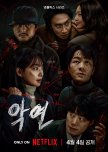
"Only good things lie ahead"
The makers of Karma liked to take the viewer on a ride that jostled back and forth and side to side for the most part in familiar territory. While I’m sure they thought we’d be shocked and awed, there were few surprises. I do admit to falling for one of the red herrings for part of the drama. Sometimes this style of filming and script writing can feel overly contrived, but for me, it worked in Karma…for the most part.Six people’s lives became entangled both from despicable actions in the past and foul deeds in the present, the majority of whom deserved whatever karma dished out. And karma was as ruthless as a finely honed scalpel but not nearly as kind.
I don’t want to say much more because this short drama is best enjoyed coming to it fresh. The cast was strong, not that you’ll like most of the characters. Even the “good” characters harbored abhorrent secrets. Karma was a dark and twisted knot of the worst of humanity’s foibles. A better title for this drama might have been “Just Deserts.”
8 April 2025
Trigger warnings: Foul language. Gruesome scenes.
Tiny spoilerish comment below:
There were a few scenes that came across as comical when the drama began to feel like Weekend at Bernie’s gone awry. lol
Was this review helpful to you?
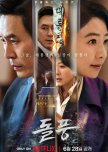
"I'll take you along to hell"
The Whirlwind was a high stakes political drama that pitted two formidable players against each other. Lies, corruption, bribery, murder, there was nothing off the table in this deadly game for power. In the end, the winner would be the one who was willing to place all their chips on the table in a daring bet, risking everything.“Just when you think you have it under control, you find that you don’t.”
When there is an assassination attempt on the President, Prime Minister Park Dong Ho becomes the acting president. Only problem is, he’s being investigated for bribery. Dong Ho plans to use the office to rid the government of corruption and exonerate his friend who was also framed for bribery and died. Deputy Prime Minister Jung Soo Jin is determined to bring down Dong Ho due to his investigations into the Daejin Group and its control of various judges, prosecutors, and politicians such as herself. The two play a relentless game of cat and mouse always trying to stay one step of the other, never worrying about getting their hands dirty…or bloody.
“At your age, courage can be dangerous”
Just like a twister churning up everything in its path, Dong Ho and Soo Jin were willing to destroy anything and anyone in their way. Dong Ho’s powerful mesocyclone was fueled by his burning desire for justice. Soo Jin’s corrupt cloud of energy came from the need for power and influence. Dong Ho found that in order to achieve his goals, he would have to borrow the playbook of his enemies all while trying to not become what he hated. Soo Jin and the comatose president both started out fighting the dictatorship in the past but had transformed into the very things they’d fought. Political alliances changed rapidly and both manipulated the media. No one was safe with a crooked prosecutorial system and judges for hire.
“Only a greater lie beats a lie”
While The Whirlwind was intriguing it could also be exhausting. There was no room to catch a breath from the oppressive atmosphere. The whirlwind of plot twists turned and flipped in every episode. The characters’ emotions and relationships had little nuance. Everyone was taciturn and calculating with little to offer to those closest to them, even their children. Park Kyung Soo’s script never slowed down even when bouncing over enormous plot holes. Kim Hee Ae played the duplicitous Soo Jin well with one exception. I don’t know if she kept her mouth open to make it look as if she was feral and always baring her teeth or has a breathing problem but I found it distracting when she was onscreen. Sul Kyung Gu was given little emotional depth to explore and often wore the same expression from scene to scene. Kim Mi Sook as Dong Ho's Chief of Staff was the MVP for me as the person who knew who, how, and when to attack. Numerous veteran actors played unscrupulous politicians on both sides of the aisle.
“There’s only one cross”
An old saying goes, “A lie travels halfway around the world before the truth puts on its shoes. By the time the truth catches up, it’s too late.” Dong Ho quoted a variation of this and sadly it is all too true. Once a lie becomes embedded, especially a lie people want to hear, truth becomes overshadowed. Many of the things that occurred in this drama have correlations in real life around the world. A powerful corrupt leader manipulating his followers to overturn the government, manipulation of and by the media, judges taking bribes, and powerful corporations buying support for the changes they want enacted, happen all the time. In this drama, one man was willing to sacrifice everything to wipe the slate clean like a whirlwind. But how long before new players move into the void to once again purchase favors? How long before those longing for power and influence sell themselves to the highest bidder at the cost of justice? Despite its flaws, The Whirlwind was an infuriatingly compelling drama.
15 September 2024
Was this review helpful to you?

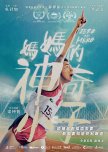
" A married daughter is like water that's poured out"
Director Tsou Shih Ching created a chaotic yet charming film using an iPhone and some of her own memories. Three generations of women working to support their families reveal archaic beliefs about gender and superstitions about left-handedness.Cheng Shu Fen with her daughters I Ann and I Jing move from the countryside to Taipei where Shu Fen sets up a noodle shop stall in the busy night market. Their apartment is crowded and the market noisy. While Shu Fen works the noodle shop, high school dropout I Ann chooses employment at a betel nut and smoke stand. I Jing goes to grade school and helps her mom afterwards, making friends throughout the market. When Shu Fen becomes saddled with debt connected to her ex-husband, her business hangs in the balance. Born without a Y chromosome, her family refuses to lend her money as they would have if she had been a son. Shu Fen’s father refuses to let I Jing use her left hand around him saying it is evil and the Devil’s hand. The old superstition leads to some curious consequences. I Ann begins a relationship that leads to its own consequences.
At the beginning it was difficult to tell if the little family actually cared about each other. Much of the film was shown through I Jing’s innocent eyes or I Ann’s jaded ones. Young Nina Yeh as I Jing gave a wonderful performance for one so young. I Jing struggled with her grandfather’s order to comply and conform to his societal view on left-handedness. She was the sunshine in the dark alley of their lives. Ma Shih Yuan’s I Ann was a tough nut to crack, always cloaked in a hard shell. Yet there were scenes where her vulnerability broke through revealing the caring, loyal young woman beneath. Ever exhausted physically and emotionally, Janel Tsai showed how Shu Fen had her own unmet needs. Each of the three longed for acceptance, affection, and attention, never daring to speak their inner desires. All three exhibited tenacity and independence often clandestinely supporting each other. One of the more touching and relatable scenes in the film took place with I Ann and I Jing traversing the market lacking any words of affection but overflowing with poignant emotions.
Left-Handed Girl followed Shu Fen and her family as they faced opportunities and set-backs in the chaotic, busy streets of the night market. Starting over is never easy when gender obligations and limits rear their ugly heads. All told, four generations of women had their own secrets that culminated in a catharsis that led to the truth, forgiveness, healing, and reconciliation. Everything you could want from a spunky family drama of women looking for a better life.
2 December 2025
Trigger warnings: Smoking. Sexual content. Brief nudity.
Was this review helpful to you?
This review may contain spoilers
Even if you start at a disadvantage, you can still be first across the finish line
Zero to Hero is an inspiring biopic about twelve-time Paralympic medalist So Wa Wai. So was the first para-athlete from Hong Kong to win gold and still holds the record in the 200m sprint. Zero to Hero is a feel good movie that also doesn't shy away from it's characters' faults and harsh reality.So Wa Wai was born with haemolytic jaundice which resulted in cerebral palsy. His mother was told he would never walk or be able to hold chopsticks. And he would only be able to hear 10-20%. She carried him on her back, literally, until he was four. In a desperate life or death moment, the mother challenged him to walk. As he gained more ability, they learned he may not walk well, but he could run.
As a teenager he joined the para-athlete's association and trained to run in competitions. The way to his success did not always run smoothly. His family was poor and used desperately needed funds to help him achieve his success. The movie highlighted how difficult it was for Paralympic athletes to continue training and competing with few subsidies from the government.
The true heart of this movie was the mother-son relationship. Sandra Ng gave a beautiful performance as the resolute mother who refused to give up on her child and sacrificed greatly to ensure he became all he could be and that he would have a financially secure future after she was gone. This created conflict with Wa Wai as he worried she was using him at one point and with his younger brother who felt at times that his only role was to be Wa Wai's future caretaker. Though perhaps flawed, the strength of this mother's love and determination to gain the best for her son and for him to overcome his limitations shined through. "Run to me at the finish line."
Leung Chung Hang's performance never felt patronizing. He poignantly portrayed a child dependent on his mother who grew into a man with his own goals and need to help his family. Yet in the end, it was the love for his dedicated mother that gave him the strength to attain those goals.
Heartwarming and inspirational with enough realistic edge to keep it from being treacly, Zero to Hero is a winner.
Was this review helpful to you?
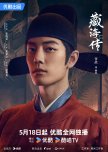
"Nothing matters more than staying alive"
Legend of Zang Hai combined China’s corrupt imperial court system with a hint of tomb raiders’ creatures and a whisper of LOTR’s “my precious.” Though the titular character had Sherlockian genius, the plot’s logic didn’t always make sense. That didn’t stop this drama from being entertaining to watch.Our hero’s family is wiped out by corrupt officials with only ten-year-old Zhi Nu surviving. Saved by a masked man he’s secreted off to a special revenge training camp designed just for him. Ten years later and renamed Zang Hai, he and his sifu, Gao Ming, head for the capital to take down his mortal enemy---the Marquis/Duke Ping Jin. Before you can say, “Mycroft is a moron,” Zang is working for Ping and putting his plan into motion. He has to amend his game plan when he determines other dastardly villains were involved with the demise of his family.
This is another Cdrama where I had to SORAS (Soap Opera Rapidly Aging Syndrome) the main lead in my mind as thirty-three-year-old Xiao Zhan did not look 20. I enjoy his screen presence so it wasn’t a big problem for me. It was a little harder to accept that Zang was an expert in nearly everything at such a young age. I also liked Zhang Jing Yi as Xiang An Tu, the owner of the Zhen Tower and also a hostage Dongxia princess. She was calculating and independent until like most FLs in Cdramas, she became less so as the drama went on and the romance heated up. Huang Jue as Duke Ping Jin did too good a job of making the villain sympathetic. The writing for him also made it difficult to believe he was the same guy who had a macabre wardrobe hiding in his basement. The last evil character revealed was the weakest for me, I found his character, motivations, and acting less than compelling. Though it was really hard to top the scenery chewing Huang. And of course, Liang Chao as ZH’s sifu who had a complicated loyalty was endearing.
The cinematography, scenery, costumes, and sets were all lovely. The music wasn’t intrusive which was a win for me. The cast was huge which meant many characters were thinly drawn. They still filled their jobs effectively-the loyal childhood friend, the dutiful but not too bright bodyguard, and various and sundry minions and court officials. I made a comment about Lord of the Rings and one scene was directly lifted from the first film. I kept yelling, “Ride, Arwen, ride!” In another instance, a person holding the artifact stroked it with a crazed look and I thought he might actually say, “My precious.”
A brilliant lead who can think and talk his way out of nearly any situation is nothing new, but that’s okay. “There’s nothing new under the sun.” It comes down to execution and for the most part Legend of Zang Hai did a good job. This story with Zang’s uncanny rise through the court and search for a magical artifact were not meant to be realistic, just entertaining. The final 12 episodes weren’t as tightly constructed as earlier ones and the third arc felt particularly uneven. Yet overall, I had a good time with this drama and binged it rather quickly. If you are a fan of Xiao Zhan or dramas that don’t adhere to a realistic storyline, it’s one to try.
5 July 2025
Spoilery comment below:
* * * * * * * * * * * * *
Finally! A male version of La Femme Nikita!
Was this review helpful to you?
This review may contain spoilers
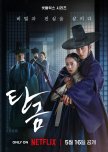
"Your love has made me human"
Dear Hongrang was a dark, twisty, tropey drama featuring two of my favorite Jae Wooks. Instead of the familiar fight for the throne and court politics, this fight played out within a wealthy merchant family that’s made a deal with the devil. When a long-lost son returns it sets a powder keg of greed and avarice on fire.Jae I has spent the last twelve years searching for her lost younger brother Hongrang after the family mostly gave up on him. Her stepmother wants her dead. Her father only sees her worth in the columns of assets and liabilities. Her older adopted brother Mu Jin is being groomed to take over the family business and has a not so secret crush on her. One day a stranger with no memory of his childhood is brought in who turns out to be her brother Hongrang. Or is he? And what murderous mysteries are hidden behind the expensive walls and hanboks of the wealthy and nobility?
Dear Hongrang takes a strong stomach to watch. Children were kidnapped and tortured in painful and vile ways. Wives who no longer fell into the asset column were taken out to be murdered. Slaves and those without power or prestige were considered less than human and expendable while those with power often walked a fine line between sanity and insanity with overtly sadistic tendencies. Into this bloody mess Jae I and Hongrang went from being adversaries to allies, and “siblings” with complicated feelings for each other.
The cinematography, lighting, and music were overtly gloomy and melancholic. One particular scene went ATLA Tui funeral with red lighting. Deceptive sunshine only gave the viewer a breath to brace for upcoming pain. The sole spoilery comment I’ll make is that you need to prepare yourself for a high body count, many of which you’ll hope will be boiled in bronze. I didn’t find the drama particularly suspenseful as most of the turning points were well foreshadowed. I did, however, find it entertaining largely due to Lee Jae Wook and Kim Jae Wook’s performances. Kim has definitely found a niche for himself playing handsome, criminally maniacal characters. While this short nightmarish drama will not be for all tastes, it managed to tell its gruesome tale without overstaying its welcome.
18 May 2025
Trigger warnings: Dismemberments, more gruesome deaths than an average Kdrama, torture scenes, and child torture scenes
Was this review helpful to you?
"No reward comes without a cost"
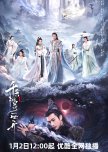
The Blossoming Love took 10,000 years to flower and at times it felt like it. A beautiful cast and a strong start, began to wilt by the final episodes.What worked for me:
I’ve had a soft spot for Bin Bin since TMOPB. He may not be the greatest actor but I find his presence comforting. Plus, he’s gorgeous.
Sun Zhen Ni gave a refreshing performance as Mu Xuan Ling.
Wang Duo once again came through as the elegant, but morally ambiguous character who threatens to steal the show.
The first half to two-thirds felt cohesive, and I was actually invested in the story.
Now for what didn’t work for me:
When the drama focused on Zhao Ming, it began to feel repetitive. While I preferred dark Bin Bin (he looked delicious in black and the darker guy-liner), the more childlike Pearl was a step backward.
There were numerous side characters, some worked, some didn’t. I tend to lose interest the further away from the main characters a story goes.
This drama is one of the most blood spitting dramas I've seen in a while. The props department must have shopped at Buckets O' Blood to keep the red fluid flowing. They also might have needed oxygen on hand for some of the long exposition dumps the actors had to spit out as well.
The last third of the drama as they hip-hopped through time began to drag. While waiting on the final episodes I watched other things and read books and completely forgot about the drama until I noticed it in my Currently Watching List which I rarely use. Forgetting a drama is not a good sign for me, despite enjoying the earlier episodes. The drama’s ending was convoluted in a timey-wimey twisted way to try and make all the pieces fit.
Final analysis:
Blossoms of Love was entertaining and pretty to look at. For the most part it kept my attention, and I enjoyed Vin Zhang and Sun Zhen Ni’s chemistry. I would have liked for it to have been shorter and had a more coherent ending. I don’t regret watching it at all, but would be hesitant to recommend to others without some serious caveats.
27 February 2025
Was this review helpful to you?

"Thank you for the meal"
A Dangerous Woman was a bizarre break-up film by Lee Ok Seop. Clocking in at under 30 minutes, the film hit a lot of notes, both comedic and dramatic.Bo Kyung has been in a relationship with her boyfriend Deok Woo for four years. Sexually attracted to another senior she decides to break up with Deok Woo. Not however, until he’s carried a couch to her apartment and later a standing fan across town for her. He’s wanting to get married and she’s wanting to have sex with Soo Jang. A last sexual encounter with Deok Woo goes unexpectedly and sets Bo Kyung into a tailspin.
Girl had every right to break up with her boyfriend and he had every right to ask why. I have to say, Bo Kyung is not someone I’d ever want to have to count on in an emergency. I’m guessing the choking scene was played for laughs, but I didn’t find it particularly funny and her selfish actions were beyond the pale. Deok Woo was obviously crazy about her and his final reaction was funny. Hurt and angry he managed to get his feelings across without actually being violent. I suspect Bo Kyung will discover that Soo Jang will not be so accommodating and to quote Spock from Star Trek, “Having is not so pleasing a thing after all as wanting. It is not logical, but it is often true.”
There were funny, frustrating, and heartbreaking moments in this short film, but I'm probably the wrong generation for A Dangerous Woman. As much as I support women choosing who they want to be with, I found Bo Kyung's actions annoying and cold. Deok Woo may come to the conclusion that he dodged a bullet. Sometimes a fan can’t be fixed.
9 August 2026
Was this review helpful to you?
"Don't cry and laugh at the same time"
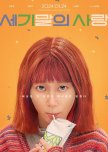
Ms. Apocalypse began in the waning days of 1999 when everyone was worried the Y2K bug would send the world crashing down. A mousy bookkeeper who was punished for becoming entangled with embezzlement left behind the old century and built a new life in the new century with someone completely unexpected.Yeong Mi is a bookkeeper at a tech company where she develops a crush on recent hire Do Yeong. She discovers he is not collecting the money on his truck route. Instead of turning him in, she works extra jobs to replace what he’s stolen. When Do Yeong turns himself in, she is arrested as well for covering up his crime. After her release from prison the only person who comes to meet her is Do Yeong’s wife. Yu Jin is a paraplegic due to a hereditary disease and confined in a wheelchair. She makes Yeong Mi an offer that the newly released prisoner cannot turn down.
I liked the premise of the film though I wasn’t always satisfied with the implementation. It came across as low budget and there were awkward edits with pertinent pieces of information left out or glossed over. Director Im Seon Ae put her efforts into developing the relationship between a very odd couple. Yeong Mi was given her derogatory nickname by male co-workers who said she looked chaotic. And the film’s hair and makeup department did their level best to make Lee Yoo Young appear unattractive. Yu Jin’s acerbic attitude hid her fears and vulnerability. Im Seon Woo accomplished a difficult performance using only her face and voice. Both characters had been taken advantage of and/or shunned by loved ones. The two should have been adversaries but found they had much in common, including kind hearts.
Y2K had people on pins and needles with Yeong Mi and Yu Jin suffering more from their families than the threat of nuclear war. In the new millennium*, Yeong Mi’s life transformed from black and white to vibrant color. The two outcasts gradually learned to trust themselves and each other even as long buried secrets and betrayals rose to the surface. With another woman to count on, they had substantial emotional growth and gained a friendship in the process. I wanted more from the ending and wished that certain transitions had been smoother and better explained but applaud a film that showed the healing power of female relationships.
7 August 2026
*Date Note: The new millennium and century didn’t actually begin until 2001.
Was this review helpful to you?
"A man is like butter, the husband is the bread"
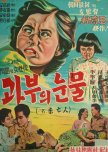
The Widow is one of those movies I’d love to rate highly as it was the first film directed by a woman in South Korea. Park Nam Ok was treated so poorly that she never made another film. As best as I can tell, the script was also written by a woman. Thank you, ladies, for attempting to break through that iron ceiling. A heads up, the film is missing sound in the last ten minutes and the final part of the last reel is missing altogether. Now to the story…Lee Shin Ja is a widow raising her young daughter Ju. Strapped for cash she meets with her husband’s wealthy friend, Mr. Lee (no relation) accepting money on occasion. Mr. Lee’s wife visits her and tells her to stay away from her husband, thinking the two are having an affair. Shin Ja’s hardscrabble neighbors drive the hoity toity woman off. When Shin Ja takes her daughter to the beach on the weekend, she discovers that Lee’s wife has her own secrets. Ju nearly drowns and Mrs. Lee’s lover, Taek, saves the girl. And before you can say “a man is like butter” we’ve got a love square going on. But wait! There’s more! Taek’s presumed dead lover comes to town. Make that a pentagon. At that point everyone should have heeded the warning sign and stopped.
Shin Ja was referred to as noble and she acted very demurely. She was graceful, spoke quietly, wore traditional clothes, and didn’t drink. She also dressed up and met with men in secluded places to talk and cajole money out of them. Why would a wife think that was suspicious? After meeting one of the men who was only dating a woman for the cash, they fell instantly in love and decided to marry. She then kicked her daughter out to be raised by the odd single dude two doors down. Ju nearly drown because Shin Ja was completely oblivious to the danger of a child in strong ocean surf by herself. If she said, “she’s such a burden” one more time I was ready to throw Shin Ja in the water. The 50s were a tough time for a single woman, especially a widow with a child. I could overlook her wheedling money out of men and looking for a husband. Abandoning her daughter to an older widower for a man was inexcusable. The movie completely lost me at that point. When her lover/common law husband hooked up with someone else, who cared? If this had been a comedy it might have made more sense, as it was, I began to laugh at the ridiculousness of the situations.
To sum up. Five stars to Park Nam Ok for having the strength to create this film, especially when she was blocked from entering the post-sound studio. I cannot imagine what she had to endure from every level of the craft to get this movie finished. I know how I would like the movie to finish ideally and it didn’t include the gigolo artist or company president but rather Shin Ja discovering she could take care of herself and her daughter by herself. Or if it went in a more realistic direction, Ju probably snapped and murdered everyone in their sleep after being shuttled about, ignored, and told what a burden she was. Like I mentioned, I really wanted to like this film, but discarding a child because she hampered romance was something I could not tolerate. I wish I could have said, "better luck next time Park Nam Ok", but she never received that chance. Truly the saddest thing about this film.
6 August 2026
Musical Note: At one point, two characters broke into song, reminiscent of the 1930s duets of Jeanette MacDonald and Nelson Eddy. Because why not, with all the crazy shenanigans going on.
Was this review helpful to you?
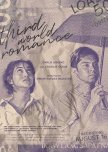
"I'm a bagger, I can carry anything. Even you."
Third World Romance was a romance set during the waning days of Covid’s terror on the world. Service professions were hit hard with many people losing their jobs. As people were able unmask it was a scramble to become employed again. During this time, two people struggling to pay their bills met and found a possible road to happiness.Alvin and Bree meet on a rainy day while standing in line for government food assistance when Bree commandeers him and his umbrella. After raiding a truck and escaping, the two swap shoes and names. When Alvin helps facilitate a job for her at the grocery where he works, the two begin to spend more time together. Alvin’s main concern is being happy and getting along with people. Bree is more concerned about making her rent payment and how to bring her mother home after being left stranded jobless in Oman. Bree also challenges her bosses for taking advantage of their employees. Happiness is not high on her list and Alvin intends to change that.
Third World Romance was a rarity for the Filipino films I’ve watched. For the most part it was just two ordinary people hustling to make ends meet and having to deal with corrupt bosses. Bree’s fight for workers’ rights was put to the test when desperation drove her. Alvin had an unconventional home life which was part biological family and part found family that included a trans woman and gay brothers that was shown as loving and normal. As in most romances there was the typical dark moment when Alvin and Bree’s love and dreams were tested that pushed the limits.
TWR was a break from interfering families, ex-lovers, amnesia, overt comedy, melodrama, and infidelity. This film focused on showing the strain debt and financial fears placed on a budding romance. The strain could make one person feel burdened and the other indebted when help was offered. Alvin would have to work overtime to convince Bree that love was possible and dreams attainable if they stuck together and supported each other. Not a strong film, but enjoyable largely due to the performances and different perspectives on a familiar genre.
6 August 2026
Notes: There was an eleven-year age gap if that is concerning. Not sure what age Alvin was supposed to be but Carlo was pushing 40. The gap didn’t bother the actors as they were married in 2024.
F Rated Note: This film was directed by a woman-- Dwein Baltazar who has a good sized film catalog.
Was this review helpful to you?
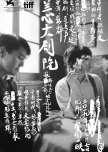
All the world may be a stage, but not everyone is a great playwright
Set in Shanghai during the days just prior to the attack on Pearl Harbor, Saturday Fiction attempted to be a noirish spy thriller. My experience with the film was trying to follow a muddled mess of a story with little character development. Even the glorious Gong Li could not overcome the film’s problems.Famous actress Jean Yu returns to Shanghai after spending time away in Hong Kong and globe-trotting. Her ex-lover, Tan Na, is directing a play based on their romance and has asked her to star in it with him. Jean stays in the Cathay Hotel situated in the French Concession. The hotel is filled with spies and soldiers, all skulking about, seeking intell on their enemy. Jean’s ex-husband is being held captive and is loathed by Chinese and Japanese alike. She’s there to help him escape and gather information for her foster father, the enigmatic bookseller, Frederic Hubert. A Japanese officer brings a new code book to town which garners a great deal of interest. Coincidentally enough, Jean is the spitting image of his late wife. Hmmmm…..
Gong Li made the most of her role as the “box of secrets”. She truly is mesmerizing to watch, even with this lame plot. Mark Chao was largely extraneous to the film though the age gap didn’t bother me. I could easily see how they would be attracted to each other. The stage play snippets only served to interrupt the flow and pace of the story which became very frustrating. Also, that was a crazy extravagant set. During the scene they showed repeatedly, the two actors whispered their lines to each other with music blaring in the background. Microphones weren’t used during plays in 1940 so no one in the audience would have heard a word spoken.
I didn’t like Lou Ye’s style in this film…at all. He overutilized extreme close-ups, blurred images, and a shaky camera following each tiny movement. Let Gong Li’s expressive face tell her story! Characters were given no backstory, development, and/or motivation. I honestly didn’t care who lived or died. For older viewers the Cathay Hotel was reminiscent of Casablanca with spies lurking about everywhere. Or for younger viewers, John Wick’s Continental if Winston and Charon listened in on all the phone calls. When the final 30 minutes were approaching, I begged the film to give me satisfactory answers. It did present a long shootout that at least helped determine which side people were on depending who they were shooting at. Even that didn’t provide definitive resolutions and revelations.
Saturday Fiction starred a great cast, was set during a tumultuous time in the glamorous “Solitary Island”, and had enough intrigue to make a dozen films. Yet due to problematic pacing and narrative issues, the film was strangely disappointing. Having said that, if you are a fan of Lou Ye’s shaky style and penchant for blending fantasy with reality, this might be one to check out. I can see where there is an audience for it, it just wasn’t for me.
22 July 2026
Trigger warnings: Sexual assault. Smoking.
Was this review helpful to you?
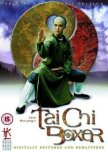
Hok Man and his cousin have been stuck in a room studying the classics, regimented by his overbearing father. Luckily, his mother has mercy on him, allowing him to escape occasionally. After 10 years he and his cousin break out to do a lion dance in a celebration and Hok meets Rose who has recently returned from studying overseas. She is engaged to Lin Rong/Wing, though doesn’t take it seriously as it was a birth betrothal. She does take a shine to Hok. Hok’s mother studied abroad, too, and teaches her son some English and gives him the English name Jacky. The way of true love is not smooth, because Jacky and Rose don’t only have to deal with Lin, there are foreign opium dealers they run afoul of.
This film felt like a patchwork of other films, primarily, Once Upon a Time in China. The story was rather weak, but the fights were strong. Billy Chow, who was nearly allows cast as a villain showed up first to challenge Jacky’s father. Billy showed off his kicking skills even though his character got his butt kicked. The father was played by Mantis expert IRL, Yu Hai. I always love watching Yu fight, especially when he drops down into Mantis pose. Wu Jing as grownup Hok Man was quick, strong, and athletic. He’s always a delight to watch, even in this early film. Mark Cheng may not have been the most skilled fighter but he honed his acting skills in numerous kung fu and action films. The foreign villain, Mr. Smith, was played by Darren Shahlavin who trained in various styles. He also was accommodating enough to rip his shirt off and pose with his well-muscled body.
Yuen Woo Ping’s fight choreography was fun and destructive. Boards were splintered, vases were smashed, not much was left standing when the fights were done. In true 90s style, not so subtle wire work and trampoline work were used. Fortunately, when Yuen wasn’t undercranking the shots, seriously, these guys were fast enough, the pros took over. That’s not to say there weren’t a lot of missed kicks and hits but the guys and stuntmen knew how to sell every supposed connection.
This lite version of OUATIC was diverting enough, the fights were the reason to watch. Each one used the environment and different skill sets to perfection, in a 1990s way. You can't go into this film expecting modern polished overly crafted fights. Wu Jing hadn’t hit his stride as an actor, yet he was still charming as the impish and thoughtful kung fu hero. And it might also be the first time, or only time, you’ll see Pigtail Fu. Past the time I usually grant a grading curve, but for Wu Jing’s introduction, I’m feeling generous.
7 July 2026
Tai Chi Note: This film was billed as Tai Chi 2, but had nothing to do with the original, Tai Chi Master, which starred Jet Li and Michelle Yeoh. Much of the cast from this film did return for a 1998 Taiwanese television drama called The Tai Chi Master. I’d watch it for sure if I came across it.
Was this review helpful to you?
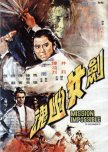
"It seems you've chosen death"
Shaw Brothers’ Mission Impossible was written and directed by the prolific Joseph Kuo. In many ways it was a typical SB film shot in Taiwan but this story had a nice twist thrown into it.The 10,000-year-old Golden Dragon Sword has been stolen from the Imperial Palace. Chaos is sure to reign without its magical light. Soldiers, martial artists, bandits, the good, the bad, and the ugly are all desperately searching for a sword so sharp it can wound a person from five steps away. The legendary swordsman Huo Yun Shan wrested the sword from thieves and now has to entrust it to his daughter Huo Xiao Fen. Her mission is to deliver the Golden Dragon to the Prime Minister, protecting it from all evildoers, but especially the Jade Child Xia Zhao. The Jade Child is 130 years old and impervious to most weapons and poisons, he is not someone Huo should tangle with.
Ching Li is one of my favorite female leads in these old martial arts films. Not a martial artist, but could look properly fierce and also vulnerable when the occasion called for it. Chen Hung Lieh had an unbeatable resting bitch face and was nearly always cast as the villain. This role gave him a chance to expand past his trademark snively laugh and sinister smirks. There were plenty of minions with colorful makeup, weapons, and costumes for Huo to cross swords with, played by familiar Taiwanese actors such as Yi Yuan and Tsai Hung.
The swordfight choreography was fairly typical for 1971. Ching Li wore a veil for a few of the more rigorous and acrobatic battles to hide the stuntman underneath. That or she had very masculine hands. There was a lot of light body wire work and trampoline work. Due to Shaw Brothers producing the film, the sets and costumes were higher end and more polished than the usual Taiwanese martial arts fare. The fight scenes weren’t shot in dark forests or at night either. There was even an underwater scene including special effects fish!
Mission Impossible followed a fairly standard format about a lost sword and the desperate need to return it before it caused societal upheaval. And then it wasn’t. The final “fight” was pretty entertaining. As usual, I grade these old kung fu films on a generous scale and in comparison to other similar films.
5 July 2026
Was this review helpful to you?
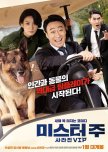
"If you don't respect animals, you'll be punished"
Mr Zoo: The Missing VIP was a cute cross between Dr. Doolittle and Pets starring a gorgeous German Shepherd named Ali and the dependable human ahjussi Lee Sung Min.Agent Joo Tae Joo leads a regimented life with a touch of OCD. He’s up for promotion and determined to get the position. When the Chinese envoy for the 25th Anniversary of the Korean-Chinese Diplomatic Relations turns out to be a panda named Ming Ming he doesn’t hesitate to volunteer for the assignment in hopes it will seal the deal for his promotion-despite his anathema for animals. His life takes a strange twist when he abuses a stray cat named GOD and later sustains a head injury trying to thwart a pandanapping. He ends up being able to understand what animals are saying and can communicate with them. The agency isn’t thrilled with his new “abilities” and benches Joo during the search for Ming Ming. Fortune smiles on him when a military dog named Ali steps in to help him find the culprits.
I found the first 40 minutes or so terribly uneven and uninteresting. Lee Sung Min gave his all as he always does so his performance was not the problem. Kim Seo Hyung made the most of this lighter role, showing she could do comedy as well. The problem was that this type of story has been done numerous times and execution is critical. The editing and scene setups came across amateurish and unpolished. There was the required estranged child who desperately needed the father who had no idea how to talk with her. And the competitive colleague licking his chops at the chance to leap frog over Joo.
Mr. Zoo had a beautiful German Shepherd, Ali, who was truly a good boy. Ming Ming, the star of the anniversary celebration knew her worth and tried to hog the spotlight whenever possible. An array of other creatures with legs and for those triggered-without them-were the highlight of the film. Not a great film, but entertaining for what it was. Fair warning, while this was a family film aimed at children there were disturbing scenes of violence against animals albeit with the requisite disclaimers.
27 June 2026
Trigger warning: A snake shown in different scenes. Dancing rats.
Kung Fu Panda Note: The animal costumes were actually pretty good.
Was this review helpful to you?


