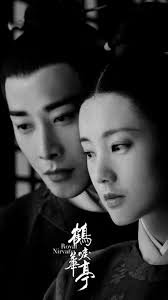
I watched RN twice a long time ago. We definitely must watch the 12 eps (special) after the 60 eps tho; otherwise,…
Oh WOW, hi
I am so walking past this drama site just to find more equally addicted to RN viewers
I just cant get over HOW deep this Drama is and how MUCH RESEARCH went into RECREATING an imperial era with all its codes of conduct, stratified bureacracy, palace geography ..
I was trying to google search SO MUCH on the various segments .. EVEN costume items and the significance of various symbols ..
Next year when the pain has settled away I think I will do a 3rd WATCH and WITH FAR more looking up of terms and words and even poems and references to literary figures
It wont make much sense if watched just for the 'romance thread' .. the plots and arcs wont fall in place .. that too in such an intensely complex plot and storyline. The romance thread is intricately woven into the larger fabric of court and imperial era politics and times ... It's a bigger story of a son and a father .. of brothers and mothers and family .. Emperors courtiers harem and eunuch and military .. If you try to only extract a thread of romance .. it will look meaningless :-P
and as I continue to bubble over post-watchI thought I'd share some stuff that viewers who come here in the future might find more depth and meaning .. as I did
During my rewatch I kept referencing to understand the deeper significances tucked in the drama (this is from Google search)
No Spoilers story and plot wise that isn't already in the MDL brief : BUT feel free to stop if you think this will reduce your enjoyment.
The original Mandarin title is VERY moving :
Title Origin: The title translates literally to "The Crane’s Cry in the Splendid Courtyard." It is drawn directly from a famous idiom in the Shishuo Xinyu (A New Account of the Tales of the World) by Liu Yiqing.
Before his execution in 303 CE, the brilliant Western Jin scholar and general Lu Ji (陆机) was falsely accused and condemned to death.
Facing his end, he sorrowfully lamented that he could never again return to his hometown of Huating (modern-day Shanghai) to hear the cranes crying.
Symbolism and Plot Analysis :
The Tragic Scholar/Prince: In the drama, this alludes directly to Crown Prince Xiao Dingquan. Like Lu Ji, he is an intellectual, a man of refined sensibilities (represented by his deep love for literature, calligraphy, and poetry) who is forced into the cruel, cutthroat world of politics.
The Crane (鹤): In traditional Chinese culture, cranes represent nobility, grace, and integrity.
However, a crane's cry is lonely and piercing. It symbolizes the Prince's moral purity, his desperate yearning for familial love, and his ultimate isolation as he sacrifices himself for the country and the people.
The Splendid Courtyard (华亭): This symbolizes the glittering yet perilous gilded cage of the Imperial Palace. While it offers immense prestige and power, it is ultimately a trap that strips individuals of their freedom and destroys those who cannot adapt to its ruthlessness.
Nostalgic Regret: The idiom universally represents profound regret over entering the treacherous path of officialdom and the agonizing nostalgia for a simpler, uncorrupted life. This mirrors the Prince’s constant anguish, his tortured relationship with the Emperor, and his continuous loss of everything and everyone he holds dear.
I just wrapped a MARATHON 60+12 episode REWATCH : am bubbling over to share some stuff that viewers who come here in the future might find more depth and maning .. as I did
No Spoilers story and plot wise that isn't already in the MDL brief : BUT feel free to stop if you think this will reduce your enjoyment.
The original Mandarin title is VERY moving :
During my rewatch I kept referencing to understand the deeper significances tucked in the drama (this is from Google search)
Am sharing here (and will also post as a standalone comment)
Title Origin: The title translates literally to "The Crane’s Cry in the Splendid Courtyard." It is drawn directly from a famous idiom in the Shishuo Xinyu (A New Account of the Tales of the World) by Liu Yiqing.
Before his execution in 303 CE, the brilliant Western Jin scholar and general Lu Ji (陆机) was falsely accused and condemned to death.
Facing his end, he sorrowfully lamented that he could never again return to his hometown of Huating (modern-day Shanghai) to hear the cranes crying.
Symbolism and Plot Analysis :
The Tragic Scholar/Prince: In the drama, this alludes directly to Crown Prince Xiao Dingquan. Like Lu Ji, he is an intellectual, a man of refined sensibilities (represented by his deep love for literature, calligraphy, and poetry) who is forced into the cruel, cutthroat world of politics.
The Crane (鹤): In traditional Chinese culture, cranes represent nobility, grace, and integrity.
However, a crane's cry is lonely and piercing. It symbolizes the Prince's moral purity, his desperate yearning for familial love, and his ultimate isolation as he sacrifices himself for the country and the people.
The Splendid Courtyard (华亭): This symbolizes the glittering yet perilous gilded cage of the Imperial Palace. While it offers immense prestige and power, it is ultimately a trap that strips individuals of their freedom and destroys those who cannot adapt to its ruthlessness.
Nostalgic Regret: The idiom universally represents profound regret over entering the treacherous path of officialdom and the agonizing nostalgia for a simpler, uncorrupted life. This mirrors the Prince’s constant anguish, his tortured relationship with the Emperor, and his continuous loss of everything and everyone he holds dear.
The English title is really misleading.... Production might have used Nirvana to ride on the success of Nirvana…
the original Mandarin title is VERY moving :
During my rewatch I kept referencing to understand the deeper significances tucked in the drama (this is from Google search)
Am sharing here (and will also post as a standalone comment)
Title Origin: The title translates literally to "The Crane’s Cry in the Splendid Courtyard." It is drawn directly from a famous idiom in the Shishuo Xinyu (A New Account of the Tales of the World) by Liu Yiqing.
Before his execution in 303 CE, the brilliant Western Jin scholar and general Lu Ji (陆机) was falsely accused and condemned to death.
Facing his end, he sorrowfully lamented that he could never again return to his hometown of Huating (modern-day Shanghai) to hear the cranes crying.
Symbolism and Plot Analysis :
The Tragic Scholar/Prince: In the drama, this alludes directly to Crown Prince Xiao Dingquan. Like Lu Ji, he is an intellectual, a man of refined sensibilities (represented by his deep love for literature, calligraphy, and poetry) who is forced into the cruel, cutthroat world of politics.
The Crane (鹤): In traditional Chinese culture, cranes represent nobility, grace, and integrity.
However, a crane's cry is lonely and piercing. It symbolizes the Prince's moral purity, his desperate yearning for familial love, and his ultimate isolation as he sacrifices himself for the country and the people.
The Splendid Courtyard (华亭): This symbolizes the glittering yet perilous gilded cage of the Imperial Palace. While it offers immense prestige and power, it is ultimately a trap that strips individuals of their freedom and destroys those who cannot adapt to its ruthlessness.
Nostalgic Regret: The idiom universally represents profound regret over entering the treacherous path of officialdom and the agonizing nostalgia for a simpler, uncorrupted life. This mirrors the Prince’s constant anguish, his tortured relationship with the Emperor, and his continuous loss of everything and everyone he holds dear.
Now on ep 56, and feels like too much dragging. Same torture, same struggles. They should have shortened it by…
:-D
I had a good ride with Pursuit of J for a while and then it got 'DUMB' and the writing became dull and unimaginative dropped it
The ONLY reason I was DYING to do the 60+12 ep marathon with RN was that there was SO much richness, depth, dimensionality to ALL the characters NOT just the leads and the PLOT of course .. so much of which I did not catch in the first round.
So is the guy always suffering nd being a weakling nd not gaining any good winning feats or more?
He has his dao .. He sees his actions and takes the path that is his dao ,, he "doesn't regret nor apologise nor compensate" .. he 'endures' the consequences of his actions and owns them
I am so walking past this drama site just to find more equally addicted to RN viewers
I just cant get over HOW deep this Drama is and how MUCH RESEARCH went into RECREATING an imperial era with all its codes of conduct, stratified bureacracy, palace geography ..
I was trying to google search SO MUCH on the various segments .. EVEN costume items and the significance of various symbols ..
Next year when the pain has settled away I think I will do a 3rd WATCH and WITH FAR more looking up of terms and words and even poems and references to literary figures
My heart breaks to see Luo Jin not win a best actor award ,, he portrayed his role so well
So happy to read your passionate review ;-p
I just did a REWATCH ;-p
Scrolling to recall who all I chatted with ha ha and what all I missed ..
I left some comments today at both RN and RNS pages ;-P
It wont make much sense if watched just for the 'romance thread' .. the plots and arcs wont fall in place .. that too in such an intensely complex plot and storyline.
The romance thread is intricately woven into the larger fabric of court and imperial era politics and times ...
It's a bigger story of a son and a father .. of brothers and mothers and family .. Emperors courtiers harem and eunuch and military ..
If you try to only extract a thread of romance .. it will look meaningless :-P
had a good break .. quick meals - loo visits - no phone except to HEAVILY use reference Imperial China deets
Am good to go and write a thesis I think.
During my rewatch I kept referencing to understand the deeper significances tucked in the drama (this is from Google search)
No Spoilers story and plot wise that isn't already in the MDL brief : BUT feel free to stop if you think this will reduce your enjoyment.
The original Mandarin title is VERY moving :
Title Origin:
The title translates literally to "The Crane’s Cry in the Splendid Courtyard."
It is drawn directly from a famous idiom in the Shishuo Xinyu (A New Account of the Tales of the World) by Liu Yiqing.
Before his execution in 303 CE, the brilliant Western Jin scholar and general Lu Ji (陆机) was falsely accused and condemned to death.
Facing his end, he sorrowfully lamented that he could never again return to his hometown of Huating (modern-day Shanghai) to hear the cranes crying.
Symbolism and Plot Analysis :
The Tragic Scholar/Prince:
In the drama, this alludes directly to Crown Prince Xiao Dingquan.
Like Lu Ji, he is an intellectual, a man of refined sensibilities (represented by his deep love for literature, calligraphy, and poetry) who is forced into the cruel,
cutthroat world of politics.
The Crane (鹤):
In traditional Chinese culture, cranes represent nobility, grace, and integrity.
However, a crane's cry is lonely and piercing.
It symbolizes the Prince's moral purity, his desperate yearning for familial love, and his ultimate isolation as he sacrifices himself for the country and the people.
The Splendid Courtyard (华亭): This symbolizes the glittering yet perilous gilded cage of the Imperial Palace.
While it offers immense prestige and power, it is ultimately a trap that strips individuals of their freedom and destroys those who cannot adapt to its ruthlessness.
Nostalgic Regret:
The idiom universally represents profound regret over entering the treacherous path of officialdom and the agonizing nostalgia for a simpler, uncorrupted life.
This mirrors the Prince’s constant anguish, his tortured relationship with the Emperor, and his continuous loss of everything and everyone he holds dear.
No Spoilers story and plot wise that isn't already in the MDL brief : BUT feel free to stop if you think this will reduce your enjoyment.
The original Mandarin title is VERY moving :
During my rewatch I kept referencing to understand the deeper significances tucked in the drama (this is from Google search)
Am sharing here (and will also post as a standalone comment)
Title Origin:
The title translates literally to "The Crane’s Cry in the Splendid Courtyard."
It is drawn directly from a famous idiom in the Shishuo Xinyu (A New Account of the Tales of the World) by Liu Yiqing.
Before his execution in 303 CE, the brilliant Western Jin scholar and general Lu Ji (陆机) was falsely accused and condemned to death.
Facing his end, he sorrowfully lamented that he could never again return to his hometown of Huating (modern-day Shanghai) to hear the cranes crying.
Symbolism and Plot Analysis :
The Tragic Scholar/Prince:
In the drama, this alludes directly to Crown Prince Xiao Dingquan.
Like Lu Ji, he is an intellectual, a man of refined sensibilities (represented by his deep love for literature, calligraphy, and poetry) who is forced into the cruel,
cutthroat world of politics.
The Crane (鹤):
In traditional Chinese culture, cranes represent nobility, grace, and integrity.
However, a crane's cry is lonely and piercing.
It symbolizes the Prince's moral purity, his desperate yearning for familial love, and his ultimate isolation as he sacrifices himself for the country and the people.
The Splendid Courtyard (华亭): This symbolizes the glittering yet perilous gilded cage of the Imperial Palace.
While it offers immense prestige and power, it is ultimately a trap that strips individuals of their freedom and destroys those who cannot adapt to its ruthlessness.
Nostalgic Regret:
The idiom universally represents profound regret over entering the treacherous path of officialdom and the agonizing nostalgia for a simpler, uncorrupted life.
This mirrors the Prince’s constant anguish, his tortured relationship with the Emperor, and his continuous loss of everything and everyone he holds dear.
During my rewatch I kept referencing to understand the deeper significances tucked in the drama (this is from Google search)
Am sharing here (and will also post as a standalone comment)
Title Origin:
The title translates literally to "The Crane’s Cry in the Splendid Courtyard."
It is drawn directly from a famous idiom in the Shishuo Xinyu (A New Account of the Tales of the World) by Liu Yiqing.
Before his execution in 303 CE, the brilliant Western Jin scholar and general Lu Ji (陆机) was falsely accused and condemned to death.
Facing his end, he sorrowfully lamented that he could never again return to his hometown of Huating (modern-day Shanghai) to hear the cranes crying.
Symbolism and Plot Analysis :
The Tragic Scholar/Prince:
In the drama, this alludes directly to Crown Prince Xiao Dingquan.
Like Lu Ji, he is an intellectual, a man of refined sensibilities (represented by his deep love for literature, calligraphy, and poetry) who is forced into the cruel,
cutthroat world of politics.
The Crane (鹤):
In traditional Chinese culture, cranes represent nobility, grace, and integrity.
However, a crane's cry is lonely and piercing.
It symbolizes the Prince's moral purity, his desperate yearning for familial love, and his ultimate isolation as he sacrifices himself for the country and the people.
The Splendid Courtyard (华亭): This symbolizes the glittering yet perilous gilded cage of the Imperial Palace.
While it offers immense prestige and power, it is ultimately a trap that strips individuals of their freedom and destroys those who cannot adapt to its ruthlessness.
Nostalgic Regret:
The idiom universally represents profound regret over entering the treacherous path of officialdom and the agonizing nostalgia for a simpler, uncorrupted life.
This mirrors the Prince’s constant anguish, his tortured relationship with the Emperor, and his continuous loss of everything and everyone he holds dear.
:-D
Ok make it bit longer .. a week .. ramped up viewing for 5
Scrolling to recall who all I chatted with ha ha as well as read those I missed
Did you watch the 12 eps?
I left some comments today (on the 60 ep page) thought I'll ping you
;-p
I for one cannot let this drama go and come to haunt its pages looking for company ..
I just did a REWATCH ;-p
Scrolling to recall who all I chatted with ha ha, and others I missed reading ..
I left some comments today (the 60 eps page) thought I'll ping you
Scrolling to recall who all I chatted with ha ha
I left some comments today thought I'll ping you .. the rare number of people who really seemed to have rolled with this one the way I did
I had a good ride with Pursuit of J for a while and then it got 'DUMB' and the writing became dull and unimaginative dropped it
The ONLY reason I was DYING to do the 60+12 ep marathon with RN was that there was SO much richness, depth, dimensionality to ALL the characters NOT just the leads and the PLOT of course .. so much of which I did not catch in the first round.
Luo Jin is a HOTTIE .. and in this when he turns on the charm you go weak knees
He sees his actions and takes the path that is his dao ,, he "doesn't regret nor apologise nor compensate" .. he 'endures' the consequences of his actions and owns them
I just did a REWATCH ;-p
Scrolling to recall who all I chatted with ha ha
Did you watch the 12 eps?
I left some comments today thought I'll ping you
ESPECIALLY one about Hamlet - Shakespeare etc
and loads of intimate scenes
OK i'll revise that to 5 .. if you count a sensuous caressing lips with thumb /fingers