


 4
4 17
17 1
1 5
5 1
1 1
1 1
1


To be honest, I am not sure what to think about this series.
But first of all: I loved the actors' performances; the background music was slightly distracting at times, and the camera work was solid. The was never a boring moment, and there was much less sports than I thought.
Very obviously a lot of world/character building has gone into this drama; apart from two supporting characters (one of them unfortunately the love interest) they all had an interesting back story going on -- interesting enough that each one of them would have deserved their own drama.
Unfortunately, the writer didn't quite use these to their advantage. For most of the series, it felt like it could tip into melodrama any moment, with the one friend and the grandmother being archetypes of melodrama, the hinting at tragic backstories, and the search for the truth about Nun's mother. Really, it felt like being teased constantly. But then it went back to being a comedy slice-of-life, following Nun in her uni days doing homework, competing with friends, lifting weights in the uni club. I slowly got used to this rhythm, and even started to like it. And I thought, what an interesting concept that is, to have all these tropes but then to make the characters just accept that what happened, happened, and now is the time to look into the now and into the future.
But then, in the last two episodes, the mood changed jarringly. Only then did the screenplay tip into full melodrama: It finally revealed the tragic destiny of Nun's mother, finally the tension between Grace and her mother escalated into shouting and over-dramatic exits, finally the grandmother dramatically came to her senses within a near-death experience. Three other story-lines were also resolved in these last two hours, which gave everything too little time to feel properly rewarding.
Actually, I'd rather the writer had committed to their previous method to lightly conclude segments instead of writing melodrama. The two story lines that they *did* resolve in that understated way were the ones I felt were written the best. In my view, it also took time away from tying everything neatly together into a single theme or message. Till now, I have no idea what exactly the writer wanted to tell us: What exactly is it that Nun has learned now?
Something about truth, lies and forgiveness? Something about friendship? Something about letting go? Something about children having to love their elders?
Although the characters were nicely written, none of them got a proper character development, which I find a necessary element in youth dramas; or at least I can't see any?
And lastly, a note on the title:
"Clean and Jerk" is a weightlifting move -- and the one that Nun has the most trouble with.
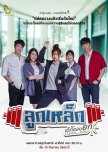
Going from the design on the poster, the Thai title ลูกเหล็กเด็กชอบยก is to be read in two parts: ลูกเหล็ก /lûuk lèk/ "the child of iron" might be an allusion to her being the heir of a steel factory or to her iron will; เด็กชอบยก /dèk chôop yók/ "The child likes to lift/pick up" is the title of Nun's brother's favourite comic book but also might be an allusion to her bearing the weight of guilt for the car accident. From my observation, Thai titles often have more than one meaning, so all of these might be intentional.
Was it good?
It was engaging, never boring. But I felt that it didn't quite get to its point, and that the resolutions stayed superficial.
Did I like it?
I did. To be honest, I started it just because Pond Ponlawit has a main role and I wanted to see how he was when he started out in his career. But his character is a bit boring -- I genuinely grew to like Nun and her friends as well as Nun's father and wanted to see how it all would play out.
Who would I recommend it to?
I think those who generally get on with Thai PBS dramas and like watching youth dramas will like it.
But first of all: I loved the actors' performances; the background music was slightly distracting at times, and the camera work was solid. The was never a boring moment, and there was much less sports than I thought.
Very obviously a lot of world/character building has gone into this drama; apart from two supporting characters (one of them unfortunately the love interest) they all had an interesting back story going on -- interesting enough that each one of them would have deserved their own drama.
Unfortunately, the writer didn't quite use these to their advantage. For most of the series, it felt like it could tip into melodrama any moment, with the one friend and the grandmother being archetypes of melodrama, the hinting at tragic backstories, and the search for the truth about Nun's mother. Really, it felt like being teased constantly. But then it went back to being a comedy slice-of-life, following Nun in her uni days doing homework, competing with friends, lifting weights in the uni club. I slowly got used to this rhythm, and even started to like it. And I thought, what an interesting concept that is, to have all these tropes but then to make the characters just accept that what happened, happened, and now is the time to look into the now and into the future.
But then, in the last two episodes, the mood changed jarringly. Only then did the screenplay tip into full melodrama: It finally revealed the tragic destiny of Nun's mother, finally the tension between Grace and her mother escalated into shouting and over-dramatic exits, finally the grandmother dramatically came to her senses within a near-death experience. Three other story-lines were also resolved in these last two hours, which gave everything too little time to feel properly rewarding.
Actually, I'd rather the writer had committed to their previous method to lightly conclude segments instead of writing melodrama. The two story lines that they *did* resolve in that understated way were the ones I felt were written the best. In my view, it also took time away from tying everything neatly together into a single theme or message. Till now, I have no idea what exactly the writer wanted to tell us: What exactly is it that Nun has learned now?
Something about truth, lies and forgiveness? Something about friendship? Something about letting go? Something about children having to love their elders?
Although the characters were nicely written, none of them got a proper character development, which I find a necessary element in youth dramas; or at least I can't see any?
And lastly, a note on the title:
"Clean and Jerk" is a weightlifting move -- and the one that Nun has the most trouble with.
Going from the design on the poster, the Thai title ลูกเหล็กเด็กชอบยก is to be read in two parts: ลูกเหล็ก /lûuk lèk/ "the child of iron" might be an allusion to her being the heir of a steel factory or to her iron will; เด็กชอบยก /dèk chôop yók/ "The child likes to lift/pick up" is the title of Nun's brother's favourite comic book but also might be an allusion to her bearing the weight of guilt for the car accident. From my observation, Thai titles often have more than one meaning, so all of these might be intentional.
Was it good?
It was engaging, never boring. But I felt that it didn't quite get to its point, and that the resolutions stayed superficial.
Did I like it?
I did. To be honest, I started it just because Pond Ponlawit has a main role and I wanted to see how he was when he started out in his career. But his character is a bit boring -- I genuinely grew to like Nun and her friends as well as Nun's father and wanted to see how it all would play out.
Who would I recommend it to?
I think those who generally get on with Thai PBS dramas and like watching youth dramas will like it.
Was this review helpful to you?


