
 News
News 


 4
4 17
17 1
1 5
5 1
1 1
1 1
1


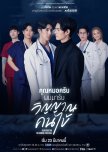
It's likely that this drama is not for everyone. Those who expect a medical drama will surely find it lacking. Those who expected a supernatural-heavy plot will surely be disappointed. Those who want a BL drama to be mainly romance focused will, too.
Because the focus is not on these -- it's on the question if a doctor's duty to save lives can be aligned with the principle of เกิด แก่ เจ็บ ตาย.
In technical aspects, this Thai BL drama is equal to others from 2022 -- overall solidly made, occasionally somewhat awkward and it could have used some more polish. The script is fine, although a few more passes over it in the writing stages would have done it good and could have sanded off some rough edges by smoothing out dialogues and tightening scenes. The actors did their best, but on occasion they obviously struggled with the unwieldy dialogue or with how they were directed to act.
Were the medical events realistic? Most likely not. Did it make any sense that the medical personnel were wearing their work clothes outside of the hospital (for example on the way to/from work)? Of course not. Were there other questionable plot-related events? Sure.
However, this drama is, like most other Thai stories I've seen so far, more about the emotional progression and the message than it is about realism or even a strictly cohesive plot.
Here, the emotional story is mainly about Prakan, who starts out as a surgeon whose ambition in life is to save as many lives as he can -- he places value in life, but hasn't yet understood one of the central Buddhist teachings: That เกิด แก่ เจ็บ ตาย "birth, aging, illness and death" are the four natural inevitable aspects of a person's life. I had already suspected that this was the drama's main point, but I was sure about this after Prakan's mother said "In a hospital, there is age, pain and death" and pointed out that this is just part of life. (Prakan's actor also says in an interview, that Prakan doesn't understand in the beginning, but later he starts to understand.)
Tuaphi's role in this drama, who is not death itself but its mere messenger, is to be a mirror for Prakan's attitude towards death -- where in the beginning Prakan rails and fights against death, he starts to accept it as the unavoidable part of being it is -- and only after he has done so, is he emotionally able to accept death as part of life and Tuaphi as a romantic partner.
Consequently, the romance takes a backseat for most of the drama, and is slow to unfold, maybe to the point that some might find it not enough.
Another issue the drama picks up is that of organ donation -- it's a barely disguised appeal to become an organ donator, and it tries to shed light on some questions Thai people might have about it, especially of whether it's "acceptable" to take an organ from a person who might be viewed as morally not good by society.
Personally, I found the drama's premise interesting -- even in the flood of BL dramas we got in 2025 and 2026 it stands out as unique. The emotional progression unfolds ... not quite smoothly but overall organically. Those who watch it as a medical or a supernatural drama or yearn for a beautiful romance, will likely be disappointed. In my view, the message it delivered was strong, especially in front of the Buddhist background of Thai society, but it means one must look deeper than just at the medical plot, the supernatural aspects, or the romance.
All in all, I liked it quite a bit, and I would recommend it for those who have the patience for a slow drama in which the romance takes a backseat, and who like to think about the relationship between life and death.
Because the focus is not on these -- it's on the question if a doctor's duty to save lives can be aligned with the principle of เกิด แก่ เจ็บ ตาย.
In technical aspects, this Thai BL drama is equal to others from 2022 -- overall solidly made, occasionally somewhat awkward and it could have used some more polish. The script is fine, although a few more passes over it in the writing stages would have done it good and could have sanded off some rough edges by smoothing out dialogues and tightening scenes. The actors did their best, but on occasion they obviously struggled with the unwieldy dialogue or with how they were directed to act.
Were the medical events realistic? Most likely not. Did it make any sense that the medical personnel were wearing their work clothes outside of the hospital (for example on the way to/from work)? Of course not. Were there other questionable plot-related events? Sure.
However, this drama is, like most other Thai stories I've seen so far, more about the emotional progression and the message than it is about realism or even a strictly cohesive plot.
Here, the emotional story is mainly about Prakan, who starts out as a surgeon whose ambition in life is to save as many lives as he can -- he places value in life, but hasn't yet understood one of the central Buddhist teachings: That เกิด แก่ เจ็บ ตาย "birth, aging, illness and death" are the four natural inevitable aspects of a person's life. I had already suspected that this was the drama's main point, but I was sure about this after Prakan's mother said "In a hospital, there is age, pain and death" and pointed out that this is just part of life. (Prakan's actor also says in an interview, that Prakan doesn't understand in the beginning, but later he starts to understand.)
Tuaphi's role in this drama, who is not death itself but its mere messenger, is to be a mirror for Prakan's attitude towards death -- where in the beginning Prakan rails and fights against death, he starts to accept it as the unavoidable part of being it is -- and only after he has done so, is he emotionally able to accept death as part of life and Tuaphi as a romantic partner.
Consequently, the romance takes a backseat for most of the drama, and is slow to unfold, maybe to the point that some might find it not enough.
Another issue the drama picks up is that of organ donation -- it's a barely disguised appeal to become an organ donator, and it tries to shed light on some questions Thai people might have about it, especially of whether it's "acceptable" to take an organ from a person who might be viewed as morally not good by society.
Personally, I found the drama's premise interesting -- even in the flood of BL dramas we got in 2025 and 2026 it stands out as unique. The emotional progression unfolds ... not quite smoothly but overall organically. Those who watch it as a medical or a supernatural drama or yearn for a beautiful romance, will likely be disappointed. In my view, the message it delivered was strong, especially in front of the Buddhist background of Thai society, but it means one must look deeper than just at the medical plot, the supernatural aspects, or the romance.
All in all, I liked it quite a bit, and I would recommend it for those who have the patience for a slow drama in which the romance takes a backseat, and who like to think about the relationship between life and death.
Was this review helpful to you?


