

 135
135 431
431 16
16 2
2 6
6 3
3 8
8 10
10 3
3 13
13 1
1 1
1 1
1 1
1 2
2 6
6 8
8 5
5 9
9


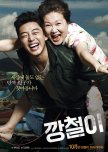
Three coincidences equals Fate or lazy writing
Tough as Iron with Yoo Ah In was a film with an identity crisis. At its heart it was a movie that seemed inspired by Gilbert Grape right down to the opening scene. To make it more exciting they threw in gangsters and the Yakuza. Then for good measure they wedged in a love story. Sometimes too much is too much.According to the synopsis Gang Cheol was a legendary street fighter. Maybe it was Sesame Street? The fight scenes weren't very well choreographed and his most powerful skill was a killer stare. Cheol's life entailed a job working on the docks and caring for his mother. His mom often accompanied him so that she wouldn’t wander off, which she still managed to do quite often. Not only did she have dementia, she was a diabetic with kidney failure. Cheol went to great lengths trying to find a way for her to receive a transplant. Cheol’s buddy, Jong Soo, wanted to be somebody and get rich so he joined a gang with a sashimi loving boss with a hotheaded brother. Of course, the trouble magnet entangled Cheol with his criminal co-workers. In moments when he wasn’t dealing with his mother, his troublesome friend, working, trying to find 100,000 won for his mom's surgery, or dealing with the gangsters, Cheol ran into a pretty photographer visiting Busan which meant it had to be fate.
The gangster angle was weak and took away from the relevant story of Cheol and his mother. Maybe the writers felt that Gilbert Grape would have been more interesting if he’d gotten mixed up with gangsters instead of planning a birthday party. The romance in this film wasn’t a lifeline or an insight into a better life, it seemed more like vacant window dressing. Yoo Ah In and Kim Hae Sook had wonderful chemistry together. There was more than enough story to tell as they navigated the stage in life when the child becomes the parent with little time for himself. This story could have used a romantic involvement to show him what he was missing. But Tough As Iron’s incoherent gangster escapades pulled too much focus from the heart of the film leaving no room for a well-developed love story.
Tough as Iron had the potential to be a powerful and meaningful film, especially with the caliber of actors involved. I thoroughly enjoyed watching the interplay between Cheol and his mother, the good days, the bad days, the exhaustion, heartache, and love. I found their relationship much more fascinating than a maniacal killer who stuttered.
5 February 2024
Was this review helpful to you?
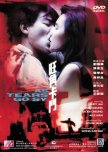
"People like us don't have tomorrows"
Wong Kar Wai had written numerous scripts before his directorial debut in 1988 with As Tears Go By. While I would enjoy many of his later works, this earliest endeavor was not one of my favorites. Andy Lau’s gangster boss Wah was torn between his “little brother” Fly and the gorgeous Maggie Cheung’s Ngor. Would not have been a difficult choice for me but gangster brotherhood was a powerful force even when one of the gangsters was inept and a trouble magnet.Wah’s Auntie sends his cousin Ngor to stay with him while she is seeing doctors in town. After a late night incident where the two seem to be attracted to each other, Ngor goes back home with a clean bill of health. Later, Wah visits Ngor but is pulled back when Fly lands in trouble-again. This is the second time he’s had to face death for the completely inept gangster whose mouth is bigger than his brain or brawn. Even though rival gangster Tony has a proper gang, Wah's gang appears to consist of him and Fly after another member leaves to get married. After handling Fly’s problems he goes back to Maggie but is once again called back to deal with Fly’s issues.
While there is a brotherhood among gangsters, when one guy’s reckless actions repeatedly put your life at danger, it’s time to jettison him one way or another. I’m guilty of becoming sympathetic with characters in gangster movies, but not this one. The sheer stupidity of Wah’s and Fly’s actions drained me of any sympathy for them. Maggie’s character Ngor was thinly drawn and also didn’t evoke any sympathy. Wah could be aggressive and worked in a field with a short life expectancy and he didn’t have any money to show for it. Why would a nice girl want to get involved with him?
WKW had some interesting shots throughout the film, especially Maggie in a moment of indecision when she slowly walks up the stairs to join Wah. The fights were brutal but not choreographed very well with many scenes rather rudimentary. The use of Top Gun’s “Take My Breath Away” took me right out of the moment and to another film from the 1980’s with a romance and a band of brothers. Andy Lau’s character seemed to fit into the underworld. Maggie did the best she could with Ngor. My biggest problem was with Jacky Cheung’s Fly and his manic performance. I cannot remember the last time I wanted a character to die a painful death who was not a “villain” this much. But in the end, his actions would have classified him as a villain regardless of how the underworld would have viewed them.
There were elements of this film that I found engaging, but Fly’s ridiculous behavior and Wah’s ride or die commitment to him were beyond my understanding. I may have struggled with much of this film but at least I found the ending satisfying.
2 February 2024
Was this review helpful to you?
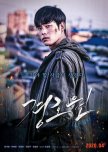
Han Soo Han rescues a kidnapped heiress about to take control of her deceased daddy’s company. The requisite evil employee with a manic laugh played by a bargain basement Jang Hyuk wannabe had her kidnapped to force her into signing over her shares of the company. HSH works for a loan shark often helping the people he shakes down for money, thus making him a good guy. He lets Choi Ye Jin stay at his place until it’s safe for her to return home. Before they can have any lingering sexy glances or heartfelt conversations, all sorts of people show up at his doorstep for nefarious reasons.
The plot sounded like an action romance and maybe it was supposed to be, but the acting wouldn’t lead you to believe it. There was no chemistry between the two actors. Kang Seok Chul’s expression stayed locked into place through the whole movie. Yoo Ye Bin was always staring off into space either thinking deep thoughts or wondering if she should try the new Thai restaurant down the street. The filmmakers saved money by not giving Choi Ye Jin any backstory or personality but splurged on blurry shaky flashbacks for HSH’s tragic man pain backstory. Han Soo Han decided to rescue her at one point, not because they shared “a moment”, unless that was what the one staring contest was about, more probable it was just because he was a good guy. Whatever the reason he wasn’t very effectual because she ended up kidnapped---again.
If the fights had been entertaining, I could have forgiven the bland acting and plots holes large enough for The White Truck of Doom to pass through but the fight choreography was also bland. Han Soo Han threw numerous haymakers which are a sure sign of someone who doesn’t know how to fight. Sure, if they connect they might hurt, but the experienced fighters he was up against should have pounded him into the ground by the time his fist arrived from Busan.
Unless you’ve never watched any sort of crime film or drama, there will be no surprises, not even one “shocking” betrayal and a “shocking” murder. The best thing about this film was the 80 minute running time which felt overly long near the end.
31 January 2024
Was this review helpful to you?
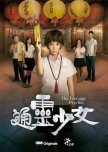
This review may contain spoilers
"If we could all be braver and accept what's different from us, the world would be a better place"
Teenage Psychic was a charming drama about Xiao Zhen, a sixteen-year-old medium who could communicate with the dead and worked in a temple. Due to her long nights performing her Holy Maiden duties she often ran late to school and fell asleep during class and in a coffin in between classes. Everything changed when Ah Le took her hand to help her as she climbed over the school wall to avoid the tardy monitors.Xiao Zhen’s father died when she was small and her mother works abroad. Her temple co-workers form an odd made family with her. Teacher Kim is her guardian and boss which can be awkward. Two comic relief helpers function as brothers or oddball cousins. Her relationship with Teacher Kim is complicated as he pushes Xiao Zhen to bring in customers and sell blessings to keep his struggling temple afloat. When Xiao Zhen meets Ah Le they form a connection that grows throughout the drama. Both are part of the drama club that is determining what sort of rendition they want to do of Romeo and Juliet. In each episode, Xiao Zhen helps to resolve conflicts both spiritual and earthly. Grief, bravery, lies for good and bad, reconciliation, gratitude for loved ones, and loss are all tackled. Xiao Zhen learns there is more to life than the dead as this teenager begins to engage in her own life and learn about love.
If Teenage Psychic had a drawback, it would be Guo Shu Yao’s acting. She often mumbled and pouted which could be distracting. Even more distracting was her disastrous haircut or wig. Maybe it was based on a manhwa, but for some reason they made her as unattractive as they possibly could. Her performances were stronger when she confidently performed her job communicating with the dead. Kent Tsai as Ah Le was a bottle of sunshine as he supported Xiao Zhen. The couple was cute together. The quirky drama club learned to put aside their fears of someone different and embrace Xiao Zhen as Ah Le had. Fear and intolerance of those who were different was addressed a couple of times for different characters. I wasn’t a huge fan of the play scenes, but that was a minor quibble.
Despite some of the acting issues, Teenage Psychic was mostly upbeat and entertaining as it focused on friendship, first love, and helping those in need—living or dead. Unfortunately, it took a turn that felt inorganic near the end, but still made it work. Through love Xiao Zhen discovered her smile and fought for balance in her life. This drama was flawed but I found it to be a relaxing watch.
25 January 2024
Was this review helpful to you?
This review may contain spoilers
"The fear of men makes them the perfect prey of the devil"
Water Monster was a taut 78-minute monster thriller with very little filler. No slapstick comedy, no overwhelming CGI, just a fishing village trying to find a way to survive a lethal water monster attack.Shui Sheng witnessed the Water Monkey killing his father a decade before. Now the creature is back and Uncle San, the village elder, declares they must once again sacrifice a virgin to save the village. After the death of her father and brother, Xiang Lan is willing to die, but her love interest, Shui, is not going to let that happen. He gathers a small force to face the village and the monster which at this time is difficult to differentiate between. Shui saves Xiang Lan. Then the heroes confront the Water Monkey and after a fierce, deadly battle cage it. Uncle San refuses to let them kill it thinking the creature to be a god. With that fateful mistake the village suffers even greater losses and must now confront not only the Water Monkey, but their fears and mistakes of the past.
Water Monster went where few guys in rubber suits movies dare to go. The body count of familiar characters was extremely high. Old beliefs were faced head on. Shui Sheng dared to call the village elder’s self-protective action as murder. Anytime someone in a movie says, “Please don’t blame us,” nothing good or righteous follows. Why is the guy who decrees someone must be sacrificed never volunteers himself? In a world where women are devalued, why not sacrifice a virgin male or the village chief as a more valuable “gift”? Chief Liu’s eyes were finally opened and he realized that “begging, sacrifice, and wishful thinking” only strengthened the monster and weakened them. It was time to unite and face death.
The atmosphere was perfectly dark and foreboding. The music and some of the lighting were reminiscent of Pirates of the Caribbean. Every time the familiar “bong pulse” rang out I wondered who had a piece of the Aztec gold. The monster costume looked like an updated version of the Creature from the Black Lagoon (1954), a movie that gave me nightmares when I watched it on the late, late-night show on tv at a childhood slumber party. The Water Monkey really would have given me nightmares as he was fast, extremely flexible and possibly a kung fu master. The fights were fierce, bloody, and deadly. An abundance of inventive weapons were created to stop the seemingly invincible foe.
The Water Monster kept the action coming at a thrilling pace. I was invested in several of the characters despite the limited amount of time devoted to them in this short movie. The village not only had to face the vicious monster, but also their fears and responsibility for their own safety. For what looked like a low budget horror movie, these still waters ran deep.
10/24/23
Was this review helpful to you?
This review may contain spoilers
My first thought when watching The Great Yokai War was that it was a Miyazaki Hayao animated film come to life. The film was filled with strange spirits call yokai who were being turned into steam punk monsters to aid the demon lord Kato in covering the world in darkness. When the fate of humanity is at stake, who can you rely on? Only a grade school boy with a fancy sword and a handful of colorful characters.Tadashi’s parents have divorced and he is living with his mother and grandfather in a rural area while his sister lives with the father in Tokyo. The other boys pick on Tadashi even after he is chosen as the Kirin Rider, the boy who will preserve world peace. What Tadashi doesn’t know is that the demon Kato and his dominatrix henchwoman Agi are rounding up yokai and turning them into destructive metallic monsters. Tadashi rescues a furry yokai and carries him everywhere as no one else can see it. The Goblin Mountain calls to him and he is tested by the yokai living there and deemed worthy. The Goblin gives him the sword of destiny before Agi and her metal minions carry the giant goblin way. Kato has created a giant frog airship to take to Tokyo. Some bystanders think Gamera has returned. Gamera was a turtle people, come on! Tadashi meets with other yokai and upon discovering Kato’s nefarious plan they travel to Tokyo to try and stop the handsome demon. A bean washing yokai joins them and is heavily foreshadowed as being key to thwarting Kato’s evil goal.
The film was extraordinarily creative. There were not just a dozen different yokai, but around 100 had some form of screen time. Tadashi’s team had a red spirit whose hair warned of danger, a turtle, and a water princess. They met a walking talking umbrella, a walking talking wall, a long-necked woman, and strange animal yokai to name a few. The Transformer elements were inventive if not unique, sadly the CGI was lacking.
The acting was about what you’d expect from this kind of movie. Some of it was quite over the top. Toyokawa Etshushi as Kato grounded the film and avoided chewing the scenery. A good thing as the yokai actors and the human artist didn’t leave much after they were done with it. The child actor did the best he could but his performance wasn’t compelling, one of the problems with putting the weight of the world on a pre-pubescent boy. Kamiki Ryunosuke has gone on to do numerous dramas and films. The music wasn’t memorable for the most part. The only funny element to me was the azuki bean song at a key moment. It was hilarious.
Kato’s revenge was based on humans ridding themselves of things that no longer serve them. Maybe it was a translation problem, but I found it confusing. “He is the resentment humanity has earned from those things you use no more and throw away.” With the example Tadashi was given about throwing away worn out shoes being bad, I wasn’t sure if Kato wanted people to be hoarders or run around naked. The yokai had good advice, especially from a country that has experienced many wars. “Those who discard their past have no future.” “Wars must not happen, they only make you hungry.”
If you want to show this film to younger children, it might be good to know that Agi and the Water Princess were sexualized. There were also dismemberments, blood, and what could be seen as scary monsters for young ones.
Director Miike went overboard to make an artistic fantasy world awaken. The biggest drawback for me was that the film took a long time to set up the story, too long. Forty-minutes passed by before the adventure began. Despite his innovate spirits, the theme was a familiar one. For once again, the only force in the universe that could protect humankind was a small boy. This time aided by a sword and a little red bean.
10/5/23
Was this review helpful to you?
This review may contain spoilers
More teeth but not more fun than the original
If you watched surprise hit, The Meg (2018), and go into The Meg 2 expecting Shakespeare, you get what you get. The first Meg film was so bad it was hilariously funny. The second film had better acting than the first and tried to have a stronger plot and slightly better science. Unfortunately, it made the cardinal sin of focusing too much on the humans and not enough on the monsters. Which was perplexing given there were more Megalodons and a dangerous menagerie of creatures from the mysterious depths of the ocean.Jason Statham returns as Jonas the Daredevil Diver who has turned into a fighter for eco-justice. Cai Shu Ya once again plays The Special Child, Mei Ying. This time Mei Ying is motherless and seems to be living at the Oceanic Institute either with Jonas or her uncle Jiu Ming. Jiu Ming (Wu Jing) is brilliant and reckless. He attempts to train a young Meg named Haiqi and is unafraid of being in the water with her. Cliff Curtis as Jonas' friend Mac and Page Kennedy as DJ (who can now swim and is no longer a terrible stereotype) are back as well. Along with new guy Jiu Ming, Melissanthi Mahut joins the good guys as Rigas, the fearless pilot.
This time instead of stumbling upon the Megs on their maiden voyage, the crew is studying the bottom of the Mariana Trench with better equipment and understanding of what lurks in the scientifically inexplicable dark…or so they believe. When they stumble upon a secret facility at the bottom of the ocean, they face betrayals and bad guys willing to do anything to protect their valuable secrets.
Statham made for a serviceable good guy who can face 90ft/27m ancient sharks without flinching and take down bad guys with his bare hands. Wu Jing was also shown as being super heroic and invincible. While I'm usually disappointed when an actor replaces an actress, Li Bing Bing struggled in her role as scientist and Mei Ying's mom in the first film. Wu Jing seemed to be enjoying his time running from prehistoric creatures and attacking a giant octopus. Curtis and Kennedy had more to do in this film instead of standing around wringing their hands. Mei Ying as the adventurous fourteen-year-old and Rigas as the tough talking pilot at least made viable female characters. The Big Bad and her minions were all but cartoon characters.
Once the critters in the water and on land showed up the movie became more interesting. Guys with guns, and not done well, really weren't. Were the confrontations between man and giant fish/octopus/freaky amphibians realistic? No. Were they fun? Most of the time, yes. There were a couple of very funny moments. The underwater scenes that should have been frightening and claustrophobic, weren't done particularly well. It was hard to care about the people who died because we didn't know them and didn't provide the jump factor either. My biggest complaint with the Megalodons was that they didn't show the size perspective very well. But there were plenty of fins and teeth. The monsters always appeared on the surface where there were revelers in the water to give the ginormous sharks and creatures plenty of people to choose from and the heroes lots of innocents to save. For those who are very squeamish the chomping wasn't too blood thirsty with a PG-13 rating.
It's hard to not compare the two movies. The Meg 2 had better acting and in some ways a better script than the original because while it also used stereotypes at least they weren't racist and sexist stereotypes. The drawback was that it took nearly a third of the movie to pick up traction. Jonas' fight with polluters in the opening scene had nothing to do with the rest of the movie except to give him a reason to pummel people. No one wants to watch someone talking on a microphone at the beginning of a giant shark movie either. Bring on the talent! For the genre, TM2 wasn't bad, if you watched Big Octopus you'll know what I'm talking about. Those who enjoyed The Meg may enjoy this one as well. If your tolerance for clichés, stilted dialogue, and people being chomped on by creatures is low, better to avoid this one. The Meg 2 may not have been an ex-squid-it Shakespeare Underwater, yet for a ridiculous movie about Megalodons, it wasn't carp either.
10/1/23
Was this review helpful to you?
This review may contain spoilers
A dream is a wish your heart makes...
Rainless Love in a Godless Land was an ambitious Taiwanese drama that wove together romance, Amis myths, and mind-bending thoughts on truth and reality, memory and emotion. On top of all that the drama brought home humans' responsibility for the blessings of the Earth and our place in stewardship of the environment.*No big spoilers*
"The end of the world is silent. It creeps up on you, you just don't notice."
Orad, the messenger of the chief god Kakarayan, is also the god of rain. He is helping to gather the Kawas, basically spirits of blessings, to send them back to the spiritual realm. Kakarayan is withdrawing his blessing from the planet which will result in a rainless Armageddon. Tien Ti, a local tour guide, crosses paths with Orad and for what turns out to not be the first time. Her fate and the beginning of the world's end are tied together. When Orad chooses free will over predestination it throws the Bureau of Corrections into crisis management mode.
"Behind every lie is a wish waiting to come true."
I will admit to liking the story more than the characters at times. Although there were a few heartfelt moments, much of the more meaningful romance was shown through flashbacks. A couple of the kisses were the guppy kind with eyes open and lips barely touching which felt awkward given Tien Ti's age and romantic history. Because she wasn't invested in the romance I found it hard to invest in it. Tien Ti often treated Orad hostilely, as more of a servant to do her bidding than a possible love interest. Orad kept his emotions close to his vest until he was truly faced with making every day choices that flustered him. Tien Ti would rail against being treated as special and then turn around and ask for special favors. When she was given a taste of power, she found it to be a more complicated thing than she first realized.
"What you see is the deity's will and what god sees as the truth."
Toam, goddess of the cloud, was one of the more complex characters and Alice Ko was magnificent as the morally ambiguous spirit. I found her far more compelling than Tien Ti and a more stylish dresser, too. Fali, head of the Bureau of Corrections, was another character who waffled between good and selfish. A lonely child who had been alone too long, he set into motion many of the characters' actions. Pu Hui was a fun sidekick for Orad though he was a terrible husband.
"When a lie is exposed, what happens to the lie?"
Orad and the Kawas Yaka found out that free will and making your own choices can lead you where you might or might not want to end up. There is a price to pay for freedom. Tien Ti struggled to have free will and make her own choices to alter her fate and the fate of the world. Other times, she was willing to give in to predestination. The drama also showed how emotions and memories are tied together.
"What I wish to see will become what you shall see."
I loved the OST for this drama. I thought the music fit the variety of moods perfectly and truly enjoyed the songs and background music. The drawback for me other than the subdued romance, were the travel office scenes. I didn't mind them at first when they were world building, but as the apocalypse was beginning it seemed surreal to think people were going to want to travel as the water began to dry up and pestilence hit. The use of flashbacks felt repetitive and overused at times. Tien Ti's mood swings could be exhausting as well.
"You are a wish I prayed for"
What is the difference between a lie and a wish? A lie has no future, but a wish might. What is real and what is a dream? Even scientists say it's possible our reality may be an illusion so is it really a lie if we perceive it to be real? Or is it simply a wish manifested? Rainless Love in a Godless Land twisted and turned through myth and perceived reality. I bought into the wish and the lie, hoping that both had happy endings.
9/4/23
Was this review helpful to you?
This review may contain spoilers
50 First Dates without the comedy
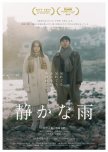
Silent Rain was like 50 First Dates but without the comedy. Yukisuke and Koyomi found each other and then found themselves in a life neither could have ever imagined. The film showed the everyday moments that build a relationship, it also showed how lack of communication and not taking pre-emptive action could cause emotional hardships.Yukisuke visits Koyomi's taiyaki stall each day as much to catch a glimpse of her as to enjoy the tasty treat. When Yukisuke helps her deal with a drunk customer a barrier is broken and the two gradually become closer. Fate is not that kind in a Japanese romance and after spending a strange evening together stalking a customer, Koyomi is injured on the way home. After two weeks in a coma, she awakens with all of her long-term memories intact though her short-term memory is damaged. Each day the previous day is wiped clean from her memory. Apparently having no family and friends to help her, the mother visits while she is in a coma and leaves, Yukisuke invites Koyomi to live with him. Every morning they share the same routine. "Is this your home?...It stopped raining." "It's a long story, but can you listen?"
Koyomi doesn't seem to be too rattled by the news upon waking and carries on as usual. She goes back to working in the stall and the two become closer. But as the days continue on and she has no memory of what they did or shared together the day before, it begins to wear on Yukisuke.
I enjoyed the slice of life element to this film and the slow buildup of the relationship. However, it could be frustrating watching two people with inadequate communication skills try to handle this new development in Koyomi's life. Both were emotionally closed off with others. Yukisuke refused to acknowledge to co-workers that he had a girlfriend much less share her short-term memory issues. Koyomi lived a solitary life as well.
Along with their social ineptness, they never brainstormed to see what they could do to ease Koyomi into the day and give her access to what happened the previous day since her brain could no longer grant her that information. Why was there no therapy to help her adapt to her new situation? Why didn't they use journals or her phone or computer to record what she needed to know to ease her into the new world each day? She'd made a few sticky notes but didn't seem to read them and some were in ridiculously obscure hiding places. Neither knew anything about the other, but at least they could have worked toward written shared memories. This lack of communication and understanding left the characters feeling flat.
Silent Rain was a languid walk through the daily lives of two awkward, kind people dealt a life altering blow. As often happens, it was the mundane daily events and interactions that slowly drew them together. Their behavior could be perplexing after Koyomi's accident, as they never felt pressured to find answers or change their lives in any meaningful way even when it could have made things easier for both of them. Perhaps neither was ready to come to terms with their new reality. It would take a series of cathartic events for these two loveable and socially inept people to find their way out of the rain.
8/31/23
Was this review helpful to you?
KBS Drama Special 2013: The Devil Rider
5 people found this review helpful
This review may contain spoilers
Don't forget to tip your rider!
The Devil Rider packed a big emotional punch into a short amount of time. Instead of single-mindedly focusing on the royal court and their politics, this drama special focused more on The Devil Rider and the people hurt and forgotten by an overly entitled elite.In 1637 Choi Munbok was assigned the task of delivering a message to a Joseon general during the conflict with the Qing dynasty. Serving his country meant leaving his wife who was in labor. He rode his horse through a harrowing hail of arrows during multiple ambushes, suffered an injury that would be lifelong, all to deliver a message that ended up being meaningless. Fourteen years later he became unwillingly embroiled in palace politics which put his daughter's life at risk. He would once again be asked to become The Devil Rider.
Yoo Oh Sung gave a wonderfully emotional performance as the imperfect Choi Munbok, portraying a broken man who often let his daughter down yet was also fiercely protective. He showed a man dragged down by guilt and a loyalty he could not forsake. All of the supporting cast were strong. Lee Chae Young gave an excellent performance as the daughter of the betrayed general looking for vengeance.
The Devil Rider could be frustrating and heartbreaking telling the story of people who were used and discarded by the imperial court. "Rags like us never had names to begin with." Still, Munbok was able to free himself from his past and grasp what was important to him with a lighter heart in the present which is all most people can hope to do even today.
8/8/23
Was this review helpful to you?
This review may contain spoilers
Lots of noise, little substance
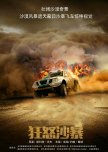
Hidden Strike starring Jackie Chan and John Cena finished filming in 2018 and finally made it to Netflix five years later. The film felt like it could have been on-hold since 2000 with its over-reliance on CGI, gravity defying stunts, and sexist humor.Dragon Luo and his security team are called to Iraq to help evacuate Chinese workers from their refinery who have been attacked by mercenaries. They load up special buses to transport the workers and their families to the Green Zone. On one of the buses is Luo's estranged daughter Mei. Chris Van Horne who used to work in private security, now resides in a village in Iraq and helps out with the local orphans. His brother Henry talks him into attacking the convoy with the story that it contains the rebel criminals responsible for their father's death. It doesn't take long for Luo and Chris to meet up, compare notes, and join forces to stop the bad guys and save the hostages.
I watch a lot of martial arts and action movies, and can appreciate a check your brain at the door movie, but was disappointed in the fight choreography for this film. Jackie's character relied on kung fu as was to be expected for many of his fights while Cena appeared super human with his strength. At the age of 69 Chan still moved pretty well. Many of the fights, especially with Cena, came across as completely unbelievable due to wire work and CGI. Jackie had one silly fight in fire suppressant that was entertaining but went on for too long. Several of the fights using both weapons and fists and kicks seemed uninspired. If you approach it as a comedy or even a cartoon with a high body count, there were humorous moments. A couple of scenes with a jet engine and one involving a cliff almost strayed into Wiley Coyote territory.
The problem with some of the comedy was that it relied heavily on hand signal jokes and flat tire jokes. Oh, and women don't know how to drive humor. The hand signal schtick was confusing because Chris' dad died due to a miscommunication, which was supposed to be the source of his man pain. The producers must have felt an action and comedy movie wasn't enough, because they threw in an ill-conceived romance. They didn't have time to effectively build the buddy/bromance aspect of the film, but still tried to wedge a possible "romance" which fell flat largely due to crude comments by Chris. Even the relationship between the two brothers was insufficiently developed, which lowered the emotional stakes when tragedy hit. It might have been a mindless action film, but buddy and romance chemistry is even more important in such cases. And while Chris' love for the villagers was supposed to show what a great guy he was, it felt a little condescending. Somehow the Iraqis were only colorful extras in the background instead of having any involvement in the goings on in their own country.
If you are a Jackie Chan and/or John Cena fan, need a movie with lots of explosions, gun fire, quippy comments, CGI, and wire-work, this may be one you need to check out. If you're hoping for something more than a few entertaining moments, best to lower your expectations or see what else is on Netflix. This was a strike out for me.
7/28/23
Was this review helpful to you?
This review may contain spoilers
What price honor and glory?
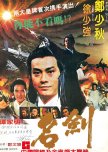
The Sword asks the question, "what price honor and glory?" It's something I always wonder when I watch these films where swordsmen try to move up the pecking order by defeating someone ranked higher than themselves and toss the word honor around while doing it. "Excuse me, I know we don't have any disagreements, but would you mind terribly battling me to the death to see which of us is the superior swordsman?" This procedure never seemed very polite, much less honorable. In this film, Adam Cheng was forced to weigh the costs of spending years hunting for a legendary swordsman simply to test his skills.Adam Cheng as Li Mak Yin befriends Ying Chih, a young swordswoman being hunted by a kidnapper, on the road to finding Hua/Wah, the legendary swordsman who has gone into hiding. Along the way he runs into his old flame who grew tired of waiting while he was on his quest and married Lin Wan (Norman Chu). Lin Wan turns out to be a vicious brute who wants Hua's sword Hon Sing. When Ying Chih is finally kidnapped Li goes to help her and is gifted the cursed sword Chi Mud to aid him by a woman who saved his life after a fierce battle with Lin's henchman. Turns out Ying Chih is Hua's daughter. In a very awkward moment after returning the man's daughter, Li asks if they could duel. After that interlude, the bodies start stacking up.
For a 1980 martial arts film, The Sword was slow, melancholic, and artfully done. Director Patrick Tam used beautiful framing and compositions combined with dramatic lighting. 1980's synth music was utilized for the soundtrack which actually worked quite well for setting the mood. The film asked how it felt to get what you wanted. Were the costs in innocent lives worth a lifetime of trying to beat and be the best? For the lone swordsman was the emptiness and loneliness of the lifestyle a satisfying tradeoff to feed one's pride and ambition?
The stunt work and fight choreography were acrobatic and quick. Despite being a more thoughtful movie, it did have gruesome ends to some of the fights. There were not only the traditional impalements, but one person decapitated himself and another was split in half. Chi Mud, much like The Ring of Power, was infused with hate and malice, and considered an evil sword. And just like the ring, it orchestrated the deadly destiny of several lives.
Adam Cheng played the conflicted and ambitious swordsman well. As Li weighed some of his exploitive actions, his life goals began to change. Norman Chu can be counted on to give depth to a villainous character and he did. Tien Feng, often cast as a baddie, was sympathetic as the aging considerate swordsman who cared for those around him. Jade Hsu found just the right balance as the firebrand daughter. She was forced to act idiotic for a scene but the writers finally put Ying Chih back on the right path. Eddy Ko, in a mostly silent role, made for a frightening henchman. Overall, the acting was quite good, especially for the genre.
The Sword was an excellent martial arts film for 1980 in comparison to so many others made during this time. The scenery, settings, and costumes were of a higher quality than most. For those looking for non-stop action, this might be a disappointment because it takes its time developing Li's character arc and the stakes being played for. The movie ends on a mournful note as Li moves beyond what he has been taught about honor and begins to understand that the real world has real consequences for his prideful actions. I would definitely recommend this film for fans of the genre. As always, I rate pre-1990 niche dramas on a curve.
6/27/23
*Many sites use a copy and pasted synopsis that says a swordsman and a samurai team up to find a blade. There is no samurai in this film, my guess is that it's either for a different movie or someone wrote a synopsis who had never seen this film.
Was this review helpful to you?
This review may contain spoilers
"What does family taste like?"
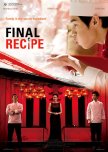
Final Recipe was like a serving of Grandma's favorite dish. There was nothing unexpected, it was cozy, familiar, and comforting. No matter who in the family makes her recipe, it brings back memories and binds people through those flavors and stories.Final Recipe was a South Korean production with a multi-cultural cast, set in both Singapore and Shanghai. Henry Lau (Canadian fluent in Mandarin and Korean) as Mark, is a high school student in Singapore who dreams of becoming a chef. His grandfather, Chang Tseng (born in China, emigrated to Canada in 1994) refuses to let him enter the family restaurant business insisting that he go to college and become an engineer. Lori Tan Chinn (American) as Mrs. Wang plays referee between the two. When it's clear the restaurant will have to close, Mark decides to secretly take part in a famous cooking contest in Shanghai called Final Recipe to help his grandfather. Run by Michelle Yeoh's Julia (Malaysian) and her husband Master Chef David Chan (Ng Han Chin-Singapore), the contest is open to people from around the world. With the film's emphasis on family, it's no surprise that family secrets will bubble to the surface of this multi-generational stew.
Henry Lau was effervescent as Mark and a real bright spot in the movie as he dealt with his beloved grandfather and also when he sought unusual paths to making recipes work. Michelle Yeoh ended up being the bridge between generations, correcting mistakes made in the past. Mrs. Wang saw beyond the moment and dealt with the little family with humor and wisdom. Chin Han was more of the straight man in his role as the master chef as was Chang Tseng's stubborn grandfather. Both characters would have to deal with their decisions from the past. The team Mark worked with during the contest brought some nice conflict and comedy among the comrades in flames.
The story in this film was not particularly unique and had huge plot holes. What it did have was heart and warmth that poured out in every scene. The film showed how food and heritage can bind people even when distance has kept them apart. It also showed how families can become locked into rigid cycles. A parent wanting a child to follow in their footsteps or not wanting that for the younger generation, desperately desiring something better for them. Ultimately, the older generation had to realize that the children and grandchildren must choose their own paths which may take them on the road to be more successful or cause them to make mistakes as well. Though their paths may diverge, food and family are still intricately bound together.
Final Recipe's recipes were a true joy to visually experience. The delectable dishes bordered on food porn at times and were treats for the eyes. This is not a film to watch on an empty stomach, be sure to have a snack nearby.
I wish the story had been stronger, yet even with the plot flaws, the characters caused me to flow right along with them on their improbable journey. The healing and reconciliations while over-simplified still brought a smile to this viewer. In the end, Final Recipe was a charming and heartwarming film about family and the food that ties them together that left me gently satisfied.
4/19/23
Was this review helpful to you?
This review may contain spoilers
"People today have forgotten that they are really just part of nature."
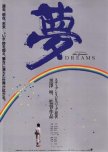
Over eight vignettes from Kurosawa's Dreams, you'll float through surreal settings with dolls come to life, tremble from the hellish landscape of a post-apocalyptic war and sit by a soothing river where life flows by, the past, present and future. Many of Kurosawa Akira's familiar themes run through the stories and some you may find more meaningful or interesting than others. If you've ever wanted to wander through a Van Gogh painting this is the film to do it with.Kurosawa begins the film with a wedding with possibly tragic consequences and ends the film with a joyful funeral. The old film master certainly likes to shake things up when he bookends stories. The first two dreams are when the central character standing in for Kurosawa, I, is a child. In "Sunshine Through the Rain", young I disobeys his mother and runs off to watch a Fox wedding procession leading to one of the most beautiful and disturbing scenes in the film. "Peach Orchard" has little I confronting the spirits of the peach trees his family had cut down. The spirits have taken the form of his sister's dolls and have mercy on the young boy due to his love of the lost blossoming trees. The spirits cause the trees to bloom momentarily in a most creative manner.
The next dreams feature an adult I. In "The Blizzard", four explorers are caught in a deadly snow storm. One by one, they succumb to the cold and fall asleep even as I encourages them onward. A mountain spirit attempts to lure I to sleep and he must resist or they will all die. "The Tunnel" sees I returning from WWII and walking through a long rural tunnel. He's confronted by a bloody grenade carrying anti-tank dog, then a private who had died in his arms. Finally, his whole ghost platoon confronts him. He must deal with his guilt and grief of being the only survivor as he faces his men.
In "Crows", I is an artist who travels through Van Gogh's paintings and meets the great artist. What he finds is a man driven to madness by his need to work and create the perfect paintings in his mind on the canvas. Perhaps the story is a reflection of Kurosawa and his own relentless drive to work. He too, had contemplated suicide, but went on to survive and continue his artistry.
The next two dreams are dark and as subtle as the old man in his I Fear to Live. In "Mt. Fuji in Red" Japan is ruined by the explosion of a nuclear reactor which covers the island in radioactive clouds. I and the people he is with have no place to run and one decision to make. Do they choose to die quickly or slowly? "The Weeping Demon" has I traipsing through a barren wasteland burned away by a nuclear war. The only life are giant dandelions and avaricious survivors with horns forced to devour one another to survive.
In the last dream, I crosses a narrow wooden bridge over a pristine river with waterwheels flanking both banks in "Village of the Water Mills". He comes across an old man fixing one of the wheels and discovers they use no electricity and have no need for scientific inventions. Most of the villagers live until they are very old due to their simple healthy way of life. The old man leaves I to join a rousing processional for a villager who has died, a celebration of the fulfilled life she had led. Kurosawa took us from cynicism.
Kurosawa's signature fog and wind showed up in most dreams, from the gentle rain misting in the sunshine, to the blinding blizzard on the mountain, to the colorful radioactive winds after the explosion with Mt. Fuji ablaze in orange and red. Many scenes were either brilliantly swathed in colorful flowers or menacingly gray and windy, never letting you find a comfortable place to rest.
The music and sounds further brought the scenes to life. The heavy breathing of the explorers in the howling wind, fighting for each step in the waist deep snow portrayed their desperate situation and resolve to live. Something as benign as footsteps became utterly haunting as the officer stood at the tunnel hearing the footsteps of his platoon coming toward him echoing louder and louder and later growing fainter and fainter. Several vignettes used stylized music and dancing, makeup, and costumes, reaching back into the past for inspiration.
Kurosawa covered an emotional diversity during his wedding, 2 apocalypses, and a funeral--- forgiveness, survivor's guilt, human resilience, and love for nature, as well as human greed and hubris. As he often did, he showed how the powerful materialistic upper tier with their out of control technology and self-absorption might destroy everything and everyone. Because of the captains of industry and their willful destruction of the environment they would be given a special hell to live in. Those who made friends with nature could live peacefully and well. If we take care of the environment, it will take care of us.
While I loved the sentiment of the final vignette, humankind will need to evolve much higher to do away with hate, envy, and the need for power. Inventions themselves are not always a bad thing, they can be very useful. As quickly as technology develops though so does our need for greater wisdom and love. Simply abandoning technology will not be enough.
Dreams took us on a trip through the river of time into the past, alternate planes of existence, and to possible futures. Whether this film comes across as a self-indulgent exercise by the director or a fascinating look into the beliefs about humankind and art by one of the 20th century's finest directors will be up to the individual. Even though he could be heavy handed at times or completely enigmatic I found the dreams thought provoking, creative, and a delight for the eyes.
2/17/23
Was this review helpful to you?

This review may contain spoilers
Bride for Rent drags out a number of tropes and scatters them about the drama. If you don’t look too deeply it’s a sweet romcom. Dig a little deeper and it unearths one of the more dangerous romantic tropes. Rocco is turning 25 and under the impression he will receive his trust from his grandmother. He’s a jerk to the women he dates and dictatorial to his buddies whom he has gone into business with. Grandma has been watching and throws a marriage clause into the trust. Regardless of the money he will come into none of his ex-girlfriends will marry him because of the way he had treated them. Along comes impoverished actress Rocky and he hires her to pretend to be married to him.
There’s a reason Rocky doesn’t make much money acting, she’s simply not very good. I’m not sure if that was in the script or a flaw on the real actress’ part. Grandma insists on a church wedding and Rocky balks. Grandma takes her aside and tells her it will be a fake church wedding but she needs Rocco to grow up and learn to love and trust again and be kind again and Rocky is just the person to teach him. At this point the forced cohabitation high jinks begin.
I was able to play along with the jerky playboy wanting to put one over on grandma so that he’d get his money. I had a harder time with the concept of a man being completely changed by a woman. Too many women believe that tired trope and have butted their bloody head against a wall trying to make an unkind man kind.
Most of the cast were capable enough actors with the exception of the female lead. When she was calm she was a pleasure to watch. Too often she came across like she’d had too much coffee with too much sugar and artificial colors.
As long as you don’t fall like Rocky did for the “you can fix a jerky playboy” trope and can look over her overly enthusiastic performance it’s almost watchable. Even the actor who played Rocco looked liked he would rather be somewhere else on several occasions.
12/8/22
Was this review helpful to you?


