K-Drama


This review may contain spoilers
Solid drama!
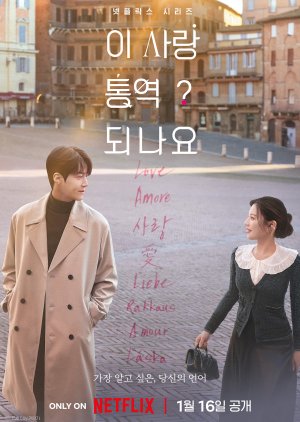
I'm a big fan of Kim Seon-ho & I think Go Young is really coming into her own as an actor. They both did a great job! I genuinely enjoyed watching this. The first 5 episodes were especially great! They had great chemistry and synergy and I really enjoyed the comedic timing. I also really liked the 2nd couple. Their story was really fun. Overall I'd say the casting was done well and you could feel the chemistry onscreen. I'm happy they didn't overdo the cringe and didn't make everyone date each other lol.The on & off with their communication was frustrating at times but I didn't dwell on it too much because the drama is literally called can this love be translated? And it's apparent from the beginning that their different communication styles would clash, so the slow burn absolutely makes sense! Now, the Do-rami arc was interesting at first but I didn't expect it to become so heavy handed for a romcom genre. I did however enjoy the funny brought out as a result of Do-rami. Revealing Mu-hee's parents were alive in the last 30 minutes was unexpected and poorly timed imo and we didn't see anything about how that actually went when Mu-hee left. I wish they'd showed us more stability in the last episode but at least we got a happy ending.
I think it's a solid drama that was well paced, lived up to the title and the dialogues were interesting so I'd definitely rewatch it and I will. Don't be dissuaded by reactive comments and reviews. It's a really good show!!
Was this review helpful to you?

This review may contain spoilers
This Must Be the Place (To Translate Love)
The premise of Can This Love Be Translated? is undoubtedly appealing.A drama that plays on linguistic differences, manages to weave Italian into its narrative structure and moves between fascinating international settings such as Canada, Italy, Japan and Korea, it seems to have all the right ingredients to surprise. However, once the initial impact has worn off, the series reveals its limitations: a rather thin narrative, which develops according to familiar patterns and struggles to stand out and really explore the subject matter, getting lost in smoke and mirrors and convoluted musings. Everything remains superficial, proceeding by accumulation and ending in a rambling and inconclusive manner.
And that's a shame, because the set of themes deserved a much more elaborate narrative; telling the story of love, identity and trauma through the filter of linguistic and cultural translation, especially in a meta-cinematic context – albeit reduced to a horrifying case of “dating show” around the world – would in itself be an excellent starting point:
Love, like language, is an imperfect system: Something is always lost in the transition from one heart to another. It is constantly filtered: By the right words, by messages, by unspoken words that must be rephrased so as not to hurt, so as not to lose the other person. The act of translation is not only linguistic, but emotional. The characters try to make themselves “readable”...
It almost seems like a “tragedy of miscommunication”: even though they speak the same language, Ju Ho Jin and Cha Mu Hui do not understand each other, and translators are not needed when the problem is not language, but meaning.
In this game of “emotional translations”, Can This Love Be Translated? introduces an element that is seemingly unrelated and unconventional, but in reality powerful, at least in principle: Do Ra Mi. A character who -initially- functions as the protagonist's alter ego — her lighter, more ironic version, the one who says what she cannot say — but who ultimately reveals herself to be something more trivially introjected.
Not an autonomous presence, but a functional projection that openly “betrays” the narrative construction; initially, the main character’s trauma is introduced with considerable weight (coma, loss of control, scarred childhood) but then it conforms, it is handled as a narrative mechanism, not as a transformative experience; Do Ra-mi - in principle - would be a “valve” that allows the protagonist to say what she does not dare to say, to act on what she cannot process, until the final “explanation” which, unreasonably, overturns everything, bringing it back to a cliché tiredly exploited in the Dramaverse, especially in the golden age; the internalised maternal voice, the one that teaches how to make oneself acceptable, how to survive emotionally, how to love “well”.
However, even this surprise is handled more as a narrative clarification than as a real emotional earthquake; even after the revelation, the conflict does not really intensify. The internalised mother does not suffocate, dominate or ever threaten to take definitive control. She is a tamed ghost, more explanatory than destabilising. In this way, the childhood trauma – which is evoked with great emphasis – never becomes a force capable of irreversibly redefining the protagonist's present. Everything is accepted and overcome with lightness...
Furthermore, from a cinematic point of view, the choice of an “off-screen” solution (... “I'll meet her in Koreatown” ...) to resolve what is, to all intents and purposes, the narrative core of the drama, is absolutely unacceptable and unforgivable!
Unforgivable, like the representation of Italy, once again reduced to a stereotype, to an imaginary concept rather than the real country; For decades, the narrative of the Belpaese, mainly due to Hollywood, has portrayed Italy as a narrative postcard, an open-air museum with its slow pace, almost invisible work, as if we were a nation of slackers, permanent conviviality, and the absurd rituals of coffee, wine and weddings (the whole part about the protagonist's mother's wedding is an anthology of the ridiculous...); and here there is also a touch of irony, where a drama entitled “Can This Love Be Translated?” ends up not really “translating” Italy, but adapting it to a convenient, already familiar language.
A compendium of the most hackneyed narrative clichés of K-drama, ‘CTLBT’ plays on the tried and tested, offering an accessible, elegant and emotionally safe narrative in which it seems that the choice has been made not to make the characters pay a real emotional price. No truly irreversible choices, no net losses. And without loss, the conclusion struggles to feel necessary in a drama that promises complexity but chooses consolation, leaving two doubts that are at least concrete;
The Netflix model focuses on building media hype to capture the “present”, with a young, beautiful, "Instagrammable" lead actress, a beloved actor who never divides opinion – their excellent performances practically single-handedly “save” the drama – and a “clean”, explained, resolved trauma; all set in a beautiful scenario that leads one to think that the whole thing is the result of a major global marketing operation.
"Can This Love Be Translated" is not a creative failure—the series is saved by its craftsmanship and adequate cast—but rather a deliberate choice of narrative safety in a context of global aesthetic ambition. Perhaps for younger generations – or for those who have no memory of the great dramas of the early 2000s or the more radical titles of the 2010s – this series seems mature because it deals with trauma, identity and social issues. But talking about them is not the same as experiencing them, it is simply finding oneself in a comfort zone that works very well at the moment, generates discussion, etc., but which, perhaps in a few years' time, will be remembered as one of those “nice Netflix dramas”.
6 ½
Was this review helpful to you?
A puzzle
I must confess, the story is a bit of a puzzle—rather disjointed and wandering, as is often the whim of the Hong Sisters. I fear the fault lies in the introductions; we were promised one sort of acquaintance, only to find the show had a different character entirely. It left many of us in quite a whirl!An unexpected story is no crime, but this one does feel a trifle scattered. However, what the narrative lacks in order, the production gains in splendid scenery. The cinematography is truly elegant, and Kim Seon Ho possesses such a natural charm that he could likely persuade any audience to follow him anywhere. Paired with a lead actress of such remarkable beauty, the screen is never dull to look upon.
It is clearly a "big budget" affair, and those who prize high quality and visual luster will find much to enjoy. For my part, however, the overall substance was not quite as captivating as the finery surrounding it.
Was this review helpful to you?

This review may contain spoilers
Translated Well, Written Thin
“Can This Love Be Translated?” is a mixed bag for me. Some things worked, some things left me with question marks about the intent behind them. I kept oscillating between ( ˶ˆᗜˆ˵ ) and ( ꩜ ᯅ ꩜;) ??Overall though, I had a good time.
Story
It’s not a deep story. A struggling actress (FL) meets a polyglot (ML) abroad, gets smitten, and they part ways. An accident boosts her popularity, she signs up for a travel diary show with a foreign rising star (SML), lo and behold - the ML is hired as their translator. He is emotionally closed off, she is very openly interested, and after a lot of push and pull (plus some unnecessary secrets), they end up together.
Is there much substance? No.
Is it particularly engaging on its own? Heck, no.
Characters
Cha Mu-hee and Joo Ho-jin carry the drama. She’s insecure and prone to self-flagellation; he’s hyper-rational to the point of rudeness. She is smitten with him; he is not interested at all. This reversed dynamic is refreshing and a welcome change from the usual ML-chasing-FL trope. Both make assumptions, stick to them, and unintentionally fuel the conflict. Their flaws actually work for the story.
Hiro, unfortunately, is pure wasted potential. What could have been a genuinely compelling character is reduced to a forced love triangle that doesn’t even form a proper triangle. The third line barely exists. Everyone else, also unfortunately, feels undercooked. The secondary romance adds nothing, The emotional weight rests almost entirely on the leads, and the drama wobbles because of it.
Strengths
The biggest strength is the lack of tropiness. Refreshing, honestly. The cinematography and production are lovely, and the dialogue lands well even in translation.
Performances are solid. Go Youn-jung shines as Mu-hee, making her relentless pursuit endearing rather than creepy. Kim Seon-han’s Ho-jin is sharp and practical, and their contrasting personalities create charming chemistry (though Mu-hee carries most of it).
Weaknesses
Unnecessary plot points. Since there isn’t much story to begin with, the drama pads itself with twists and secrets to stretch across 12 episodes. The final twist is especially underwhelming. Ho-jin’s mother’s track isn’t irritating, but it begs the question: what does it actually achieve? And Ho-jin and Ji-seon’s confrontation toward the end…what was the point, other than ticking a romance drama checklist box? Eh.
Also, certain repetitiveness. It’s like they all have short term memory losses. The push and pull between the OTP as well as with Hiro, is the same rinse and repeat over and over again.
Overall
This drama wants to be thoughtful but settles for pleasant. It’s uneven, padded, and carried almost entirely by its leads. But as a laid back, low stakes watch for a lazy Sunday afternoon, it does the job.
Was this review helpful to you?
Very entertaining romance but the story did not translate well
The only reason you should watch, is that the cast and acting is so well done, it's entertaining. Especially the acting of Go Youn-Jung is phenomenal. Hence 10/10 for acting and casting. Music is good but could have been better, so 9/10 for music. The problem is the story, the story is at best average, and feels a bit stretched, so 6/10 for story. As the story itself is not that interesting, I would hardly watch the series again, but it is still entertaining, so again 6/10. Overall 8/10, just because I enjoyed the series, thanks to a great cast and strong acting.Was this review helpful to you?
This review may contain spoilers
KSH worst show in recent times - an absolute let down.
As a true Kim Seonho, it breaks my heart to say how terrible this show was. K-dramas have become frustrating lately, instead of exploring complex emotions or giving characters meaningful depth, they just throw in DID as a plot device. I get that these are common tropes, but this felt like a complete waste of an otherwise talented cast.I can’t believe I spent all of 2025 looking forward to this show, only to be completely let down by the plot, and, I can’t believe I’m saying this, an incredibly frustrating character for KSH.
Was this review helpful to you?

A Polished Romance Driven by Emotion and Atmosphere
Great chemistry between the leads and a strong cast overall. The story focuses heavily on romance, with a plot that mainly serves to accompany the emotional journey of the characters. Beautiful scenery and a very high production quality give it a polished Netflix-drama feel. The romantic elements were especially satisfying, and the overall tone is quite rewarding.One minor downside is that the professional setting the characters are involved in can feel a bit frustrating at times and may initially give a slightly misleading impression about the direction of the story. There are also moments where character decisions and actions can seem confusing, especially as emotions develop, though this is eventually handled in a coherent way.
The ending feels somewhat rushed, and a few background aspects - particularly regarding personal circumstances and future challenges - could have been explored more deeply.
9/10
Was this review helpful to you?
I loved it!!!
I loved this series! I actually never really knew where it was going. I loved the acting! I loved the pairing of couples. I loved the scenery and the cinematography! the scenes shot in Canada and Italy were absolutely breathtaking. as were the scenes shot in Japan and Korea. The whole thing was well done and kept my interest throughout. I would rewatch this. I especially loved the chemistry between the FL and ML! And between the FL and her acting partner in thereality program within the show! Overall great!
Was this review helpful to you?

This review may contain spoilers
Personally, I really liked this drama. I watched each episode with pleasure and genuine curiosity. I think the whole story was carried out smoothly. The visual aspect deserves special recognition — it did not disappoint. There were many beautiful frames and shots connected to the places they traveled to. I also liked how the series portrayed the pressure that comes with popularity and how suddenly gaining fame can affect a person.I also really enjoyed the relationship of the first main couple — Cha Mu Hui and Ju Ho Jin. On the surface, they seemed like complete opposites to me, but together they began to complement each other. It was wonderful to watch how much of a support Ju Ho Jin was for her, even though she wasn’t always aware of it. Overall, their relationship developed quite slowly and was interwoven with many dramas that could have been avoided through communication, but in essence, that’s what this series was about — trying to understand the language of love. Over time, we could see that they truly learned it and started talking to each other instead of running away.
It’s also worth pausing on her relationship with Hiro. In my opinion, it was also very pleasant to watch. I watched most of their travel scenes with a smile on my face. Even though she never had any romantic feelings for him, and I personally rooted for her to be with Ju Ho Jin, Hiro’s feelings were not irritating, and his support and devotion to Cha Mu Hui were wonderful as well. The fact that he learned Korean for her stole a piece of my heart, and he himself was a character I wished happiness for with someone else. Even though we didn’t get to see that, I’m glad the story showed that he began to fulfill himself as an actor in what he had always wanted to do.
Now it’s worth moving on to the character of Do Ra Mi. Personally, I found this storyline intriguing and, in general, I liked it for most of the series. Her character added a lot of color with her edge and intensity. That said, mental illnesses were heavily simplified here, which may not appeal to everyone. They were largely “cured” through love, which doesn’t necessarily reflect reality. Personally, this didn’t bother me, but I think it’s worth pointing out — in my opinion, it would have been even better if we had been shown how the character, thanks to him, begins therapy. What disappointed me much more was the ending of this storyline — namely, her leaving to go to her mother, which we never got to see. Because of that, I consider the survival of her parents to be unnecessary, since we didn’t witness it anyway, and as a result we also didn’t see her “farewell to and victory over” Do Ra Mi. As for her aunt and uncle, I have one word for them: “trash.” Treating a child so horribly — a child who believed she had lost her parents — while knowing the truth is rock bottom. You can’t sink any lower, and the fact that years later they still saw nothing wrong with their behavior says everything about them.
The last important storyline I want to discuss is the relationship of the second main couple — Sin Ji Seon and Ju Ho Jin. The chemistry between them was great, and I think we got far too few scenes of them together. They intrigued me just as much as the first main couple. I liked how, thanks to him, she realized that in true love you don’t have to fight for the other person’s attention or effort. The only issue I have here is that the storyline with her former fiancé was slightly oversimplified — in the sense that he appeared and then disappeared. What happened to him afterward? No one really knows (something was mentioned, but only in passing), even though he is the main character’s brother.
Was this review helpful to you?

I really liked it amazing
Just binged watch the drama , Worth watching every bit both actors acted very well the story was amazing blend of romance , comedy and little bit of horror I get offended in between but ended very well some scenes amazing and heart fluttering to watch love the drama and ost is amazing too there's not a single part where I get bored after a really long time a good romecom k drama that really held me .Was this review helpful to you?
This review may contain spoilers
Lost in the Sauce (So much potential, so little focus)
As most of the audience of this show can agree, it was far from the premise we were initially told. Honestly when I watched the trailer I couldn't imagine how they were planning to make an entire show about an actress/translator and expected it to be chock full of stupid misunderstandings that dragged the plot and insane love triange drama. Ironically, instead of keeping things simple, the writers threw in every possible curveball they could think of.Contrary to a lot of people in this review section, I actually really liked Ho Jin’s character. The nuances of his personality set him apart from the usual blunt, boring K-drama male lead stereotypes. His relationship with his family, his personal boundaries around love, and his rigid principles all made him genuinely interesting to watch. Kim Seonho executed this extreme T type personality extremely well.
Cha Muhee as a character was incredibly confused, but I think it was that confusion that gave her relatability. e. Her constant awkward rambling and very real pining for her translator man were portrayed in a cute rom-com way that still felt believable. That said, if we start talking about how both her and Ho Jin were completely nonchalant about her having multiple personality disorder and an active alter ego roaming around the world, we’ll be here all day, so let’s just ignore that.
The chemistry between the leads was also fantastic in the first half of the show. The back-and-forth, Ho Jin not outwardly admitting his feelings, and Muhee just sending it and declaring her intentions were all very entertaining to watch. That is… until it wasn’t.
What even was the point of all that angst? I get that they wanted to drag out the couple-getting-together phase like most K-dramas, but this was entirely unnecessary and way too confusing. In the span of one episode, they almost explicitly confess their feelings, decide to get together, and then she stands him up and that’s suddenly the final straw? Or earlier in Canada, when they’re basically confessing to each other but then he gets mad that she’s pushing him away. Like… what? This is your girl, man. You know this about her. What are you so surprised by?
The writers clearly grasped at any available straws to come up with dumb reasons for them not to just get together and be done with it. Unlike most K-dramas, the leads realized their feelings for each other pretty early on, so having them get together around episode 7 or 8 and then working through the remaining plotlines together would have been so much better.
Speaking of those plotlines- I mean what was the deal with her parents? Why drop such an insane reveal in the last 30 mins of the show and have her resolve it by herself off screen?? That was highkey the only part I was interested in man. The whole vibe of the Do Rami and flashbacks and creepy-fun music was very reminiscent of It's Okay not to be Okay, and similar to that show they could have leaned more into Cha Muhee's childhood by showing us scenes of her upbringing in that fairy tale-esque way. The whole show we are told to feel bad for Cha Muhee because of her childhood but we do not see any of it so it makes it hard to actually understand why.
And yet, despite the confused writing, the set designers and costume designers absolutely outdid themselves. The wonderful cinematography in combination with the amazing sets and costumes was such a visual treat and I might recommend the show just for that. All of Do Rami's movie scenes, the childhood house set and all spanning travel shots were so beautiful.
The second leads however, had no purpose to me. Like what even was going on there. Jisun's character was so freaking confusing?? Like who is she as a person? We don't even know what her relationship with Hojin's brother was and we barely even get the full flashback of her time in in Japan with Hojin, so we can't even understand his years long crush on her. And then out of nowhere she decides to get a divorce and embrace her sexuality (good for her). but if that was the direction they wanted to go in, they should have committed to it. If what she needed was a physical release after her engagement fell apart, the tone of that relationship could have stayed fast-paced and heavy instead of turning into yet another random K-drama romance where the guy develops a savior complex.
I loved Hiro's character from start to finish though. What an absolutely funny guy. And the actor playing him gave exactly what was needed to portray a slightly narcisstic A-List celebrity with just enough humanity to make him likeable.
In conclusion instead of unnecessarily keeping the main leads from getting together until the very last moment they should have spent more time fleshing out the other characters (Jisun, Hojin's brother, Cha Muhee's parents and adoptive parents) and giving more screen time to other plots (Cha Muhee's childhood).
Was this review helpful to you?

Hong Sisters Missed the Mark
I waited for this drama with deep anticipation as a fan of the Hong Sisters. What I LOVE about them is their capacity to create rich fantastical world for their characters to occupy, full of metaphor and meaning. In this instance, the psychological inner world of Mu Hui took that place in the narrative, inside of an otherwise very mundane world. This psychological landscape, however, was neither innovative, fantastical, rich, and neither did it lean on realism. While it added depth to our FL, there was nothing that could not have been accomplished through character development in the otherwise real world. Further, it felt incomplete in what it aimed to accomplish, relying on an external plot at the end of the 12th episode that we never find out how it ended. It feels to me like this time the Hobg Sisters tried to play it safe for the international Netflix audience and neither achieved their usual artistic brilliance, nor psychological intrigue. I am certainly disappointed.Positive points for Go Youn Jung wonderful, bright portrayal of our Mu Hui. Fukushima Sota as Hiro also brought in a wonderful arc to his character portrayal. Kim Seon Ho as Ho Jin did excellent work with the language, but it was average or even below average performance. I did like the chemistry of our leads, however, it was sweet.
Worth watching if you’re a Hong Sisters fan so you may form your own opinion, but it’s not brilliant, merely safe.
Was this review helpful to you?