


 4
4 17
17 1
1 5
5 1
1 1
1 1
1


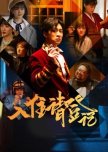
I had no idea how this ended up on my "Watch Later!" list on iQIYI, and was not aware at all what this would be about. So, it took the first two episodes to figure things out -- is it horror? Mystery? Thriller? Elements of these were present in the first episode -- and the second turned out to be more on the silly side?
Finally, I understood that this is a collection of short stories -- they are just all happening in a remote run-down hotel.
Now, short stories are a genre that not everybody can get along with. They tend to have no real introduction, only outlines of characters, and often an abrupt or open ending. Nowadays, when we are used to media that spells things out more often than not (and, when in doubt, more than once), we are occasionally thrown by this form of story telling.
Keeping this in mind, these twelve short stories (each of them just about ten minutes) were well done. In each episode, we get a guest (or a group of guest) who come to the hotel -- and most of the episode is spent trying to find out what on earth is happening, who they are and why they have come there. All of the stories are more or less absurd, some silly, some surreal. Some with a layer of meaning below the obvious.
It's very clear that this was made on a shoestring budget, but that it was used well! The location fit well with the stories, and the actors were mostly doing a good job -- with the shortness of the stories it was occasionally hard to tell. I wish the writer had given the recurring cast -- the hotel's employees -- a bit more character: Not necessarily multi-faceted, broad strokes are more than enough, but just slightly more -- especially the two female characters stayed too bland.
I did like how they integrated elements of horror and mystery as well as rom-coms, mixed with comedy, into their little absurdist stories -- you'd never quite knew how things would turn out.
Overall, it was a nice change of pace, and I enjoyed some episodes a lot, other were ... forgettable, which is the norm for me with anthologies. I liked the dramatics of the hotel manager and the absurdity of the short stories.
If the English subs on iQiYi had been better better (they were machine translated, and I occasionally had to guess what was being said), this would get a rec from me.
Was this review helpful to you?

Good message lost in slow and light story-telling
I had started to watch this drama back when it aired in 2024 but dropped it relatively quickly because I didn't feel that there was much story. I now picked it up again and watched a few minutes here and there -- and once I got into the second half, I even enjoyed the series.The first six or so episodes tells us how a star and a normal guy get together -- and the second half deals with the consequences. Where the first part is extremely predictable, the latter part had potential to become much more interesting, but it didn't: It still remained mostly light and soft, and because of that, it felt a bit superficial.
I do have to commend the writer for their dedication to their vision: None of the conflicts lasted long, the relationship between the two main characters was extremely stable and notable for their good communication.
Unfortunately, combined with the length of twelve episodes à one hour, that means that the whole thing starts to feel quite slow and even a bit boring. What's more, the incredibly important message gets lost in between the sweetness of the main couple.
Because this drama picks up a topic that I think fans in our modern world should be aware of: How social media blur the lines between the public persona of a celebrity and them as a private person even more. How fans think a celebrity is a commodity they can "play with" instead of a human being with feelings. How celebrities are dependent on their fans' goodwill. How "ships" and the heteronormativity of society impacts celebrities' lives and livelihoods.
And also, for the second couple, the topic of (internalized) transphobia, with a trans woman who, for once, is shown as a human being instead of as a comedy plot point (and she's played by a trans woman too!)
These themes are all there in the plot -- they just could have been used for more emotional impact. Since the main couple's relationship is so stable, the external problems could have made for an exciting contrast: Let the problems spiral for much longer, let the stakes rise higher -- so that the sweetness of the couple has something to balance out. And would that not have made the win in the end much more satisfying?
Alas, the writer had other ideas, and if they don't align with mine, then that's that. However, even so, there are a few aspects that did not help.
For one, the first five or six episodes were too slow in story telling, especially as it's mostly set-up for the actual plot. Also, some scenes don't have any impact for the later story (e.g. when a character repeatedly shows up in the "wrong" clothes for his internship), some scenes just went on slightly too long.
I also don't think the directing was particularly inspired. While most of the actors were showing a slightly-above average for newbies in a Thai BL, they obviously needed more and better directing -- often I found myself thinking "This is too static." or "Why are they just standing around?" More movement, more interesting camera angles, different placements of characters, even more interesting lighting would have helped a lot. As soon as the actors get something to do, their performance becomes much better, and the scenes much livelier and much more engaging.
And as a last point, I need to talk about Krommatha's characterization because that was the one point where the drama dropped the ball. The screenplay tries to tell us that Krommatha and Fueang don't follow the usual heteronormative seme/uke dynamics. They even talk about who will top and who will bottom during sex -- a scene that quite a few viewers loved.
But from the very first minute we meet Krommatha, it's obvious that *he* is the bottom/uke. From his pastel and wide-cut clothing and his softer haircut to his teenaged-girl behaviour when he talks about his crush with his friends, he is the stereotypical BL bottom. Dear writers and producers, if you're not going to commit, don't give me lip-service.
What I did love about Fueang and Krommatha was that the screenplay showed us how much a new couple (both of them, not just the top!) in their honeymoon phase is obsessed with getting it on and generally being all over each other, even if it's just sitting closely together in a more public setting. I missed that in some other soft-and-gentle Thai BLs.
Was it good?
It had a good story to tell, but was hindered by slow story-telling, static scenes and the writer obviously committing to the "soft and light" style instead of tightening the pace and heightening the potential external conflicts.
Did I like it?
Not really. It was okay, but I like its potential more than the actual drama.
Who would I recommend it to?
Maybe to those who want light and "green flag" stories?
Was this review helpful to you?
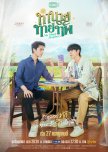
Solid gentle romance
GMMTV BL romance dramas tend towards the easy fluff, occasional with a bit of depth but definitely made for mass consumption by girls / young women. There are exceptions, but "My Magic Prophecy" is *not* one of those exceptions.On the contrary, it leans hard into the sweet-sweet romance between the main couple, even ships them off to a faraway place so they can be domestic together and gently explore both their mutual attraction and address any traumatic experiences of the past.
So, anyone who wants a deep exploration into belief systems beyond motivational quotes or who wants a gripping thriller about chasing a murderer or a heart-wrenching story about friendship and betrayal? You are in the wrong place.
Both the crime part and the romantic parts of the drama are almost ridiculously simple; I knew the culprit two episodes in, and the romance is nothing but predictable.
As always, in these cases, I do mourn the potential for a drama with more depth -- especially the friendship between Thap and Karn is woefully underexplored for its impact to the plot -- and there are some minor points that are teased but never even mentioned again, for example why the family would fall apart without Thap.
Although I have to concede that this drama never pretends to be more than a simple romance, and it makes it rather clear in the first episode already.
For what it is -- a gentle romance -- is was good. The characters get just enough backstory and character development as to be not boring, the surrounding plot (about who wants to kill Thap) and the romantic plot fit nicely together. I didn't feel that the story went around in circles (unlike "Memoir of Rati") or dropped sudden plot or backstory on us (unlike "Sweet Tooth Good Dentist"). The villagers are predictably cliched and the secondary couple's story line stays a quick outline, never to be fleshed out enough.
So, overall, in my opinion, this drama has a solid, though not outstanding, screenplay.
Both main actors were fine, and First Kanaphan's acting was subtle enough to offset some of the clumsy writing for his character. Everybody else didn't have a lot to work with, so I can't say how good they were.
Technically, it comes up to the usual GMMTV standards -- although I wish they would stop following the trend of using the smallest depth of field possible -- at times it's so bad that *nothing* is in focus any more for a second of two. I also find it exhausting when they constantly switch the focus from one person to the other in one single shot -- why not increase the depth of field that I can see both characters and their facial expressions simultaneously?
The usual product placements were also there but mostly integrated into the story.
One thing I did like was the mostly balanced relationship dynamics -- this is not a story about the (emotionally) strong top healing their (traumatized) bottom -- they both have their difficulties, even if those are very different: one is still grieving his parents and the other is threatened by outside forces. I found the relationship and character progression mostly solidly written (within the constraints of the genre, of course).
Was it good?
It's a very typical GMMTV romance; and among those, I'd place it in the upper third.
Did I like it?
As always, I waited for the right mood to come along. It was nothing outstanding, and I will have forgotten most of it in a month or so, but I cannot say I was bored or annoyed.
Who would I recommend it to?
To those who love simple and gentle romances.
Was this review helpful to you?
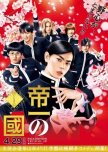
The Emperor's Country
This film is *terribly* well done.I hated the first hour, I freely admit it, because it was definitely on the far side of "too much". I am always the first one to point out that Japanese manga adaptations have their own style and that's how it is; and if you know what I mean by that, imagine it ten-fold that and you have a good approximation for how this film is done. I really struggled with the shouting and the overdone reactions and the wigs and ... everything, really. But for some strange reason, I also could *not* put it down.
It was all worth it for the ending -- I won't say anything to not spoil it, but let it be known that I had to get up, paced there for several minutes and then shouted "That's so clever!", and I meant both Teiichi's actions *and* the writing.
This film is set in an oligarchic and patriarchial society, both in the "adult" and in the "school" part of it -- it reminded me of the Kaiserreich society of around 1900 (go and read "Der Untertan" and "Unterm Rad", if you haven't yet!), others might think of England's Edwardian public schools, Japanese viewers will probably think of their own Imperial era. That oppressive, hierarchical society, governed by ties of obligation and old history which span generations, with its homosocial enviroment and the (homophobic) (or do I mean homoerotic?) bromances, the sizzling rivalries and the masochistic self-degradation towards the powerful -- and then, for a minuscule moment, a glimpse of a dream, of change, of humanity -- or maybe not?
All of this is perfectly distilled into the set designs and the costumes, into the use of light and color, into the pace of the ceremonies with the ritualistic stand-bow-sit and the hard-and-short applause, into the perfect timing of every single actor, and even into the kumi-daiko with half-naked men.
With this in mind, it makes a lot of sense that the female characters barely have screentime, that the younger sister (who is maybe about 13?) carries a teddy bear whereever she goes, that in his moment of victory, Teiichi leaves his girfriend(?) and runs towards his number one lackey to embrace him. Actually, that makes it even more clever that the girlfriend(?) is the only voice for egalitarianism in this film.
It would take a while to talk about all the different layers of meaning that hide behind the manga-esque facade, so I'll just point out that there are many, and leave it at that -- I think every viewer will find their own preferred reading.
And in the end, even on the day after finishing this film, I sit here and ask myself "Who is the real Teiichi?" and "What the heck is Dan hiding?"
Very much worth it.
Was this review helpful to you?
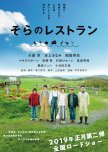
I also feared that this would be one of those films that romanticise country life to the point of making it almost unrecognisable. It's not the case -- yes, the hardships are mostly glossed over, but at least all of the locations and tools are real, and there are a few hints to how difficult it is for organic farming to be recognized by the old guard.
I would have liked to see the women shown as more than "kind and supporting their men", especially after that impressive first scene, where a woman dramatically arrives in a snowstorm at the milk farmer's home and is proposed to immediately. It's unfortunate that this has no impact on the story whatsoever (and I don't think we ever get to know why she came there at that time) -- and I wish the writer (who is also the director) had been more honest and either written out the female characters entirely or given them more to "do". It's especially jarring as each and every one of the five farmers get a unique character and an interesting backstory.
Overall, despite the shortcomings, it's not a boring film, which is mostly because of the the beautifully filmed landscape and the outstanding performances of the high-class actors.
Was it good?
It was a good representative for its genre, not too preachy and with beautiful landscapes and excellent acting.
Did I like it?
I'm not a fan of the genre, I admit, and if not for JFF Theater making this available, I wouldn't think to seek it out. That said, I enjoyed it for what it was.
Would I recommend it?
If you like films about community, good food and a beautifully filmed country side, then this is absolutely a film not to be missed.
Was this review helpful to you?
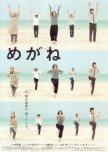
Nothing is ever explained -- why is is so cool to ride on the lady's tricycle that even the student who has just arrived knows about it? Does the school teacher ever teach? Why does the guest house owner not remove the wheel of the tricycle when he checks for punctures in the tire? (That last one hurt to watch.) And what about that other hotel? Nothing is connected, even though it seems to want to be until the last minute. This is not simplicity, this is faked depth.
It did have its surreal moments, with the hotel where guests worked on the vegetable fields or how the woman pulled her heavy suitcase along the sandy beach -- but these moments were far and inbetween.
I don't really have anything else to say, the film deeply annoyed me. *And* it bored me to tears.
If you want to see a cool film set on an Okinawan island, go watch "Nabbie's Love".
Edit to add: This film has won the Manfred Salzberger priye at the 2008 Berlinale and was a nominee for the "World Cinema - Dramatic" categegory of the Sundance festival, so there are certainly people who think the film is excellent. And as you can see from Elisheva's comment below, there are viewers who like the film. Please don't follow other opinions, make up your own.
Was this review helpful to you?
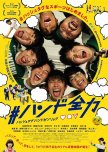
Was the film good?
Yes, it was a coming-of-age film done with precision, and tied together local history of the place with a positive message.
Did I like it?
I don't get on with the performative SNS of the modern age, and that impacted my enjoyment massively. But I understand that this is my own problem. Now, some days after watching, I find that this *was* an outstanding fim.
Who would I recommend it to?
To people who like coming-of-age stories.
The thing is that I really struggled to get through the first half of this film. Modern socmed and their empty performativity, that is nothing I know or care about. So, to see Masao and his friends fake being handball players and fake caring about their hometown just for likes from people they don't even know, that felt strange to me. How can they love this kind of empty praise? How can they not feel ridiculous when they do this? On an intellectual level, I know that this must be addictive. but I don't (want to) understand.
I also did not understand Masao's gloom and doom attitude, when everybody else around him had already picked up the pieces after the devastation of the 2016 Yumamoto earthquake. On an intellectual level, I know that this film was done very well.
I could see the quality of the story telling and of the actors. I liked that the film was so grounded in the history of the 2016 earthquake and its aftermath (I'm reasonable sure that the places we saw are original locations, especially the temporary shelters). I liked the background characters, the grandpa with the wolly hat, Masao's brother and his girlfriend, Masao's parents -- all of whom were sweet people, who had no idea of what happened with Masao's "dutch ball" and the "SNS". I liked that the boys were realistically boys, not sanitized at all -- rough and hormonal but never mean.
I just wasn't able to bring up a shred of interest, but I know that this is solely my own problem, not a problem with the film itself.
Luckily, this changed in the second half. Or rather, about 35 minutes before the film ended. It was only then that the film showed us its core theme. And the theme surprised me in the best of ways. Earlier, a girl had asked Masao "What are you "striving" for?", and he didn't have an answer. And if the film had followed the usual path for a film like that, the boys would have banded together to win the nationals as underdogs, and would have worked hard and harder, with a lot of "ganbarimasu" -- and they would have beat the odds, or at least they would *almost* beat them etc. etc.
Thing is, this does not happen here. Not quite. Yes, the boys band together -- but they immediately quarrel about trivialities. Yes, they take part in the nationals -- but the focus is on the audience, who came to cheer them on, because, as two elderly people said in the beginning: "It feels good to cheer someone on." -- "Yes, instead of being the ones cheered on." And when Masao leaves for the game in the morning, he tells his mother: "I will have so much fun!"
And I think this is the core of the film.
"To "strive" to enjoy life." Don't live in gloom and doom, after something bad has happended. Live your life to the fullest, find joy in the trivialities. Do what you like, whether it's being a funeral dicrector (like Masao's brother), a hostess (like Masao's brother's girlfriend), or a handball player. Show the world that peace sign and smile into the camera, not for others to cheer you on, but for yourself.
Was this review helpful to you?
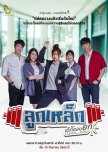
But first of all: I loved the actors' performances; the background music was slightly distracting at times, and the camera work was solid. The was never a boring moment, and there was much less sports than I thought.
Very obviously a lot of world/character building has gone into this drama; apart from two supporting characters (one of them unfortunately the love interest) they all had an interesting back story going on -- interesting enough that each one of them would have deserved their own drama.
Unfortunately, the writer didn't quite use these to their advantage. For most of the series, it felt like it could tip into melodrama any moment, with the one friend and the grandmother being archetypes of melodrama, the hinting at tragic backstories, and the search for the truth about Nun's mother. Really, it felt like being teased constantly. But then it went back to being a comedy slice-of-life, following Nun in her uni days doing homework, competing with friends, lifting weights in the uni club. I slowly got used to this rhythm, and even started to like it. And I thought, what an interesting concept that is, to have all these tropes but then to make the characters just accept that what happened, happened, and now is the time to look into the now and into the future.
But then, in the last two episodes, the mood changed jarringly. Only then did the screenplay tip into full melodrama: It finally revealed the tragic destiny of Nun's mother, finally the tension between Grace and her mother escalated into shouting and over-dramatic exits, finally the grandmother dramatically came to her senses within a near-death experience. Three other story-lines were also resolved in these last two hours, which gave everything too little time to feel properly rewarding.
Actually, I'd rather the writer had committed to their previous method to lightly conclude segments instead of writing melodrama. The two story lines that they *did* resolve in that understated way were the ones I felt were written the best. In my view, it also took time away from tying everything neatly together into a single theme or message. Till now, I have no idea what exactly the writer wanted to tell us: What exactly is it that Nun has learned now?
Something about truth, lies and forgiveness? Something about friendship? Something about letting go? Something about children having to love their elders?
Although the characters were nicely written, none of them got a proper character development, which I find a necessary element in youth dramas; or at least I can't see any?
And lastly, a note on the title:
"Clean and Jerk" is a weightlifting move -- and the one that Nun has the most trouble with.
Going from the design on the poster, the Thai title ลูกเหล็กเด็กชอบยก is to be read in two parts: ลูกเหล็ก /lûuk lèk/ "the child of iron" might be an allusion to her being the heir of a steel factory or to her iron will; เด็กชอบยก /dèk chôop yók/ "The child likes to lift/pick up" is the title of Nun's brother's favourite comic book but also might be an allusion to her bearing the weight of guilt for the car accident. From my observation, Thai titles often have more than one meaning, so all of these might be intentional.
Was it good?
It was engaging, never boring. But I felt that it didn't quite get to its point, and that the resolutions stayed superficial.
Did I like it?
I did. To be honest, I started it just because Pond Ponlawit has a main role and I wanted to see how he was when he started out in his career. But his character is a bit boring -- I genuinely grew to like Nun and her friends as well as Nun's father and wanted to see how it all would play out.
Who would I recommend it to?
I think those who generally get on with Thai PBS dramas and like watching youth dramas will like it.
Was this review helpful to you?
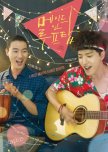
I found it to be a solid film, with a well-written script, fine acting and overall thoughtful design choices. It's "slice-of-life" in the sense that we only see the turning point in the protagonists' lives, with only hints of what happened before and an indication of what will happen after the ending credits.
The ending that doesn't tie everything up with a nice and neat bow is a suitable choice for the underlying universal themes of the film: the fragility of life, the struggle to find what you want and can do, the importance of listening and trying to understand.
And while it is a film that talks about themes that concern every human being in this earth, it also picks up topics specific to life as a gay man (some of them stereotypically so), and as such it is very much a gay film.
And even with all of these heavy themes, the characters are what bring the film to life and give it a wonderfully light optimism. Both Bongshik and Haneul are extremely likeable and realistically written characters, who get a decent bit of character growth in the one-and-a-half hour of the film's runtime.
Was it good?
I think so, I loved the actors' performance and the mix of lightness with heavier themes.
Did I like it?
It made me laugh and cry with the characters, which is always a good sign.
Would I recommend it?
Yes! It might not be the world's most groundbreaking film, but it's a solid production.
Was this review helpful to you?

It's hilarious, stupidly so, at least for those who can laugh at themselves. But I think if this had been much longer, it would have been too much very fast. As it is, it's just a glimpse into Hibiki's thoughts and his reactions to his own fantasies -- just a small collection of what he encounters daily, not a continuous story, and very much open ended.
I loved the juxtaposition between his outrageous fantasies and his earnest mixology skills -- and what is a Japanese production without some food/drink appreciation? -- a well as the bar's subdued atmosphere contrasted with Hibiki's antics. The short fantasy stories of Hibiki's were done with great care, so much so that I got invested in the ships myself -- only to be ripped out of the fantasy by Hibiki having a seizure / a nose-bleed / a fever and everyone around him being concerned. I was surprised to see so many Japanese actors with an arms-long list of previous acting roles; and that only contributed to the mix of contrasts.
One other thing I also liked is Hibiki's self-awareness. He knows very well that his fantasies are just that: Fantasies. He never expects any of them to become real -- he even has his own moral code of who is shippable (Married men are a big No-no!), and that is what makes him likeable, even with all of his antics.
Was it good?
It was a well-crafted parody, Japanese style; and a lot of care has obviously gone into the set, the costumes and the casting.
Did I like it?
I loved it! I found it hilarious.
Who would I recommend it to?
To fujoshis/fudanshis/slash-fans who are able to have a good laugh at themselves.
Was this review helpful to you?
Now, a few years later, I see that I was too hung-up about whether the publishing world was realistically depicted or not, when "Happy Ending Romance" is not about that.
No, it's a drama that tries to address several topics that revolve about one of the fundamental questions of life: What makes a life a good life?
It deals with issues around relationships between people (How will your choices affect the people around you?), around freedom of choice (Who gets to decide what is good for someone?), around honesty versus making a living (What does "success" mean?) and, ultimately, around he complexities that follow if you try to answer these questions.
This is where the story both has a strength, but also a weakness -- the characters' decisions in the past all have consequences, none of them were purely good or purely disastrous, but untangling them to see the right path forward is not easy, and requires that the characters be honest to themselves and to others. It's a strength because complex stories are usually more intriguing than straight-forward "red/green flag" romances. It's also a weakness because it requires great story-telling both in the screenplay itself and in the execution.
And this drama, unfortunately, does not reach the required quality and did not manage to evoke the right emotions for me. I think that the director did the story an injustice when they decided to start the drama with a strange, almost disjointed mix of present and flash-backs, showing the same scene repeatedly but giving us little new insight, and only tell the "big reveal" at the end of episode 7.
This way of telling the story and the backstory also put Kim Jungyhun in the "antagonist" category for most of the drama, when he should have been painted as a complex character with conflicting desires (actually, he could have been the most interesting of the three main characters).
I also feel that this should not have been a romance at all -- I did not feel a romantic attraction from Cha Jungwoo towards Taeyoung -- and in the other direction, it always felt more like a professional admiration. That the screenplay never made the exact relationship between Jungwoo and Jungyhun clear did not help. The romance was also irrelevant for the underlying topics, and everything would have worked as well, if not better, without it.
To evoke the right emotions in the audience, we should have seen and felt both writers' unhappiness in their situation. As it is, we got told, not shown and when we got told, it was too little, too late. This could have been a drama that starts with a stifling atmosphere, where everything is still, almost claustrophobic, living-but-not-alive to then finally end in freedom and light(ness).
Unfortunately, everything is bland and stays flat throughout. Neither the soundtrack (often too loud and misplaced in tone), nor the lighting, or anything except for the dialogue really changes between beginnning and ending. The sets showed that the designer tried but has no idea how a bibliophile lives -- why would you fill a perfectly fine shelf with knick-knacks and put your books on the floor? And why would you not put up another book shelf as long as you have the wall space? -- and they also missed an opportunity to make a greater distinction between Kim Junhyun's cold, still, and sterile house and Han Taeyoung's cozy and warm flat.
All in all, the drama failed to connect my emotions with those of the characters, and that might be why I didn't like it when I first watched it. I wonder if the director even had a clear vision of what story they wanted to tell?
Note that this is not the fault of the actors -- actually, they were the highlight of this drama. I loved Taeyoung's puppy energy, the long-suffering but loving friend Kang Woojoo, and the professor was appropriately disgusting. I would like to see more of all actors here in the future.
Was it good?
It's watchable but doesn't reach it's potential.
Did I like it?
Not really. I had to put in too much rational thought to understand what the drama's theme was, and it didn't make me feel with the characters.
Would I recommend it?
Not really.
Was this review helpful to you?
The last aspect is something the film doesn't do very elegantly, obviously to the confusion and disappointment of other viewers -- they feel that it's almost two different films, one a silly comedy, the other a serious crime thriller. I think it's certainly no "Le Salaire de la Peur" or even a "High Noon", but it does have its own charm and rhythm, if you're comfortable with the Thai way of switching moods within a story. Also, I felt that the comedy was still there, mainly carried by Noi, but also in some of the interactions between the bandits.
There is some romance, which I (and Noi!) felt came out of nowhere, but it seems that a romance is part and parcel if you have two main characters in the appropriate age range. (Also, it was kind of a long-term-setup for another joke at the end, so I don't mind too much.)
I grew to like the characters -- Noi, of course, who charmed me instantly, but also the prickly Chana and the wilful Riam. Even some of the villains were kind of sympathetic, although I agreed with Noi that "they [should] just kill each other".
When I looked up more information about the film, I learned that it's one of the first Thai films which were filmed on 35mmfilm, which means it has synchronized sound, i.e. that the actors' voices were recorded along with the image. Usually, Thai film makers usually used a cheaper sort of film, and the voices were either dubbed later or sometimes even dubbed by live voice actors in front of the audience. What a wild concept! I never knew that this was a thing.
I suspect that this was one of the reasons why there's so much singing and music in the first half -- Rattana Pestonji, who wrote, directed and produced this film, seems to have used the possibilities of the more expensive film stock to the fullest.
Rattana Pestonji is, according to Wikipedia, "the father of modern Thai film" -- which could explain why some aspects of "Country Hotel" feel very familiar. I will definitely check out his other works if I can find them, it should be worth it to understand where modern Thai films come from.
The copy that is available via the Film Archive Thailand on YouTube seems to not have been digitally restored, there are quite a few artefacts from degradation of the original film material. At times, the background score overwhelms the actors' voices, and there are strange cuts here and there. But to expect modern standards would only be an exercise in frustration.
Was it good?
It's not global top-tier in comparison to high-budget films from the same time. But I do think that it was made with love, and with all the expertise and abilities the crew and the actors had. The script and how the story is developed is very Thai, and that might not be to everybody's taste or feel unusual or surprising to Western viewers.
Did I like it?
Yes! I loved the comedy, I grew to like the characters, and I wanted to know how it would end. Afterwards, I felt fullfilled, and just wanted to sit a few minutes, not doing anything.
It was definitely entertaining and educational, and well worth my time.
Who would I recommend it to?
To anyone who is interested in Thai / SE Asian film history, or in Thai films in general.
Was this review helpful to you?
I assume Champ Weerachit (the director and screenwriter) did the same here as he would later do in "1000 Years Old", only there it was vampires, whose tropes and clichés I know well enough; namely that he played with the tropes, inverted/subverted them and combined them to build a new and surprising world. I suspect that I would have enjoyed it more if I knew the (pop) cultural tropes around the films referenced, Thai gangs, and เด็กวัด "temple kids". I am very sure that a lot of the scenes we saw were richer in meaning than I could possibly understand.
What both dramas have in common is a colourful design -- from the clothing and the accessories the characters wear to the sets, which are lovingly decorated. I like that "I Will Knock You" is set in a middle-to-lower-class area and both young men come from this background too -- it's unfortunately quite unusual till today in Thai BLs.
The bright colours and the way the script plays with tropes make this drama seem like it's set in a world that is a step to the side of ours, a world where fights don't really end in more than a few scrapes and temple kids and /or gangsters are not actually dangerous. Which is why the brief dip into the reality of classism and real-life consequences of knife violence felt like being doused in ice water. On the one hand, refreshing and finally something more than Thi's eternal waffling about, on the other a disruption in style. Whichever it was, the realism doesn't last too long, and in the end, we're back in Champ's fantasy world.
I do think if the script and the direction would have leaned even more into the absurd side of things, it would have made this world even more distinct and thus different from anything else in the BL industry.
I also loved the way music is used in the drama -- both as helpful characterization for Thi and Noey and as background music for setting the mood. I am a fan of Luk Krung anyway, and this was a delight.
Now, on to the two aspects that really should have been better.
One is the script, and Thi's character. He endlessly waffles about, and is never quite clear on his feelings for Noey. For the most part, it just seems as if he lets things happen around him, and never actually takes action or speaks out for himself. Even after he stopped being afraid, he never says outright "I don't like you like that, Noey" or "I like you, Noey". Not even in his own mind does he do that. And there are scenes where it seems like he has made up his mind by the way he acts -- and a few minutes later he goes "What is happening to me?" in his inner monologue. It's exhausting. It feels like Champ Weerachit didn't really want Ti to commit to being Noey's boyfriend.
The second thing, and this is even worse, is that there are quite a few scenes where Bom's ("Thi") and Tar's (Noey) acting is not good, but rather awkward. It's especially obvious in scenes where Thi is afraid, happy or feels any other intense emotion; I didn't feel his emotions at all. Maybe it was supposed to evoke second-hand embarrassment? But I didn't feel this one either. It was just ... awkward. Several of Tar's scenes felt similarly mis-acted. I wonder if this is due to the abilities of the actors or due to how they were directed by Champ?
Both of these aspects, especially the latter, are a problem throughout the series, and not even the fantasy world or the interesting premise could help. Overall, this feels like a beta version of an interesting drama (and "1000 Years Old" would be the release version 1.0) -- the main points are in place, but it doesn't quite get there.
Was it good?
I liked some aspectss of it, others were awkward and not quite polished enough to be good.
Did I like it?
I don't know. I want to like it more than I actually do, I think?
Who would I recommend it to?
Fans of fluff and plots that are different from the usual type of BL fare, who are able to tolerate rough acting.
Was this review helpful to you?

Shinmai Kisha Torokko: Watashi ga Yaraneba Dare ga Yaru!
2 people found this review helpful
I would have love it at thirteen
I didn't quite get on with this film, and I think the reason is that it might be aimed at young teenagers.Because the plot itself is nothing new -- group of underdogs discover corruption/a conspiracy, and must fight against the system/corrupt corporation/evil group to make it public. The only difference is that here, the setting is at an elite high school and the underdogs are a non-sanctioned newspaper club -- and it's all infused with messages about morals, truth and growing up. It also points out sexism, classism, adultism and how an imbalance of power easily leads to injustice. And the main protagonists and their idols are all girls and women, which I like a lot.
Viewed through this lens -- that the target audience are young -- some more things in this film make sense, for example that the evil CEO is a milk-drinking caricature of an antagonist, or that the young ones on the side of the good are Very Earnest and Very Brave.
The story starts out very slow, and builds up momentum along the script I mentioned above, with some but not many surprises who are already familiar with the tropes, and finishes in a finale that might be more emotionally satisfying for those unaccostumed with them.
Performances were appropriately earnest/comedic throughout; and there's nothing to complain about iregarding technical aspects -- I found the music slightly invasive at times, but I could blend that out quite quickly.
I wonder if this might be adapted from a manga. The actors spoke with the same speed and intonation as anime voice actors. The sets were strangely distinct, in an artificial way -- the small room for a tea ceremony in the school clashed with the modern school building, while the CEO's office would have fit in right into a business melodrama; and the way the actors stood and moved in the sets felt straight out of a manga panel.
Was it good?
It was done very well, and there was not much to complain about.
Did I like it?
I admit it, if this had been a series, I would probably not have finished it.
Who would i recommend it to?
Teenagers, aged 13 to 15. I think they might love it.
Was this review helpful to you?

So much potential wasted -- again
What all of the four-and-a-half VBL productions I've watched so far have in common is that they take an intriguing premise with a lot of potential for interesting world building and plot with depth -- and then turn it into a piece of fluffy romance.So, when I saw that "Fight for You" was another VBL production, I knew what I was in for:
* attractive main and secondary characters,
* fluff, and maybe sexy romance,
* shallow plot that never explores the rich potential for story and characters,
* the main hurdle to overcome does not naturally follow from the premise but is derived from a romance cliché,
* mediocre to great acting,
* solid camera work.
And I got all of that.
In this case, the acting was good to great -- I loved Nelson Li's performance and hope to see him in something with more depth -- and the plot was thankfully not too full of holes (like it was in "Eternal Butler") or fell apart (like in "Stay by my Side"). The background music consisted mainly of pop songs that are fine on their own but not really working as background music (same as it was in "You are Mine"), often more distracting than enhancing the experience.
And the end was so cheesy that I could have hosted a fondue party for my extended family.
The secondary couple was superfluous here and they did them a disservice in tacking them on to this drama instead of giving them their own story. (Also, why the need for monogamy?)
So:
Was it good? -- For a VBL drama, it was alright. But I do wish VBL's writers would finally commit to their plot ideas instead of reducing themselves to the (perceived?) tastes of the masses. What's most disappointing with their dramas is that there's so much more potential for a great story, layered characters and, especially as their stories are all set in the same universe, intricate world-building.
Did I like it? -- I am maybe not the best judge here, because I knew what I would be getting into when I started.
Who would I recommend it to? -- To BL fans who really want a drama to help pass the time while ogling (mostly clothed, alas!) cute / attractive guys.
Was this review helpful to you?


