

This review may contain spoilers
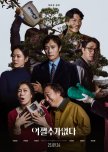
Oh mama, Why do I?
If only it had a little more character development or if it went a depth to man-su's character, it would have been great.I really like the showcase of the masculine aspect as I thought it was real. the action was phenomenon too. I still don't like the fact that a daughter is still waiting for her father who would never return to her...i at least thought that Man-su will leave him as both of them have daughters...but sadly that's not the case. (i do wish i could snape my fingers and see the aftermath of what happens even if it's the obvious.)
son ye-jin definitely gets wife of the year as her action was PEAK! - knowing what your man did, knowing HOW far he is actually going for her and the children and still supporting him takes REAL BALLS! (I do wonder how a story would go if the wife was the killer and the husband found out...?)
The First Act was the best part of the movie, and I will probably remember it in years to come. Overall, a Good 8/10 Movie.
(Glad I didn't have any expectation coming to this film.)
Was this review helpful to you?
Tightly Crafted and Atmospheric, Slightly Rushed but Emotionally Grounded
A tightly constructed microfilm with a polished, cinematic atmosphere and strong audio design. While its message is familiar, the storytelling remains engaging throughout. The only drawback is a slightly rushed ending that limits its emotional impact. Still, it’s a well-executed and memorable short.Was this review helpful to you?
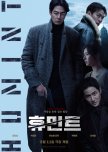
Great !
This is an excellent action film. We find all the elements of the genre. Obviously you have to disconnect from reality to appreciate this type of film. There is no social or moral theme for the spectators. There are no unnecessary or overly long moments. The actors are very good. If you want to have a good time then you have to see this filmWas this review helpful to you?
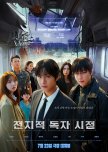
The first thing that stands out is how the plot's ambition far outpaced the post-production budget (or talent). In a story where monsters and cosmic powers are fundamental, encountering digital effects that look two decades old completely breaks the immersion.
For those who haven't read the webtoon or the novel, the sheer amount of world-building rules (coins, attributes, stigmas) can feel overwhelming within the first 30 minutes.
The "disrespect to the author" criticism is not an exaggeration. By altering key events and oversimplifying the "scenario" system, the film betrays Sing Shong’s core message. They have attempted to turn a deconstruction of the genre into the same kind of empty commercial product that the original story itself criticizes.
My personal recommendation: Now that you have the character´s faces in your head, run to read the Webtoon or the Novel. You will realize that the movie barely scratched the surface of what this story truly is.
Was this review helpful to you?
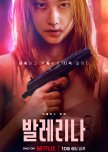
A Beautiful Wrapper for a Predictable Story
This is a real find for film lovers. The cinematography is impressive, it's rare to see such a talented and distinctive visual style. The background, color palette, and shot composition are all top-notch. Even the bloody fight scenes are well-choreographed and original.However, the story itself is quite simple and predictable, lacking real intrigue. The pacing is slow, especially at the beginning, with many drawn-out scenes and dialogue filled with unnecessary fluff. At times, the film falls into genre cliches like a 50kg heroine knocks grown men aside with her miracle kick or emerges from a fight with just a few scratches and pretty bruises instead of real injuries and broken bones.
Was this review helpful to you?

This review may contain spoilers
Sunglasses After Dark
Whilst “Branded to Kill” can be seen as the most obvious breaking point in the relationship between Seijun Suzuki and the Nikkatsu production system, “Trapped in Lust” appears to sit within an even deeper, almost subterranean continuum, where that same rift resurfaces in other forms, adapting to a production context that has since changed.It is no coincidence, after all, that behind the project we once again find Atsushi Yamatoya, who was already one of the writers of “Branded to Kill”, and who here - as well as playing the role of Takagawa- is involved in a reworking that feels more like a detour than a real remake.
In his compelling analysis, ‘Il Fiore e Il Serpente’ (2022), Beniamino Biondi devotes a section to Yamatoya, also mentioning three different screenplays that formed the basis for “Branded to Kill”, although, curiously, he merely touches upon “Trapped in Lust”.
We are in the midst of the pinku eiga and roman porno season – that cinematic realm where the body becomes the central element, both an exposed surface and a narrative device. Yet precisely where one might expect greater freedom of expression, the film immediately introduces a more ambiguous tension.
Sex, in fact, is never truly liberating. It is obviously ever-present, pervasive, almost obsessive — yet progressively stripped of meaning, as if, by inertia, it continued to exist even after having lost its purpose.
Hoshi, the main character played to perfection by Genjiro Arata, navigates this system as a figure already broken. A rising killer, driven by a desire for recognition that coincides with his climb to the top of the organisation, he soon finds himself caught up in a decidedly complex dynamic that ultimately overwhelms him.
The character of Mayuko (the voluptuous and alluring Moeko Ezawa) — an apparently faithful wife, but in reality a pawn of the organisation — introduces an element of structural ambiguity right from the start: there is no relationship that is not, to some extent, constructed, manipulated or prearranged.
His (apparent) elimination, however, does not result in what might be seen as a strengthening of the protagonist, but rather marks a rupture. It is as though, just at the moment when the body should (and could) re-establish itself as the centre of the action, something ends up breaking irrevocably.
The resulting impotence — made all the more evident in his encounter with Yumeko (Nozomi Yasuda), the young prostitute at the hotel — is not merely a narrative element, but a genuine deviation from the system: desire, stripped of his ‘object’ and, at the same time, of its mystery, is transformed into an automatic gesture, a function incapable of producing any meaning whatsoever.
It is no coincidence that Hoshi spends almost the entire film behind a pair of sunglasses, worn regardless of whether he is indoors or outdoors, or whether it is day or night: it is as though his gaze, filtered and obscured, ends up conveying an inevitably distorted view, a reflection of a cinema in which reality is no longer simply shown, but is constantly obscured, distorted and re-enacted.
As was already the case in "Branded to Kill", a recognisable structure is present here too: there is always an organisation, rules are followed, and a hierarchy is in place. But it is precisely in the relationship with these rules that the film finds one of its most significant turning points.
Hoshi’s fault lies not so much in the mistake itself, but in the return. In returning to the scene of the crime, in reopening what ought to remain closed. It is an act that disrupts the system’s internal balance — and lays it bare. From that moment on, the climb is no longer merely ambition, but a form of attraction towards the point where the mechanism seizes up, becomes visible, and turns inevitable.
It is in this context that some of the film’s most unsettling characters emerge.
The ruthless and sadistic killers Mario and Saigo form a dual, almost unreal, certainly hallucinatory presence: a seemingly fragile female doll juxtaposed with a rigid, armed, silent body. Only later does the apparatus reveal itself for what it is: a simulated identity and mechanical bodily artificiality, a sort of Cronenberg-esque hybridisation.
Even once revealed, the effect does not fade. A sense of unsettling continuity remains, as if the body could now be broken down, reassembled and manipulated without any stable point of reference. It is precisely through these figures that violence takes on a further dimension: no longer a source of tension, as is typical of noir, but a repeated, almost abstract function.
The deaths follow a pattern that borders on the grotesque — bodies frozen in baffling, ambiguous poses, even the act of defecation abruptly interrupted (a pure homage to Suzuki, worthy of the finest Abel Ferrara) — whilst the narrative seems to constantly veer away from a linear progression. Curious musical and choreographic interludes, featuring Crazy Horse-style dancers who are stripped down and seemingly out of context, do not interrupt the narrative, but rather throw it off balance.
In Hoshi’s journey, this gradual loss of coherence results in an ambiguous transformation. Having eliminated his opponents, though physically scarred — blind in one eye — the protagonist seems to regain a form of ‘vigor’, but this recovery does not amount to a genuine restoration. Rather, it is the final stage of a process: the body returning to function just as everything else has ceased to make sense.
The final confrontation takes place in a stunning, almost Stanley Kubrick-esque setting that is both a fortress and a stage: a concrete building, isolated and surrounded by vegetation, which gradually reveals itself for what it is.: A theatre. The boss offers no resistance. He sits, observes, waits. The gesture that concludes the confrontation is simple, direct, inevitable. And immediately afterwards, something cracks.
Hoshi bows. Not to anyone in particular — perhaps, hypothetically, to an invisible audience; is this, ideally, a breaking of the fourth wall!?
It is at this point that the film ends with a meta-cinematic short circuit: power reduced to the role of spectator, the killer to that of performer, violence to mere representation. There is no victory left. Here too, there is no conclusion, but only the realisation that what we have witnessed was nothing more than a visionary performance taken to the extreme.
Whilst “Branded to Kill” depicted a system that had ceased to function, “Trapped in Lust” portrays what happens when, in place of rules, only the body remains. And even that, inevitably, ends up breaking down.
8/10
Was this review helpful to you?
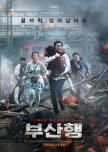
More Than Just a Zombie Movie
I watched Train to Busan expecting a good zombie movie, but it turned out to be one of the best Korean films I have ever seen. It is not just about zombies and survival, it is also about family, sacrifice, humanity, and how people show their true selves during difficult situations.What makes this movie so special is how intense it feels from beginning to end. Once the story starts, it never slows down. Every scene keeps you nervous and emotional at the same time. Even though there are so many action scenes, the movie never forgets its emotional side, which is why it feels much deeper than a normal zombie film.
The relationship between the father and daughter was easily the strongest part of the movie for me. Their bond felt real, and watching their journey together made many scenes even more emotional. I also liked how every character had a different personality and different way of reacting to fear. Some characters were selfish, some were brave, and some were heartbreaking to watch.
The acting was incredible. Everyone felt natural, especially during the panic and emotional moments. The fear on their faces never felt fake, and that made the movie even more intense. The action scenes were also very well done. The zombies looked terrifying, and the train setting made everything feel more claustrophobic and stressful in the best way possible.
One thing I really loved is that Train to Busan is not only scary, but also emotional. There were moments that made me sad, angry, shocked, and even emotional enough to almost cry. Very few movies can balance action, horror, and emotion this well.
For me, this movie deserves a full 10/10 because it is exciting, emotional, unforgettable, and perfectly made. Even if someone does not usually like zombie movies, I think Train to Busan is still worth watching because it is much more than that.
Was this review helpful to you?
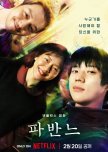
A Story That Hurts Quietly
Pawane was one of those movies that slowly grows on you while watching it. At first, it feels simple and calm, but as the story moves forward, it becomes much more emotional and meaningful. It is the kind of film that does not need big dramatic moments to leave an impact.What I liked most about this movie was how natural everything felt. The emotions were not forced, and the characters felt real. Their struggles, conversations, and relationships felt believable, which made it easier to connect with them. I think that is one of the strongest points of the film.
The movie has a quiet and emotional atmosphere throughout. It is not very fast-paced, but that works in its favor because it gives you time to understand the characters and what they are going through. Some scenes are very simple, but they stay in your mind because of how honest they feel.
The cinematography was also beautiful. There were many scenes that looked visually soft and emotional without trying too hard. The background music matched the mood perfectly and made some scenes feel even more touching.
The acting was really strong too. The actors did a great job showing pain, loneliness, and hope in a very realistic way. It never felt overdramatic, which made the emotional moments hit harder.
For me, Pawane is not a perfect movie, which is why I would give it an 8.5/10, but it is still very memorable. It is emotional, beautifully made, and has a story that stays with you after it ends. If you like slow and meaningful Korean movies, then this one is definitely worth watching.
Was this review helpful to you?
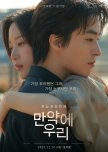
Some Goodbyes Stay Forever
I did not expect Once We Were Us to affect me this much. I started watching it thinking it would be another emotional romance film, but it turned out to be much deeper than that. It is not just about love, it is about timing, memories, regret, and the people we become after losing someone important.What I loved most about this movie is how realistic it feels. The characters do not act like perfect movie characters. They feel like real people carrying pain, confusion, and feelings they do not know how to express properly. Their chemistry feels natural, and even the quiet scenes say so much without needing too many words.
The movie has a very soft and melancholic atmosphere. Every scene feels beautiful in a simple way, especially with the cinematography and background music. There were moments where I had to pause because some scenes felt too real. It reminded me that sometimes the hardest part is not losing someone, but learning how to live with the memories they leave behind.
The acting was also one of the strongest parts of the movie. Both leads delivered their emotions so naturally that I never felt like I was watching acting. Their expressions alone were enough to show heartbreak, longing, and the pain of unfinished feelings.
What makes Once We Were Us special is that it does not try too hard to be dramatic. It is emotional in a quiet way, and that is what makes it hit even harder. It leaves you thinking about your own past, the people you once loved, and the things you wish you had said.
For me, this movie deserves a 9/10 because it is beautiful, emotional, and unforgettable. It is the kind of film that stays with you long after it ends.
Was this review helpful to you?
This review may contain spoilers
If you don't mind a sad ending...
First I was impressed by the actress since so far in ger career she felt very wooden.I'll admit, I'm not a fan of melodrama or sad ending in general. My life is already awful at it is, I want to dream joy, not get slap with reality which this movie does brilliantly.
The part where they kinda lost me is when we learn he has a daughter. Yes it's realistic that in 10 years stuffs happened but you can't drop a kid twist and then have him sobbing asking 'what ifs'. For all we know he has a partner at home with a young daughter.
I wish they didn't leave each other again after meeting on the plane and I wish he didn't have a family and I wish he didn't wish he had fought for their relationship while knowing he has a toddler.
If they separated peacefully both acknowledging that they were different people and their love was great but they changed too much it would have been, in my opinion, a better ending than what we got.
Also it's messed up to close the movie with a letter from his now-dead dad.
Good movie but it made me upset and I should have read reviews before watching it.
Was this review helpful to you?
This review may contain spoilers
Masterpiece
I am not good at writing reviews. This was amazing in every way. Took me a second to understand what was going on but once I did it all clicked. I feel like a changed person after watching this movie. Great stoey, great actibg, amazing ending! I have a new book list to read after thisWas this review helpful to you?
This review may contain spoilers
Not what you expect
I am a huge fan of Nana Komatsu, and I was really excited for this movie when I saw her being part of the cast. She chooses very interesting scripts, so I am always excited to know more about her projects.At the beginning, this will feel like another crazy age gap, high school student falling for an old guy kind of story, but hear me out; this is far from any romance. I would call this a journey of healing, a journey to save each other, and a journey to find back the path they walked away from.
On one side, we have Akira, a promising track athlete who was so unbeatable, but since her injury, she doesn’t know whether she’ll be able to continue again and is contemplating giving up on running entirely, putting her into a depressive spiral. On the other side, we have Masami, a 45-year-old divorcee with a son, who completely gave up his lifelong dream of becoming a writer. He is in the middle of a mid-life crisis but is a sweetheart and deeply cares about his employees, wanting to make sure they’re comfortable and happy.
Although Masami refuses Akira's love confession due to their large age gap, she somehow convinces him to go on a date, and that’s where we see their friendship birth. After learning each other’s struggles and lost dreams, the two develop a relationship of respect for each other. This is not love but more of two friends cheering each other and looking at each other fondly. The best part of their relationship is how they were able to inspire each other, and especially Masami seeing someone young and passionate like Akira rekindles his own forgotten feelings of youthful passion toward literature.
Masami and Akira’s relationship was never meant to be, but their "romance" touched both of them deeply and made them rediscover how much they loved their own passions.
Although the premise might make it look like this was going to be an awful, weird age gap romance, it’s far from that. Instead, it’s a beautiful story of two lost individuals who find each other and become friends, and help each others find back the path they walked away from. It’s a nicely made movie, but since this was from a manga, making it into a movie did cut a lot of important time frames. To adapt to the short duration of the movie, most scenes feel rushed and don’t allow enough time to develop or explore the feelings.
The only flaw I found was that the whole focus was on Akira's story and Masami felt left out. We don’t get to know much about his divorce, his struggles, and his thoughts (maybe due to the movie format), but the focus is only on Akira. However, it’s an inspiring movie, but the structure of the movie and time constraints really take a lot of its impact and make it feel incomplete.
Was this review helpful to you?
Jaunty, jovial western music as the soundtrack seems an odd choice for going off to war from today's point of view. The pieces do bring energy to their scenes, a different way of accomplishing with a few cameras what takes many (and a lot of editing) today. I kept thinking the extras must have had fun filming this, with all the running around and shouting.
Moments of surprising humour some of which were clearly intentional, like that song quote.
How much history is in this? There were several rulers given the epithet "King of the White Elephant". It's located to a specific year (1540 CE), king (Chatra) and cities (Ayodhya and Kanburi), but the flattening of the two kings into vice and virtue complicates that. Is it fair to read an undercurrent of chauvinistic nationalism into that binary? Residual (maybe even nurtured) trauma from Burmese invasions still lingering, more recent anxieties and difficulties finding their way out through this, or simply fodder for this and other movies? The King of Ayutthaya in 1540 was not all virtue en.wikipedia.org/wiki/Chairachathirat
Or was 1540 easy, because it was a tidy 400 years earlier? Long enough ago to become part of malleable mythic memory.
I have so many questions =D
Available on Thai PBS and Film Archive Thailand's YT
Was this review helpful to you?
This review may contain spoilers
It's hard to give this a low score when I went to a great deal of trouble to find a copy of it to watch ! The acting was fine. Alot of the comedy : like the multiple shirt ripping/exposing man's chest instances, didn't work for me. For an older movie though, it really brought the creep factor. They do the ghost suddenly in your face really well. I'm not a fan of horror or thrillers & going into this, I had thought that it would be milder on the thriller/creepy side . So the level of creepy influenced my lower rating. I was glad that it had a happy ending, but it wasn't 100% of a warm fuzzy hit because it was contrived, not (completely) chosen. I was dismayed that the male lead only agrees to call his current girlfriend when she threatens to not sleep with him. So, I shouldn't have been (but I was) shocked when 3/4 of the way through the movie the female lead says what she wants to do as a new couple is to have the big 0 (which it's implied they pursue off screen & without further comment). For some reason I was expecting this (as an older movie) to be more innocent & less scary/creepy. So lower score for unrealistic expectations !Also, a small thing, but some of the music was odd & the song that played at the end (before the credits) was really really weird !!
Was this review helpful to you?
This review may contain spoilers
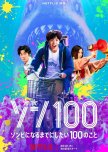
Zom 100: Bucket List of the Dead: 10/13/2025
This is by far one of the weirdest movies I have ever watched, it was all over the place from the start and was funny to watch. literally nothing made sense and it was just something in its own. It is a funny one-time watch if you turn off your brain and ignore any logic. I simply say watch it for shits and giggles.Was this review helpful to you?


